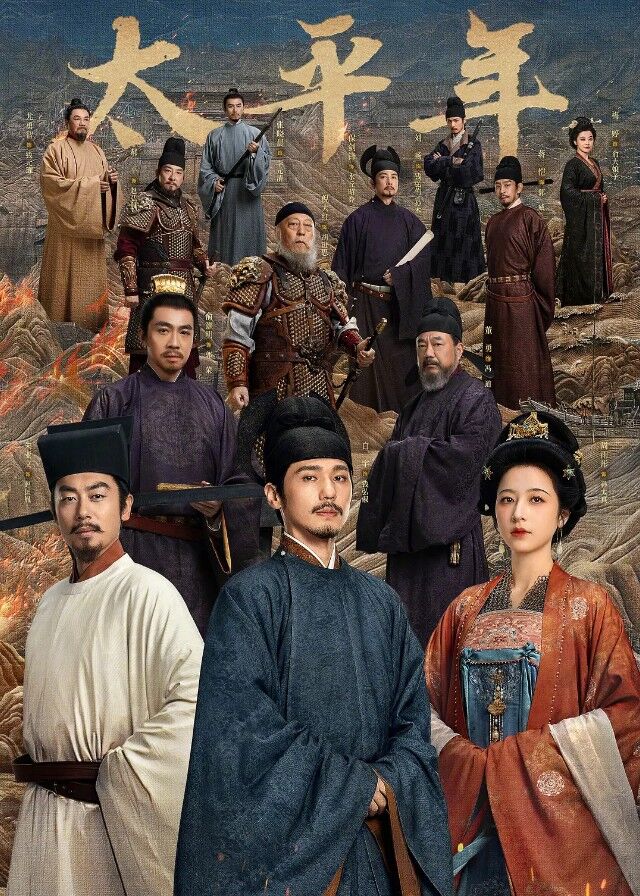



Swords into Plowshares Episode 6 Recap
> Swords into Plowshares Recaps
That night, Zhao Hongyin rushed straight to Feng Dao's residence. Vice Commander Yao Yuanfu led him inside; the atmosphere was as heavy as iron. Zhao Hongyin had originally intended to apologize to Feng Dao, but Feng Dao had long observed Zhao Hongyin's strict military discipline, understanding that the collapse of the situation was beyond one person's control, and did not delve deeply into the matter.
Upon hearing that Zhao's wife, Mrs. Du, was pregnant, he bestowed the name "Mei" upon their upcoming third son. He then entrusted Zhao Hongyin with the Imperial Guards, promising to protect his family's safety. Zhao Hongyin was immensely grateful. In early 947 AD, when the Wuyue delegation entered Bianliang, they saw refugees everywhere and palaces covered in dust. That night, a sudden fire broke out in the Wansui Palace.
Zhao Hongyin led his troops to extinguish the fire and maintain order, but the imperial street was already chaotic like a boiling cauldron. Fleeing dignitaries' carriages crashed into each other, and rogue soldiers ran rampant, taking advantage of the disaster. Even the Imperial Guards, who were supposed to protect the people, degenerated into wolves, plundering and assaulting women, their tragic cries echoing throughout the night. Zhao Kuangyin was ordered to lead cavalry to quell the riot.
He beheaded the leading villainous general with a single spear, rescuing the common people from dire straits. Shuiqiu Zhaoquan saw the team struggling to move forward in the chaos and decisively detoured to the guesthouse in Beixiang, avoiding the bloodiest battlefield. Seeing this, Guo Rong quietly left the team to secretly observe the situation. Zhao Kuangyin received a secret report from Yang Guangyi and quietly led troops to provide support.
When the state collapsed, Shi Chonggui intended to take his own life with a blade to preserve his ambition, but ultimately had a change of heart and was found curled up in a corner of the ruined palace. After the Wuyue delegation settled into the guesthouse in Beixiang, they quickly faced a practical problem: the extreme inconvenience of purchasing supplies. At that time, Bianliang city was desolate due to Khitan pressure and internal turmoil.
Beixiang was a remote area where merchants and travelers were rare. Everyone was at a loss for a solution, so Shuiqiu Zhaoquan proactively sought an audience with Feng Dao. Meanwhile, things were not peaceful within Feng Dao's residence either.
Fan Zhi and Sang Weihan visited together, conveying to Feng Dao the growing consensus in the court and among the populace: that the current emperor's rule was corrupt, and many civil and military officials harbored thoughts of deposing him and establishing a new emperor. Feng Dao's mind was clear like a mirror; the so-called proposals, though seemingly for the country and its people, largely contained private opportunistic motives.
Therefore, he resolutely rejected them, strongly advocating for the maintenance of the status quo, and promoted Zhao Kuangyin to Commander of the Zhongshu Menxia Tanghou, allowing him to stand ready for duty in the core area of the Political Affairs Institute. Afterward, Zhao Kuangyin led Guo Rong to an audience with Feng Dao. Guo Rong's adoptive father, Guo Wei, was a trusted confidant of Liu Zhiyuan from Hedong, and this trip was also to represent Hedong in gathering information.
Although Guo Rong was young, his words were clear and his insights extraordinary. He presented to Feng Dao the perilous situation of the increasing Khitan threat and subtly conveyed Hedong's attitude towards the current state of the court. Feng Dao greatly appreciated Guo Rong, but he did not follow up by discussing specific strategies.
Instead, after Guo Rong finished speaking, he offered a seemingly simple yet profoundly significant reply: "Since Liu Zhiyuan has waited his whole life, he might as well wait a little longer." Inside the guesthouse in Beixiang, Sun Taizhen and Qian Hongchu had a disagreement. Qian Hongchu proactively apologized and incorporated his observations of political anomalies into his persuasion.
He stated that Guo Rong had voluntarily left the team, and both Shuiqiu Zhaoquan and their Third Brother tacitly understood, with no one exposing it. This made him lament that the Central Plains were like looking at flowers through a mist, everywhere revealing an indescribable strangeness. As outsiders, they could only be doubly cautious to avoid being drawn into this unfathomable vortex.
After Guo Rong departed, Fan Zhi could not hide his confusion and privately asked Feng Dao why he strongly protected Shi Chonggui. Feng Dao rarely showed such indignation. He explained that it was not so much about preserving Shi Chonggui's imperial throne as it was about voicing discontent for the corrupt state of the world and human hearts. When Shi Chonggui first ascended the throne, his military might was strong, and he achieved much.
At that time, which civil or military official in the court did not praise his accomplishments as surpassing those of Yao and Shun? Now, with the Khitans approaching again, those who once flattered him actually wished to bind their lord and offer him to the enemy, performing ignoble deeds in the name of "the state." The so-called loyal ministers and good generals were merely petty individuals who wanted to change their spiritual tablet to continue enjoying wealth and honor.
This was so lamentable and pitiable that Zhao Kuangyin, standing guard outside the door, felt a heavy heart. At dawn the next day, the bells of Bianliang city rang loudly, one after another. Shi Chonggui, the last monarch of the Later Jin, in a night of drunkenness and despair, personally wrote the abdication edict. Feng Dao announced it publicly at the grand court assembly. Not a single duke or minister in the hall expressed sorrow; instead, most seemed relieved.
Qian Hongchu took in this sight of opportunism, of officials eagerly seeking to disassociate themselves from the old lord and embrace the new one. He was so enraged that he publicly denounced the assembled officials. Strictly speaking, as an envoy, he had no need to intervene, but his righteous words resonated with two other young men: one an insider caught in the vortex, the other an outsider observing the shifting winds.
Both felt depressed and indignant at the sight of a crumbling dynasty and scattered loyalty. Before the court assembly even ended, Guo Rong and Zhao Kuangyin accompanied Qian Hongchu to a side hall for an audience with the emperor. Shi Chonggui was dishevelled and his eyes were bleary with drunkenness, completely lacking any imperial dignity. Facing the questioning represented by Qian Hongchu, Shi Chonggui offered no defense.
Instead, he let out bursts of desolate laughter and, in a muddled yet sharp tone, thoroughly ridiculed the foundational ethical principles that upheld dynasties, such as "ruler acts as ruler, subject as subject, father as father, son as son," and "loyalty, filial piety, rites, and righteousness."
His words were full of drunkenness, yet revealed a terrifying lucidity: the throne was easy to sit on but difficult to hold for long; they handed it to you when needed, and took it away when not. Whoever could don armor and wield a sword could potentially become the Son of Heaven. After he finished speaking, the three men completely calmed down.
They might have arrived with a reproach for his lack of struggle, but at this moment, it all transformed into complex pity. While Shi Chonggui certainly had his own faults, it was this thoroughly rotten court that had pushed him to the pinnacle and then cast him into the abyss. Finally, they prostrated themselves deeply once before Shi Chonggui.
This bow was not to an emperor or to power, but more to the tragic conclusion itself, and to the lingering sorrow of a monarch and his subjects in their hearts.