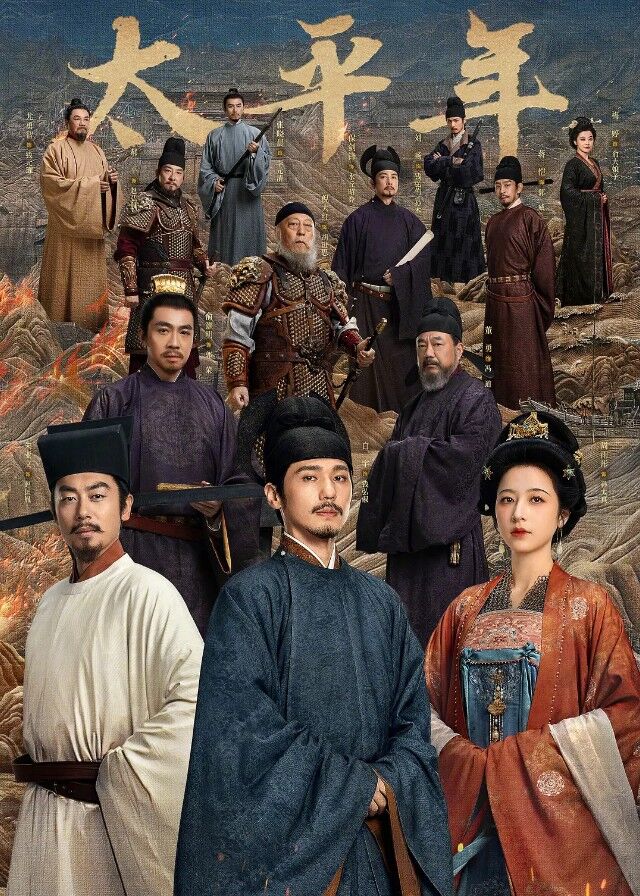



Swords into Plowshares Episode 48 (Ending) Recap
> Swords into Plowshares Recaps
In the Imperial City of Bianjing, the Hall of Eternal Longevity was filled with an air of solemnity. Zhao Kuangyi rushed in, pushing open the door, and prostrated himself deeply before his elder brother, who had long since passed away on the bed. Civil and military officials, led by Xue Juzheng, hastened into the hall.
Without the drama of a thrilling coup, in an almost suffocating atmosphere of solemnity and tacit understanding, they successively pleaded with the Prince of Jin to ascend the throne to stabilize the realm. On November 14, 976 AD, Zhao Kuangyin passed away in the Hall of Eternal Longevity. He was posthumously honored as Emperor Yingwu Shengwen Shende, with the temple name Taizu, and lived for fifty years.
Prince of Jin, Zhao Kuangyi, ascended the throne before the coffin in accordance with the posthumous edict of the "Alliance of the Golden Coffer," becoming Emperor Taizong of Song. On January 18 of the following year, the reign title was changed to "Taiping Xingguo." The sad news of Taizu's passing quickly reached Hangzhou. Qian Hongchu immediately ordered the court to be suspended for eleven days, and the entire nation mourned.
He even personally fasted and purified himself for Emperor Taizu, performing the courtesies of a subject with the utmost piety. In a corner of the common folk, Fan Yong visited Li Yuanqing and mentioned mediating land disputes for the villagers. An unintentional remark instantly prompted Li Yuanqing to reconsider the "Hundred Family Surnames." The order of Zhao, Qian, Sun, Li became a reflection of imperial power and aristocratic families in folk symbolism.
However, before the national mourning ended, a lament arose again in the inner palace. Sun Taizhen was gravely ill and bedridden. On her deathbed, she told Qian Hongchu that she wished to distribute all the grain, rice, and fields she received as dowry to the common people, issuing a strict order: "No reclaiming, selling, or leasing." She also requested a sea burial after her death, wishing her soul to return to the waves rather than occupy an inch of land.
Qian Hongchu, with tears in his eyes, agreed and tightly embraced his weakening beloved. The emperor's grief was no different from that of an ordinary husband. On the day of the farewell, Qian Hongchu took his children and sailed out to sea, watching the small boat carrying Sun Taizhen's remains disappear into the misty depths. Afterwards, he ascended to the mountaintop alone, gazing at the Leifeng Pagoda by West Lake, remaining silent for a long time.
In a village school in Ninghai County, Li Yuanqing and his disciples freely discussed the current affairs. Fan Yong resolved to embark on an official career, serving the nation with his practical knowledge of governance. After joining the Agricultural Administration Department, he showed his talent, achieving remarkable political successes such as surveying land and compiling household registers. Shen Yin, who had retired and returned to his hometown, greatly appreciated him and actively recommended him.
Meanwhile, in Hangzhou, Qian Jun, on his deathbed, tightly grasped Qian Hongchu's hand and instructed him not to care about worldly praise or slander, nor to concern himself with the old and young remnants of the clan.
He said that in this world, there has never been a thousand-year-unbroken imperial temple and state; what can truly be passed down for a thousand years are those generations who are unwilling to rest on their laurels, willing to struggle, and willing to exert all their strength to live good lives. Soon, the Wuyue Kingdom faced a choice of survival.
Before the trend of unification, expressed as "there cannot be two suns in the sky, nor two lords for the people," Qian Hongchu decided to cede his territory and submit to avoid the calamities of war and to protect his clan and the people of Liangzhe.
He gathered the imperial family members and officials in Fengxian Hall, and as the King of Wuyue, led everyone in reciting the Qian family ancestral precepts, jointly bowing before the ancestral tablets, and holding a solemn farewell ceremony. In 978 AD, Qian Hongchu led his relatives and officials northward across the Huai River, finally reaching Dongjing (Tokyo), where he presented the imperial seal and maps of thirteen prefectures and eighty-six counties to Zhao Kuangyi.
Jiangnan, which had been fractured for nearly a century since the Huang Chao Rebellion in the late Tang Dynasty, was thus finally unified under the Zhao (Song Dynasty). Zhao Kuangyi commended Qian Hongchu's loyalty and courage in assessing the situation and considering the overall interest, issuing an edict of generous treatment and commendation.
The Song Dynasty gained the wealthy and strategically important southeast without shedding a drop of blood, and the Qian family also met with a good end, receiving respectful treatment. Their descendants flourished for a thousand years, producing numerous distinguished figures. As the commendation edict spread throughout the land by post horse, at dusk, Qian Hongchu once again ascended to the summit, as if returning to the past.
At that time, as the Ninth Young Master, he had gazed into the distance alongside Zhao Kuangyin and Guo Rong. The mountains and rivers remained, and a slowly unfolding historical scene was gently narrated. From then on, the Qiantang River tide temporarily subsided, and the misty waters of Taihu Lake returned to tranquility. There was no longer a need to rely on natural barriers for self-preservation, nor to calculate military provisions and supplies.
Peddlers and laborers could peacefully enjoy the lamps burning deep into the night, and literati could freely travel the official roads. The so-called unification of the realm was ultimately to allow the vast mountains and rivers to return to ordinary life and create an era of peace.