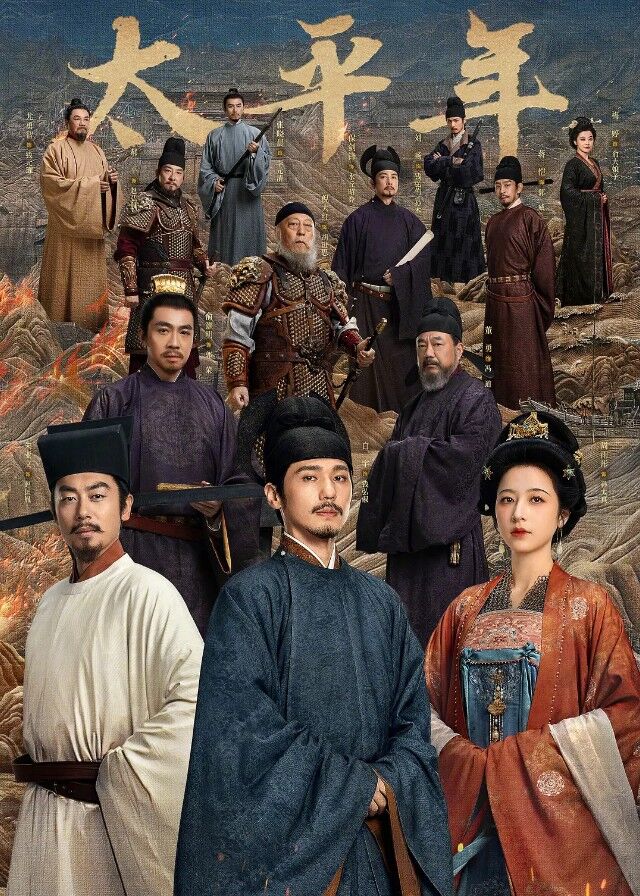



Swords into Plowshares Episode 37 Recap
> Swords into Plowshares Recaps
The imperial court, in preparation for a military campaign, cut some military expenses, provoking resentment among the imperial guards. Led by military commanders Zhang Da and Liu San, hundreds of soldiers rose up in the night, rushing directly to the Zhao mansion, intending to coerce their superior officers and demand an explanation from Guo Rong.
Zhao Hongyin was well prepared; dressed in armor, holding a long saber, he sat alone in front of the mansion gate, sternly rebuking them to quickly return to the barracks, promising to accept eighty military strokes himself and treat tonight's events as if they never happened. However, blinded by greed, the mutinous soldiers were already past the point of no return.
Zhang Da and Liu San, presuming their numerical superiority, completely disregarded the old general's earnest admonitions and rallied their men to forcefully breach the mansion. Immediately, blades clashed. Zhao Kuangyin led the Palace Guard Command to swiftly suppress the uprising; the ringleaders were killed, and the mutineers were captured. The following day at the imperial court, Zhao Kuangyin reported the suppression of the rebellion to Guo Rong.
Guo Rong ordered the execution of all the leaders and accomplices, and he proclaimed to the entire army that anyone who indiscriminately killed, harmed civilians, or rebelled would be put to death without mercy. As soon as this order was issued, all military officials in Bianliang trembled.
With the frequent military disasters during the Five Dynasties, Guo Rong's action was truly a case of "using killing to stop killing," reshaping strict military discipline and unprecedentedly strengthening central authority, laying the foundation for subsequent military campaigns. In 955 AD, Guo Rong, using the elite of the Palace Guard Command as the core of his new army, launched a major campaign against Southern Tang.
Qian Hongchu was ordered to provide support, advancing north to attack Huzhou, Suzhou, and other areas to tie up Southern Tang forces. Guo Rong personally led the campaign; the Zhou army was unstoppable, successively capturing Chuzhou, Yangzhou, Taizhou, and other prefectures. However, they encountered fierce resistance from Liu Renshan in Shouzhou and had to temporarily retreat when the rainy season arrived.
In February of the following year, Guo Rong again campaigned against Southern Tang, ambushing and decisively defeating the Southern Tang reinforcements in the Battle of Zijinshan. Zhao Kuangyin performed heroically, leading his troops to repel the Southern Tang Prince Li Jingda's division, thus making Shouzhou an isolated city. Liu Renshan fell ill from worry and exhaustion and was on his deathbed.
His subordinates, seeing that the general situation was lost, had no choice but to open the city gates and surrender. On the day of entry, Shouzhou Inspector Zhou Tinggou and Deputy Field Commissioner Sun Yu carried the dying Liu Renshan on a stretcher to meet Guo Rong.
Guo Rong deeply respected Liu Renshan's loyalty, courage, and integrity, still bestowing upon him the title of Military Governor of Tianping Army, and strictly ordered the entering Zhou army not to harm or plunder the populace. The Southern Tang court and public were shaken. Chief Minister Song Qiqiu and other peace advocates strongly urged Li Jing to send envoys to seek peace.
However, Li Jing still fantasized about persuading the Qian family with the principle of "when the lips are gone, the teeth feel cold," so he sent Xu Xuan to meet Wu Cheng, implying that if Southern Tang were to fall, Wuyue would directly face the Central Plains' military might.
However, Wu Cheng did not fall for the trick, stating that Wuyue had always adhered to "serving the Central Plains well and honoring the legitimate imperial authority," these mere eight characters completely shattered Southern Tang's illusion. At the same time, Guo Rong personally went to the sea area near Taizhou to summon Qian Hongchu, to discuss the post-war situation.
Qian Hongchu, based on realistic considerations, proposed a strategy of "preserving their state, removing their imperial title, and making them declare vassalage and pay tribute," intending to keep Southern Tang as a buffer to prevent Wuyue from directly bordering the powerful Central Plains.
Although Guo Rong was determined to unify, he also knew that the time for completely destroying Southern Tang was not yet ripe, so he went with the flow and agreed, but put forward a tough condition: Southern Tang must repay all outstanding tributes from previous years in one lump sum. To raise the reparations, Southern Tang had to impose heavy taxes domestically, further worsening the people's livelihoods.
Kuangyin was disappointed with Qian Hongchu's strategy of preserving Southern Tang, believing that they should have pursued victory further, while Guo Rong had his own considerations. Upon parting, Guo Rong and Qian Hongchu agreed to meet again in Bianliang thirty years later to plan for lasting peace. In 958 AD, Qian Hongchu shifted his focus to domestic affairs, issuing an edict to open seaports widely and encourage maritime trade.
The Wuyue Kingdom was rich in resources, abundantly producing silk, porcelain, and tea, and possessed advanced shipbuilding technology. Leveraging these advantages, the Qian regime, in an officially organized manner, extensively exported local products such as grain and silk to overseas markets, while also importing spices, treasures, and other goods.
For a time, ports like Mingzhou and Hangzhou were bustling with ships, merchants gathered, coastal residents profited from participating in trade, government tax revenues significantly increased, and the national treasury was unprecedentedly abundant. In the autumn of the same year, Hu Jinsi was gravely ill and bedridden.
Before his death, he advised Qian Hongchu, mentioning that Guo Rong of the Central Plains was a ruler of great talent and strategy, incomparable to ordinary conservative monarchs, and urged Qian Hongchu to carefully safeguard the Wuyue territory in anticipation of future great changes in the realm. From then on, a powerful minister of a generation suddenly passed away; his complex life can be called legendary.
In his youth, he abandoned literary pursuits for military ones, assisting Qian Liu in rising from obscurity, experiencing dozens of battles, big and small, and together with the Qian clan, laying the foundation of Wuyue.
In his long political career thereafter, he had suppressed internal rebellions, escorted Qian Yuanguan back to Hangzhou, and skillfully persuaded Laizhou to pledge allegiance to Later Tang; he had also gradually monopolized power, manipulating successions multiple times, earning both respect for his achievements and fear for his authority from within and outside the court. Now that his life had ended, his loyalty and stratagems, his guardianship and ambition, ultimately etched a mottled passage in historical records.
Turning back to Guo Rong, after his great victory in the third campaign against Southern Tang, he put the northern expedition against the Khitans and the recovery of the Sixteen Prefectures of Yan and Yun on the agenda. Fan Zhi, holding his tablet, strongly advised against it, arguing that Southern Tang was not yet stable and Western Shu was cautiously observing from its perilous strongholds; a rash northern expedition might lead to being attacked from both front and back.
Many ministers seconded Fan Zhi, further suggesting that if the northern expedition were to proceed without worries, the southeast must first be stabilized, and the foremost task was for Wuyue to surrender its territory to the imperial court. After hearing this, Guo Rong turned to ask for Zhao Kuangyin's opinion.
Zhao Kuangyin held an opposing view, emphasizing that the northern expedition was imperative, and if Southern Tang and Western Shu indeed made any moves, the Qian family would certainly weigh the principles and interests and fully assist the Central Plains.