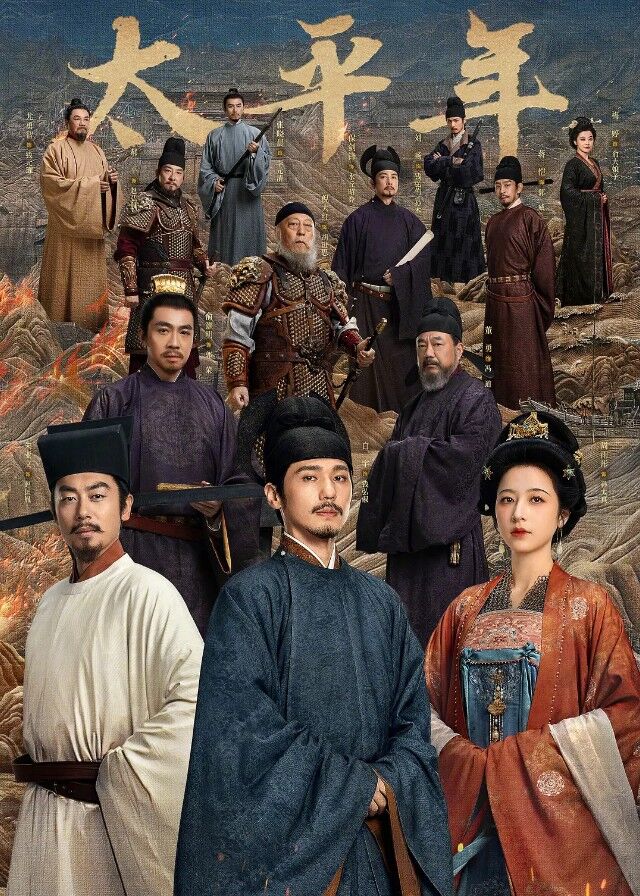



Swords into Plowshares Episode 16 Recap
> Swords into Plowshares Recaps
Qian Hongchu was in charge of the army, and Shen Yin became a sharp blade in his hand. Shen Yin acted decisively, often giving orders on behalf of Qian Hongchu. As the army was about to set off and material allocation was imminent, Shen Yin ordered Sun Bin, the grain supervisor, to prepare all required supplies, including items and quantities, within seven days. Even a single "shi" or grain missing would not be tolerated by military law.
Meanwhile, Qian Hongchu personally inspected the military camp, and a troop named "Zhongshun Du" caught his attention. The troop's origin was quite peculiar; its predecessor was a group of rebel soldiers from the Huaixi region, later incorporated into the army. The current leader was Deputy Commander Lu Yanzhu. Due to lax discipline, virtually nonexistent, this troop was unpopular and had a peculiar nickname, "Yutou Du" (Fish Head Troop), because they often lacked rations and ate fish heads daily.
The reactions of the soldiers were polarized: some, like Jiang Duoxun, would curse angrily every time he held his bowl; while others, like Ma Youcheng, could savor the taste and find joy in their hardship. Shuiqiu Zhaoquan revealed to Qian Hongchu that out of thirty-eight military divisions in the Wuyue State, the Zhongshun Du was the smallest, with fewer than a hundred registered soldiers.
Because Li Renda had sent three urgent distress calls within just five days, the military situation was critical. The Ministry of War clerks were overwhelmed, scrambling to recruit and assemble soldiers, which was why they hastily filled the roster with the Zhongshun Du's name and brought them in to make up the numbers. Logically, these useless soldiers should have been disbanded.
However, not only could they not be dismissed, but they were also granted hereditary positions, passed down from father to son. As long as their family lineage continued, they were guaranteed a steady income and rations. The root cause was that the "Zhongshun Du" was formerly the "Wuyong Du," whose ancestors had established outstanding merits for the founding monarch. Their achievements were so great that they could provide patronage for their descendants, allowing them to live off their salaries.
Faced with such deep-seated problems in the Zhongshun Du, Cui Renji clearly saw that keeping them was a waste of rations and they would be useless in battle. It would be better to send them back early to avoid burdening the army. However, Qian Hongchu had other plans. He voluntarily requested Yang Renquan, the chief commander, to allow him to concurrently serve as the commander of the Zhongshun Du and personally rectify the situation.
This move was seen by everyone as seeking trouble, and opposition arose from all sides. But Qian Hongchu's attitude was firm, and Yang Renquan had no choice but to agree. Late at night, Qian Hongchu arrived at the Zhongshun Du camp. The seasoned veterans, led by Ma Youcheng and Jiang Duoxun, were naturally filled with disdain. Qian Hongchu said little, directly ordering forty strokes of the rod for several of the ringleaders.
As this "shawei bang" (prestige-establishing beating) was administered, wails echoed throughout the entire camp. That night, the tents were filled with curses as everyone clutched their buttocks, vehemently condemning the old Qian family as entirely bad. The next morning, everyone, full of resentment, was brought to the center of the parade ground, where they discovered Qian Hongchu had already prepared dozens of tables for a full-fish banquet.
Qian Hongchu sat with everyone, sharing the meal with chopsticks, and publicly announced that from that day forward, the Zhongshun Du would no longer have to eat fish heads. Lu Yanzhu was a sensible man; he knew that resistance was futile and was touched by Qian Hongchu's determination to rectify military discipline and care for the soldiers. He thus explicitly ordered his brothers to comply. Qian Hongchu unbuckled his personal treasured saber and personally presented it to Lu Yanzhu.
This gift signified trust and respect, and at this point, the hearts of the men were finally won over. On the day the army was about to set off, a torrential downpour suddenly struck. The roads instantly turned into mud, and carts, horses, grain, and equipment became deeply mired and difficult to move.
In the rear, Wu Cheng and others explained the grain transport plan to Qian Hongzuo, while in the front, Qian Hongchu directed soldiers to lay straw mats, ensuring the army could pass smoothly. This also allowed these former "useless soldiers" to demonstrate their utility for the first time. During this period, Qian Hongchu discovered a stark disparity in the treatment of regular soldiers and auxiliary soldiers.
Almost all the strenuous labor and fatigue were borne by the lower-status auxiliary soldiers, while the regular soldiers were relatively idle, only needing to reprimand and direct. When the troops set up camp at Xixi Ferry, the unfairness became even more apparent: regular soldiers huddled around fires inside their tents, devouring dry rations, while auxiliary soldiers outside huddled in the rain, their stomachs empty. Qian Hongchu was furious.
He publicly summoned Commander Tian Biyou, reprimanded him without mercy, and strictly ordered that from then on, all food, drink, and firewood must be equally distributed between regular and auxiliary soldiers. Soon after, Qian Hongchu fell ill and was confined to bed due to continuous exertion and travel. Precisely at this time, bad news arrived from the front line: torrential rain had caused mountain floods, completely cutting off the grain supply route.
As provisions could only last for ten days, Qian Hongchu, disregarding his serious illness, resolutely made a decision: he appointed Shen Yin to act as the Commissioner for Military Affairs, to rush to the front line and stabilize morale, while he himself would remain in Wenzhou, responsible for raising provisions and investigating potential local grain corruption to resolve the food shortage.