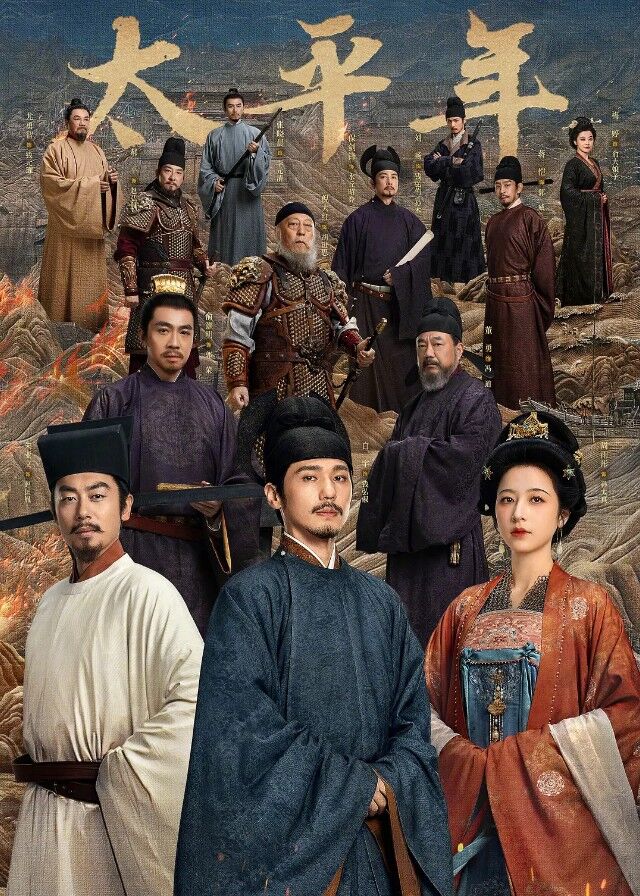



Swords into Plowshares Episode 15 Recap
> Swords into Plowshares Recaps
Qian Hongchu's party returned to Hangzhou from Taizhou to report. No sooner had he stepped through the palace gates than he was met with "elder's concern." Wu Cheng, Minister of Rites, specifically entered the palace to plead for his nephew, earnestly reminding Qian Hongchu that times had changed, and his conduct should be befitting of a court minister, admonishing him not to act as recklessly as he did in the past. While pleas were heard, punishment was unavoidable.
Wu Cheng led Qian Hongchu and Shuiqiu Zhaoquan outside the hall. Qian Hongzong emerged from the hall holding an imperial decree, punishing Qian Hongchu by making him kneel in the Fengxian Hall, thereby temporarily bringing this matter to a close. Within the hall, Qian Hongzuo summoned Shuiqiu Zhaoquan and others, announcing a major event: turmoil in Southern Tang.
Since Li Jing's ascension to the throne, he had considered himself a descendant of the Li Tang imperial family and had long harbored intentions to unify the Central Plains and restore the former capital. Therefore, Li Jing explicitly issued an imperial decree, appointing Wang Chongwen as the Chief Commissioner for the Southeastern Expeditionary Army, formally dispatching troops to attack Fuzhou.
Fuzhou, a strategic stronghold in the southeast, was originally the former territory of the Min Kingdom, later occupied by General Li Renda. Li Renda, being resourceful and adaptable, had previously feigned submission to Southern Tang. Now, with the Southern Tang army pressing close, he immediately turned to the Wuyue Kingdom for urgent assistance.
Due to the suddenly tense situation, Qian Hongzuo discussed with everyone and decided to dispatch troops south for reinforcements, making the repelling of foreign invaders the top priority. The handling of the Taizhou case had to be temporarily put aside. That night, Qian Hongzong personally went to Fengxian Hall to fetch Qian Hongchu, who had finished kneeling as punishment. The two sat in the courtyard, drinking wine and gazing at the moon.
Qian Hongchu, hearing that he was to go on an expedition with the army, feared he might not be competent enough. Qian Hongzong comforted him, saying he needn't worry too much. Similarly, Qian Hongzuo, dressed simply and with few attendants, visited Boyi Office at night to meet with Qian Hongyou. The two brothers had a heart-to-heart talk, laying bare all past grievances and disputes, resolving their old grudges.
Qian Hongzuo got straight to the point, mentioning the matter of sending reinforcements to Fuzhou, explaining that if troops were to be deployed to Fujian, the transportation of military provisions would primarily rely on sea transport. He hoped Qian Hongyou would persuade Yu Daniangzi to use her sea vessel fleet to help transport military supplies. Qian Hongyou gladly agreed. At the imperial court meeting, Qian Hongzuo sat formally in the Mingtang Hall, rearranging personnel assignments.
Shuiqiu Zhaoquan, Yang Renquan, Zhang Jun, and Zhao Chengtai all received actual appointments and were entrusted with military authority. Qian Hongchu, however, was appointed as the Commissioner for Inspecting Military Affairs of the Southeastern Expeditionary Army, specifically in charge of provisions and logistics. This position seemed far from the battlefield, but in reality, it controlled the lifeline of the entire army and was also a hot potato.
In that era of war and chaos, the quartermaster was always a thankless job where merit went unnoticed, but blame was always assigned. But Qian Hongchu clearly knew in his heart that this was the first test his elder brother gave him; if he could navigate this difficult situation, he would lay the foundation for sharing in national affairs in the future. Hu Jing scoffed at this appointment, considering it a "nominal and idle post."
Hu Jinsi himself was like an old monk in meditation, one couldn't tell what schemes he was contemplating. When the news spread among the ranks, those battle-hardened soldiers discussed it heatedly, their words full of sarcasm. They believed that the battlefield was originally a business of bloodshed and sacrifice, and now they were sending a "jade-faced gentleman" to guard the vital supply route—was it not to make them fight desperately on empty stomachs?
Yang Renquan had his own judgment and warned everyone to be cautious in their words and actions so as not to give others cause for criticism. Qian Hongchu personally visited Cui Renji, explaining the stakes, and hired him as a military secretary and advisor for the army. Immediately after, the two went to the prison to see Shen Yin and explained their purpose.
Shen Yin told Qian Hongchu that the world had been in turmoil for nearly a hundred years, with wars breaking out every year. Those who could survive unscathed in this battlefield to this day were all shrewd and seasoned survivors forged in the crucible of experience.
But Qian Hongchu did not put on airs as a member of the imperial family; he invited him with sincerity alone, finally persuading Shen Yin to take up the post of manager, to jointly manage logistics with Cui Renji, and assist Qian Hongchu. " "" On the eve of his departure, Sun Taizhen prepared Qian Hongchu's travel gear, full of worry. Qian Hongchu gently comforted her.
The next day, upon entering the camp, Qian Hongchu was in full armor and referred to himself as "your humble general" before the commander. Qian Hongzuo heard the news from the palace attendants, smiled, and sighed that "Ninth Brother" had made progress, feeling greatly pleased. Qian Hongzong inquired about the unresolved old Taizhou case. Qian Hongzuo's expression was solemn.
He stated that this case's long delay was not due to fate, but rather because it involved powerful nobles, and a ruler must weigh matters carefully and administer justice impartially. After much deliberation, Qian Hongzuo ordered the principal culprits of the Taizhou case to be dealt with. As a key suspect in the case involved Du Hao, Hu Jinsi, to avoid getting burned himself, secretly ordered Hu Jing to discreetly eliminate the person.
After Qian Hongchu took up his post in logistics, he realized the difficulty of maintaining the supply lines: river channels were blocked, laborers were scarce, and local powerful families intercepted supplies. In extraordinary times, extraordinary measures must be taken. He decisively requisitioned resources, opened granaries, borrowed routes, and pressured local influential figures. For a time, impeachment memorials flew like snowflakes to Hangzhou. Court officials denounced Qian Hongchu as arrogant and autocratic.
Only Wu Cheng, defying all opposition, stated that when the late king passed away, the ministers scrutinized the princes and deemed Qian Hongchu frivolous and incapable of heavy responsibilities. But now, facing danger and entrusted with a mission, this prince, who was once the most "mischievous," was actually the most courageous and responsible.