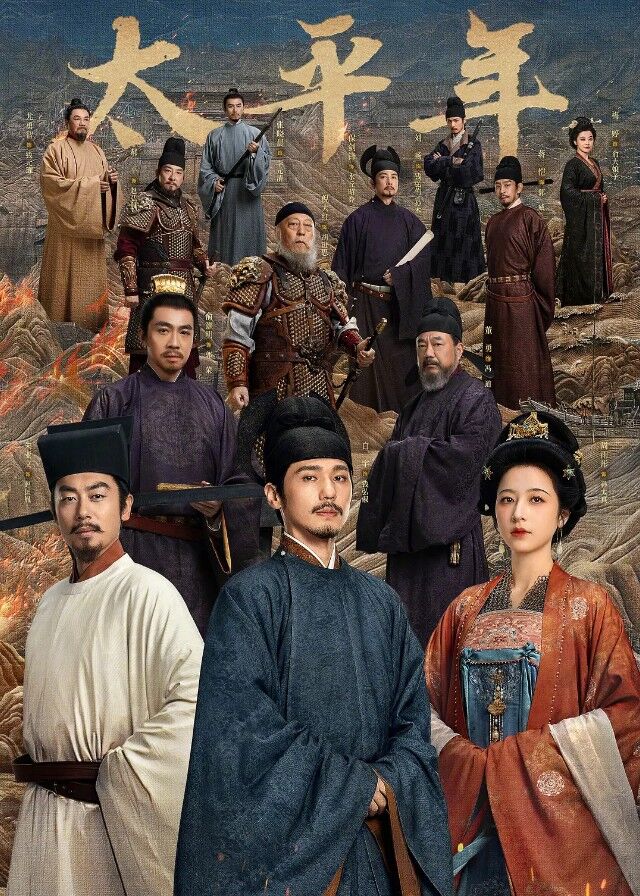



Swords into Plowshares Episode 3 Recap
> Swords into Plowshares Recaps
The King passed away, which for the fourteen-year-old Qian Hongzuo was like the sky had fallen. He grieved over his father's death and feared the future, able to rely only on Hu Jinsi for self-preservation. But Hu Jinsi, who had served as an official for decades, was outwardly a loyal regent. At this moment, what he was calculating was how to use this situation to firmly grasp power in his hands.
Without its backbone, the palace saw shifting loyalties and unpredictable human nature. Yan Tong, who guarded the inner treasury, was suddenly murdered, leaving no witnesses. The lead on the stolen royal private property was cut off, and Hu Jinsi then turned his suspicion to Dai Hun. Dai Hun's identity was special; he was a highly trusted general of the late king, and also the princess's husband, the uncle of Qian Hongyou.
This kinship, a bonus in peaceful times, became the most dangerous variable during the sensitive period of royal succession. If the aunt and nephew conspired together, the consequences would be unimaginable. To nip the problem in the bud, Hu Jinsi decided to play a high-stakes game of "killing with a borrowed knife". This "knife" was He Chengxun, who had just killed Yan Tong.
The next day, as the palace gates opened, Dai Hun had just stepped into the imperial city passageway when soldiers in ambush rose from both sides, bows strung, swords drawn, surrounding him and his retinue. Immediately after, Hu Jinsi publicly announced several charges against Dai Hun, including destroying and burning palace forbidden areas and conspiring to usurp power. The charges were fabricated on the spot, and the logic didn't need scrutiny; political purges always only require pretexts, not irrefutable evidence.
He Chengxun delivered a fatal blow to Dai Hun. Killing Yan Tong might have been to silence him, but killing Dai Hun was a blatant "certificate of allegiance". Hu Jinsi watched the entire process from a high vantage point. With a casual remark about exterminating three generations of his family, and also pinning charges on Qian Hongyou, he cleared obstacles and seized power. On Yu Daniangzi's side, she was preparing travel arrangements for Qian Hongyou.
Because her son was returning to Hangzhou, and fearing he might suffer grievances outside, she ordered servants to pack several large chests of belongings. The spectacle was less like sending her son back to his fief and more like moving half of Huanglong Island for him. In contrast, the Wuyue Royal Palace was solemn and grim. Du Zhaoda stood in the hall, holding an imperial edict.
The edict's content was concise and powerful, with one central message: commanding Qian Hongzuo to inherit the throne and oversee national affairs. Qian Hongzuo's first reaction was not joy, but apprehension and unease. He claimed to be young and lacking in virtue, unfit to bear the heavy responsibility of the state. The hall fell silent. Qian Hongjun and Qian Hongzong successively stepped forward, unanimously recommending Qian Hongzuo. Finally, Qian Hongzuo took the heavy imperial edict.
This acceptance was not just a roll of yellow silk; it was the heavy burden of continuing the Qian regime amidst the chaos of the Five Dynasties, it was the national policy of "protecting the borders and bringing peace to the people," and it was the future of the beautiful land. In the imperial city passageway, He Chengxun was bent over, scrubbing bloodstains.
The former armed attendant, now in rough brown clothes, clutched a hemp cloth, grinding it repeatedly over the blue bricks. Cheng Zhaoyue, carrying a wine pot, came before He Chengxun and asked if he regretted killing Dai Hun. He Chengxun, neither annoyed nor sorrowful, recounted how he had served Dai Hun as a personal retainer for three years.
Dai Hun had saved his life, but when faced with a life-or-death choice, that bit of kindness and loyalty was often the first thing to be discarded. To kill was to live, not to kill was to die. Between life and death, he instinctively chose the latter, even if it meant becoming a mad dog who betrayed his master and murdered his benefactor in the eyes of outsiders. Hearing this, Cheng Zhaoyue smiled and took a gulp of wine.
His tone suddenly shifted, sliding into that profound history. In his eyes, Emperor Li Cunxu of Later Tang was an extraordinary hero. He destroyed Later Liang, drove out the Khitans, and awed the world, yet he was shot full of holes by his most trusted entertainers and bodyguards, dying amidst a pile of ashes. Whether it was Dai Hun or Li Cunxu, they were both tragedies of this era of "collapsed rites and shattered music".
Nothing is eternal and unchanging; loyalty and betrayal often lie in a single thought. Qian Hongchu, Shuiqiu Zhaoquan, and Qian Hongyou returned to Hangzhou, unaware of the changes in the palace. Du Zhaoda held a scroll of documents and unrolled the so-called "last testament of the late king". Every word and sentence directly pointed to Qian Hongyou's "crimes". How sudden these "crimes" appeared.
Anyone with a discerning eye could see that it was not a trial in the legal sense, but rather a prelude to political purges. Seeing his third brother framed and convicted, Qian Hongchu fiercely drew his sabre, threatening self-harm, forcing Du Zhaoda to temporarily return to the royal palace to report. Subsequently, Qian Hongyou was imprisoned, and Qian Hongchu was brought back to the royal palace by Qian Hongzong. Qian Hongchu knelt before the ancestral shrine, overcome with grief.
He was angry at his sixth brother's ruthlessness and resented the coldness of the world. The throne, it seemed, was a black hole that devoured human nature, sucking away all previous fraternal affection. Qian Hongchu listened to his ninth brother's cries, unable to defend himself, feeling immensely distressed. Qian Hongchu went alone to find his eldest brother. Because his eldest brother had always commanded prestige and was benevolent, perhaps he could save his third brother's life.
But Qian Hongjun did not agree; he merely remained silent, and his silence conveyed a suffocating heaviness and helplessness. Shen Wenqi revealed a cruel truth to Qian Hongchu: Qian Hongyou's true crime was not what he had done, but that he held the military command of both the Bow-and-Arrow Division and the Yue Cavalry Division.
When a new monarch had just ascended and power was not yet consolidated, any military force not directly controlled by the royal authority was itself the greatest threat and original sin. Moreover, within the Qian imperial clan, the greatest threat was not Qian Hongying, but rather Qian Hongjun. The reason was simple: Qian Hongjun was the Commander-in-Chief of the Inner Tooth Guard forces.
If the forces of the Marquis of Xi'an were fierce tigers, the Inner Tooth Guard forces in his hands were giant dragons coiled within the palace forbidden areas. Qian Hongzuo dispatched Shuiqiu Zhaoquan as an envoy to Bianliang.
This mission had three objectives: first, to present a memorial announcing mourning, meaning to report the death of the King of Wuyue to the central court, essentially issuing an official obituary; second, to observe customs and understand the political climate and people's livelihoods of the other side; third, to pay respects to important officials, especially to specifically call upon Feng Dao. Likewise, Qian Hongchu was not idle. He personally wrote a letter and sent it to Huanglong Island.
Upon hearing that her son was arrested, Yu Daniangzi personally led over a hundred warships, majestically heading straight for Qiantang Naval Base. She adopted a stance of "If you don't release him, I'll start a fight." Seeing this display, all the civil and military officials of Wuyue faltered. Because Huanglong Island was not a regular army; it belonged to sea potentates. If a real fight broke out, the naval base might not be able to withstand it.
Moreover, winning would bring no benefit, and losing would be disgraceful. None of the ministers offered a good plan. Qian Hongzuo's gaze fell on Cheng Zhaoyue, and he ordered him to personally go negotiate and to change into purple court robes. Yu Daniangzi directly presented her conditions: release Qian Hongyou and Dai Hun's family members. These two people, one was her son, the other an old acquaintance.
If they were released, she would withdraw her troops; if not, she would fight. When Cheng Zhaoyue returned to report, everyone was in an uproar. Prime Minister Yuan Dezhao came up with an idea: He suggested demoting Qian Hongyou to a commoner, restoring his original name Sun Ben, and releasing him to Huanglong Island.