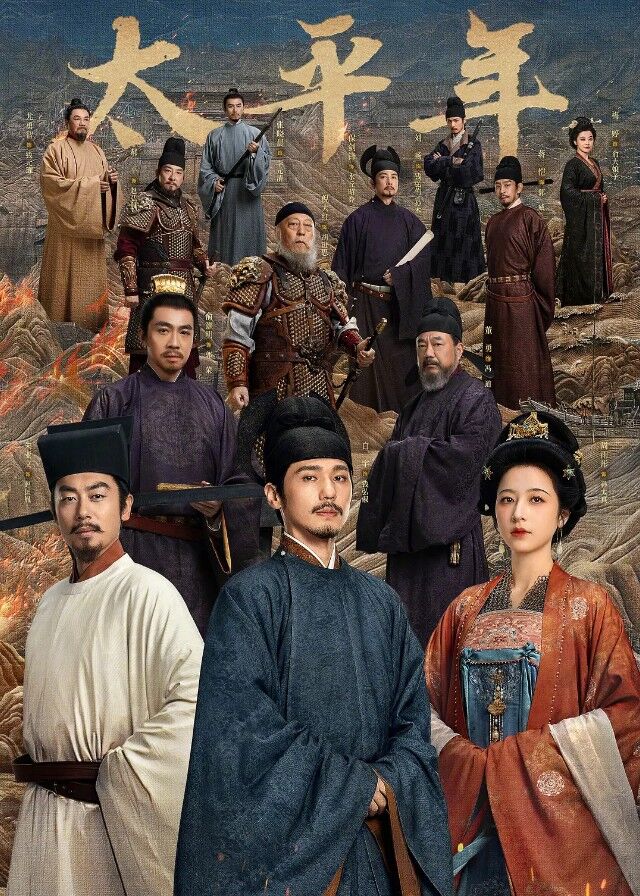



Swords into Plowshares Episode 25 Recap
> Swords into Plowshares Recaps
Qian Hongchu knew very well in his heart that Wei and Ge were merely a deterrent; to deal with the local powerful families, relying solely on execution was a poor strategy. Killing Ge Yanping and Wei Lun would only lead to others filling their void. The true solution was to fundamentally tie their interests to the imperial court.
For this reason, Qian Hongchu publicly announced that all families who had lent money through the Agricultural Affairs Bureau, as long as they could submit the signed contracts, would not only recover the principal and interest in grain but also obtain an imperial court-certified "Boyiwu" maritime trade concession certificate, enjoying extremely low tax rates. This cleverly transformed the powerful families' illicit gains into legitimate trade privileges, turning enemies into friends.
As soon as this measure was introduced, the people of Taizhou felt as if they had met a long-awaited rain after a drought. The common people regained their land and were moved to tears with gratitude. As for the powerful families who had not yet attended the banquet, they could no longer sit still. A group of gentry led by Gu Yancheng brought gifts and sought an audience.
They straightforwardly explained their intention, stating that as long as they could participate in the Boyiwu affairs, they would hand over all the loan contracts as promised. Shen Yin calmly responded, saying that the Ministry of Revenue had only allocated a hundred certificates, which had all been distributed on the day of Shangyuan, and there were no remaining ones.
In fact, Qian Hongchu and his people had only issued eighty-nine certificates; claiming they were all distributed was a pretense to curry favor with those ten prominent families. Shen Yin brought two large boxes full of loan contracts. Qian Hongchu promised to issue ten certificates to the ten prominent families, but on the condition that the certificate holders must undertake the collection of autumn taxes for ten years.
Cui Renji's expression changed upon hearing this, and he immediately spoke up to object, arguing that the tax farming system had always been a major administrative flaw. Those capable of undertaking tax collection were invariably powerful local families. Granting them the imperial court's taxation authority would be tantamount to giving them the power to govern the people within their territories.
Once powerful families held the right to collect taxes, it would be like holding a knife to carve up the spoils: at best, they would levy excessive taxes and extort money; at worst, they would raise private armies and partition land. Seeing the disagreement between Shen Yin and Cui Renji, Qian Hongchu proposed to make the conditions explicit and set a fixed amount.
The autumn taxes would be demanded from the ten families annually, without increase in good harvest years or decrease in lean years. Even if all ten families were corrupt, they would only exploit more than two hundred powerful households, and any resentment would be borne by themselves. "
"" By the Golden Embankment of the Great River in Tanzhou, Guo Wei handed a sealed letter to Zhao Kuangyin, instructing him to return to the capital quickly and deliver it to Feng Dao. Guo Rong personally saw him off, signaling him to meet Liu Chengxun. Since Liu Chengxun was already the heir apparent, and the Guo family father and son held significant military power, an overt association would inevitably invite the emperor's suspicion and court officials' criticism.
Zhao Kuangyin understood implicitly. However, just as Qian Hongchu was personally sewing a wedding dress for Sun Taizhen, far away in Hangzhou, Qian Hongzuo was already emaciated by illness. The imperial physicians diagnosed him with lung carbuncle, claiming he would recover with rest. Qian Hongzong sensed something was amiss and privately inquired. The imperial physicians finally revealed the truth: Qian Hongzuo was now eating little and overwhelmed with duties, his vitality exhausted, and his end was likely near.
Qian Hongzong summoned Shuiqiu Zhaoquan and Yuan Dezhao into the palace to entrust them with his posthumous affairs. He did not, however, inform Hu Jinsi. The two men's hearts sank, knowing well that Hu Jinsi, as a veteran general of two dynasties and head of the military, was deeply entrenched in both the court and the army. Excluding him at such a critical juncture was tantamount to undermining their own defenses and planting seeds of disaster.
After Yuan Dezhao rushed into the palace, he emphasized to Qian Hongzong the importance of mending the fold after the sheep had been lost, urging him to quickly invite Hu Jinsi and Qian Yuanyi into the palace to stabilize public morale. Unfortunately, Qian Hongzong was inherently indecisive, and coupled with the slanders and obstructions from petty individuals like He Chengxun, he actually disregarded this crucial advice. Qian Hongzuo, enduring his illness, made arrangements for his posthumous affairs.
He formally entrusted Qian Hongzong to Shuiqiu Zhaoquan and Yuan Dezhao, and looked at his young child and consort, his eyes filled with guilt, feeling that he had fallen short as both a husband and a father. After Qian Hongzuo dismissed everyone, he left Qian Hongzong alone by his bed.
He incisively pointed out that if he wished to be a monarch, he must understand that while there should be checks and balances between ruler and ministers, favor must also be bestowed. Since he would need to rely heavily on Hu Jinsi in the future, he should not have excluded him today. Without the favor of entrusting him in times of crisis, it would instead create a rift of estrangement.
This action would undoubtedly draw a line of intimacy and distance in the hearts of his officials. How could he sit securely on the throne if, before his foundation was solid, he first alienated a crucial minister? On his deathbed, Qian Hongzuo clearly instructed three things: first, entrust the state affairs to Yuan Dezhao; second, disperse and balance military power; and third, prepare ample betrothal gifts for Qian Hongchu and ensure the wedding is grand and complete.
Qian Hongzuo had arranged all his posthumous affairs, yet he could not soothe the regrets in his heart. He could only let out a sigh: "This life is too short. So short that only debts of father-son affection, shortcomings in husband-wife righteousness, deficits in brotherly love, and violations of ruler-minister virtues remained, none of which were fulfilled. He only hoped that Qian Hongzong would not repeat his mistakes, and that his path would be longer and more stable."
Having spoken, Qian Hongzuo passed away suddenly. This enlightened ruler, rarely known for his civil governance and benevolence during the Five Dynasties and Ten Kingdoms period, in the seven years from when he was thirteen to twenty years old, internally reduced levies and taxes, abolished oppressive taxes, and heavily relied on capable ministers, leading to sustained prosperity in Wuyue's economy. Externally, he maintained neutrality, strengthened border defenses, resisted invasions from surrounding separatist forces, ensuring peace and security within his territory.
Historical records describe him as "skilled in nurturing soldiers, fond of Confucianism, gentle and generous by nature, and capable of poetry." Alas, he died young, leaving his profound foresight and unfulfilled regrets to his successor brother.