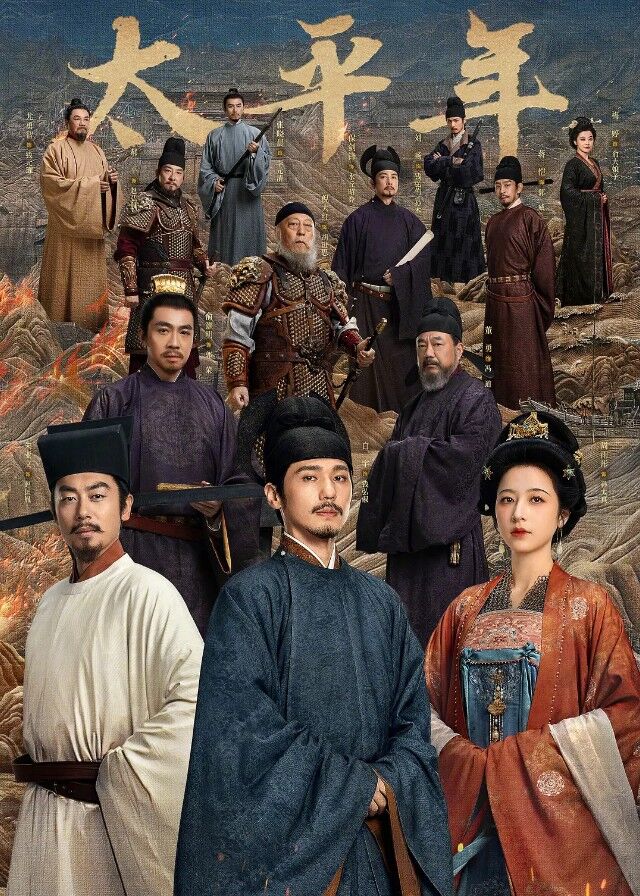



Swords into Plowshares Episode 1 Recap
> Swords into Plowshares Recaps
In 907 AD, the last embers of the Tang Dynasty extinguished. Zhu Wen, the military governor of Xuanwu, led his troops to declare himself emperor, establishing the Later Liang Dynasty. From then on, power in the Central Plains frequently shifted, with regional governors fighting amongst themselves, abruptly ushering in the prelude to the Five Dynasties and Ten Kingdoms period.
The so-called Five Dynasties and Ten Kingdoms refers to the Central Plains losing its sole "spokesperson," becoming a giant arena where five dynasties succeeded one another and over a dozen regional regimes, collectively known as the "Ten Kingdoms," emerged. " Is there a specific lineage for an emperor? Only those with strong armies and robust horses can claim the throne, those with the hardest fists can become emperor." This was the most extreme portrayal of that era.
Not long after, Li Cunxu, the military governor of Hedong, broke through the Later Liang and established the Later Tang Dynasty, which lasted for thirteen years. However, after Li Cunxu's death, his trusted general Shi Jingtang conspired to usurp the throne.
To seize the throne, he offered the Sixteen Prefectures of Yanyun as a bribe, borrowed the Khitan cavalry to destroy the Later Tang, and even acknowledged Yelü Deguang, the Khitan ruler ten years his junior, as his adoptive father, willingly becoming an "imperial son." This act caused the Central Plains' defenses to be wide open, allowing northern nomadic peoples to advance deep into the land, leaving a legacy of disaster for hundreds of years.
In the blink of an eye, time reached 941 AD, an era of moral decay and great drought in Guanzhong, where a thousand li of barren land was strewn with starving corpses, and people resorted to cannibalism. Zhang Yanze, the military governor of Zhangyi, under imperial decree to collect grain, led his cavalry rampant through Jingzhou. As the suffering farmers had nothing to offer, he ordered that if they couldn't produce grain, they should pay with their lives.
For three days, villages were besieged, with thousands killed daily. Heads hung piled high on city walls, and mangled bodies and broken bones lay everywhere. He even drove living people into giant mills, grinding them into a paste to be distributed among soldiers as military provisions. His adopted son Zhang Haisu, naturally benevolent and filial, could not bear to witness the horrific scene. His attempts to dissuade Zhang Yanze were fruitless, and he was subsequently murdered by Zhang Yanze.
Zhang Shi, the chief secretary, was also on the verge of death. Ten days later, Zhao Hongyin and his son Zhao Kuangyin received an imperial edict, holding banners and leading light cavalry to Jingzhou. They saw yellow sand covering the fields, scattered white bones. A wooden plaque was diagonally inserted into the soil, with the blood-written characters "Chongmo Zhai" (Pounding Mill Fort) eerily striking.
This method was common among warlords' brutal tortures, taking the meaning of "pounding and grinding," crushing and grinding living people like grain. The soldiers guarding the camp completely disregarded the Zhao father and son, shutting the gates, refusing the imperial edict, and being arrogant and haughty, claiming that even the emperor himself would have to follow their rules. Zhao Kuangyin, young and impetuous, immediately drew his saber to intimidate them, subduing the guards and rescuing Zhang Shi.
He was immediately whipped severely by his own father, leaving his skin torn and flesh lacerated. Zhao Hongyin scolded his son for being ignorant of the world and recklessly displaying a common man's bravery, stopping only when the whip broke. This beating, seemingly a punishment, was in fact the old general's wisdom for survival: "Those who show too much prowess often die the quickest; only by 'hiding one's edge' can one ensure survival." Just then, pursuers suddenly arrived.
The Zhao father and son led people to protect Zhang Shi, breaking through encirclements and barriers, escaping the perilous situation, and rushed back to the capital overnight to report. Currently, Zhao Kuangyin held no official position and could only kneel outside Jixiang Palace, his mind filled with the bewilderment and indignation of an idealist.
As a scion of a military family, aspiring to become a military governor, he found it hard to imagine that there could be someone as tyrannical and lawless as Zhang Yanze in the world, and even less understood how such a person could wield power over a region. The atmosphere inside the palace was solemn. Zhang Shi tearfully recounted the tragic situation in Jingzhou, every word laden with sorrow. Prince Qi, Shi Chonggui, suggested a thorough investigation.
Shi Jingtang, however, citing the reason of framing a military governor, returned Zhang Shi to Zhang Yanze for disposal. Shi Jingtang originally intended to pursue the trespassing offense of Zhao Hongyin and his son into the military camp. But Feng Dao, the Grand Chancellor, suddenly coughed repeatedly, giving a meaningful look. This political "tumbler" was most adept at "smoothing things over" at critical moments. Shi Jingtang understood the hint and thus ceased further inquiry.
On the way out of the palace, Zhao Kuangyin remained deeply indignant. He didn't understand why justice seemed so pale before brute force, nor why human lives were treated like weeds. He kept talking incessantly along the way. Zhao Hongyin suddenly interrupted him, stating that he had arranged a marriage for him with the third daughter of the He family, and urged him to prepare for the wedding soon. In contrast, An Chongrong intended to rebel against the Khitan.
Shi Jingtang, to show loyalty to his adoptive father, decided to help the Khitan suppress the rebellion. Wars required provisions and money, but where would the funds come from? Shi Jingtang's eyes darted, and his gaze fell upon the "money bag" of Wuyue Kingdom in the southeast corner. Speaking of Wuyue, since Qian Liu founded the state, successive generations had followed a policy of "serving the Central Plains well."
Regardless of who the Central Plains emperor was, they would declare allegiance and pay tribute annually, buying peace with money, and using the Central Plains' prestige to contain their powerful neighbor, Southern Tang. Therefore, although the Wuyue Kingdom was not large, it was the wealthiest "major taxpayer" of its time. Its descendants guarded the prosperous land of Hangzhou, living in relative peace in a corner of the realm. However, beneath this tranquility, undercurrents often lurked.
On the surface, the military was discontent, almost on the verge of mutiny. Zhou Ping gathered a crowd to demand rewards, indignantly questioning why the provisions and fodder earned by soldiers in bloody battles should all be handed over to that old villain Shi Jingtang. Covertly, there was also embezzlement of military funds and deception on a grand scale.
Shen Wenqi, the official in charge of affairs at the Eastern Bureau, held an order to retrieve silk from the imperial treasury, but was instead blocked outside the door by Commander He Chengxun. These two incidents caused quite a stir. Hu Jinsi, as the Grand General of the Right, directly intervened. First, he executed Zhou Ping according to military law. Then, he whipped He Chengxun severely, forcing him to open the treasury.
King Qian Yuanguan of Wuyue, recalling Zhou Ping's past loyalty and bravery, to prevent disheartening the soldiers, ordered his eldest son Qian Hongjun to open the imperial treasury to compensate Zhou Ping's family and issue overdue rewards to the army. He Chengxun and Du Zhaoda, the Internal Administration Supervisor, had long been colluding. Fearing that opening the treasury would expose their malpractices, they hastily sought help from Cheng Zhaoyue, the wealthy proprietor of Shanyue Society.
Cheng Zhaoyue was a powerful merchant in the city with extensive connections. He instructed them to fill the boxes with miscellaneous silk fabrics and load them onto carts first, to comply with the king's order. Before Shen Wenqi could enter the treasury to inspect and select, he found that the carts were already fully loaded with silk. He reported this with a mind full of doubts to Qian Hongjun.
The ninth young master, Qian Hongchu, though still young, was exceptionally astute. He discerned that the wooden boxes used for transporting silk were not of imperial make, but rather resembled those used by the Shanyue Society's commercial firm. Furthermore, regarding He Chengxun, a minor commander who had only been in office for two years, he had managed to buy two large three-compound residences by West Lake and married nine concubines.
This was akin to a security captain buying two siheyuan in Beijing's Second Ring Road. Anyone would have suspicions. Commander Dai Yun, whose mind was clear as a mirror, ordered He Chengxun to present all his income and expenditure accounts from the past two years. He Chengxun panicked. Qian Hongchu's heart stirred. To uncover the truth about the Shanyue Society, he disguised himself as a fisherman's apprentice named "Jiujin" to investigate.
Coincidentally, Cheng Zhaoyue was secretly meeting with Li Yuanqing, the proprietor of Southern Tang's "Qinhuai Society." In their conversation, they mentioned the recent death of the Wuyue crown prince, the king's severe illness, and the vacant position of heir apparent.
Looking around, only three individuals had a slightly greater chance: the eldest son Qian Hongjun, who enjoyed the highest prestige; the third son Qian Hongyou, who held military power; and the sixth son Qian Hongzuo, who was then serving as the Deputy Military Governor of Zhenhai and Zhendong. The first two were adopted sons, while only Qian Hongzuo was the king's biological son. However, the father-son relationship was strained, and his actions were unpredictable.
As they were talking, Qian Hongchu brought in some raw fish. Li Yuanqing's gaze was like a knife; he immediately noticed that the servant's demeanor was unusual. Qian Hongchu also sensed something unusual about Li Yuanqing. That night, he took his personal attendant Xue Wen and climbed aboard the Qinhuai Society's merchant ship. Unexpectedly, they were captured on the spot.
Just as Li Yuanqing was about to interrogate them, the merchant ship was suddenly ambushed by a group of black-clad figures. Qian Hongchu seized the opportunity to leap into the sea amidst the chaos. He was immediately caught by a huge net that descended from above, and a blade was instantly placed against his neck, rendering him immobile.