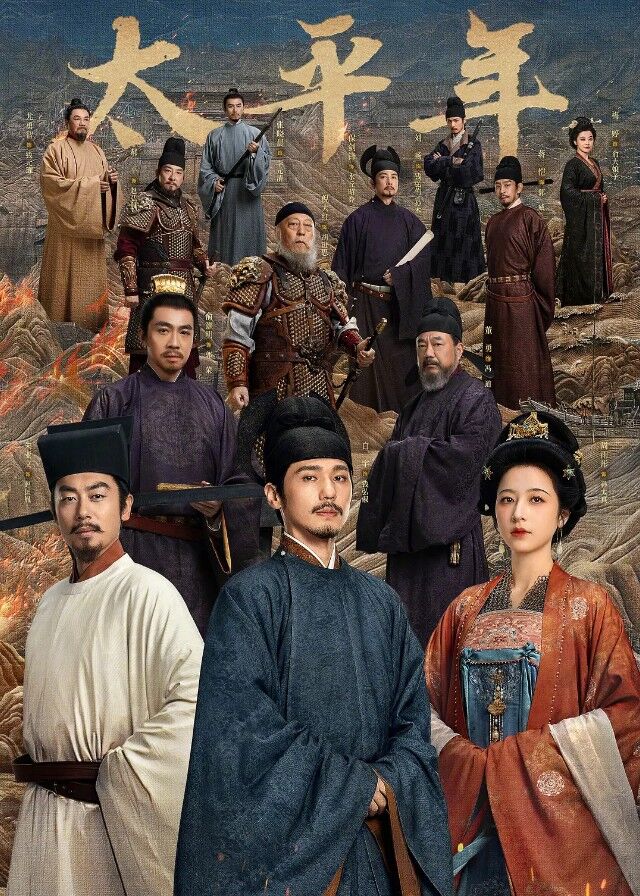



Swords into Plowshares Episode 31 Recap
> Swords into Plowshares Recaps
Originally, Hu Jing thought Qian Hongchu would be a more difficult ruler to deal with than Qian Hongzuo, but through this incident, he discovered that Qian Hongchu's nature was benevolent and gentle, much like the late King Qian Yuanguan. This made him secretly wonder how such a mild-mannered person could sit firmly on the throne. Hu Jinsi heard this and corrected him, saying that Qian Yuanguan seemed benevolent towards external officials but was decisive and merciless towards his own brothers.
Therefore, Qian Hongchu was more like the founding patriarch Qian Liu, capable of both killing and loving. Soon after, Qian Hongchu transferred Shen Yin from Taizhou back to Hangzhou. Just as Shen Yin was entering the palace for an audience, Yuan Dezhao hurriedly delivered an urgent report: the Later Han Emperor Liu Zhiyuan's health was failing. In the first month of 948 AD, the atmosphere in the Bianliang imperial palace was solemn.
Liu Zhiyuan was critically ill, and his officials knelt before his couch, imploring him to issue an imperial edict, establish a crown prince, and stabilize the foundation of the state. Liu Zhiyuan did not heed them. Instead, he gazed long at his wife, Li Sanniang, filled with reluctance, and finally passed away with lingering concerns. Upon Liu Zhiyuan's death, the Central Plains, which had just settled from conflict, suddenly lost its backbone. The eighteen-year-old Liu Chengyou hastily ascended the throne.
To ensure political stability, he continued to use the late emperor's reign title "Qianyou" to signify succession. However, with a young ruler and a suspicious state, crises followed one after another: Li Shouzhen, a famous general of the Later Jin, rebelled in Hezhong, and the Khitans cast a covetous eye from the north. Guo Wei, Yang Bin, Su Yu'gui, and others gathered to discuss. Feng Dao frankly stated that the Hedong army must not be moved.
Although the Khitans were in internal turmoil, their strength still remained. As long as Liu Chong guarded Taiyuan, the northern defense line would be relatively stable. Once Liu Chong was transferred away, Yelü Talie from Yunzhong would surely march south to assault the passes and probe the Central Plains' strength. In the same year, Guo Wei personally led a large army to suppress Li Shouzhen. Qian Hongchu, facing the chaos in the Central Plains, discussed countermeasures with his officials.
Hu Jinsi asserted that Li Shouzhen could not amount to much, and the real hidden danger was that Southern Tang might take advantage of the weakness and invade. Yuan Dezhao recommended Yang Renquan to patrol the northern border, but Hu Jinsi had another candidate, proposing his old subordinate Shen Chengli instead, claiming that he was familiar with Southern Tang's internal affairs. Qian Hongchu approved of Hu Jinsi's thorough consideration.
Then, with a turn of phrase, he subtly changed the candidate back to Wu Cheng, both preserving the old official's reputation and ensuring military power was in the hands of a trustworthy person. After the court assembly concluded, Qian Hongchu privately kept Shen Yin and asked him for his views on the day's matters. Shen Yin believed that Yang Renquan excelled in civil administration, and military affairs were indeed not his strongest suit.
Hu Jinsi's promotion of Shen Chengli was not without selfish motives. Therefore, it was most appropriate to heavily rely on Wu Cheng, because Wu Cheng was both a royal in-law and a chancellor for many years, enjoying high prestige in the army. With him guarding the northern border, even if Southern Tang had ambitions, they would certainly find it difficult to act rashly. After hearing all this, Qian Hongchu was very satisfied.
He praised Shen Yin, saying he would surely enter the chancellery in the future, but there was no rush for now. He first appointed him as a "Scholar of the Tongru Academy," to serve at the king's side, responsible for drafting documents and participating in consultations. After arranging the defense, Qian Hongchu told Shen Yin about the truly important matter weighing on his mind: the "tax farming system" previously implemented.
This decree had led to a sharp increase in household registration in Taizhou and significant tax revenue. Qian Hongchu resolved to leverage this momentum to completely abolish oppressive policies like "collecting first then measuring" and implement the tax farming system nationwide. On the other side, Li Ye, under the guise of an army supervisor, rushed to the Han army camp with a secret imperial edict, ordering Guo Wei to achieve a quick victory.
Guo Wei, upon receiving the order, did not rush to deploy troops. Instead, he beat the drums to assemble his generals, openly defied the order in front of all his officers, stating that a commander on the battlefield should have the power of independent decision, and emphasized that any further false orders disregarding the battlefield situation would result in the execution of the messenger.
Li Ye hit a wall, held a grudge against Guo Wei, and hastily returned to the capital. Liu Chengyou was furious and wanted to execute Guo Wei. Fortunately, Yang Bin and Shi Hongzao timely broke into the palace, brazenly remonstrating him, earnestly stating that the Emperor, secluded deep within the palace, should not remotely control battles outside the capital, nor should he believe slanderous talk and suspect a pillar of the state like Guo Wei.
Although Liu Chengyou was the Son of Heaven, his foundation was unstable, and military and state power were entirely in the hands of veteran officials like Yang and Shi, who were entrusted with his care. Facing their pressure, he could only temporarily suppress his murderous intent and acknowledge his mistake.
On the front lines, Guo Wei, facing repeated challenges from Li Shouzhen, adopted a defensive strategy, conspicuously displaying a "no battle" banner, deliberately showing weakness, and allowing the enemy to dismantle the outer fortifications of his camp. This move seemed like cowardice in battle but was actually a "strategy to wear out the enemy." Once the rebel army's morale was exhausted, Guo Wei secretly deployed elite forces and launched a surprise attack, ultimately achieving a great victory.
Li Shouzhen set himself on fire and perished. When the victory report reached the palace, Liu Chengyou originally intended to reward Guo Wei for his merits and promote him. However, Li Ye again offered slanderous advice, suggesting that Guo Wei be transferred away from the central government to guard Ye Capital in Hebei, far from the capital.
This way, firstly, Guo Wei's prestige could deter the Khitans; secondly, it would allow Guo Wei to check and balance powerful central court officials like Yang Bin and Shi Hongzao, making Yang and Shi somewhat more apprehensive when they became arrogant and wielded unchecked power in court. At the court assembly the next day, Yang Bin, upon hearing of the decision regarding Guo Wei, immediately questioned it sternly.
Liu Chengyou brought out his pre-prepared excuse, parrying with the reason that "frequent border alarms in Hebei required a high official to be stationed there." Li Ye even stepped forward to agree, claiming that the Wude Directorate (equivalent to a royal intelligence agency) had indeed detected signs of instability on the borders. However, Yang Bin, having long experience in military and political affairs, simply scorned these far-fetched reasons.
He fired off several critical points like a volley of cannonballs, each directly hitting the crucial spot, leaving Li Ye speechless. In a fit of rage, Yang Bin demanded Li Ye's execution to rectify the court discipline. The court assembly broke up unhappily. Li Ye privately tearfully complained to Liu Chengyou, instigating him to entertain the idea of eliminating powerful regency officials like Yang Bin. Guo Rong secretly paid a visit to Yang Bin and presented Guo Wei's letter.
Yang Bin knew well that Guo Wei's true profound meaning was not conveyed in writing, so he had Guo Rong verbally relay it. Guo Rong stated that it was currently a case of "a new emperor, new officials," and that veteran officials of the previous emperor, whose merits overshadowed the ruler, would inevitably be resented.
He advised Yang Bin to simply take the initiative to request to be stationed as an external vassal while their past achievements and goodwill still held. Upon hearing this, Yang Bin sighed, lamenting that scoundrels like Li Ye clinging to the ruler's side would sooner or later bring disaster to the nation and its people. He asked Guo Rong to relay a famous quote from "Chu Shi Biao" (Memorial on Going to War) to Guo Wei.
Guo Wei sensed the dangerous message from this and immediately instructed Guo Rong to travel light and return to the capital quickly to bring his family back to Ye City for settlement.