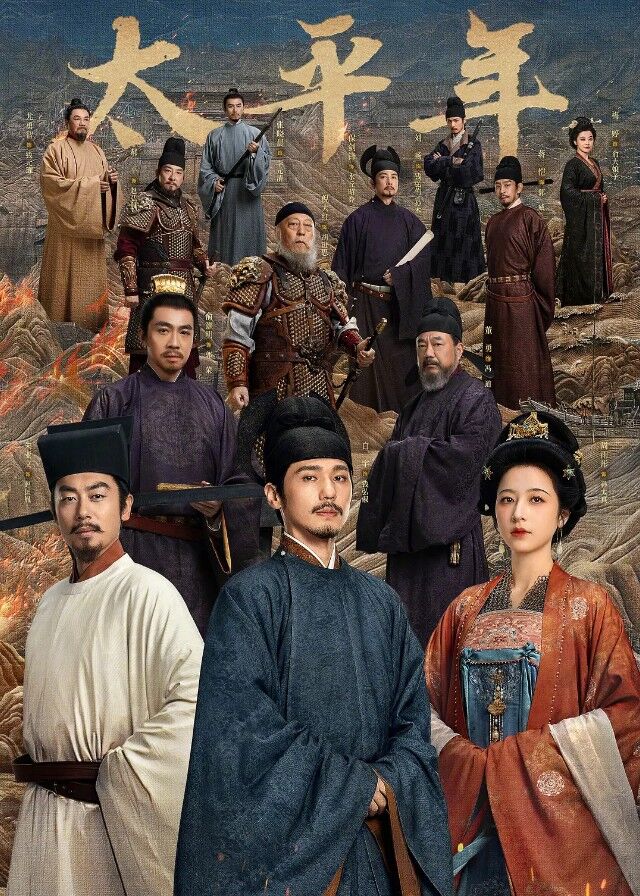



Swords into Plowshares Episode 12 Recap
> Swords into Plowshares Recaps
Zhao Kuangyin arrived in Jinyang and immediately visited Guo Wei, the Inspector-General of the Palace Guard cavalry and infantry, explaining the pros and cons to him. His courage was deeply appreciated by Guo Wei, who lamented that Zhao Hongyin had finally been clever for once, backing the right horse. Meanwhile, Sun Taizhen, worried about Qian Hongchu, went to the Censorate prison to visit him. Guo Rong arrived shortly after.
Seeing Qian Hongchu imprisoned but still composed, he felt a little relieved and encouraged him not to be disheartened, saying that he was no longer an ordinary man, as everyone in the world cared for him. That night, Liu Zhiyuan discussed with everyone, while Zhao Kuangyin and Zhang Yongde waited quietly outside the door. If it were peacetime, Zhao Kuangyin would never have been as calm as he was today.
But having experienced the calamity of a fallen state, he deeply understood that powerful officials and regional commanders like Liu Zhiyuan and Guo Wei, who occupied Hedong and eyed the whole world, had to be extremely cautious with every step. With the Khitans eyeing them from the north, various garrisons surrounding them from the south, and Hebei beyond Hedong, under such circumstances, personal bravery and loyalty often had to give way to the balancing of interests.
Behind that door, Commander Shi Hongzhao, Observation Official Su Yu gui, and others sat upright, each with their own opinions. Commander of Soldiers and Horses Liu Chong led Liu Jiye inside.
The latter was proficient in several tribal languages and brought an important piece of intelligence: Yelü Tali was not in the main camp but had disguised himself as a Xinu (a warrior slave or militiaman of Xi ethnic origin) and had been staying in the Huishui River camp for over a month. Yelü Deguang's son-in-law, Xiao Siwen, was frequently entering and exiting the camp.
Liu Zhiyuan, recognizing Liu Jiye's talent, promoted him to Deputy Inspector-General and dispatched Wang Jun to Bianliang, feigning submission and tribute to Yelü Deguang, intending to test him. Just as the Khitan officials in the Bianliang palace were debating fiercely, urging Yelü Deguang to return north and choose another high official to govern the Central Plains, Wang Jun suddenly entered the palace to present a memorial of submission. Feng Dao saw through the pretense at a glance.
Guo Rong, Qian Hongchu, Shuiqiu Zhaoquan, and others were also speculating about the true motive behind the "feigned surrender." Similarly, Yelü Deguang was undecided and personally sought out Feng Dao to ask for guidance. Feng Dao took Yelü Deguang up to the city wall, where he stood high above, overlooking the capital region. Of the so-called twelve counties in the capital region, only Chenliu still had its city walls intact; the rest of the prefectures and counties had become ruins.
Ordinary households had long run out of food, and countless people, seeking a glimmer of hope, could only lead their elders and children, leaving their homes to rush to Bianliang, hoping to beg for a bowl of life-saving porridge under the Son of Heaven's gaze. Feng Dao pointed to the desolate scene, strongly arguing for the necessity of relief.
To establish a foothold in the Central Plains, it was not merely about "plundering" like raiding for provisions, but more importantly, about winning "the hearts of the people." At this moment, opening granaries to distribute food was not only a benevolent policy but also a strategy to secure the foundation. Yelü Deguang was persuaded by Feng Dao and ordered the execution of Zhang Yanze to quell public anger.
On this day, Zhang Yanze was paraded through the streets to the market execution ground. The common people along the way were no longer silent but erupted in fury, throwing tiles and stones. The fear he had once inflicted upon others was now repaid a hundredfold. Later historical records state, "His wrists were severed, his shackles broken, and people in the market vied to slice off his flesh," truly a culmination of evil deeds, finally reaping what he had sown.
Qian Hongchu, learning of this, his mood gradually shifted from indignation to despondency. Fortunately, Sun Taizhen accompanied him, offering some solace on a bleak, cold night. He even made a self-deprecating wish that if he were to survive and return south someday, he would simply abandon the royal troubles and go to Huanglong Island in the East Sea to become a carefree "live-in son-in-law." On the other side, Wang Jun's request to see Feng Dao was rejected.
Feng Dao had Fan Zhi relay a message: if Liu Zhiyuan wished to submit, he must offer 300,000 hu each of grain and seed, adding a light remark, "This world, at present, is probably only worth this much." Zhao Hongyin, at Feng Dao's suggestion, warned Guo Rong that if he wished to preserve his life, he should behave himself and not wander around carelessly these days.
The next day at court, Feng Dao, on behalf of all officials, presented the imperial title "Liao" to Yelü Deguang, formally acknowledging that the Khitan regime had received the Mandate of Heaven and thus possessed the cloak of legitimacy to rule the Central Plains. Sun Taizhen was quite indignant, believing Feng Dao's action went against Sang Weihan's last wishes.
However, Qian Hongchu saw more clearly, stating that even if Sang Weihan were to be resurrected, he would probably also bow and pledge allegiance. Counting from the "Migration of the Gentry to the South," the Central Plains had been in turmoil, with Hú and Han cultures intermingling. The so-called scholarly integrity and righteousness had long become blurred and utilitarian. The only hope was now placed on the enlightened lord of Hedong.
At that time, while Bianliang held court felicitations, Taiyuan was staging a dramatically rustic enthronement. Liu Zhiyuan had originally wanted to observe further, but the generals and officials, led by Guo Wei, could no longer sit still. They simply resorted to brute force, forcefully carrying Liu Zhiyuan out of his room, dressing him in a "dragon robe," and then shouting "Long live!" thus simply completing his enthronement.
Zhao Kuangyin was deeply shocked by the sight, never having imagined that the beginning of a new era, the birth of a Central Plains emperor, could be so casual and hasty, without grand ceremonies, with only a military standard representing military power serving as the initial symbol of imperial authority. In February 947 AD, Liu Zhiyuan officially ascended the throne. With the banner raised, supporters gathered like clouds.
The long-suppressed populace of the Central Plains and Han Chinese forces, as if finding an outlet, erupted with a roar. Various regional warlords and former Jin generals rose in response, successively beheading Khitan supervisors or envoys. The common people revolted en masse, spontaneously executing Khitan-appointed local officials. Wang Qiong, leader of the Chan Prefecture rebel army, led his troops to attack the prefectural city and besieged Yelü Langwu, the Khitan defending general.
The Eastern rebel army, furthermore, advanced with irresistible force, successively breaking through Song, Bo, and Mi prefectures. When the news reached Bianliang, Yelü Deguang was greatly alarmed and intended to abandon the city and flee north.