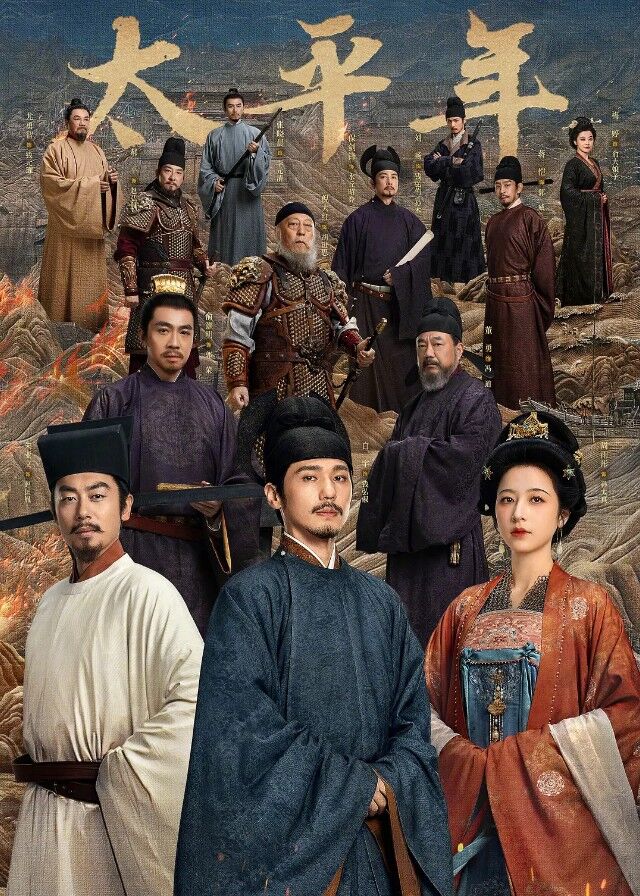



Swords into Plowshares Episode 9 Recap
> Swords into Plowshares Recaps
At midnight, Zhao Kuangyin personally led a team of two hundred men, stealthily infiltrating the southern camp of the Khitan army. He set fire to and destroyed their grain and fodder, killed several Liao army generals in the chaos, and captured Yelü Jieli, the Khitan Censor-in-Chief. However, this also resulted in heavy casualties among his troops. So, as soon as Zhao Kuangyin returned with his men, he was caught red-handed by his father.
Zhao Hongyin, without a word, raised his horsewhip and struck his son, scolding him as a "scoundrel" for always taking reckless risks and gambling with his life. He said that killing a few Liao generals was merely an act of venting anger with no strategic value, and would instead thoroughly infuriate the Khitans, inviting even crazier retaliation.
In fact, Zhao Kuangyin's action greatly boosted the morale of the city defenders, and Zhao Hongyin was indeed proud of his son in his heart. That winter, the cold was bone-chilling. Zhao Kuangyin, Qian Hongchu, Guo Rong, and Sun Taizhen sat together on the city wall, drinking. Their cups held inferior turbid wine, yet it tasted like jade liquid and ambrosia.
They reminisced about their youthful ambitions, sighing that if they could share a cup of hot wine together in peaceful times, it would be enough to comfort them for life. Even if the chaotic era was long, they would eventually await the sunrise. Unfortunately, dawn did not bring hope, but only illuminated deeper despair. After ten days of defending the city, provisions and reinforcements were exhausted, wounded soldiers filled the camp, and morale rapidly plummeted.
Qian Hongchu stared at the almost transparent vegetable soup in a soldier's bowl, suddenly snatched it, and tilted his head back to drink it down. The taste was even more bitter than wine. Of the more than two thousand elites originally, only eight hundred wounded soldiers were now still fighting for their lives.
Every brick and stone on the city wall was soaked with blood, while in the grand hall at the rear, civil and military officials were arguing fiercely, with only one point of contention: to fight or to surrender. Feng Dao received an imperial edict from the Khitan and publicly announced the withdrawal of troops. Zhao Kuangyin was indignant and puzzled, but Guo Rong calmly pointed out that without reinforcements, holding out was futile.
He suggested they should withdraw the remaining brothers back into the city as quickly as possible, while Zhang Yanze's army had not yet been mobilized. Qian Hongchu also felt deeply angry and confused. Shuiqiu Zhaoquan bluntly stated that the capital had long been indefensible, and the ten days of bloody battle were merely for a dignified exit.
Sang Weihan, however, explained to Qian Hongchu: this battle was not for victory, but for a "demonstration," to show the world that even when people's hearts were scattered, there were still foolishly loyal individuals willing to bet on the imperial court, and on the tradition of loyalty and righteousness. But the world only ever remembers the monuments of the victors. Who mourns the righteousness of the defeated?
In this ruthless world, if one does not scheme and is not ruthless, one is not fit to stand at the pinnacle of power. Upon returning to the city, Zhao Kuangyin immediately sought out Feng Dao to request merits for the fallen and wounded soldiers. Feng Dao agreed, and the process moved quickly, providing final solace to the sacrifices. Immediately, the situation took a sharp turn. Zhang Yanze's army arrived at the city gates, which opened without a fight.
The banners on the city walls changed hands. Yelü Jieli, who had been captured, was respectfully escorted out again. Shi Chonggui was moved to another palace, and Zhang Yanze transformed into the new Defender of Tokyo. Before Zhang Yanze took over the government office, Sang Weihan arrived at the Kaifeng prefectural office first.
He ordered the dismissal of Xue Juzheng, Lü Yin, and other military advisors and scribes, and provided each of them with an additional three months' worth of money and rice. This act seemed ruthless, but in reality, it was to ensure their safety. These loyal and virtuous officials were unwilling to spare their lives and insisted on staying to face the situation together, but Sang Weihan forcibly drove them out.
He then sat alone in the empty main hall, waiting for Zhang Yanze's arrival. At night, Zhang Yanze led his men to surround the Kaifeng prefectural office. Sang Weihan showed no fear; he had already smashed the official seal, burned the household registers and case files, and refused to obey the Khitan emperor's imperial decree.
He declared that his path had ended, but being able to use his frail body to block the path of promotion for Zhang Yanze and Du Chongwei was not a loss. Zhang Yanze was enraged; a sharp sword pierced his chest. Sang Weihan did not utter a sound throughout, his integrity not faltering even slightly.
This Prime Minister of Later Jin died; his life's merits and demerits were torn apart: "Old History of the Five Dynasties" praised him as "harmonizing and establishing, truly a minister of the state"; but as one of the key figures in handling the cession of the Sixteen Prefectures of Yanyun, he was branded a "sinner for ten thousand generations" on the pillar of shame by later Confucian scholars.
Especially during the transition from Ming to Qing dynasties, those scholars who surrendered to the Qing were the fiercest in scolding him, judging him with the most venomous language. Sang Weihan's tragedy lies in his talent, being born at the wrong time, and living in a chaotic era where morality had completely collapsed.
He once cared for the common people, achieving local political successes, arresting thousands of powerful bandits, and ascending Mount Hua to pray for rain for the people; he also extensively accepted bribes, accumulating vast wealth within a year. Yet, ultimately, he misguidedly attempted to maintain a dynasty through political maneuvering and compromise, only to be devoured by the very tigers and wolves he had brought in. He preserved his loyalty to the Shi family and himself, but lost his righteousness to the world and its people, which is both tragic and tearful.