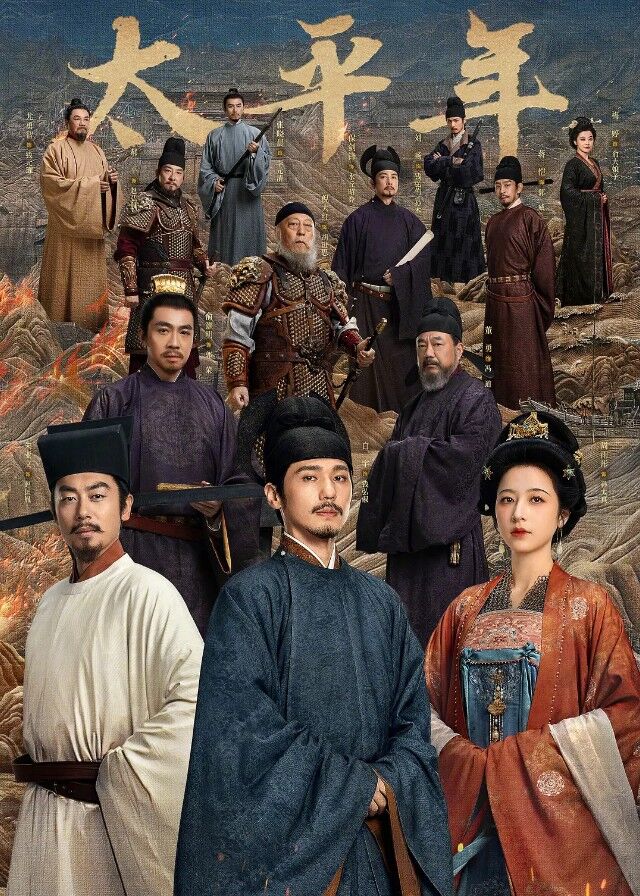



Swords into Plowshares Episode 34 Recap
> Swords into Plowshares Recaps
In the imperial court, Feng Dao stepped forward and mentioned that Guo Rong had merit in managing the great river in Chanzhou, and should therefore be praised and granted a title. However, as soon as he finished speaking, Wang Jun suddenly raised an objection, disliking Guo Rong's growing influence; while civilian officials like Fan Zhi and Li Gu strongly advocated for rewarding merits to appease the people.
Both sides held their ground, with documentary allusions and political maneuvering intertwined, even turning an imperial assembly on state affairs into a deadlock. Guo Wei had a solemn expression, taking in all these disputes without saying a word. After the court session ended, Guo Wei only kept Wang Jun to drink together in the inner palace.
After a few cups of imperial wine, Guo Wei pretended to be drunk, muttering and recounting the tragic past of his entire family suffering calamities that year and his lineage being cut off, claiming that he was like a lone widower, and now only had Guo Rong as his son. At the emotional part, Guo Rong shed tears. Seeing this, Wang Jun felt uneasy in his heart.
Even with a thousand calculations and ten thousand schemes, he eventually swallowed his advice, stood up, and pushed the door open to leave. On the other hand, after seeing Wang Jun leave, Guo Wei instantly lost all traces of drunkenness. He immediately called for Zhao Kuangyin, ordering him to go by imperial decree to summon Guo Rong from Chanzhou back to the imperial court.
Zhao Kuangyin received the order, dared not delay for a moment, and traveled day and night to the Chanzhou river dike. The scene before him made him, a military general accustomed to seeing noble military families and arrogant sons of warlords, couldn't help but be astonished. This sole heir of the Later Zhou emperor was surprisingly dressed in coarse cloth and dark robes, covered in mud, toiling vigorously alongside laborers and conscripts.
What he was managing was not just a river, but more like trying to mend the "dike of public sentiment" that had long been riddled with holes in this era. A vague thought crossed Zhao Kuangyin's mind: if such a person were to rule the world, perhaps things would be different. " "" After Guo Rong returned to Bianjing from Chanzhou, Feng Dao voluntarily submitted a memorial requesting retirement and return to his hometown.
Guo Wei knew deeply that the world had been in chaos for decades, and that governing the country and stabilizing the people could not do without him, so he spoke to persuade him to stay, and even sent Guo Rong to the Secretariat-Chancellery, arranging for him to learn state affairs and secrets from Feng Dao.
However, this arrangement made Wang Jun feel like sitting on pins and needles, because under the current special military and political system, the Bureau of Military Affairs held military power and the Secretariat-Chancellery managed civilian affairs, the two were originally a system of mutual checks and balances. Once Guo Wei appointed a crown prince, he feared his own great power would be lost.
In order to prevent the establishment of a crown prince, Wang Jun secretly plotted, intending to harm civilian officials like Fan Zhi and Li Gu who supported Guo Rong. Guo Wei sensed something amiss and privately revealed his painful thoughts to Feng Dao, lamenting that in the past in the army, all his brothers shared clothes and food, but now that he resided in the imperial palace, his brothers had fallen apart.
Feng Dao pointed out to him that an emperor must be selfless; as a subject, he could speak of brotherhood, but as a ruler, he must have all the people in the world in his eyes, and could no longer favor some over others as before. Old brothers would naturally develop resentment and slander, and this was the price of becoming an emperor.
Hearing this, Guo Wei already had his answer and personally issued an imperial decree to send Wang Jun out of the capital to a provincial post. After nightfall, Guo Wei and Guo Rong, father and son, talked late into the night about their vision for a prosperous era. Guo Rong proposed a grand plan of "ending factional disputes, curbing arrogant troops, promoting cultural education, reducing warlord power, and seeking unification."
The so-called "ending factional disputes" directly referred to the calamity of sectarianism since the Niu-Li Factional Strife; "curbing arrogant troops" targeted the lingering evils of warlords; and "reducing warlord power" was even more about eradicating the internal cancerous growths. What was most alarming was the "seeking unification." This was the first central plains regime since Emperor Zhuangzong of Later Tang to explicitly make unification a national policy.
Though Guo Wei felt this ambition was like Kuafu chasing the sun, he was still moved by his adopted son's spirit. The next day at the grand court assembly, Guo Rong was formally enfeoffed as Crown Prince. Li Gu, Wang Pu, and Zhao Kuangyin were all promoted. The new Crown Prince immediately made arrangements, sending the three to respectively serve as envoys to Southern Tang and Wuyue.
Ostensibly for trade and forming good relations, it was actually to investigate their true situation and establish intelligence networks. His new wife, Lady Fu, seeing Guo Rong review memorials all night, brought him soup and advised him to take care of his body. This ordinary concern touched Guo Rong's longing for his deceased wife, Liu Luojia, and he sighed that if she were here, she would surely understand his myriad difficulties.
Currently, Guo Rong and Lady Fu did not have much affection; it was more of a political marriage. Because she was the daughter of Fu Yanqing, Jiedushi of Tianxiong Army, a widow living with her family, Guo Wei had arbitrarily arranged this marriage for Guo Rong, also considered for consolidating the Hebei military alliance. Zhao Kuangyin suddenly came to seek an audience to inquire about the intention to conquer the south.
Guo Rong's discourse on "reducing warlord power" showed insight: The Qian clan of Wuyue, since Qian Liu's secession, had been submissive to the central plains for over fifty years, protecting their territory and stabilizing their people. Their people and merchants had close ties with the central plains; such warlord states should be dealt with gently and gradually. When the people of both regions intermarry and merchants travel continuously, political unification will happen naturally, like water finding its course.
On the other hand, Southern Tang, though occupying the rich lands of Jianghuai, often considered itself the legitimate successor of the Great Tang; this cultural barrier was harder to resolve than military threats. Meanwhile, on the other side, Feng Dao and Guo Wei talked late into the night by candlelight.
Feng Dao, with decades of experience in officialdom, analyzed the roots of chaos: since the An Lushan Rebellion, warlord states grew powerful, all because the central government was weak and local areas amassed troops. Now, if one wished to reduce warlord power, it should not be through relying on strength and military conquest, but by clever strategy: divide their power, weaken their armies, and guide their interests.
Far away in Hangzhou city, Qian Hongchu, to relieve the people's burden and save state expenditures, resolved to disband redundant troops and reorganize the military system. Reducing the size of the army was both for rest and recuperation and even more so to show submission to the central plains dynasty, but this move was fiercely opposed by Hu Jinsi. Qian Hongchu had a firm attitude, vowing to implement this policy to solidify the foundation of the state.