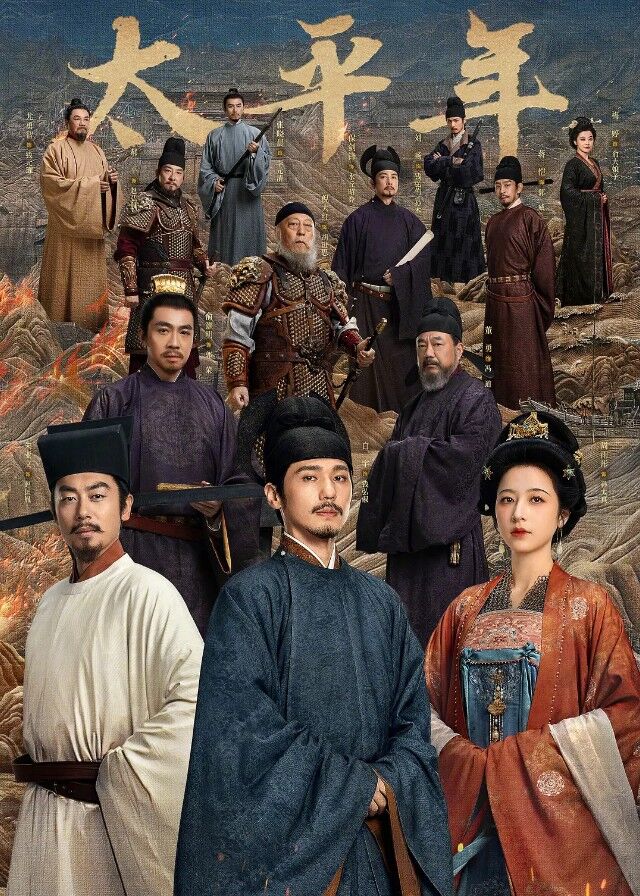



Swords into Plowshares Episode 33 Recap
> Swords into Plowshares Recaps
Guo Wei pretended to transmit an imperial edict and led his army on an eastern inspection tour to Chanzhou to manage the river, aiming to avoid power struggles and suppress Wang Jun and others' attempts to enthrone him. However, Wang Jun and his associates did not restrain themselves; instead, they set up a "persuasion to advance" scheme.
On the day of preparing the camp, Wang Jun entered Guo Wei's tent at night with a wine pot, reminiscing about old times with him; meanwhile, Wang Yin arranged for the generals to sign a joint blood compact, forcing Guo Rong to sign. Guo Rong refused to sign, so Wang Yin placed him under house arrest in the tent, only instructing the soldiers to guard him carefully and not harm his life.
Because Zhao Kuangyin stood guard at the tent with a halberd, the soldiers could not enter. They simply held up the ceremonial banners and knelt, requesting Guo Wei to emerge from the tent and declare himself emperor.
Guo Wei suddenly drew his sword and held it to his throat, sternly asking if Guo Rong was safe, and stating that if Guo Rong was unharmed, the mutiny could still be controlled; but if he was harmed, he would rather commit suicide to apologize to the world. This move turned the tables, and Wang Jun and the others were at a loss. They had no choice but to bring Guo Rong out, completely reassuring Guo Wei.
In the end, Zhao Kuangyin witnessed a repeat of a scene from yesteryear: Guo Wei, simply clad in ceremonial banners, ascended the throne. However, he made a three-chapter oath before all the soldiers: no indiscriminate killing, no looting, and kind treatment of the former imperial clan. Once the general situation was initially settled, Wang Jun rushed back to Bianjing overnight to meet Empress Dowager Li Sanniang and demand the imperial edict appointing a regent.
Little did he know, Li Sanniang had already drafted the edict on the day Guo Wei entered the palace, but Guo Wei steadfastly refused to accept it, causing her sleepless nights. Now that the edict was issued, Guo Wei transformed from a "rebel leader" to a "regent by order of the Empress Dowager," making his legitimacy flawless.
And Li Sanniang, relying on her wisdom, preserved herself and her young son, Li Chengxun, which was considered the best outcome for the imperial family after the fall of the dynasty. Meanwhile, as Liu Yun's carriage had just arrived in Songzhou, news of the "Chanzhou mutiny" came from the capital. A chess piece was pushed to the forefront, only to instantly become a discarded pawn. Liu Yun naturally did not want to become a dead piece.
He frantically knelt before Feng Dao, weeping and begging for a good strategy to protect himself, repeatedly professing his adherence to rules and his lack of ambition for the throne. Feng Dao, who had served four dynasties and witnessed their rise and fall, stepped forward to help Liu Yun up.
He quietly reminded him that he could neither return to Xuzhou, lest he be suspected of separatism; nor could he seek refuge with his birth father, Liu Chong, which would provoke war between north and south; going back to Bianjing would be walking into a trap.
The only path to survival lay in the words "non-action" (wuwei): settling in Songzhou, closing his doors to read, refusing visitors, and ceasing to inquire about affairs, thereby demonstrating his lack of ambition and contention. In the first month of 951 AD, Guo Wei ascended the throne as emperor in Daling Palace in Bianliang, and at Feng Dao's suggestion, established the dynastic title as "Zhou." The first court discussion was about establishing an heir.
Wang Jun, using Guo Rong's status as an adopted son, raised an objection, which enraged Guo Wei. He sternly declared that Guo Rong was his biological son, and if anyone dared to dispute it again, they would not be spared. After the imperial assembly, Guo Wei and Guo Rong, father and son, rarely sat together for a meal.
Guo Rong, having suffered the tragedy of his family's massacre, dared not live in the mansion for fear of being reminded of the past. He specifically requested Guo Wei to let him go to Chanzhou to manage the Yellow River, which Guo Wei gladly granted. Simultaneously in the southeast, Qian Hongchu accompanied Sun Taizhen on her return visit to her family, completing the betrothal gifts. Yu Danianzi was thoroughly satisfied and fully recognized him as her son-in-law.
At this time, news from the Central Plains reached Qian Hongchu. He was startled to hear that the Guo family had suffered a clan-wide calamity. Only after confirming that Guo Rong was safe and sound did he breathe a sigh of relief. In the autumn of 951 AD, a rebellion suddenly erupted in Xuzhou, instigated by Liu Yun's former subordinates. Guo Wei dispatched Wang Yin to suppress the rebellion, and Xuzhou was captured.
In the first month of the following year, Guo Wei personally led his main forces eastward to Yanzhou, where Murong Yanchao, the Jiedushi of Taining, committed suicide by jumping into a well. In 952 AD, Guo Wei visited the Confucius Temple in Qufu. Kong Renyu, the 43rd generation descendant of Confucius, led Confucian scholars in red robes to welcome him. As the Confucius Temple was a Confucian holy site, Guo Wei's visit was intended to promote Confucian governance.
Soon, Guo Wei issued an imperial edict to renovate the Confucius Temple, granted one hundred qing of land, and ordered all prefectures to establish schools. Feng Dao was overjoyed by the news, lamenting that after serving four dynasties, he had finally welcomed a true enlightened ruler. From then on, the "military prosperity and cultural decline" situation, which had characterized the chaotic Five Dynasties period for half a century, finally saw its first glimmer of light.