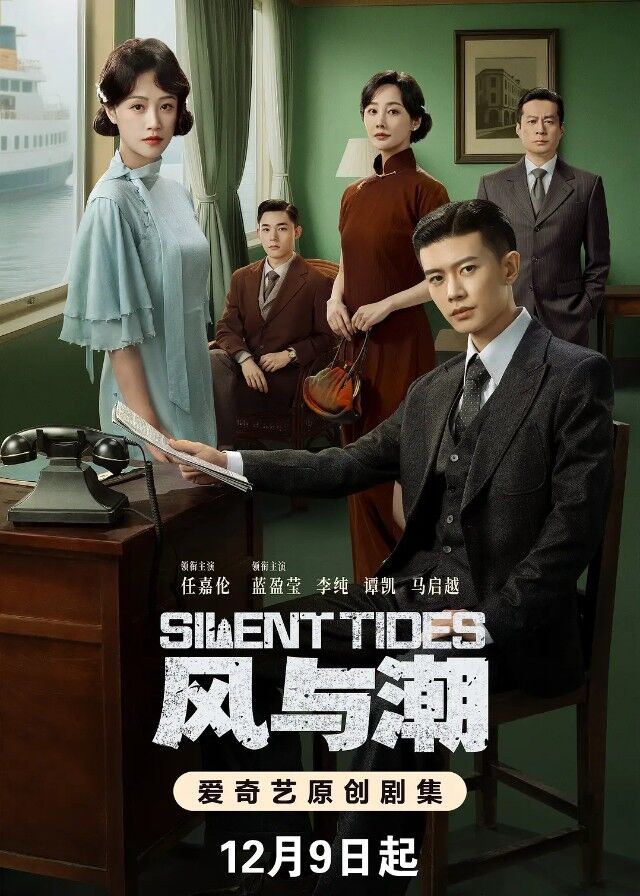



Silent Tides Recap, Plot, Synopsis
Silent Tides Synopsis
The story unfolds during the "isolated island" period in Macau between 1942 and 1945, amidst the turmoil of World War II. After the fall of Hong Kong in December 1941, Macau became a vital hub for the exchange of strategic materials and international intelligence, thrust into the spotlight. Although the Portuguese colonial government claimed neutrality, it allowed the Japanese spy agency led by Ze Rong to operate unchecked.
He Xian, a small-time banker, relocates with his family to Macau and unexpectedly becomes entangled in the turbulent world of political and criminal intrigue. During this time, he meets the patriotic youth Qiao Yinwan. With the encouragement and support of his wife Guo Qiwen, He Xian joins forces with CCP agent Ke Lin, patriotic entrepreneur Ma Wanqi, and other devoted individuals. United by a deep sense of patriotism and duty, they rally support from Chinese organizations in Macau such as the Chinese Chamber of Commerce, Kiang Wu Hospital, and Tung Sin Tong, engaging in intense battles of wits and strategy against enemy forces in financial and trade warfare.
In times of crisis, they come to realize that only the Communist Party of China can save the country and bring new hope to the Chinese nation. Together, Macau's patriotic Chinese community and the Communist Party fight courageously against Japanese aggression on multiple fronts—financial, intelligence, and logistics—achieving repeated victories. Macau's anti-Japanese resistance not only helped its people survive one of the most difficult chapters in the city's history but also contributed significant funds and materials to support China's war effort and the global fight against fascism.
Silent Tides Recap
Episode 1 Recap
In December 1941, He Xian, the manager of Hong Kong Huilong Bank, returned from a business trip and immediately joined his father, He Chengxi, wife Guo Qiwen, and children for early tea. During their meal, He Xian discussed the shifting political landscape and his plan to move the family to Macau. As a first step, he intended to travel to Macau to obtain a financial services operating license.
Guo Qiwen expressed her anxiety about another relocation, recalling their difficult escape from Guangzhou in 1938. He Xian reassured her that it was a precautionary measure, not an immediate move, and that having a backup plan for the family was wise. He also mentioned that Hong Kong, being British territory, was currently safe, especially with ongoing negotiations between the Americans and Japanese. Later that winter, He Xian and Lyu Xiuyuan sailed to Macau.
Onboard, He Xian noted the absence of German reports on the Eastern Front, which raised his suspicions. Upon arrival, after securing his financial license, He Xian and Lyu witnessed a patriotic charity gala for national salvation, where Tanka fishermen were donating money through a young girl named Yu. However, strict old customs in Macau prohibited Tanka people from stepping ashore. Suzuki, the manager of the Yokohama Specie Bank's Macau branch, seized the opportunity to disrupt the event.
He had already expressed displeasure over the gala's anti-Japanese songs and now demanded Yu's arrest for illegally coming ashore, insisting that her collected donations were "illegal funds" and should be confiscated. Liang Yanming, Ke Lin, and Qiao Yinwan stepped forward to defend Yu and the donations, leading to a heated argument. Lok Pak, the Deputy Director of the Macau Economics Bureau, attempted to mediate, even offering to cover Yu's donation if she returned to her boat.
However, Qiao Yinwan refused, asserting that the matter concerned Yu's dignity and the patriotic spirit of all Tanka fishermen. She vowed that the donations must be accepted and Yu protected. Suzuki remained resolute, threatening that if the Portuguese-Macau police failed to enforce the custom, the Japanese would no longer adhere to Macau's laws. The Inspector General regretfully announced the suspension of fundraising and the temporary confiscation of funds.
Yu, distressed, apologized and offered to leave, begging them not to confiscate the public's donations. Suzuki cruelly mocked the Chinese for losing their own land and attempting patriotism in Macau. At this critical moment, He Xian stepped forward. He asked the Inspector General whether custom or law held greater authority in Macau.
Citing Macau's commercial law, which guaranteed free movement for anyone engaged in international activities as an international free port, regardless of their background, He Xian presented his newly acquired financial license. He declared Yu his client and proposed an immediate foreign exchange trade with Yokohama Specie Bank on her behalf. Suzuki challenged this, pointing out Yu's limited funds compared to the 100 patacas minimum margin. He Xian countered by offering to lend Yu the necessary funds, combining her 28.
57 patacas with his 131. 6 patacas. He promised that he would bear any losses, while all profits would go to Yu. Yu agreed to this arrangement. He Xian then placed a short order on the German Mark, demanding same-day settlement with twenty times leverage, a bold move given Germany's ongoing advance on Moscow and the Mark's rising value. Qiao Yinwan, concerned, warned him against such a risky trade, but He Xian remained confident.
He then invited anyone who trusted him to join the trade against the Japanese, to which Ke Lin immediately responded, followed by others, pooling a total of 9,755 patacas. Suzuki, confident of German victory, saw this as an easy win and instructed his Hong Kong branch to relay Mark prices every five minutes via a public telephone. Initially, the Mark rose, seemingly confirming Suzuki's confidence and causing He Xian's partners to lose a quarter of their initial investment.
But He Xian remained calm. Five minutes later, the Mark unexpectedly dropped. Everyone cheered at the sudden profit. Suzuki dismissed it as a "technical correction" and predicted a rebound. However, in the next five minutes, the Mark crashed dramatically. He Xian explained his reasoning: Germany, which typically trumpeted its victories, had been silent on the Eastern Front for three days, while the Soviet TASS news agency had announced it would release a major war update.
This suggested the Red Army had launched a successful counteroffensive in the Battle of Moscow three days prior, effectively collapsing the German offensive. The news of the Soviet victory would surely trigger a market panic and a further Mark crash. Indeed, as He Xian finished speaking, the Mark had fallen by over thirty percent, prompting Yokohama Specie Bank's headquarters to issue an urgent order for immediate liquidation. Suzuki, in a panic, admitted defeat.
He Xian, however, prolonged the settlement, insisting on a 45% return, which resulted in a tenfold payout, and demanding that Suzuki and all Japanese present bow and apologize to Yu for their derogatory remarks against the Chinese, and shut down their promotional activities. Faced with He Xian's unwavering resolve and the threat of further losses, Suzuki relented, bowing with his staff and agreeing to a payout that resulted in a loss of 97,000 patacas for the bank.
Before He Xian's departure, he gave Yu 1,600 patacas, her principal and profits, without taking commission or repayment for his loan. Yu, deeply moved, immediately placed the money into the donation box. Ke Lin then presented Yu with a commemorative medal, acknowledging the Tanka people's contribution to national salvation. Inspired by Yu's generosity, Ke Lin proposed that everyone donate their winnings from the Japanese to the fund, which they enthusiastically agreed to do.
When they turned to thank He Xian, he had already quietly boarded his ship with Lyu Xiuyuan. Lyu Xiuyuan was delighted but regretted settling too early. He Xian explained that the Mark's rapid fall was a temporary market shock due to breaking news; the Soviet-German front was vast, and a single victory would not overturn the entire war, so the market was bound to recover somewhat by closing.
He Xian had shrewdly maximized his advantage when Suzuki was in a state of panic. Meanwhile, in Hong Kong, Huang Gongjie, the Second Helmsman of the Tai Ho Brotherhood, attempted to withdraw all funds from his anonymous account at Huilong Bank. The large sum required a week's prior notice, and with He Xian in Macau and markets closed, he was told he couldn't get the money until the next day.
As Huang Gongjie left, Greedy Gambler Rong spotted a wanted poster for him, prompting them to flee. However, they were ambushed by Liang Zhong, the master of the Hai Feng Hall, and other gang members. Liang Zhong accused Huang Gongjie of betraying the brotherhood by colluding with the Japanese to smuggle tungsten. Huang Gongjie swallowed his bank deposit receipt and was seized by the gang. Qiao Yinwan recounted the day's events in Macau to her brother, Qiao Renyu.
Qiao Renyu was impressed by He Xian's remarkable financial acumen and courage, especially his precise prediction of the Soviet-German war's outcome, something few experts had foreseen. He admired He Xian's boldness and expressed a desire to meet such a "hero from humble beginnings." Qiao Yinwan offered to introduce them at the next anti-Japanese event.
However, Qiao Renyu then urged his sister to reduce her public involvement in such activities, citing concerns for her safety due to the Japanese secret service's history of kidnappings, assassinations, and bombings. Qiao Yinwan passionately rebuked him, arguing that in a nation with half its territory occupied, promoting national salvation was not "provoking" but a duty. She asserted her determination to continue her efforts, leading to a tense disagreement between the siblings.
Back in Hong Kong, He Xian returned home and, with his father, He Chengxi, offered incense to their ancestors, assuring them that his business dealings had been conducted with integrity and a clear conscience. Guo Qiwen again expressed her worries about moving to Macau, fearing a Japanese attack on Hong Kong, noting the Japanese troops stationed across the Shenzhen River.
He Xian reiterated that their planned relocation to Macau was merely a contingency plan, not an immediate move, and that they would continue to observe the situation closely. Guo Qiwen hoped Hong Kong would remain peaceful. At the Tai Ho Brotherhood Grand Hall, Huang Sanhe presided over Huang Gongjie's public trial. Huang Gongjie was condemned for treason and tarnishing the brotherhood's name.
The traditional punishment for such an offense was "three stabs, six wounds," and his followers were to have an arm severed and be expelled. Huang Gongjie desperately pleaded with Fifth Master, reminding him of his family's sacrifices for the gang. Fifth Master interceded, successfully persuading Huang Sanhe to reduce Huang Gongjie's sentence to merely losing both arms and expulsion.
However, as Fifth Master approached, Huang Gongjie, unrepentant, suddenly drew a dagger, stabbed Fifth Master, and escaped with his men in the ensuing chaos, despite attempts by Huang Zixia and others to stop him. In the early hours of December 8, 1941, the Japanese Navy launched a surprise attack on Pearl Harbor, igniting the Pacific War. News of this reached the Headquarters of the Japanese Expeditionary Army to Southern China in Guangzhou.
Yazaki Kanju, the chief of the Japanese Special Service Organ, celebrated with Ze Rongzuo and Fukae. He declared that with the Pearl Harbor attack, the Empire of Japan now faced no rivals in the Pacific, and the Imperial Army's advance would be unstoppable, sweeping across Southeast Asia. He revealed that Commander Sakai Takashi had issued "Operation Eagle," and at dawn, a full-scale assault on Hong Kong would commence. The officers raised a toast to the "Greater East Asia Holy War," as one of them then pondered the fate of Macau.
Episode 2 Recap
As December 8, 1941, dawned, Yazaki Kanjuro, a Japanese official, informed Ze Rongzuo that their Headquarters was considering Macau as a strategic replacement for Hong Kong. He explained that once the Empire controlled Hong Kong and Southeast Asia, Macau would become the sole isolated island in the South China Sea and Western Pacific, easy for Japanese imperial forces to occupy given Portugal's limited military presence. Their priority was therefore to attack Hong Kong.
Meanwhile, in Macau, Mr. Lin was assisting Ma Wanqi with a shipment of medicine when Rodrigues, a Portuguese merchant, suddenly halted the loading. Rodrigues announced that an urgent telegram from his American supplier required the payment to be changed from Hong Kong dollars to US dollars.
Ma Wanqi argued against the unreasonable demand, explaining that Macau transactions were typically in Hong Kong dollars and he couldn't procure such a large sum of US dollars on short notice, especially since Hong Kong banks and foreign exchange markets wouldn't open until 9 AM, well past their 8 AM shipping deadline. Rodrigues, however, was resolute, stating the deal would be canceled without US dollar payment.
Mr. Lin suggested sending a speedboat to Hong Kong for the exchange, but acknowledged the time constraints. Desperate, Mr. Lin contacted He Xian in Hong Kong, recommending him to Ma Wanqi. He Xian initially declined the urgent request, even when offered double commission. But when Ma Wanqi explained that the medicine was vital war supplies for frontline soldiers, and if delayed, could fall into Japanese hands, He Xian changed his mind.
He promised confidentiality and his utmost effort to secure the US dollars by noon. He immediately instructed his assistant, Quan, to prepare at Huilong Bank. During this frantic period, the Tai Ho Brotherhood discovered Fifth Master's body at the dock. Huang Sanhe, the gang leader, learned that Huang Gongjie had fled across Lingding Channel to Hong Kong. Enraged, he issued a manhunt order for Huang Gongjie in Hong Kong, instructing his men to kill him on sight.
Through the night, He Xian rushed around Hong Kong's Finance Street, seeking assistance from fellow money changers. Lyu and other proprietors generously pooled their available US dollars. Lyu, trusting He Xian's assurance that the client was legitimate despite the secrecy, personally helped contact several other money changers. By dawn, Assistant Manager Chen of Hengfengyu Bank arrived with the Hong Kong dollar payment, but upon calculation, they were still 6,000 US dollars short.
With banks not opening for hours, Assistant Manager Chen suggested He Xian visit Qiao Renyu, the Chinese chief accountant at HSBC, known for his willingness to help fellow Chinese. He Xian arrived at Qiao Renyu's residence, where a doorman initially tried to turn him away due to the early hour. Fortunately, Qiao Yinwan, Qiao Renyu's sister, was practicing piano on the balcony and recognized He Xian. She ushered him in and introduced him to her brother.
Qiao Renyu expressed admiration for He Xian's earlier feat of assisting the boat dwellers. He Xian apologized for the intrusion, stating the urgent and critical nature of his client's confidential business. Qiao Renyu hesitated, citing the large sum and the need to inform the bank's treasury to access the vault before opening hours. But Qiao Yinwan pressed him, reminding him of his respect for He Xian and insisting that helping a friend was reason enough.
With his sister's spirited persuasion, Qiao Renyu agreed to arrange the exchange immediately. He Xian thanked Qiao Yinwan, acknowledging her role in securing the help. Moments later, newsboys shouted headlines across Hong Kong and Macau: Japan had launched a surprise attack on Pearl Harbor and declared war on America. Panic erupted as people realized Hong Kong would soon be indefensible, and the Hong Kong dollar faced imminent collapse. Money changers, including Lyu, were furious.
They accused He Xian of insider trading, leveraging pre-knowledge of the war to convert their Hong Kong dollars into valuable US currency before the market crashed. Qiao Renyu, too, grew suspicious, expressing his dismay to Qiao Yinwan about He Xian's seemingly opportunistic actions. Confronted by angry peers demanding their US dollars back, He Xian stated he could not reverse the exchange due to his promise of client confidentiality and the urgent nature of the client's matter.
He offered apologies for any losses incurred. As the argument escalated, Japanese warplanes roared overhead, unleashing bombs on the city. He Xian, realizing the large sum of US dollars was still in Huilong Bank, ignored warnings to take cover and rushed back inside. A bomb directly hit the bank, reducing it to ruins. Assistant Manager Chen tragically perished, but Quan, though shaken, survived.
He Xian instructed Quan to take the suitcase of US dollars to safety while he re-entered the burning building, risking his life to retrieve the vital deposit ledgers from a collapsing safe. He Xian narrowly escaped the crumbling structure just before it fully gave way. Lyu, witnessing He Xian's perilous return to the bank, misinterpreted his actions, believing he was prioritizing the bank's assets over his own life and integrity.
Lyu felt utterly disillusioned, convinced He Xian was driven by greed. Meanwhile, the news reached Ma Wanqi and Mr. Lin in Macau. They learned from a fellow traveler that Huilong Bank had been destroyed. They immediately confronted Rodrigues, accusing him of changing the payment terms to US dollars because he had advance knowledge of the war. Rodrigues, concerned about his payment, demanded his money.
Ma Wanqi passionately declared that the sudden payment change and the war constituted force majeure, absolving him from legal obligation. He then made a solemn vow: if Rodrigues promised not to sell the seized medical and precision instrument shipments to the Japanese, he would pay the full amount, even if it meant selling his house, land, and borrowing from loan sharks. However, if Rodrigues betrayed them by selling to the Japanese, Ma Wanqi would refuse payment. Rodrigues reluctantly agreed.
Back home, Guo Qiwen tearfully confronted He Xian, expressing her terror over his reckless act of re-entering the burning bank. He Xian's father, He Chengxi, was also deeply upset, hearing rumors about his son's supposed dishonesty and nearly administering family punishment before their ancestors. He Xian defended his actions, explaining that his urgent currency exchange was purely coincidental with the war outbreak and was part of a critical, nationally important mission that he was sworn to keep secret.
He then revealed that he risked his life not for money, but to retrieve Huilong Bank's deposit ledgers. He explained that most of Huilong's clients were poor, who had entrusted their hard-earned savings to his family's integrity. With Hong Kong now in chaos, these deposits were life-saving funds for many, and he could not let them be lost. He Chengxi, moved by his son's explanation, acknowledged that He Xian had made the right choice.
However, the bank was destroyed, and most of their funds were inaccessible due to suspended trading and unpaid loans from other banks. He Xian calculated that by selling their house and all other assets, they could only cover forty percent of the deposits. Guo Qiwen, having overheard the conversation, reassured her husband that she would stand by him, willing to endure any hardship. He Chengxi then presented his entire life savings, urging He Xian to use them.
He emphasized that while a business or bank might fail, a person's conscience, honesty, and integrit must never be lost, for these values were far more important than wealth. The next morning, while other money changers were either unresponsive or offered only partial withdrawals, with Lyu explicitly demanding 20% interest from depositors at his Kwong Yik Bank for their withdrawals, He Xian and Quan set up a makeshift counter amidst Huilong's ruins.
He Xian announced that for the next fifteen days, the bank would provide full withdrawals to all depositors who presented their slips. Passersby and depositors, amazed that a destroyed bank was paying out in full when others were not, quickly formed a line. Lyu, observing the scene, scoffed, accusing He Xian of feigning kindness by exploiting his industry peers through wartime speculation.
Quan, angered, began to retort, but He Xian quietly stopped him, silently enduring the accusations, mindful of his father's teachings on integrity. On December 24, 1941, Christmas Eve, Hong Kong plunged into darkness and power outages as it faced imminent collapse. He Chengxi, relieved that most depositors had been paid, urged He Xian to leave for Macau, where he had already secured a financial services license. He Xian, however, appeared troubled and suggested delaying their departure.
He Chengxi, though curious, did not press him further. Later, Guo Qiwen noticed He Xian's distress and learned that one last, large anonymous deposit remained. He Xian could recall the depositor's face and the substantial sum of over 30,000 dollars, but no other identifying details as that ledger page had been burned. With the withdrawal deadline set for tomorrow, the depositor's continued absence deeply worried him, as paying out this final sum would leave the He family penniless.
Meanwhile, Qiao Renyu returned home late, bringing an apple pie for Qiao Yinwan. The siblings shared the pie, reminiscing about their childhood in an orphanage and the cherished tradition of Qiao Renyu making her an apple pie every Christmas Eve.
Episode 3 Recap
Guo Qiwen urged He Xian not to go to the Huilong money changer the following day, reminding him that the last outstanding deposit was their family's remaining savings, which they would need for their father and two children when they moved to Macau, where expenses would be high. She pointed out the chaotic state of Hong Kong, with people fleeing or dying, and suggested the last depositor might have already left the city and wouldn't appear.
He Xian didn't respond immediately, grappling with his sense of obligation and responsibility, but then quietly asked what if the person hadn't left. Meanwhile, Qiao Renyu advised his sister, Qiao Yinwan, to prepare her luggage and avoid the orphanage the following day, predicting Hong Kong's fall within "just a day or two at most," despite the British Governor's claims of a six-month defense. He believed transport to Macau would be among the first links to resume.
Qiao Yinwan, trying to lighten the mood on Christmas Eve, offered to play a tune, and he responded by singing "Moonlight shines on the threshing floor." In another part of the city, Mary confronted her husband, William, about his involvement in a smuggling operation. William admitted he sought "extra money" but claimed he wouldn't have participated had he known Huang Gongjie was smuggling "tungsten ore," a "critical strategic material" for military vehicles, urgently sought by warring nations.
Mary realized William had trafficked strategic materials to the Japanese, calling it "treason." William pleaded with Mary to use her distant relation to Colonel Lyons, the investigating officer, to frame Yang Chang, the Chinese sergeant who frequently visited their home with bribe money, arguing that as a Chinese man, Yang Chang's fate wouldn't hinder the case's resolution. Mary was troubled by her conscience but ultimately yielded to her husband's pleas, making him promise to rescue Yang Chang.
At Stanley Prison, Yang Chang was denied food by a guard who mocked him, calling him a "Japanese collaborator" for smuggling "undeclared goods." Yang Chang vehemently denied being a traitor, insisting he only took "bribe money" and hadn't exposed William. He spotted Mary visiting Colonel Lyons and desperately cried out for help.
Mary quickly turned away, her conscience clearly troubled, especially after Lyons had just told her that Yang Chang, as a Chinese prisoner, would likely be sent to the most dangerous front lines and not survive. At HSBC, Qiao Renyu urgently warned Chief Manager Mr. Quiver that the Hong Kong dollars and printing plates in the vault needed immediate disposal to prevent a "historical mistake."
Mr. Quiver, however, dismissed his concerns with a condescending and racist remark, stating that the Japanese were only "fit to bully the Chinese" and insisting Hong Kong, the "crown jewel of the British Empire," was safe. Offended, Qiao Renyu, who identified himself as Chinese, immediately resigned, calling the items "financial time bombs" before leaving.
Just as he was leaving, Mr. Quiver rushed after him, apologizing and revealing that Governor Sir Mark Young had just called to announce the British government's formal surrender to the Japanese, with the signing scheduled for 6 PM. He begged Qiao Renyu to stay and assist with transferring the crucial assets, which Qiao Renyu agreed to, determined to keep them out of Japanese hands.
Almost simultaneously, Qiao Renyu called Qiao Yinwan, urging her to pack her things and find out if there was a boat to Macau. William also called Mary, instructing her to quickly pack their valuables as the British were surrendering and Hong Kong was doomed. Mary reminded him of his promise to save Yang Chang, which William reiterated, assuring her he would rescue him before they left.
After a night of deep reflection, He Xian decided to honor his commitment to the last depositor and wait for them at the money changer. Guo Qiwen supported his choice without complaint, and together with the children, began selling her jewelry and other valuable household items in preparation for their move. Meanwhile, Huang Gongjie, destitute and in hiding, was informed by his subordinate, Qiu, that Huilong Money Changer was still open for withdrawals, but today was the final day.
Huang Gongjie despaired, revealing that his deposit slip had been destroyed when he was captured by the Tai Ho Brotherhood, which had issued a "kill-on-sight order" against him and his men. Desperate and without proof of deposit, he decided they would "rob it." British forces began evacuating prisoners and sensitive materials. Qiao Renyu confronted William for using "serious criminals" (who Qiao Renyu mistakenly believed were civilians) for such a critical task, but William insisted they were criminals.
Amidst a Japanese air raid, the convoy was bombed and scattered. William found Yang Chang and, at gunpoint, forced him to help load cargo onto a boat. However, Japanese warplanes strafed the beach, forcing William to flee with his men, abandoning the cargo despite Qiao Renyu's protests. Yang Chang was thrown into the sea but miraculously survived. He Xian recognized Huang Gongjie as the anonymous depositor.
Huang Gongjie, discovering that the ledger page containing his account details had been destroyed in the bombing, prepared to use force. To his surprise, He Xian, recalling the precise deposit amounts, handed him 31,100 Hong Kong dollars, representing the principal amount without investment returns. Overwhelmed, Huang Gongjie was deeply grateful and pledged loyalty, declaring them brothers.
Soon after, Yang Chang, having escaped the sea, stormed into a local club, brandishing a pistol and holding Huang Zixia , a member of the Tai Ho Brotherhood, at gunpoint. He demanded Huang Gongjie. Huang Zixia revealed that the entire Tai Ho Brotherhood was hunting Huang Gongjie, whom they considered a "bastard traitor" who had been "raising travel expenses" for an escape.
Realizing Huang Gongjie had used his retrieved funds for an escape, Yang Chang confronted He Xian, accusing him of aiding a traitor. He Xian calmly explained that as a banker, it was his duty to honor withdrawals. Yang Chang, along with the Tai Ho Brotherhood members, rushed to intercept Huang Gongjie but he had already departed. A city-wide radio broadcast abruptly shattered the remaining sense of calm.
Governor Sir Mark Young formally announced the British government's surrender to the Japanese forces, transferring all sovereign authority over Hong Kong to the Japanese military. He ordered all police and military personnel to lay down their weapons and citizens to maintain order, cooperate, and accept the "peaceful takeover" of Hong Kong. The city descended into despair and indignation.
Japanese forces swiftly occupied HSBC, seizing "unsigned new banknotes" worth over one hundred million Hong Kong dollars, which Qiao Renyu had attempted to destroy. Qiao Yinwan watched helplessly as Japanese soldiers led her brother away, suppressing her grief. Huang Zixia learned that Huang Gongjie had escaped to Macau on Fearless Biao's opium speedboat. The Tai Ho Brotherhood, seeing an opportunity in the desperate refugee exodus, dispatched boats to Tsim Sha Tsui Beach to profit from transporting people to Macau.
Yang Chang borrowed a gun from Huang Zixia and headed to William Jones's residence to seek revenge. That same night, the Communist Party of China's underground organization held an urgent meeting to plan the immediate transfer of "high-priority, publicly recognizable individuals" to Macau, fearing their easy identification by the Japanese and traitors. Ke Zhengping was appointed to lead this escort mission.
Liu Shaowen, his superior, instructed him that upon arrival in Macau, a seasoned comrade code-named "Buddha's Hand" would assume command for their concealment and further relocation, trusting his experience for accurate judgment and suitable arrangements. Yang Chang confronted William, Mary, and Colonel Lyons at their home. Despite his burning rage, he chose not to shoot William, recognizing that leaving them behind would doom them to certain death at the hands of the Japanese.
Mary pleaded with him to take them to Macau, believing he would not abandon them to die under Japanese guns. Meanwhile, He Xian returned home, filled with remorse for the loss of their family's last savings. Guo Qiwen reassured him, mentioning the 470 Hong Kong dollars she had raised by selling her jewelry, which she hoped would be enough for their boat tickets.
His father, He Chengxi, encouraged him, reminding him of their family's humble beginnings and emphasizing that as long as they remained together and upheld their integrity, they could overcome anything and rebuild. Inspired by their resolve, He Xian decided their family would go to Macau together to forge a new future.
Episode 4 Recap
As night falls, Tsim Sha Tsui Beach is swarmed by refugees. In the chaos, Qiao Yinwan is knocked down, and her scattered belongings are snatched. He Xian helps her recover her items, but due to a previous misunderstanding, she is unable to express her gratitude. He Xian then asks if she is also heading to the dock, offering to travel together. Qiao Yinwan politely declines, and He Xian, after telling her to take care, leaves with his family.
His father asks if Qiao Yinwan is a friend, and He Xian explains she is the woman who previously helped him exchange US dollars. Ke Zhengping, tasked with escorting important individuals, arrives at the beach. He instructs a member of his team to hide their distinctive hair to avoid detection and urges his group to follow him carefully through the crowd.
He introduces Ou Xin, captain of the Zhongshan Anti-Japanese Guerrillas, and Long Haishan, captain of the White Dove Team, who confirms a boat is ready and guides everyone aboard. At the overcrowded beach, boat tickets to Macau are exorbitantly priced at $100 per person, far exceeding the usual $8. Yang Chang and Mary manage to board a boat. He Xian, with his family of five, is quoted $500.
His wife tries to get a discount for their children, explaining they only have $470, but the boatman refuses. He Xian pays $400 cash and offers his valuable watch, claiming it is worth over $300, to cover the remaining cost, allowing his family to board. Qiao Yinwan, however, cannot afford a ticket and remains stranded on the shore. Yang Chang recognizes He Xian and calls over Huang Zixia, leader of the Tai Ho gang.
Huang Zixia confronts He Xian for boarding his gang's boat, accusing him of helping Huang Gongjie, Tai Ho's rival. Yang Chang and Huang Zixia mistakenly believe He Xian is colluding with Huang Gongjie. He Xian explains his ignorance of the gang's feuds and Huang Gongjie's betrayal, but Huang Zixia orders him off the boat, threatening to throw him to the fish.
He Xian tries to leave alone, asking his family to continue to Macau, but Huang Zixia demands that his entire family be thrown off. He Xian appeals to the gang's code, stating that family should not be involved in personal disputes and offering to take responsibility himself. Huang Zixia angrily reminds He Xian that Huang Gongjie killed his grandfather and that if not for He Xian's help, Huang Gongjie would already be dead.
He Xian's family urges him to leave, and He Xian demands a refund for their tickets, but Huang Zixia yells at them to "Get lost!" Meanwhile, at the Macau pier, Liang Yanming, Lok Pak, and Chairman Gao urgently discuss refugee rescue efforts. Lok Pak attempts to coordinate public and Portuguese commercial vessels, while Chairman Gao manages Chinese merchants. Liang Yanming proposes the Steamship Sai On depart first.
However, Inspector General Gonçalves arrives, conveying Governor De Solaire's order: all Macau-registered vessels are prohibited from traveling to Hong Kong. Gonçalves explains that while Hong Kong has surrendered, Japan has not yet approved resumed travel, and Macau must ensure shipping safety and maintain its cooperative relations with Japan. Liang Yanming passionately argues that many high-ranking Chinese officials are trapped in Hong Kong and are Japanese targets, warning of immense losses if ships are not sent immediately.
Gonçalves coldly dismisses his plea, stating Portugal's neutrality in the Sino-Japanese conflict and ordering the Steamship Sai On to halt operations. Stranded on the beach, He Xian's father asks him what they should do. He Xian tries to console his family. The port's ban on ships is overheard by Yu's family, who immediately alert all Boat Dwellers. That night, hundreds of small fishing lights appear on the dark sea, slowly advancing towards Hong Kong, offering hope.
When refugees ask about the cost, Yu announces the journey to Macau is free. He Xian's family recognizes Yu, and Qiao Yinwan identifies her as a Boat Dweller girl she met in Macau. Qiao Yinwan thanks Yu profusely, saying they would not have escaped without her. Yu replies that they had helped her previously.
As the fishing boats approach Macau waters, Governor De Solaire orders the Portuguese naval fleet to deploy for defense, emphasizing that they are only to guard and not to intercept or attack the Chinese civilian ships. Japanese warships, however, pursue the boats at full speed, bombarding and strafing them, destroying several vessels and causing numerous casualties. He Xian's family takes cover, watching Portuguese warships warn armed vessels to stay out of Macau waters.
Ou Xin, leader of the guerrillas, heroically orders Long Haishan to gather armed comrades to confront the Japanese. He then rams his boat into a Japanese warship, causing a massive explosion that illuminates the sea. Long Haishan tearfully directs the remaining boats to break through towards Macau, while He Xian learns that these sacrificing individuals are Communists.
Japanese General Yazaki Kanjuro, after assessing the situation, orders his forces to cease pursuit and dispatches a secret telegram to Colonel Sawa and Consul Fukue, instructing them to coordinate arrests in Macau. At dawn, the refugees reach the Macau pier. He Xian and his family are reunited, and his child asks who saved them. He Xian proudly answers, "They're Communists—members of the Zhongshan Anti-Japanese Guerrillas."
Long Haishan hands over the escort mission to Ke Zhengping and immediately begins searching for missing comrades. Meanwhile, Agency Chief Sawa pressures Governor De Solaire to temporarily close the border gate for 24 hours to prevent the entry of "fugitives." Although De Solaire initially resisted, he eventually yielded to Sawa's pressure. Lok Pak tries to negotiate with Deputy Chief Yamaguchi Kumi of the Special Service Division, but is informed the Governor has already given the order.
Huang Gongjie, now in Macau, offers his services to Agency Chief Sawa, promising to recruit all necessary personnel within a day in exchange for becoming Captain of the Sawa Agency's Special Operations Team. Sawa agrees, assuring Huang Gongjie that success will grant him significant influence in Macau. A harsh cold wave hits Macau, bringing temperatures to historical lows and causing widespread frostbite and deaths among the stranded refugees, leading to much suffering and crying children.
He Xian's children are hungry, but his wife comforts them, promising a meal once the gate opens. He Xian realizes he still has an apple he bought for the children. Yu's injured mother collapses, and her family frantically tries to revive her. Medical personnel note her wound, though not severe, is at risk of infection due to the lack of hospital access. They highlight the urgent need for food, which is scarce.
He Xian's children generously offer their apple to Yu's mother, claiming they have already eaten. Yu thanks He Xian, who vows to care for Yu's mother and expresses deep gratitude to Yu's family for saving them. Ke Zhengping discusses dwindling food supplies and the plight of elderly refugees, also worrying about "Buddha's Hand."
He tells a distraught Qiao Yinwan not to worry about her brother, Qiao Renyu, believing the Japanese won't harm him since he's merely a bank employee, not British military or official. Qiao Yinwan, however, cannot understand what could be so important that he would risk his life and delay his escape.
An elder explains to young Zai, who wonders why Chinese people are barred from Macau, the historical seizure of Chinese territories by foreign powers due to a weak Chinese government, reciting Wen Yiduo's "Song of the Seven Sons," moving many to tears. He Xian thanks Ke Zhengping for rescuing his family. Agency Chief Sawa informs Yamaguchi Kumi that screening thousands of refugees before the gate's scheduled 9 AM opening is impossible.
Sawa then reveals his plan to offer "special passes" as bait to identify fugitives and instructs Yamaguchi Kumi to present this to Governor De Solaire. At the Executive Council meeting, which Governor De Solaire convened to discuss refugee arrangements, Chairman Gao presents a food supply solution, urging Governor De Solaire to open the gate.
However, an assistant announces that Sawa has reneged on his promise to reopen the gate, claiming he only said "initially 24 hours" and needs more time to screen fugitives with newly received intelligence from Hong Kong. Chinese merchants protest vehemently, citing the dozens of refugee deaths at the gate and warning of international pressure. The Portuguese members of the council, however, harbor suspicions towards the Chinese and are unwilling to offend the Japanese.
The proposal to open the gate is ultimately defeated by a vote of six to five, with council member Rodrigues casting the decisive vote against, stating his distrust of Chinese promises in general, citing a previous issue with Mr. Ma. Sawa enters and offers De Solaire a "good way to ease that pressure": issuing special passes for "designated travelers" to discreetly filter and apprehend targets.
The Macau government broadcasts an announcement: special passes will be issued temporarily for "special tourists" as the sole valid entry document before the official reopening. Liang Yanming angrily confronts Lok Pak about the mere 30 passes allocated to the Chinese community, despite hundreds of prominent Chinese figures needing them, while foreigners received a disproportionate share. Lok Pak explains that Governor De Solaire prioritizes international pressure over Chinese refugees, and he fought hard to secure even these 30 passes.
Lok Pak then requests one pass for Qiao Yinwan, and Liang Yanming ensures a list of important individuals he has will be prioritized. At the pier, Huang Gongjie briefs his new team, supervised by Deputy Chief Yamaguchi Kumi. He explains that he will monitor those receiving passes at the gate while his teams search refugees, using recently arrived fugitive photos from Hong Kong.
He stresses the critical importance of this first mission for the Special Service Division, vowing that no wanted Imperial Army fugitive will escape. Simultaneously, Ke Lin, Director of the Medical Department at Kiang Wu Hospital and leader of its volunteer medical team, demands entry to provide emergency medical aid to the refugees. Despite being warned he cannot leave once inside, he insists on entering. He then announces to the refugees that his team will offer free medical services, prioritizing severe and critical cases, and instructs them to queue for initial check-ups.
Episode 5 Recap
Ke Lin was directing his medical team, assigning tasks, when his brother Ke Zhengping, whom he hadn't heard from since the war in Hong Kong began, called out to him. Ke Lin expressed his relief and worry about Zhengping's well-being. Zhengping assured him he was fine, and Ke Lin asked him to step aside for a private conversation. Ke Zhengping then introduced his companions, mentioning that some were famous and well-known to Ke Lin from charity events in Macau.
He explained that these individuals had special identities and needed to leave the checkpoint urgently, asking Ke Lin for assistance. Ke Lin, however, explained that the checkpoint was sealed off, with Japanese secret agents monitoring outside and suspicious individuals gathered in nearby alleys. Facing a severe shortage of medical personnel for the large number of patients, Ke Lin saw an opportunity.
He suggested that his brother's friends could pose as medical volunteers to avoid detection by special agents while they were stuck inside. Ke Zhengping agreed, highlighting their higher education and ability to understand English labels on medicines, making them suitable. Ke Lin was delighted, instructing the group to help move patients and assist doctors. When another medical staff member questioned the new volunteers' competence, Ke Lin defended them, emphasizing their educational background. Meanwhile, the Japanese began to assert their influence.
A Portuguese official, Inspector General Gonçalves, questioned Lok Pak about the unidentified people entering the checkpoint, and Lok Pak revealed they were Japanese-arranged personnel. Huang Gongjie, leading a team of special agents, then announced the distribution of special passes, instructing people to come forward when their names were called. Amidst the crowd, He Xian recognized Huang Gongjie.
To covertly alert Ke Zhengping and others, He Xian deliberately spoke loudly to Qiao Yinwan about Huang Gongjie, mentioning that he was a former client in Hong Kong rumored to have ties with the Japanese. As names of prominent figures like He Xiangning, Liu Yazi, Mei Lanfang, and Cai Chusheng were read out, one of Ke Zhengping's protected individuals, Cai Chusheng, almost reacted. Just in time, He Xian cleverly created a diversion by "accidentally" knocking over a medicine bottle.
He apologized, quickly provided new medication to a patient, and then discreetly moved his family and Yu away from the area. Elsewhere, Huang Zixia was informed by Huang Sanhe that Huang Gongjie and Wang Qiuzai were present at the checkpoint, issuing passes. Overwhelmed by anger, Huang Zixia intended to confront Huang Gongjie, but Huang Sanhe intervened, cautioning him that the many Portuguese soldiers at the checkpoint would make any impulsive action suicidal.
As Chairman Gao continued to announce names, he specifically called for British nationals to collect their exit passes. Yang Chang, spotting William and Mary, quickly and quietly warned them to remain silent if they valued their lives, then led them to a secluded spot to hide. Qiao Yinwan's name was also called. Chairman Gao confirmed it was the last available pass, specifically reserved for her at Lok Pak's instruction, as he held her in high regard.
Qiao Yinwan, however, defiantly rejected the pass, stating there were countless injured, sick, elderly, weak, women, and children within the checkpoint who needed help far more than she did. She vehemently criticized the authorities for confining refugees to die, dismissing the issuing of a few passes as an act of "fake compassion" and "shamelessness" by those who held the power to trap them. Amidst this, Governor De Solaire, Rodrigues, and Ze Rongzuo were engaged in a heated debate.
Rodrigues argued that at least the elderly, children, and patients should be released, emphasizing the growing number of deaths and Portugal's Catholic values. Ze Rongzuo remained unyielding, asserting his identity as a soldier, stating he had no need for gentlemanly conduct, and was solely focused on mission accomplishment, refusing any compromises. After Qiao Yinwan’s public refusal, Huang Gongjie provocatively announced that whoever picked up the discarded pass could leave immediately, beginning a countdown.
Concerned about those outside the checkpoint who desperately needed funds, He Xian quietly told his family he had business and would return. He then stepped forward, picked up the pass, and, amidst the jeers and accusations of being a "shameless traitor" and "profiteer" from the crowd, silently exited the checkpoint with a box full of US dollars. Outside, He Xian met Lin and delivered the box, confirming that the money was all there and untouched.
Lin, surprised and deeply grateful, acknowledged the heavy losses He Xian's bank suffered and the death of his assistant Chen. He Xian, in turn, apologized for the delay in delivery due to the war. Lin then escorted He Xian to meet Rodrigues and Governor De Solaire. Rodrigues was greatly impressed and astonished that He Xian had risked his life to protect the money, which was delivered in full despite his bank being destroyed.
Rodrigues then proposed to Governor De Solaire that special passes be granted for He Xian and his family. Faced with this tempting offer, He Xian's thoughts remained with the suffering refugees still trapped at the checkpoint. He directly questioned what would happen to them. Governor De Solaire explained that the Japanese demanded the border closure and the capture of "Chinese and British fugitives," citing Portugal's neutral status.
He Xian vehemently challenged this "neutrality," accusing the Portuguese authorities of allowing innocent refugees to perish. He condemned their inhumane actions, stating that their conduct was no different from that of the Japanese invaders, and passionately declared that Macau had always been Chinese territory, asserting that justice would ultimately prevail. With that, He Xian rejected the offer of special passes for his family and resolutely left the Governor's office.
He then walked back to the checkpoint, moving against the flow of people, a sight that stunned onlookers. Rodrigues, deeply touched by He Xian's principled stand, immediately reversed his previous vote and voiced his support for opening the gate. Inspired by his change of heart, other Portuguese representatives also raised their hands in agreement. Finally, Governor De Solaire officially announced the lifting of the Macau Customs closure and ordered the gate to open immediately.
As the gate slowly opened, a massive wave of refugees surged forward, their pale, weary faces finally illuminated by the sunlight. Governor De Solaire publicly apologized for the closure and the inconvenience caused, reaffirming Macau's status as an internationally recognized free port.
Meanwhile, a Japanese official reported to Ze Rongzuo that Huang Gongjie and Wang Qiuzai's team had identified their targets and were about to apprehend them, but the sudden opening of the gate led to complete chaos, scattering the crowd and causing their capture plan to fail. The influx of refugees caused Macau's housing prices to skyrocket. William and Mary, conspicuous due to their appearance, were guided through crowded streets to a squalid shack.
Yang Chang warned them that the Japanese were still hunting for them, and they needed to remain completely hidden to survive. Qiao Yinwan, having found a modest room, politely declined Lok Pak's offer of accommodation at the East Asia Hotel, stating she and her brother had endured worse conditions. Ke Zhengping temporarily stayed at his brother Ke Lin's home and asked him to place a missing person notice in the Public Newspaper.
Having exhausted their savings, He Xian's family, through the introduction of a boat person named Buck-Tooth Qiang, found lodging on a Flower-Stern Ferry, an old, dilapidated passenger ship converted into cheap housing. He Xian's wife, Guo Qiwen, was initially dismayed by the cramped and exposed conditions, particularly with seven people needing space. The boat owner explained it was the most affordable option in Macau. Seeing Yu's bare, frozen feet, Guo Qiwen immediately offered her own shoes.
Yu's mother, explaining that boat people traditionally went barefoot, was deeply moved by the gesture, and He Xian's family promised to look after them. Despite Yu's mother's concerns for their own well-being, He Xian insisted that their two families were now one. Later that night, as they lay in the cold, He Xian expressed guilt over the hardships his wife was enduring, but Guo Qiwen, without complaint, assured him that her heart felt warm and content.
He Xian vowed to find work the next day at Hengfengyu Bank. Yazaki Kanjuro convened a meeting with Ze Rongzuo and Fukue to discuss an overall strategy for Macau. Fukue advocated maintaining the status quo, believing the Portuguese Macau government was weak and accustomed to compromise, making diplomatic pressure through the Imperial Army's backing sufficient to ensure cooperation without military intervention.
Ze Rongzuo, however, sharply refuted this, pointing to the Portuguese government's recent open defiance of Japanese demands by opening the gate and allowing targets to escape, which rendered Fukue's strategy mere "wishful thinking." Ze Rongzuo argued that military deterrence was essential. He proposed a strategy of "preservation in name only, but occupation in reality" for Macau.
This meant retaining Portugal's nominal suzerainty to uphold Macau's status as an international free port, crucial for the Empire's strategic supplies, while simultaneously seizing complete control over Macau's politics, economy, military, and security to prevent China and the Allied forces from gaining any advantage. When Fukue dismissed this as a "pipe dream," Ze Rongzuo confidently declared they possessed the most powerful weapon to achieve this goal: food.
Immediately, Macau faced a severe food crisis, with rice prices skyrocketing by two jiao in a single day, driving many refugees to beg in the streets. Lin, concerned about He Xian, made plans to travel to Thailand to procure food supplies.
He decided to only search for He Xian's whereabouts publicly after the current cargo was safely delivered, fearing that an earlier search, if it revealed He Xian's role in delivering the funds to Rodrigues, could compromise their remaining supplies with the Japanese. Unbeknownst to Lin, He Xian arrived at Hengfengyu Bank, hoping to ask Lin for help finding a job, but narrowly missed him as Lin had just departed for his month-long business trip to Thailand.
With jobs scarce due to the massive influx of refugees, Buck-Tooth Qiang kindly offered He Xian's family piecework making firecrackers, teaching the children the process, which could at least earn them some rice. He Xian, disheartened by his own unsuccessful job search, joined his family in making firecrackers.
During his job hunt, He Xian also encountered He Hongshen, a University of Hong Kong student, at a recruitment drive, both sharing their dismay at the overwhelming number of applicants and the slim chances of securing employment. Ke Lin handed Ke Zhengping a letter addressed to "Comrade Mingshi" from "Buddha's Hand."
The letter stated that due to the complex situation in Macau, Ke Zhengping was to remain at Kiang Wu Hospital, diligently caring for the protected individuals and awaiting evacuation orders, with all future communications to be channeled through the clinic. Ke Zhengping, who had already decided to move to Kiang Wu Hospital to be closer to his friends, expressed this to Ke Lin.
Seeing an opportunity, Ke Lin offered Ke Zhengping a position in the hospital's pharmacy to help with the refugee crisis, clarifying that it was a charity hospital offering only room and board, not a salary. Ke Zhengping readily accepted, requesting that any future letters addressed to "Empresa Comercial Mingshi" be brought directly to him. Elsewhere, Huang Gongjie, now the captain of Ze Rongzuo's Special Operations Team, established their base on the entire upper floor of the Bachongtian Club.
He proudly informed Ze Rongzuo that the location was chosen for its strategic vantage point, convenient transportation, and the fact that one of the club's shareholders was Lok Pak, the Deputy Director of Macau's Economic Bureau. Ze Rongzuo was highly satisfied with the choice. He then pressed Huang Gongjie about the lack of success in capturing their targets, suggesting that a well-organized entity, possibly from Chongqing or Yan'an, was actively aiding the fugitives.
Episode 6 Recap
Ze Rongzuo gave Huang Gongjie two critical orders: first, to intensify the search for Chinese dignitaries and British prisoners of war hiding in Macau, as intelligence suggested organized help from Chongqing or Yan'an; second, to immediately lead forces to Zhongshan to seize control of the local rice market, thereby completely cutting off Macau's food supply.
Huang Gongjie acknowledged the difficulty of the first task, noting that despite Japanese Imperial Army surrounding Macau and round-the-clock monitoring of the British Consulate, the British had cut their phone lines to prevent POWs from calling. He understood they must lie in wait for the hidden individuals to reveal themselves. He then accepted the more urgent mission to Zhongshan.
In Zhongshan County, Magistrate Zhao Dinghua, under duress, announced the immediate closure of the rice market and the suspension of all grain transactions. He ordered all rice merchant inventories to be surrendered to the county authorities, with Captain Huang Gongjie responsible for exclusive sales. When merchants protested, Huang Gongjie brutally silenced them, asserting his military control over Zhongshan's rice.
He warned away anyone attempting to buy rice and instructed all sellers to register their stock, demonstrating a violent takeover of the local food source. News of the unfolding crisis swiftly reached the Government House in Macau. Officials reported that the population had soared to over 450,000, triple its pre-war size, largely due to the Japanese military's policy of sending Hong Kong refugees to Macau without allowing anyone to leave.
Macau's rice reserves, originally less than five thousand bags, were now nearly depleted. Adding to the catastrophe, the Japanese had blocked Gongbei Port, preventing any grain from Zhongshan from reaching Macau. An official confirmed that a grain ship ordered by the Portuguese Macau government from Vietnam had been seized by Japanese warships.
The lack of food caused prices to skyrocket, with rice reaching two dollars two cents per half kilogram, a massive increase from the previous forty cents or even ninety cents, leading to widespread public suffering. Returning home empty-handed, He Xian was overcome with guilt upon seeing his wife, Guo Qiwen, pawn her coat for a meager amount of rice. She reassured him that she was not cold and that the coat was unnecessary for the warmer weather to come.
He Xian tried to pawn his own suit to redeem hers, but Guo Qiwen gently but firmly stopped him, insisting that he needed a presentable suit to maintain his dignity and make a good impression while seeking employment. Meanwhile, De Solaire directly confronted Fukue and Ze Rongzuo, condemning their actions. Fukue denied Japanese involvement in the seizure of the grain ship, claiming it was the work of "damn pirates" whom the Japanese Navy was pursuing.
De Solaire angrily refuted this, citing the grain ship's radio transmission that reported Japanese interception and the presence of only Japanese warships at the scene. Unmoved, Ze Rongzuo warned De Solaire to halt all maritime trade, stating that the Imperial Navy would detain all suspicious vessels to eradicate pirate gangs, portraying this as a long-term benefit for Macau. De Solaire challenged the simultaneous blockade of Gongbei Port, asking why Zhongshan grain was blocked if no pirates were there.
Fukue claimed the Zhongshan blockade was an anti-smuggling measure by the Wang Jingwei government in Nanjing, unrelated to the Japanese. De Solaire passionately argued that by sealing off Macau, the Japanese were condemning hundreds of thousands to starvation. Ze Rongzuo, feigning sympathy, then presented a "cooperation plan" he claimed had been drafted just before De Solaire's arrival. Faced with the Japanese's escalating pressure to strangle Macau, De Solaire reluctantly accepted their proposal.
In her humble lodging, Qiao Yinwan struggled to cook a simple meal over a rudimentary, smoky stove due to the exorbitant food prices. Lok Pak visited her, expressing concern that her hands, meant for playing the violin, were engaged in such rough work. Qiao Yinwan explained she was trying to save money by cooking herself.
When Lok Pak attempted to offer her money and provisions, she firmly refused, asking him not to bring such things again, as she could not accept charity. Respecting her strong will, Lok Pak reiterated his previous invitation for her to play the violin at his Bachongtian Club, emphasizing it would be an honest way for her to earn a living. Qiao Yinwan, touched by his sincerity, promised to seriously consider his offer.
At an emergency meeting, Lok Pak announced a grain control order: all grain merchants in Macau were forbidden from hoarding. Seventy percent of their existing grain stock was to be surrendered to the General Chamber of Commerce for the establishment of soup kitchens to provide unified famine relief. Ma Wanqi, a member of the General Chamber of Commerce's Board of Directors, was tasked with overseeing the inspection and collection work alongside the General Economic Bureau.
The merchants erupted in protest, but Chairman Gao appealed for unity, emphasizing the dire situation and the need to cooperate to ensure everyone's survival. Ma Wanqi then stepped forward, declaring that his Hengfengyu Bank would immediately donate its entire grain inventory for disaster relief. Crucially, he pledged that all grain requisitioned from other merchants would be considered a loan from Hengfengyu, for which he would personally issue promissory notes and formal contracts, promising full repayment after the famine.
This bold declaration swayed the dissenting merchants, and the resolution was unanimously approved. Ma Wanqi asked his fiancée, Luo Baixin, to find He Xian, to whom he felt indebted. Luo Baixin reported that despite checking all decent hotels and inns, she couldn't locate him, and she knew he didn't own a house in Macau. Ma Wanqi, recognizing the difficulty of finding him among the tens of thousands who had poured into Macau, resolved to keep looking.
Back home, with their family's rice completely gone, Guo Qiwen comforted He Xian, reminding him about the newly established soup kitchens on the streets and her plans to find laundry work to support them. Despite their hardship, she assured him they would manage. Later, Fukue and Saito Kenichi, representing the Japanese Chamber of Commerce, presented a proposition to Lok Pak: for the Japanese to take a stake in Lyun Coeng.
Lok Pak explained that Lyun Coeng was a joint venture between the General Chamber of Commerce and the Portuguese Macau government, with Chinese merchants holding a 60% controlling stake and managing the company, especially its procurement of daily necessities from mainland China. He warned that any sudden change in control would severely impact Macau's supplies. Fukue dismissed the Chinese merchants' ability to provide supplies under the blockade.
Saito suggested a shared management model, but Fukue countered with an ultimatum: either the Chinese merchants fully withdraw from the board, allowing the Japanese to take complete control with Saito as chairman, or the Macau blockade would remain indefinitely. Lok Pak pressed for assurance that the blockade would be lifted if they agreed.
Fukue, however, could only promise to convey Macau's "sincerity" to Ze Rongzuo and headquarters, ensuring the supply of daily necessities for officials and their families, including Lok Pak's Bachongtian Club. Seeing no other option, Lok Pak reluctantly agreed to take them to Chairman Gao. He Xian arrived at Lyun Coeng for a job interview and once again encountered He Hongshen, who revealed he had been homeless for two nights after leaving his relatives' home and brought his bedroll with him.
He Hongshen admitted he felt He Xian, with his experience, was the preferred candidate. As they spoke, a heated argument erupted upstairs. Inside, Lok Pak and the government-appointed directors presented the Japanese proposal to Chairman Gao and the Chinese directors. Lok Pak explained the government's dire situation and their reluctant decision to approve the Japanese takeover.
When Chairman Gao insisted that any shareholding change required unanimous board approval, Lok Pak stated that Japanese entry was now a certainty and Saito's chairmanship had government approval. Infuriated, Chairman Gao declared that all Chinese directors of the General Chamber of Commerce were withdrawing from Lyun Coeng immediately. Downstairs, He Hongshen shared his mixed heritage, explaining his Dutch Jewish great-grandfather but his family's long-standing identification as Chinese from Bao'an.
Qin, the assistant manager, informed He Xian and He Hongshen that the board had been reorganized, and their interviews were now under the new management. Sakagami Jiro, the new Japanese assistant manager, summoned He Xian. During the interview, Saito praised He Xian's extensive business experience and vision, offering him a position. He Xian questioned the sudden changes, and Saito confirmed the Japanese had completely taken over Lyun Coeng, though original job terms would be honored.
Saito then explained the company's new focus on procuring special materials like tungsten, tin, hog bristles, and tung oil. He offered He Xian a promotion to Procurement Manager with double salary and year-end bonuses if he could source these materials. He Xian, recognizing the nature of the Japanese demands, firmly stated he knew nothing about such goods and could not procure them. He then decisively withdrew from the interview, telling He Hongshen that the job was not suitable for him.
On his way back from the interview, He Xian saw a recruitment drive for dock workers to carry grain bags. He signed up, taking on the physically demanding labor. To spare Guo Qiwen worry, he later told her he had secured a trainee position at Lyun Coeng, which included meals and half a catty of grain daily. Meanwhile, Macau's grain reserves were dangerously low, and Chinese merchants had almost exhausted their personal savings.
At an empty soup kitchen, Chairman Gao and Ma Wanqi discussed the city's dire situation. Gao suggested that Macau's strength was too limited and proposed engaging Hong Kong merchants who had fled to Macau, as they possessed greater financial resources and broader connections. He believed that by mobilizing them, Hong Kong and Macau could jointly find new ways to overcome the famine, emphasizing the power of collective effort.
Elsewhere, Yang Chang saw Mary attempting to pawn her family's turquoise brooch, which the pawn shop dismissed as having little value. He warned her against lingering on the streets and angrily lamented William's irresponsibility in providing for his family. Yang Chang offered Mary some money, but she, maintaining her dignity, politely refused. Meanwhile, Ma Wanqi sought out Huang Sanhe of the Tai Ho Brotherhood to arrange for more grain transportation.
Huang Sanhe revealed the immense risks involved, including two of his men killed and one injured while navigating the Zhongshan blockade, and stated that the Tai Ho Brotherhood would be discontinuing grain transport after this trip due to the heavy toll. He warned of the dangers of transporting grain from Zhongshan, emphasizing that money was no longer the issue, but the blood and sacrifice involved.
Ma Wanqi, in turn, expressed to Huang Sanhe that he was determined to hold on for Macau's hundreds of thousands of starving people, inspired by a friend who taught him the importance of keeping one's word and acting with conscience, even if he didn't know if he could succeed. He also mentioned that this friend was someone he knew only by reputation, never having met in person. At the docks, He Xian was struggling to unload grain bags alone.
Huang Zixia and Yang Chang, present due to their recent losses and frustration, deliberately targeted He Xian, ordering him to unload the entire cargo of two boats by himself for the pay of five men. He Xian silently accepted the challenge. Yang Chang, observing He Xian, remarked to Huang Zixia that He Xian, a former bank owner, had been reduced to such a state by Macau's desperate conditions.
As He Xian was about to collect his meager pay, Huang Zixia spitefully demanded he crawl between his legs. Just then, Ma Wanqi arrived, intervening and reminding Huang Zixia that everyone was struggling to feed their families and there was no need to humiliate the elderly laborer. Huang Zixia, yielding to Ma Wanqi's authority, backed down. Ma Wanqi then departed, unknowingly walking past He Xian, whom he failed to recognize despite having spoken to him on the phone.
Episode 7 Recap
Dr. Ke Lin and his medical team conducted street-side epidemic control work and free clinics. He diligently examined patients, diagnosing upper respiratory infections and prescribing medication. Qiao Yinwan, who was passing by after purchasing a newspaper, observed the overwhelmed team and spontaneously offered her help, mentioning she had gained basic medical knowledge at a missionary school. Initially, Ke Lin hesitated to impose, but he gratefully accepted her assistance, welcoming her aboard.
Later, at his clinic, which he had temporarily closed to dedicate his efforts to fighting the epidemic, Qiao Yinwan expressed how profoundly fulfilling and meaningful her day helping the team had been since she arrived in Macau, assuring him of her continued support. Meanwhile, Guo Qiwen instructed her son, Zai Zai, to deliver a bowl of medicine to Xiao Yu and her mother.
However, when Zai Zai arrived at their residence, he discovered they had quietly left and disappeared amidst the surging number of refugees, their whereabouts unknown. At Kiang Wu Hospital, a doctor reported a critically ill patient suffering from severe diarrhea, dehydration, sunken eyes, and alarmingly low blood pressure, who had fallen into a coma. Director Ke Lin swiftly confirmed the diagnosis: cholera. He immediately ordered the ward cleared, the outer corridors sealed, and prohibited entry to all unauthorized personnel.
A public notice was then posted, declaring Kiang Wu Hospital as Macau's designated isolation facility for the epidemic, accepting only patients with cholera, typhoid, and malaria, and turning away all other general cases. To arrange their departure from Macau, Mary gave James a note to deliver to the British Consulate, instructing him to at least throw it inside the compound if he encountered trouble, as their address was on it.
Unbeknownst to them, Huang Gongjie and Rong, acting on orders to apprehend British fugitives for the Imperial Army, were surveilling the area. Upon seeing James behave suspiciously, they swiftly moved to intercept him. Mary, witnessing the ambush from afar, cried out a warning to James, but he was shot and collapsed. As Huang Gongjie's men dragged James away, he managed to hurl the note towards the Consulate entrance, where it was later recovered by the British Consul.
Despite the British Consul's secretary, David, confronting Huang Gongjie and asserting James's status as a British citizen, Huang Gongjie dismissed his demands, declaring the area outside the Consulate as his territory. A doctor later informed Huang Gongjie that James's lung had been pierced and he was beyond saving, leading Huang Gongjie to order his execution. Simultaneously, Rong relentlessly pursued Mary into a congested alleyway populated by refugees.
He Xian, who was conversing with Qiao Yinwan, spotted Yang Chang discreetly concealing Mary. As Rong closed in, He Xian deliberately bumped into Rong, causing his bag of rice to tear and spill. The sudden sight of scattered rice prompted a frantic scramble among the hungry refugees, creating a diversion. Perceiving He Xian's intent, Qiao Yinwan discreetly gestured to Yang Chang, enabling him to lead Mary to safety through the alley's back exit.
Enraged by his failed search, Rong pressed his pistol against He Xian's forehead. Huang Gongjie then appeared, stopping Rong and feigning a cordial, surprised reunion with He Xian. He invited He Xian to dine with him, offering Portuguese Potter wine—a gift from the Imperial Army—and insisted they celebrate. He Xian politely declined the alcohol, stating his low tolerance, and was urged to eat instead.
Back at their refuge, Yang Chang angrily chastised Mary for her reckless actions, which nearly compromised everyone and led to James's death. Mary retorted that, unlike Yang Chang, they had no guaranteed sustenance and that not seeking help would have condemned them to starvation. Later, David, the British Consulate's secretary, arrived and apologetically returned Mary's note.
He explained that the British Empire's influence in Southeast Asia had collapsed, and their consulate, under constant surveillance by Ze's Agency, could barely ensure its own safety, rendering them unable to arrange safe passage for Mary's group. He concluded that James's sacrifice was ultimately meaningless. Mary was furious, condemning the British Empire for abandoning its soldiers who had fought to their deaths.
She shamed the Consulate and the entire Empire, highlighting the stark contrast with Yang Chang, a Chinese man whom the British had unjustly imprisoned, yet who still demonstrated remarkable kindness, tolerance, and courage by risking his life to help them. Moved by Mary's impassioned words, Yang Chang proposed a new course of action: seeking assistance from the Communist Party of China's underground organization in Macau.
He reminded them of the agents who had searched for Chinese celebrities and British prisoners of war when they first entered Macau. He recounted how Commander Ou Xin of the Zhongshan Anti-Japanese Guerrilla Force, a known Communist hero, had rammed a ship to block a Japanese gunboat, diverting attention to protect refugees.
Yang Chang also recalled seeing Dr. Ke Lin's younger brother, from the Kiang Wu Medical Team, escorting Chinese celebrities at the border gate, and later witnessing them depart in a Kiang Wu Hospital ambulance. With no other viable options, he suggested they try their luck at Kiang Wu Hospital, hoping to find a lead to the Communists there.
Meanwhile, Huang Gongjie, aware of He Xian's previous experience in the grain and oil business, attempted to ensnare him in a treacherous scheme. He admitted to seizing ten million kilograms of grain from Zhongshan, acting on orders from the Japanese Imperial Army to blockade Macau and starve the Portuguese Macau government into submission. His plan was to create a severe famine and then sell the hoarded grain at exorbitant prices once the blockade was lifted and Macau capitulated.
Huang Gongjie offered He Xian a 10% profit if he helped find buyers, boasting that the deal could earn him ten times the value of Huilong Bank. He Xian, recognizing the immoral nature of the plan, initially refused, citing his lack of capability and the immense scale of the undertaking, requesting time to consider.
Despite He Xian's steadfast refusal to accept the provisions, invoking his family motto of "accept no reward without merit" and his professional obligation in their previous transaction, Huang Gongjie insisted, citing He Xian's family's hunger. He then dispatched Rong and his men to deliver the food to He Xian's boat. He Chengxi, He Xian's father, became suspicious upon seeing strangers deliver the provisions. He Xian, anxious to spare his father worry, falsely claimed they were his friends.
After Rong and his men departed, He Chengxi began distributing the food to their hungry neighbors on the boat. However, a neighbor named Qiang angrily knocked the food to the ground, exposing the suppliers as "damned traitors" who had served the Japanese and caused the deaths of many compatriots. Enraged, He Chengxi confronted He Xian, accusing him of dishonesty and bringing shame upon the family.
He declared that the He family had been "clean and honorable for generations" and would rather starve than consume "a single grain from a traitor," then slapped He Xian and ordered him to leave the house. Guo Qiwen intervened, defending He Xian's actions as being motivated by concern for their children and highlighting his struggles, while young Zai Zai tearfully pleaded with his grandfather not to banish his father.
Amidst this family strife, Zai Zai suddenly developed a high fever and lost consciousness. He Xian and Guo Qiwen desperately rushed him to several hospitals. One hospital informed them it was now a designated epidemic prevention facility, treating only specific infectious diseases, and thus could not admit Zai Zai. Another demanded an additional ten patacas for emergency services upfront, refusing treatment without immediate payment, despite He Xian's heartfelt pleas.
Distraught and without options, they fortunately encountered Qiao Yinwan, who directed them to Dr. Ke Lin. After examining Zai Zai, Ke Lin diagnosed him with pneumonia, severely exacerbated by prolonged hunger and malnutrition. He gently reproached the parents for the delay in seeking medical attention but reassured them that, thankfully, Zai Zai would recover. Overcome with guilt, Guo Qiwen tearfully blamed herself for not adequately caring for her son.
He Xian sat alone in the living room, consumed by profound sorrow, feeling he had failed as a son, husband, and father, unable to protect his family. He saw himself as a "failed businessman" in a world where "Japanese invaders, traitors, robbers, scoundrels" operated with impunity, making a mockery of right and wrong. Ke Lin approached to offer comfort, reminding He Xian of his past acts of integrity.
He recalled He Xian's courageous confrontation with the Japanese Specie Bank at the Macau pier, which not only defeated the Japanese but also restored dignity to the Chinese people. He also highlighted He Xian's brave intervention to protect Chinese celebrities from traitors at the checkpoint.
Most importantly, Ke Lin revealed that He Xian's unwavering adherence to principles and his honest return of US dollars to the Portuguese merchant, Mr. Rodrigues, had had far-reaching consequences: it had not only saved crucial resistance supplies from falling into Japanese hands but also secured a long-term supply channel for Ma Wanqi and others to continue supporting the resistance effort within the country.
Furthermore, this act of integrity directly influenced Mr. Rodrigues to change his vote, leading the Portuguese Macau government to agree to open the border gate, thereby saving thousands of refugees who were on the brink of death. Ke Lin asked if, after hearing this, He Xian still believed his actions were meaningless. He then offered a philosophical perspective, acknowledging China's shattered land, national peril, and profound suffering, and the temporary dominance of darkness and evil.
However, he emphasized that as long as He Xian upheld his principles, he would remain one of the "solitary yet unyielding sparks of light in the boundless darkness." Overhearing this conversation, Qiao Yinwan, who had also previously misunderstood He Xian, approached Guo Qiwen and expressed her newfound, complete understanding and respect for He Xian, sincerely thanking them both. After this profound revelation, He Xian's heavy heart found a measure of peace, freeing him from his self-reproach.
The situation in Macau remained dire, with hundreds of deaths from starvation and disease being recorded daily. Despite repeated diplomatic protests, the Portuguese Macau government received a telegram from Lisbon advising them to consider all Japanese demands, provided Portugal's sovereignty over Macau was not threatened. Consequently, the Governor reluctantly signed seven "cooperation" agreements with Japan, pledging to suppress all anti-Japanese activities and ceding nearly all control over Macau's foreign trade, shipping, customs, and anti-smuggling rights to joint Japanese control.
However, Ze Rongzuo remained unsatisfied, demanding that three additional "suggestions"—which Macau officials argued amounted to de facto occupation—also be signed. He presented this as an ultimatum, setting a deadline of 6:00 PM on February 18th for the Governor to sign all ten terms, after which the offer would expire. Consul Fukue vehemently reported Ze Rongzuo's aggressive demands to General Yazaki, criticizing them as an impractical overreach of authority that jeopardized diplomatic relations and caused immense international pressure.
Ze Rongzuo, however, presented compelling evidence of Macau's desperate state—with only two remaining porridge distribution points and a rapidly increasing death toll—to argue that the city was "drained dry" and on the verge of total collapse. He reassured Yazaki that the Chinese merchants were on their "last legs" and could not produce more grain.
He confidently asserted that it was "the final stage of this contest of endurance" and that, with Japan in a winning position, they should not abandon the opportunity to achieve "de facto control over Macau." He guaranteed that by the February 18th deadline, they would "secure Macau completely for the Empire," a strategy General Yazaki ultimately endorsed. Meanwhile, Ke Zhengping, Dr. Ke Lin's younger brother, met with Liang Yanming, presenting a letter confirmed to be in "the Old General's handwriting."
Ke Zhengping, while not specifying his origin, emphasized their shared Chinese identity and reassured Liang Yanming that the Communist Party's rescue efforts had no political conditions, driven purely by "the Chinese conscience." He then sought Liang Yanming's help to contact Ma Wanqi of Hengfengyu, known for his extensive connections from supplying special materials to Chongqing, to establish a safe and swift transfer route from Macau to Zhongshan for those being rescued.
Liang Yanming readily agreed, trusting Ma Wanqi's diligence in any task he undertook. Ke Zhengping explained that he approached Liang Yanming directly to spare his elder brother, Dr. Ke Lin, from further involvement in such "confidential transfer and escort work," desiring for Ke Lin to continue his peaceful and steady life as a doctor. Liang Yanming, acknowledging Ke Lin as a cherished and respected friend, concurred that it was best to keep him out of harm's way.
Episode 8 Recap
That night, Ma Wanqi visited Huang Sanhe at the Tai Ho Brotherhood, seeking his help to transport important individuals and supplies out of Macau. Ma Wanqi explained the urgency, citing the strict Japanese blockade and the possibility of the Portuguese Macau government signing an agreement with the Japanese, which would make any transfers impossible. Huang Sanhe acknowledged the gravity of the task, affirming his duty to assist.
He noted that while getting out of Macau by small speedboats was feasible, ensuring safety in Zhongshan, which was under Huang Gongjie's control, was a significant concern. Ma Wanqi reassured him, stating that Ke Zhengping had a plan and Commander Qu of the Zhongshan Anti-Japanese Guerrilla Team would guarantee safe passage in Zhongshan. Huang Sanhe, recognizing Commander Qu's formidable reputation, agreed to his guarantee. However, he requested proof, given the life-threatening nature of the mission.
Long Haishan, introducing herself as part of the White Dove Team of the Zhongshan Anti-Japanese Guerrillas, then stepped forward, vouching for Commander Qu's promise and reminding Huang Sanhe that Commander Qu was the one who had saved his men and the Tanka people at sea. Impressed by her testimony and Commander Qu's past kindness, Huang Sanhe agreed to undertake the operation, which was set for New Year's Eve, a time when the Japanese would be least vigilant.
Meanwhile, at Kiang Wu Hospital, Ke Lin looked at an old photo of himself and his brother. Ke Zhengping received a secret message from his superiors, coded "Buddha's Hand," instructing him to cooperate in rescuing British military personnel to uphold the Anti-Fascist United Front. Soon after, British Consul Reeves, accompanied by Yang Chang, came to see Ke Zhengping.
Reeves explained that the British government, after consulting with the Communist Party's Eighth Route Army office in Chongqing, understood that although the Communist Party did not officially acknowledge an underground organization in Macau, they did not object to Reeves seeking "medical treatment and medicine" from Ke Zhengping, implying their consent for assistance. Ke Zhengping feigned ignorance of political affiliations but agreed to help evacuate British personnel, as some of his friends were already planning to leave due to the famine.
His only condition was that Yang Chang would be his sole point of contact for all future arrangements. Ke Zhengping explained that the consulate was under heavy Japanese surveillance, and Yang Chang's ability to find the hospital demonstrated his competence. He also trusted Yang Chang's conscience since he brought British, not Japanese, officials. Yang Chang accepted, and Ke Zhengping instructed him to maintain contact and await further instructions. Zai Zai had recovered from pneumonia and was ready to be discharged.
Ke Lin, aware of He Xian's financial struggles, offered him some money, stating it was a loan for Zai Zai's nutrition and could be repaid later. Zai Zai, having shown a keen interest in Qiao Yinwan's violin, made a pinky swear with her to learn from her once he was fully recovered. Ke Lin then encouraged He Xian to attend the Hong Kong-Macau Chamber of Commerce New Year's Eve gathering at the Bachongtian Club.
He explained that Macau was in dire straits and the gathering aimed to unite the business communities to combat the famine. He stressed that He Xian's abilities were needed and that Ma Wanqi, one of the organizers, would be pleased to see him. He Xian initially expressed hesitation about his usefulness, but later considered it an opportunity to seek employment.
As Qiao Yinwan bid farewell to He Xian's family, she learned that Yu and her mother were still missing and promised to keep an eye out for them. She also revealed that she had accepted a position as a violinist at the Bachongtian Club, explaining that everyone had to find a way to survive by their own skills.
He Xian, in turn, told Guo Qiwen that Ma Wanqi might not be able to clear his name yet as some "goods" remained unsettled. Guo Qiwen reminded He Xian to return early for a New Year's Eve dinner with their family, which she would prepare with the remaining money from Ke Lin. He Xian arrived at the Bachongtian Club.
Before the official gathering began, he was openly ridiculed by Lyu Xiuyuan, who accused him of "profiting from the nation's suffering" by betraying his peers in Hong Kong's finance industry. Lyu Xiuyuan further claimed He Xian was an accomplice of Huang Gongjie, the "traitor who hoarded all the grain in Zhongshan," prompting other guests to demand He Xian's expulsion. Just as the situation escalated, Huang Gongjie burst in with his men, drawing a gun.
He Xian quickly intervened, falsely claiming he was discussing a potential buyer for Huang Gongjie's grain with the peers, and that they were merely expressing jealousy over the large deal. He then suggested a private discussion. Huang Gongjie, satisfied with this explanation, agreed and invited He Xian to his private room, while the angry guests continued to curse He Xian as a "traitorous scum."
Meanwhile, Ke Zhengping was forced to change his evacuation plan after spotting a special agent disguised as a rickshaw puller monitoring the hospital. He urgently contacted Ke Lin for help. Ke Lin, dressed as a medical orderly, drove an epidemic control vehicle, ostensibly transporting cholera patients' corpses for burial. At a checkpoint, a special agent from Sawa Agency's Special Operations Team, claiming to be searching for fugitives, demanded Ke Lin exit the vehicle and reveal his identity.
Ke Lin refused, citing epidemic prevention regulations. He eventually identified himself as a doctor from Kiang Wu Hospital and, when the agent insisted on inspecting the vehicle, offered the key but warned him of the strict regulations. The agent opened the back, only to be overwhelmed by the putrid smell and oozing fluid from decomposing cholera bodies. Panic-stricken, he recoiled, believing he was infected, and rushed off to find water for a thorough wash.
At the Bachongtian Club, Lok Pak entertained Ze Rongzuo and Captain Inoshita. Ze Rongzuo informed Inoshita that the Portuguese were desperate, "practically begging our Imperial Army to lift the blockade," and urged the Navy to "just hold out a little longer" to achieve "total victory." Inoshita expressed reservations, citing multiple transfer orders from the Combined Fleet and questioning if a few more days of blockade would truly break Macau. Ze Rongzuo insisted it would.
In another private room, Huang Gongjie resumed pressuring He Xian to accept his grain deal. He Xian repeatedly refused, claiming he couldn't find a buyer and had decided to abandon the business. Huang Gongjie grew impatient, accusing He Xian of fearing a bad reputation. He dismissed reputation as meaningless, emphasizing the "real money" offered by working for the Japanese and quoting the saying "Evildoers often get rich and enjoy glory, while do-gooders get no recognition and suffer."
He bluntly told He Xian that by dealing with him, He Xian "can't escape being partners in crime" and that "mountains of gold and silver" awaited them. When He Xian still resisted, Huang Gongjie resorted to threatening his family, reminding him that he had "Elders above and children below." Just then, Ze Rongzuo entered, having just received a call from Major Yamaguchi reporting that a corpse truck from Kiang Wu Hospital had left without inspection.
Ze Rongzuo immediately ordered Yamaguchi and Fearless Biao to meet at the cemetery. Seeing Ze Rongzuo, Huang Gongjie quickly instructed his subordinate, Rong, to take He Xian to the main ballroom and offered to cover his expenses. Qiao Yinwan then took the stage as the newly appointed lead musician. Captain Inoshita loudly demanded she play a Japanese military march, "The Warship March" or "Song of the Etajima Boys," to liven up the party.
When Qiao Yinwan stated she did not know these songs, Inoshita became aggressive, demanding she play a Chinese song instead, but purposefully mispronounced "When Will the Gentleman Return" as "Celebrating the Japanese Army's Return," implying a song that celebrated the Imperial Army's occupation of Shanghai, and insisted everyone sing along. Disgusted, Qiao Yinwan walked off stage.
Lok Pak followed, trying to persuade her to compromise, arguing that "when you're living under someone else's roof, sometimes you have to bow your head" to avoid suffering at the hands of the "vicious Japanese." Qiao Yinwan vehemently refused, declaring she "can't be as diplomatic" as him and would "certainly not applaud or sing praises to a bunch of bandits who invade our land and kill our people."
She announced her immediate resignation if the job required her to "flatter the devil," and reminded Lok Pak that despite his Portuguese citizenship, he still had "Chinese blood flowing in your veins." Meanwhile, Yu had found her mother collapsed from prolonged hunger. She desperately ran to the back alley of the Bachongtian Club, rummaging through a swill bucket for food, only to be pushed around by other hungry street children.
Qiao Yinwan, overhearing Yu's cries for her starving mother, quickly grabbed some pastries wrapped in newspaper. She rushed to the alley, but Captain Inoshita, still fuming, intercepted her and harshly scolded her. Qiao Yinwan managed to shove the pastries into Yu's hands, urging her to leave quickly. He Xian, who had been waiting in the main hall, saw the confrontation and intervened, pushing Inoshita, causing him to stumble and fall, knocking over a flowerpot.
Inoshita's escorts immediately drew their guns, pointing them at He Xian and Qiao Yinwan. Lok Pak quickly stepped between them to de-escalate the situation, just as Ze Rongzuo and Huang Gongjie arrived, alerted by the commotion. Despite Inoshita appearing unconscious, he drunkenly rose, still disoriented. Lok Pak and Huang Gongjie interceded, with Lok Pak defending Qiao Yinwan as a "defenseless woman" and suggesting Inoshita's fall was due to his drunkenness, not an assault.
Huang Gongjie also vouched for He Xian, stating he was a friend and wouldn't attack an Imperial Army officer. Ze Rongzuo, after a brief inquiry with other guests who claimed not to have seen anything, concluded that Captain Inoshita had "accidentally fell while drunk" and declared it "purely an accident." He allowed He Xian and Qiao Yinwan to leave, telling He Xian their business could be discussed later.
Ze Rongzuo then warned Lok Pak, who was heading to an important meeting at the Government House, that the Imperial Army was awaiting his "wise decision." The general gathering at Bachongtian Club was subsequently postponed due to the urgent meeting at the Government House. He Xian and Qiao Yinwan immediately began searching for Yu and her mother.
They asked passersby on the street, but eventually, someone informed them of the tragic news: Yu and her mother had been "sleeping outside our door for several days now" and had died of starvation. The mother "just passed away," and Yu herself had collapsed upon finding her mother dead. A Tongshan Hall corpse truck had "happened to pass by and took them both away" to the new government cemetery in Taipa.
Qiao Yinwan refused to believe Yu was dead, insisting she was "still able to run just now," and demanded to go to the cemetery to check. He Xian silently accompanied her. Unbeknownst to them, Ze Rongzuo had already set an ambush at the Taipa cemetery, having learned from Yamaguchi that the Kiang Wu Hospital corpse truck, driven by Ke Lin, was late and therefore "suspicious." Ze Rongzuo was now awaiting Ke Lin's arrival, prepared to intercept him.
Episode 9 Recap
Ke Lin, a renowned doctor and medical director, found himself questioned by Ze Rongzuo at the cemetery while transporting bodies. Ze Rongzuo, suspicious of the two-hour delay in his journey, interrogated him, asking why a doctor of his standing was performing such a task. Ke Lin calmly explained that he was on duty, and as an epidemic prevention doctor, he had to assist Tongshan Hall with plague victims found in the shantytown, including disinfection.
He presented official handover documents as proof. Despite this, Ze Rongzuo insisted on inspecting the vehicle's cargo. Ke Lin warned him that the bodies were highly contagious, but Ze Rongzuo, undeterred, opened the vehicle himself. Confronted by the sight of the corpses, Ze Rongzuo recoiled, then apologized to Ke Lin and departed.
Unbeknownst to Ze Rongzuo, an hour earlier, Ke Zhengping had orchestrated a body swap in the shantytown with Yang Chang, ensuring the vehicle contained only plague victims, leaving no trace of the actual target Ze Rongzuo was searching for. Later that night, He Xian and Qiao Yinwan arrived at the cemetery, desperately searching for Yu and her mother. Despite warnings about the unsanitary conditions, Qiao Yinwan insisted on entering.
Ke Lin, who was already there, directed them to the specific area where the most recent plague victims from Tongshan Hall were buried. Amidst the horrifying sight of mass graves, they tirelessly searched through the bodies, calling out Yu's name, until they discovered her barely clinging to life with a faint pulse. They rushed Yu to the hospital, where Ke Lin confirmed she was suffering from severe starvation rather than plague and would recover with proper nourishment.
Ke Lin urged He Xian to return home for his family's New Year's Eve dinner, while Qiao Yinwan volunteered to stay by Yu's side. He Xian, deeply moved, decided to walk with Ke Lin to clear his head. At the Bachongtian Club, Ma Wanqi addressed an assembly of Hong Kong and Macau Chinese merchants, revealing a grave development. He announced that the Government House had received war dispatches confirming Japan's full-scale military assault on Portuguese Timor, a Portuguese colonial territory.
This act proved Japan's utter disregard for Portugal. Consequently, the Portuguese government had left the decision of whether to sign an agreement and accept all of Japan's terms entirely to Macau's discretion. The merchants reacted with outrage, condemning the Portuguese as "cowards" who "only pick on the weak," equating signing the agreement to Japanese occupation.
Ma Wanqi emphasized that the critical issue was grain, explaining that failure to resolve the famine would lead to more deaths, regardless of whether the agreement was signed or delayed. He revealed that Governor De Solaire would hold an Executive Council meeting the next afternoon to vote on signing the agreement, stressing that even if the vote failed, the final deadline was only four days away, leaving Macau in a desperate situation without food.
When asked for solutions, the merchants expressed despair, noting that money cannot buy grain. Amidst this, one merchant asked about He Xian, whom another quickly branded a "traitor." Ma Wanqi, however, vehemently defended He Xian, recounting his unwavering integrity and courage in protecting crucial funds and upholding his word, despite facing severe personal hardship. This revelation finally cleared He Xian's name, particularly for figures like Lü Xiuyuan, who were filled with remorse for their past misjudgment.
Ma Wanqi led the sympathetic merchants to the Flower-Stern Ferry, where He Xian's family resided in a dilapidated cabin, eagerly awaiting his return for New Year's Eve dinner, despite their hunger. The merchants present the New Year's gifts they brought, suggesting they share them for the family's dinner. Lü Xiuyuan, deeply apologetic for his past accusations, repaid a short-term loan to He Xian with interest, an act followed by other merchants.
Upon seeing the unexpected generosity and the collected funds, He Xian was overwhelmed with grief. Qiao Yinwan explained that He Xian wasn't crying for himself; his tears were for the countless suffering people after they had just visited the horrific mass graves at Taipa Cemetery to rescue Yu, a sight that traumatized them both. Everyone present was profoundly moved by He Xian's sorrow.
As Mary and the other British escapees prepared their belongings, Yang Chang sensed a peculiar shift in their mood. He learned that the British Consulate had received a confidential cable from MI6. The message requested that one or two of the military officers who escaped from Hong Kong volunteer to remain in Macau to establish a British Military Service Station.
The station’s dual purpose would be to receive any further British personnel fleeing from Hong Kong and to exploit Macau’s neutral port status as an "outpost intelligence station" to covertly gather intelligence on Japanese forces across Guangdong, Hong Kong, and Macau. Yang Chang bluntly interpreted this as asking them to "stay behind as spies," which Mary confirmed.
Yang Chang expressed disbelief at MI6's audacity, pointing out that all the officers were on Japanese wanted lists and agreeing to such a mission would be a "death wish." Mary countered that with the Allies currently having "zero presence" in the region, intelligence gathering was crucial for future counteroffensives. The rescue efforts orchestrated by the Communist Party intensified throughout the night, with a large-scale operation successfully transferring patriotic democratic figures, cultural elites, and international friends to safety.
Yang Chang personally accompanied Mary to the pier, and before her departure, he surprised her by returning a piece of jewelry she had pawned, remarking that he knew how important it was to her. Their recent interactions had clearly stirred feelings in Yang Chang. After seeing her off, he returned to his lodging. Looking at a photograph of Mary with William, he silently tore off William's image, keeping only Mary's silhouette. Moments later, Mary unexpectedly returned.
Yang Chang was initially relieved, thinking perhaps the evacuation failed, but his relief turned to shock and anger when Mary declared her decision to remain in Macau and establish the British Military Service Station. Yang Chang vehemently protested, calling her decision "nonsense" and a "death wish," highlighting the extreme danger of spying under Japanese occupation. He challenged her lack of experience, resources, and contacts, arguing that a "society lady" like her was ill-equipped for such a perilous undertaking.
Assuming she was staying out of loyalty to William, Yang Chang urged her to abandon such a "dream." Mary fiercely refuted this, emphasizing that William was not a factor in her decision. She maintained that as a military dependent, she was less likely to be noticed by the Japanese, and her past experience at the telegraph office was an asset.
While not fully disclosing her true motivations, Mary firmly asserted that from that day forward, she was the station chief of the newly formed British Military Service Station in Macau. He Xian, Ma Wanqi, and Ke Lin engaged in a crucial discussion to analyze the true motives behind the Japanese actions in Macau. He Xian posited that Japan's refusal to militarily occupy Macau, despite the ease with which they could, suggested a deeper objective beyond the surface-level blockade.
Ma Wanqi then elaborated, explaining that Japan was primarily interested in maintaining Macau as an "international free port" because, before the fall of Hong Kong, Japan utilized disguised British and Chinese enterprises to procure China's strategic specialties and Anglo-American industrial goods. With these routes now severed, Japan desperately needed a new trade channel.
He Xian further clarified, from a wartime financial perspective, that with Hong Kong's status as an international financial hub effectively defunct since the Pacific War began, Macau remained Japan's sole option for an "international financial foothold" to handle foreign currency transactions for these imports. Understanding this hidden agenda, and recalling Huang Gongjie's prior offer, He Xian declared his resolute decision to cooperate with Huang Gongjie to buy grain, prioritizing the urgent need to feed Macau's starving population.
He Xian confronted Huang Gongjie, who, seeing He Xian's change of heart, initially questioned his motives. He Xian presented the meager "pig slop" that constituted his family's New Year's Eve dinner, explaining that without the generosity of friends, their situation would have been dire. This emotionally powerful demonstration swayed Huang, who acknowledged that "no one says no to money." He Xian, however, clearly separated personal sentiment from business, demanding Huang disclose his "bottom line."
Huang revealed that his 10 million kilograms of rice from Zhongshan cost 6 million patacas, including all overheads. He then stated his selling price: 4 patacas per kilogram, a total of 40 million patacas, justifying it by declaring that "whoever has grain calls the shots" in Macau. He Xian agreed to seek buyers at this steep price but highlighted the difficulty of finding someone capable of paying such a massive sum upfront.
Huang then insisted on 6 million patacas in cash at contract signing, with the remaining 34 million to be paid via Banco Nacional Ultramarino post-dated checks, "cashed upon delivery." Crucially, Huang revealed a major constraint: the deal can only proceed after 6 PM on the 18th, Japan's final deadline to the Portuguese Macau government, as "not a single grain of rice can enter Macau" before the blockade is lifted.
He Xian initially despaired, declaring the deal impossible, but quickly countered that if they waited until the blockade was lifted, grain prices would plummet as supplies flooded the market, eroding their profits. He proposed a tactical solution: transport the rice from Zhongshan to waters just outside Macau "before" the deadline, keeping the grain barges anchored.
The moment the agreement was signed and the blockade lifted, He Xian, being the first to know, would notify Huang to "bring the boats in and unload." This strategy, which Huang praised as "brilliant," allowed them to profit without violating Japanese orders. Ma Wanqi and He Xian successfully contacted two influential Hong Kong merchants.
Upon learning that the grain was destined to alleviate Macau's famine, the merchants immediately agreed to the terms and signed the contracts, accepting the 6 million patacas upfront cash risk, knowing the post-dated checks for the remainder would not be cashed. Back with Huang Gongjie, his associate, Rotten Gambler Rong, voiced deep suspicion of He Xian, recalling how he previously spilled grain to aid a foreign woman.
While Huang Gongjie had initially explained that He Xian was needed as a "trusted middleman" to manage the merchants and conceal their dealings and true profits from the Japanese, Rong's warning prompted Huang to acknowledge the need for an additional "backup plan" due to He Xian's perceived unpredictability. Simultaneously, Ke Lin discovered that the Portuguese Macau government was scheduled to vote that very afternoon on whether to sign the agreement prematurely, a move that would completely derail their intricate plan.
He Xian realized they needed a "discreet channel to pass the message" to the government, as solving the famine would surely appeal to them. Qiao Yinwan was identified as the ideal intermediary. She arranged a meeting with Lok Pak, who had previously hosted her at the Bachongtian Club. During their meeting, Lok Pak apologized to Qiao Yinwan for the earlier incident.
Qiao Yinwan, acting on behalf of He Xian and Ma Wanqi, passionately conveyed the urgency and the immense risks of He Xian’s plan, which she described as "walking a tightrope over a cliff," emphasizing that a single misstep could lead to the ruin of all Macau. She expressed her unwavering faith in He Xian, prompting Lok Pak to ask about her strong confidence. Qiao Yinwan eloquently responded that if a man like He Xian cannot be trusted, then who can?
Moved by their earnest plea, Lok Pak intervened with Governor De Solaire just before the crucial vote. After a brief but intense appeal, the Governor officially announced the cancellation of the day's vote, assuring that the government would not consider signing the agreement prematurely before the February 18th deadline. With buyers secured and the Portuguese Macau government's vote on early signing postponed, the immediate challenge shifted to arranging the "shipping fleet" capable of transporting the massive grain supply.
Ma Wanqi asserted that only the Tai Ho Brotherhood possessed the necessary resources and audacity to execute such a large-scale, clandestine operation under the watchful eyes of the Japanese and their collaborators. He then brought He Xian to meet Huang Sanhe, the leader of the Tai Ho Brotherhood, at their Hengqin headquarters. While Huang Sanhe expressed admiration for their "integrity and courage," he was deeply concerned about the "immense risks" involved, fearing "ruin for the entire gang."
At this critical juncture, Huang Zixia, the Master Huang, stepped forward. He knelt before He Xian, making a personal apology for his past "blindness" and repeated misunderstandings of He Xian's true character, offering him "apology tea" as a gesture of profound remorse. After He Xian accepted his apology, Huang Zixia shifted to the matter of "gang business," invoking the Tai Ho Brotherhood's core principle of "righteousness" and its motto, "Loyalty lasts forever."
He declared that for the Haifeng Hall, led by himself, to shrink back now would be a betrayal of their values. He pledged that "all my hall's brothers" would "follow Xian and Mr. Ma" through any hardship, even "fire and water." Following his impassioned declaration, Liang Zhong, the master of Haiyun Hall, also stepped forward.
He vehemently condemned Huang Gongjie, asserting that the Macau famine was orchestrated by him in complicity with the Japanese, branding him "our Tai Ho Brotherhood's traitor." Liang Zhong asked how the "jianghu" would judge them if they stood idly by. He then pledged that his "Haiyun Hall's brothers" were willing to transport the grain for Macau, aiming "to atone for the sins of our gang's traitor." Inspired by their conviction, other hall masters quickly voiced their full support, ready to join the cause.
Episode 10 Recap
He Xian presented the grain purchase contracts from Mr. Cui and Mr. Fu to Huang Gongjie. Huang Gongjie, impressed by He Xian's efficiency in securing the contracts and funds within a single day, was easily convinced. He Xian explained that given the large sum required, only Mr. Fu and Mr. Cui had the capability to provide the money quickly, which saved time.
As a condition for the deal, the merchants requested a handwritten authorization from Huang Gongjie, explicitly stating He Xian was entrusted to sell the grain at two dollars per catty. This authorization was essential to ensure their trust before releasing the six million cash. Huang Gongjie agreed but cautioned He Xian to keep this authorization strictly confidential, as revealing the actual selling price to the Imperial Army would jeopardize their profits.
Concerned about the transport fleet, Huang Gongjie questioned He Xian's arrangement with Datong Shipping, a Chinese-owned company, fearing complications with Japanese warships blockading the Lingding Channel. He suggested using Lyun Coeng's Japanese-controlled fleet and its manager, Saito, who was keen on the deal. Despite He Xian's concern about the tight deadline of just one day to secure transit permits, Huang Gongjie insisted that Saito could handle it, declaring the decision final.
To ensure oversight, Huang Gongjie assigned Lan Du Rong to accompany He Xian to Lyun Coeng and oversee the permit process. He explained that He Xian was needed in Zhongshan, and Lan Du Rong, having previously dealt with Magistrate Zhao during the grain seizure, could facilitate coordination. Huang Gongjie sternly warned Lan Du Rong to remain focused, threatening severe consequences if his gambling or drinking habits jeopardized the crucial business.
At Lyun Coeng, He Hongshen was struggling with the permit process. His superior, Deputy Manager Sakagami, chastised him, noting that the former Chinese staff had left and new approval procedures had been implemented between the Portuguese Macau government and the Imperial Navy. He Hongshen, who had rapidly become proficient in Japanese and Portuguese within a month, quickly provided the correct Customs phone number and efficiently handled the call, arranging for document submission the following morning.
Sakagami, surprised by He Hongshen's rapid language acquisition, asked He Xian if he trusted He Hongshen to manage the transit permits. He Xian agreed, prioritizing a swift resolution. Huang Gongjie later reported the early grain shipment plan to Ze Rongzuo, explaining it was for better profit, with 20% going to the Special Operations Team and 80% to Ze Rongzuo.
Ze Rongzuo, noting the Portuguese Macau government's delay in signing, received assurance from Huang Gongjie that his men would escort the ships and no grain would enter Macau before the contract was signed. Meanwhile, Huang Zixia brought Yang Chang to meet He Xian. Yang Chang, profoundly moved by He Xian's past kindness, knelt and offered a sincere apology for his previous wrongs, pledging his unwavering loyalty.
Later, after He Hongshen had efficiently processed the transit permit, He Xian offered him gambling chips from Mr. Fu as a thank you. He Hongshen politely declined, stating he never gambled. However, Lan Du Rong, unable to resist his gambling addiction, took the chips and, despite He Hongshen's initial reluctance to defy Huang Gongjie's orders, left for the casino with the transit documents.
He Xian advised He Hongshen, now promoted to secretary, to exercise caution and adhere to rules to avoid giving anyone leverage, especially in his new role and with such a significant deal. As planned, Yang Chang appeared at the casino and provoked Lan Du Rong, reminding him of past grievances, including being made a scapegoat. They engaged in high-stakes gambling, and Lan Du Rong quickly accumulated a debt of 50,000 dollars.
Yang Chang warned him that his boss, Huang Sanhe, was not to be trifled with. Huang Sanhe then made his appearance, intending to enforce Tai Ho Brotherhood rules, which meant taking Lan Du Rong's life. Mr. Fu intervened, reminding Huang Sanhe that they were in a casino in Macau, where the law prevailed, and a death would be inappropriate. Huang Sanhe agreed to respect Mr. Fu's wishes but insisted on collecting the debt.
Lan Du Rong begged for mercy, promising to pay in a few days. Liang Zhong, a kind-hearted elder in the brotherhood, suggested giving Lan Du Rong another chance, as he had been misled by Huang Gongjie. Huang Sanhe consented, but Lan Du Rong was made to perform the traditional finger-cutting blood oath, vowing to return to the Tai Ho Brotherhood and never betray it again.
While Lan Du Rong was intoxicated and unconscious, Yang Chang helped him back to his room and retrieved the crucial transit documents. During a subsequent meeting to finalize the plan, the group decided to leverage Lan Du Rong's predicament. He Xian reiterated his belief that He Hongshen was fundamentally decent, merely trying to make a living at Lyun Coeng, and thus unlikely to cause problems.
However, Ma Wanqi expressed significant concern: even with a few hours' delay, once 20 million catties of grain were loaded at Zhongshan Pier, the limited time remaining meant the real and decoy fleets would likely meet on the return journey, inevitably exposing their deception. Hearing this, Huang Sanhe proposed a decisive solution: directly blocking the Hengmen Waterway, which would force all incoming fleets to reroute via the Modaomen Waterway.
On the night before the grain transport, Guo Qiwen tearfully packed He Xian's bags, reminding him that he was their family's sole provider and urging his safe return. He Xian assured her he would return. His father encouraged him to act decisively. Ke Lin, Qiao Yinwan, and others came to bid him farewell. Qiao Yinwan played "Auld Lang Syne," also known as "Safe Journey," on her violin for He Xian's son, dedicating it to He Xian's safe journey.
At 5:15 AM on the fourth day of the Lunar New Year, a tardy Lan Du Rong arrived at Macau Pier No. 2, explaining he had overslept. He Hongshen demanded the shipping documents before departure, but Lan Du Rong couldn't find them.
He Hongshen, upholding company regulations, refused to allow the ships to depart without the proper paperwork, informing a distraught Lan Du Rong that replacement procedures couldn't begin until government offices opened at 8 AM and would take until at least 9:30 AM. Meanwhile, He Xian arrived at Shiqi Pier in Zhongshan, where Magistrate Zhao welcomed him and led him to inspect the stored grain. He Xian confirmed the quantity and handed over payment for the grain merchants.
The Tai Ho Brotherhood, disguised as Lyun Coeng's fleet, then arrived. Magistrate Zhao confidently confirmed the paperwork was in order, but He Xian still urged caution. As the loading commenced, He Xian offered Magistrate Zhao a "hardship fee," which was accepted. He Xian then requested Magistrate Zhao to change the transit permit to the Modaomen Waterway, citing reports of a blockage in the Hengmen Waterway. Magistrate Zhao, skeptical of the need for a detour, called the Hengmen checkpoint for verification.
The checkpoint confirmed a blockage but explained that a Japanese warship was currently clearing the waterway and expected it to be open soon. Magistrate Zhao relayed this information, assuring He Xian that no detour would be necessary. He Xian, despite his earlier plan, agreed to proceed via Hengmen Waterway and requested the permit. This unexpected turn of events put the plan in jeopardy.
Huang Zixia confronted He Xian, highlighting that it was already past noon, and taking the longer Modaomen route would make it impossible to reach Macau by 6 PM. If Lyun Coeng's real fleet arrived at Zhongshan Pier before they passed the Modaomen checkpoint, Magistrate Zhao's call could expose everything. He Xian, making a quick decision, realized there was only one solution: to alter the permit himself. He carefully erased "Hengmen" and rewrote it as "Modaomen."
When the fleet reached the Modaomen checkpoint, Japanese soldiers conducted an inspection. An officer discovered the altered transit permit and immediately questioned it. He Xian's subordinate explained that an accident on the Hengmen Waterway had necessitated the change, leading Magistrate Zhao to modify the permit. The Japanese officer then telephoned Magistrate Zhao for verification. By this point, Magistrate Zhao was under the control of the guerrilla team.
With no other option, he confirmed that he had indeed modified the permit, citing a shortage of blank forms. The guerrilla team expressed their gratitude to Magistrate Zhao for his cooperation. Despite these maneuvers, valuable time had been lost, and the signing deadline between the Portuguese Macau government and the Japanese side was rapidly approaching. Fukue and De Solaire grew increasingly anxious, while Ze Rongzuo remained outwardly calm, confident in his scheme.
Fukue urged Ze Rongzuo to contact De Solaire and reduce their demands, warning that the blockade would end that night, and their plan would fail if they dragged it on any longer, with only 34 minutes left until the 6 o'clock deadline. De Solaire, seeing no grain ships, rushed back to Government House in a panic. Just as he was telephoning Ze Rongzuo to agree to the signing, Lok Pak burst in, stopped him, and pointed to the window.
Outside, a flag signal proudly announced, "Grain has arrived! Macau has grain now!" Below, the Tai Ho Brotherhood's grain ships were steadily docking, greeted by jubilant crowds on the pier. Witnessing this overwhelming success, De Solaire, greatly relieved, immediately informed Ze Rongzuo and Fukue that the Macau government rejected Japan's unreasonable demands and would not sign the agreement, completely shattering Ze Rongzuo's intentions.
As the grain was unloaded, members of He Xian's team thanked Huang Sanhe and Huang Zixia for their arduous work, but also cautioned He Xian that Ke Lin had warned he could not expect to return to Macau unscathed.
Episode 11 Recap
Governor De Solaire announced to the citizens of Macau that the long months of unprecedented famine, plague, and indescribable suffering, including the loss of loved ones, had finally come to an end with the arrival of food supplies. He publicly thanked the General Chamber of Commerce, various charitable organizations, caring individuals, and especially the valiant Chinese people who had made sacrifices. The crowd erupted in cheers and applause.
Watching from a distance, Sawa Rongzuo and his associates looked furious and left the scene. Huang Sanhe intercepted Huang Gongjie, taunting him as a "heinous traitor" who couldn't even manage to curry favor with the Japanese, calling him a "wretched lapdog." Enraged, Huang Gongjie drew his gun, but Gonçalves intervened, sternly reminding him that Macau was a place of law.
Before leaving to "celebrate with drinks," Huang Sanhe hinted that he had left a "present" for Huang Gongjie in the northwest corner of the warehouse. Following the hint, Huang Gongjie found He Xian tied up and injured, with He Xian immediately telling Huang Gongjie that he nearly lost his life. Huang Gongjie interrogated He Xian, who stated that Rong had mentioned having "something to do" and would not escort the ships.
He Xian recounted that he and Magistrate Zhao had carefully reviewed all shipping documents before the payment was made. When questioned about the transit permit for Modaomen Waterway, He Xian explained that Magistrate Zhao had insisted on it due to a blockage at Hengmen Waterway, and a Japanese officer had even confirmed the route change with Magistrate Zhao. He Xian claimed that after passing through the checkpoint, he was ambushed, covered with a sack, and savagely beaten.
His assailants, from the Tai Ho Brotherhood, stated the grain heist was a lesson for Huang Gongjie, and threatened "three knives and six holes" as a sacrifice for Fifth Master's soul for Huang Gongjie betraying the gang and becoming a "traitor to the country." Huang Gongjie then questioned Rong, who initially claimed he was delayed by a logjam at Hengmen Waterway at 11 AM, arriving at Zhongshan Pier at 3 PM only to find the grain ships had departed.
He Xian quickly pointed out that according to their plan, Rong should have passed Hengmen Waterway by 8 AM. Rong then changed his story, claiming he found the shipping documents missing at 5 AM, causing a delay of several hours. He denied telling He Xian he wouldn't escort the ships, insisting it was an "essential task" given by Huang Gongjie.
Rong added that he tried to call Magistrate Zhao but couldn't reach him, found him gone with a Special Higher Police envoy, and then rushed back to report the lost grain. When asked about his injured hand, Rong vaguely attributed it to a knife falling from the wall. Huang Gongjie, finding He Xian's story more coherent than Rong's, sent his men to check casinos for Rong and search his home, stating he was unsure whom to believe.
Meanwhile, news spread that Magistrate Zhao Dinghua had fled with funds and was killed by Commander Qu of the Wugui Mountain guerrilla team in Zhongshan County. Chang, upon hearing the news, expressed relief that He Xian would be able to extricate himself, noting that "things will always work themselves out." With Magistrate Zhao dead, Huang Gongjie arranged a face-to-face confrontation between He Xian and Rong.
Rong immediately accused He Xian of colluding with the Tai Ho Brotherhood and Magistrate Zhao to steal their grain. He Xian calmly challenged Rong with three questions: How could he have colluded with the Tai Ho Brotherhood when they considered him an enemy for helping Huang Gongjie? How could he have conspired with Magistrate Zhao, whom he had never met, to set up such a large scheme?
And how could he have given the transit permit to the Tai Ho Brotherhood when it was always in Rong's possession? Rong struggled to answer, only repeating that it was He Xian's doing. At that moment, Huang Gongjie's subordinates reported that Rong had gambled at Hou Heng Casino until midnight two nights prior, and a blood oath to the Tai Ho Brotherhood was found at his residence.
Rong desperately tried to explain the blood oath, claiming Huang Sanhe forced him to write it after he lost a lot of money, as a means to escape, and that it meant nothing. Seeing Rong's contradictory statements and the evidence, Huang Gongjie was convinced of Rong's betrayal.
Despite Rong's pleas of innocence and offers to take the blame, Huang Gongjie, in a moment of emotional anguish, shot Rong dead, telling him to "rest in peace," though lingering doubts about He Xian remained. Following Rong's execution, two merchants, Mr. Fu and Mr. Cui, arrived, demanding a refund for the undelivered grain, citing Huang Gongjie's personally signed sales certificate as legally binding.
Huang Gongjie avoided them, then tasked He Xian with pacifying them, warning that both sides would suffer if the matter escalated to the Japanese. He Xian agreed, but first articulated his understanding that the Tai Ho Brotherhood had stolen the grain for the General Chamber of Commerce, implying collusion.
He Xian asserted that if they denied involvement, he would "go for a mutual destruction," framing Rong, Cui, Fu, and the Tai Ho Brotherhood, leaving the Japanese to deal with the fallout.
He Xian agreed to "try to put an end to all this" but insisted on the return of Cui and Fu's promissory note, framing it as a deal where the General Chamber of Commerce paid 6 million for 10 million kilograms of grain, which he considered "not a bad deal." Huang Gongjie also asked He Xian to retrieve his consignment for grain sales.
He Xian feigned forgetfulness, claiming he might have misplaced it but assured Huang Gongjie that it would "not appear where it shouldn't be" as long as He Xian himself was "safe and sound." On their way to Sawa Rongzuo's office, Huang Gongjie instructed He Xian on two crucial points: first, to falsely report the grain price as 6 jiao per catty to Sawa Rongzuo; and second, to pin the entire incident on Magistrate Zhao Dinghua and Rong.
He Xian was to state that Zhao Dinghua and the Tai Ho Brotherhood colluded, and that Rong was executed solely for losing the transit permit. Huang Gongjie stressed that the Special Ops had only been negligent, not infiltrated by a mole. He Xian confirmed his understanding. At Sawa Rongzuo's office, He Xian, He Hongshen, and other implicated individuals were interrogated.
Sawa Rongzuo expressed his frustration, noting that "everyone's trying to steer clear" and that the entire blame was placed on "a dead man," Magistrate Zhao Dinghua. He questioned how Zhao Dinghua died, how "the Communist Party guerrilla team" suddenly appeared in Zhongshan, and doubted that Rong was executed merely for failing a task. Convinced that Huang Gongjie was hiding something, Sawa Rongzuo angrily demanded a continued investigation to uncover the truth.
However, he then received a phone call from his General, who informed him of his impending promotion to colonel and advised him to "not cause any trouble" before then, instructing him to "follow the instructions in the telegram" regarding the grain shipped to Macau. Sawa Rongzuo reluctantly agreed. Subsequently, He Xian was called in to sign his interview record.
Sawa Rongzuo summarized the document for He Xian, stating that "The Japanese Imperial Army, in a compassionate response to the hardships faced by Macau, specially authorized you, Mr. He, to procure grain from Zhongshan on behalf of the Macau General Chamber of Commerce. You then successfully brought grain to Macau, thus saving hundreds of thousands of starving people."
When asked if he had any objections to this "truthful statement," He Xian confirmed he had no issues and proceeded to sign the document, officially concluding the case. On his way back, He Xian saw people in the streets receiving rice, which filled him with a sense of purpose, realizing his actions had been worthwhile. He returned to the Flower-Stern Ferry, where Ke Lin, Ma Wanqi, Qiao Yinwan, Huang Sanhe, Huang Zixia, and Yang Chang were waiting.
They shared a knowing smile. That evening, everyone gathered at He Xian's new residence. The atmosphere was harmonious. Ma Wanqi toasted to He Xian's family moving into their new home, wishing them prosperity and everlasting business success. He announced plans to establish Tai Fung Bank, Macau's first joint-venture bank founded on Chinese capital, with other Chinese merchants. He invited He Xian to be a shareholder and serve as its general manager.
Everyone present agreed, but He Xian, citing his limited capital and shallow experience, humbly suggested starting as a regular clerk. The others accepted his decision for the time being. Later, He Xian escorted Qiao Yinwan home. She mentioned she would be teaching music at Kiang Wu Elementary School. Qiao Yinwan asked He Xian to call her "Yinwan" instead of "Miss Qiao," and He Xian reciprocated, telling her to call him "Xian."
He Xian offered to help her move with Guo Qiwen in a couple of days, also planning to visit Yu. Ke Zhengping visited Ma Wanqi to thank him for his previous help and for the supplies received by his friends. He offered a tea toast, but Ma Wanqi insisted on drinking wine, declaring Ke Zhengping a true friend based on his actions.
Ma Wanqi then encouraged Ke Zhengping, a pharmacist, to consider "switching from medicine to business," drawing a parallel to Mr. Lu Xun abandoning medicine for literature. He suggested that a new role in business might allow Ke Zhengping to "save more people," hinting at a partnership to "do business openly." Ma Wanqi urged Ke Zhengping to consider this advice, concluding their meeting with a pledge to "get drunk."
Elsewhere, He Hongshen thanked He Xian, acknowledging that He Xian's prior warnings about the grain shipping had saved him from serious trouble. He Hongshen subtly probed He Xian, asking if he had "foreseen the future" regarding the transit permit going missing, noting the remarkable coincidence. He Xian skillfully deflected the question by reminding He Hongshen of his previous statement about the He family, including He Hongshen, being Chinese.
He Xian then feigned forgetfulness of the question itself, emphasizing that the "hundreds of thousands of people in Macau have been saved," which was "what matters." Meanwhile, Huang Gongjie, driving on the street, believed he spotted Mary, the "foreign girl who tipped off the British army." He exited his car to search for her, but Yang Chang had already hidden Mary in a corner, out of sight.
Episode 12 Recap
Following the arrival of grain in Macau, Yang Chang saves Mary Jones from a dangerous situation but is frustrated by her reckless and amateurish attempts at espionage. He points out that her disguise as a vegetable seller while spying on the Sawa Agency and various smuggling warehouses was easily seen through. To ensure her safety and the mission's success, Yang proposes a formal partnership where he is hired as a secret intelligence operative for the British Army Service Station.
He sets three conditions: his salary is to be recorded based on his former water police pay (plus interest), they will have a clear division of labor with Mary handling internal coordination and Yang managing field operations with full autonomy, and finally, all of Mary’s decisions must be approved by him. Despite her being the station chief, Mary agrees to these terms.
As the city stabilizes, He Xian and Guo Qiwen help Qiao Yinwan move into her new teacher’s quarters at Kiang Wu Elementary School. While organizing her belongings, He Xian discovers a precious photo album that Yinwan risked everything to save during her escape from Hong Kong. Yinwan recounts her childhood, explaining how she and her brother, Qiao Renyu, were orphaned young and raised at the Benevolence Orphanage.
She shares a memory of hiding inside a concealed wall behind a statue of the Virgin Mary—activated by the statue's shoes—only to be found by her brother who had been crying in despair while she sang "Moonlight" to keep her courage up. Though they were once inseparable, Yinwan laments their recent arguments over her resistance activities, as Renyu’s fear for her safety made him appear cowardly to her. Now, with no word of his fate, her worry for him grows.
In occupied Hong Kong, Qiao Renyu and HSBC Chief Manager Mr. Grayburn are being coerced by General Yazaki Kanju to sign off on the issuance of over 100 million Hong Kong dollars that lack any equivalent reserves in pounds sterling. Renyu warns that this will destroy the currency's credit and trigger a financial crisis, but Yazaki resorts to brutal coercion, ordering his men to execute bank staff and their families at a rate of ten people every minute.
Unable to bear the sounds of children crying and the impending massacre, Renyu finally breaks and agrees to sign the banknotes. Back in Macau, Tai Fung Bank celebrates its grand opening. During the festivities, Lok Pak from the General Economic Bureau announces that the Macau Financial Exchange will officially open on Avenida de Almeida Ribeiro in five days. The celebration is interrupted when Suzuki and the new manager of the Yokohama Specie Bank, Ogata Yozo, arrive.
Ogata deliberately challenges Tai Fung’s strength by demanding to exchange ten million Hong Kong dollars for gold or hard currency. When He Xian, acting as manager, admits the bank lacks such physical reserves on its first day, Ogata mocks their lack of capital and warns other depositors to stay away. However, Liang Yanming arrives and counters the provocation by entrusting Tai Fung Bank with 2. 5 million Customs Gold Units to be exchanged for Hong Kong dollars.
Since these units are directly pegged to gold, He Xian is able to accept Ogata’s ten-million-dollar request, even offering a discount on the handling fee. Following this, Liang Yanming and the Chinese merchants meet with Rodrigues to discuss purchasing rubber. Rodrigues reveals that the legendary "Rubber King" Lee Kong Chian had his massive stockpile moved to Hawaii by the U. S. Navy just before the Japanese arrived.
While rubber is scarce, Rodrigues agrees to source other vital supplies like lubricating oil for the Resistance within fifteen days. The Japanese, meanwhile, are executing a predatory financial strategy. Ogata explains to Sawa (Ze Rongzuo) that they intend to dump their worthless Hong Kong dollars into the Macau market to seize total financial control. He views the Chinese merchants as "frogs" to be boiled slowly.
When the Financial Exchange opens, the exchange rate for the Hong Kong dollar begins at 3. 75 and starts to slide. He Xian notices that the influx consists entirely of brand-new notes printed after 1937, bearing the signatures of the captive HSBC managers. Suspecting a trap, he worries about the market's stability as Tai Fung alone has already absorbed over five million Hong Kong dollars. The crisis deepens when Hong Kong Governor Isogai Rensuke holds a press conference.
Flanked by a coerced Mr. Grayburn and Qiao Renyu, the Governor falsely declares that only ten million Hong Kong dollars were issued and that they are fully backed by reserves. During the event, Renyu and Grayburn stage a distraction involving a faked medical emergency, allowing Robert, the bank’s treasurer, to escape. Robert is shot while fleeing through Causeway Bay but manages to disappear into the water, prompting a massive manhunt by Yazaki’s forces.
In Macau, the devaluation of the currency leads Rodrigues to threaten the cancellation of his supply contract unless the Hong Kong dollar stays above a closing price of 3. 4. Faced with the potential loss of supplies for the front lines, Liang Yanming appeals to the local Chinese banks to unite. Despite his heavy suspicions regarding the new banknotes, He Xian agrees to join three other major Chinese banks—Wing Lung, Tianxiang, and Hengyi—in a desperate bid to support the market.
The situation takes a turn when Huang Zixia’s men find the wounded Robert hidden on a smuggling boat. Yang Chang is brought in to translate and hears the man’s delirious mumbling about HSBC and the Hong Kong dollar. Realizing the man holds the truth that could shatter the Japanese financial plot, Yang Chang has him moved to Dr. Ke’s clinic for secret treatment.
Meanwhile, He Xian rushes to the school to hide copies of the "Xiangdao Daily" that report on Renyu’s "collaboration" with the Japanese, desperate to protect Yinwan from the news of her brother’s forced betrayal. At the same time, Sawa’s agents begin to close in on the trail of the missing treasurer.
Episode 13 Recap
He Xian maintains a calm front before Qiao Yinwan, carefully avoiding any mention of the newspaper reports detailing her brother Qiao Renyu’s collaboration with the Japanese. Their quiet moment is interrupted by Yang Chang, who arrives in a hurry to take He Xian to Jinghu Hospital to see Robert, the wounded man found at the pier. Upon hearing that the man mentioned HSBC and the Hong Kong dollar before collapsing, Qiao Yinwan insists on coming along.
At the hospital, Dr. Ke Lin administers an adrenaline injection to the critically wounded Robert to buy a few final moments for questioning. While Ke Lin deals with the medical emergency, he instructs Qiao Yinwan to call Lok Pak and the Macau police in a specific order to secure the scene before the Japanese arrive.
Before Robert passes away, he manages to reveal a devastating secret to He Xian: the Japanese forced HSBC to issue 120 million Hong Kong dollars without any gold reserves. He warns that once these notes are circulated to plunder the market, the Japanese intend to declare the currency invalid, rendering the Hong Kong dollar worthless. He Xian attempts to call the exchange to warn Boss Lin, but Sawa Eisaku suddenly appears and cuts the phone line.
To prevent the information from leaking, Sawa orders the detention of everyone inside the clinic. Meanwhile, at the exchange, Boss Lin and the Chinese merchants decide to push the exchange rate higher to protect their interests. Outside the clinic, a tense standoff ensues between Huang Gongjie and Yang Chang until the Portuguese police arrive. Though the police are hesitant to challenge Sawa’s authority, Lok Pak arrives with a swarm of reporters.
Fearing a public relations disaster, Sawa refrains from forcibly removing the witnesses but refuses to let anyone leave, claiming a formal autopsy is required to determine the cause of death. Inside the exchange, Ogata Yozo closely monitors the Chinese merchants. Sawa orders the military doctor, Tanaka, to intentionally prolong the autopsy until after the 5:00 PM market close. Trapped in the clinic, He Xian and his companions watch helplessly as time slips away.
Lok Pak protests the detention of innocent citizens and suggests they be allowed to call their families, but Sawa dismisses him under the pretext of a criminal investigation, threatening that releasing them would be seen as the Macau government harboring fugitives. At the exchange, the Hong Kong dollar reaches a high of 3. 43 as the four major Chinese banks exhaust their liquidity to stabilize the market.
Ogata Yozo manipulates the board, occasionally buying small amounts to create a false sense of hope before preparing a massive sell-off. Believing the Japanese are out of resources, Boss Lin and the other merchants gamble their remaining four million dollars to hold the price. At the same time, Rodrigues is poised to sign a contract with Liang Yanming. However, a sudden phone call reveals that the Hong Kong dollar has crashed, plummeting below 3. 0 and spiraling down to 2.
6 within the final hour. The contract is abandoned, leaving everyone in a state of despair. With the market closed, Sawa concludes the autopsy and releases the detainees. He Xian rushes to call Tai Fung Bank, only to realize the financial system of Macau is on the brink of total collapse. De Solaire calls an emergency meeting, concluding that the Banco Nacional Ultramarino has lost over half its assets and the Chinese banks are effectively bankrupt.
This disaster allows the Yokohama Specie Bank to emerge as the dominant force in Macau. To mitigate the damage, De Solaire orders the Economic Bureau to suspend the market for an additional 48 hours. Sawa visits Ogata Yozo to celebrate, but Ogata reveals his ambition is to spend all 120 million Hong Kong dollars.
He plans to notify all Japanese businesses to use the currency to stockpile essential supplies and quietly buy up Guangdong silver coins, liquidating their holdings into hard assets before the Hong Kong dollar is officially abolished. He Xian returns home and realizes he left his jacket at the clinic. Qiao Yinwan, who has already retrieved it, discovers the newspaper hidden in the pocket detailing her brother’s collaboration with the Japanese Governor.
She later overhears Liang Yanming and Ma Wanqi discussing how Qiao Renyu’s actions have ruined Macau. Though devastated, she refuses to believe her brother is a traitor, a sentiment He Xian finds suspicious and worth investigating further. While reflecting on the crisis, He Xian notices a photograph of Qiao Yinwan with Lee Kong Chian, the renowned "Rubber King."
He devises a counter-strategy and asks He Hongshen to help by leaking information to Saito, claiming that Rodrigues is in possession of a massive shipment of rubber belonging to Lee Kong Chian. Fearing that this strategic resource will fall into Chinese hands, Ogata Yozo decides he must intervene. To convince Rodrigues to accept Hong Kong dollars for the rubber, Ogata realizes he must drive the currency’s value back up. He plans to push the exchange rate higher one last time to spend the remaining 70 million dollars on the rubber before finally letting the currency collapse.
Episode 14 Recap
Rodrigues hosted a critical three-party negotiation where Ma Wanqi and He Xian represented the Chinese merchants, facing off against Ogata Yozo and the Yokohama Specie Bank team. Tensions were high as Rodrigues demanded payment in U. S. dollars due to the volatility of the Hong Kong dollar, or alternatively, a ten percent price increase with immediate full payment. Ma Wanqi argued that business in Macau had always been settled in Hong Kong dollars and requested more time to raise funds.
Seizing the opportunity, Ogata Yozo expressed his willingness to pay but insisted on verifying the purchase contract for the rubber shipment. He introduced Qiao Renyu, the Chief Accountant of HSBC Hong Kong, who had handled Lee Kong Chian’s financial transactions and could verify his signature. He Xian watched with bated breath, knowing that the signature on the contract had been meticulously forged based on a damaged sample with a missing corner provided by Qiao Yinwan.
However, to He Xian’s surprise, Qiao Renyu examined the document and publicly confirmed that the signature was genuine. This moment was a revelation for He Xian; he realized that Qiao Renyu had not truly betrayed his country but was acting as a mole within the enemy's ranks. Following the verification, Rodrigues set a deadline for the next day at six o'clock, promising the contract to whichever party could pay the full amount in one go.
During the social gathering that followed, He Xian managed to approach Qiao Renyu. Despite the Japanese monitors, he quietly asked how Qiao was faring. Qiao Renyu replied that he missed his family dearly, and He Xian offered comfort, suggesting that with the help of friends, things would eventually improve. To create a diversion, Qiao Renyu "accidentally" spilled wine on He Xian’s suit and then excused himself to the restroom, claiming stomach discomfort.
Huang Gongjie, ever suspicious, kept a close eye on the interaction. When He Xian followed to clean his suit, Huang blocked him at the restroom entrance, citing Ze Rongzuo's orders that no one approach their "honored guest." Once Qiao Renyu finished, Huang entered the restroom himself, meticulously searching the stall and even confiscating a roll of toilet paper to check for hidden messages. Finding nothing, he finally allowed He Xian inside.
He Xian searched the room and noticed the soap box was empty. He checked the toilet water tank and discovered a bar of soap submerged inside. Carved into it was a series of numbers—the serial number ranges for the counterfeit Hong Kong dollars the Japanese were forcing into the market.
Huang Gongjie briefly doubled back to catch He Xian off guard, but he found He Xian calmly cleaning his clothes with the soap back in its tray, which momentarily dispelled Huang's doubts. Meanwhile, Qiao Yinwan remained despondent over her brother’s perceived role as a traitor. Her student, Xiao Yu, stayed by her side to offer comfort, suggesting that in chaotic times, people are often forced into difficult choices to protect their loved ones.
Listening to Xiao Yu's words, Yinwan felt a slight sense of relief. At the same time, He Xian shared the decoded intelligence with Liang Yanming. Realizing the immense risk Qiao Renyu had taken to reveal the truth about the 120 million in unbacked currency, Liang was struck with remorse for misjudging him. He wanted to tell Yinwan the truth immediately, but He Xian stopped him.
He explained that if the information became public, the Japanese would instantly identify Qiao Renyu as the source. Telling Yinwan now would essentially be making her witness her brother’s death sentence; a temporary misunderstanding was far less cruel than the alternative. On the day the market reopened, the exchange was packed with anxious investors. Ogata Yozo, acting on a strategy he believed Qiao Renyu had helped him uncover, prepared for a showdown.
The four major Chinese banks began by dumping currency as bait, driving the price down to two dollars and forty-five cents. Ogata, thinking he was beating them at their own game of "buying low," began a massive buy-back, eventually pushing the rate to three dollars and twenty cents. He Xian and his colleagues feigned exhaustion and helplessness, leading Ogata to believe he had crushed the Chinese merchants.
However, the tide turned abruptly when the Banco Nacional Ultramarino (BNU) suddenly dumped eight million Hong Kong dollars. The exchange rate plummeted back toward three dollars, throwing the market into chaos. Rodrigues was outraged and confronted the BNU board of directors, only to find they had acted in secret to protect the bank's survival.
They admitted they preferred a loss of two or three million now rather than risking destruction alongside the Chinese merchants, and they intended to clear out all remaining holdings by that afternoon. This sudden shift led Ze Rongzuo to suspect that Qiao Renyu was colluding with the merchants. Qiao Renyu defended himself, suggesting that the merchants were simply desperate and trying to shake Ogata’s confidence.
Ogata, driven by ego and his reputation as a financial genius, decided to double down on his market support rather than retreat. Seeing that the situation had reached a breaking point, Ke Lin advised that they must make the gamble even larger to force the Japanese to believe the BNU dump was a joint Chinese-Portuguese tactic to lower prices for a massive buy-in.
To secure the enormous amount of cash needed to maintain this illusion, Ma Wanqi was dispatched to seek the help of the Da Hao Bang and convince their leader, Huang Sanhe, to stake his fortune on the resistance.
Episode 15 Recap
Ma Wanqi personally visited the Tai Ho Brotherhood to meet with Huang Sanhe, being brutally honest about the stakes of their plan. He admitted that he could offer no guarantees of repayment; if the strategy failed, the four major Chinese merchant banks would be ruined, and both Tai Fung Bank and Hengfengyu Bank would be forced to declare bankruptcy. Despite the grim outlook, Huang Sanhe chose to bet his entire life savings to support the cause.
Meanwhile, He Xian sought out Qiao Yinwan and deliberately revealed her brother Qiao Renyu's apparent involvement in the Japanese currency conspiracy. Knowing that the public would not trust the word of the merchants alone, He Xian convinced Yinwan that her brother was a traitor, realizing that only someone with her familial connection to the HSBC Chief Accountant could gain the people's trust. Devastated, Yinwan resolved to publicly expose the Japanese plot to save Macau.
As the afternoon session opened, internal tensions peaked at the Banco Nacional Ultramarino. Rodrigues successfully pushed back against the board’s decision to sell and instead ordered them to pivot entirely to buying Hong Kong dollars. Outside, the Tai Ho Brotherhood began transporting massive wooden chests to Tai Fung Bank. During the transfer, silver dollars "accidentally" spilled from a chest, a sight carefully noted by Japanese spies.
Once the spies retreated to report, Ma Wanqi immediately ordered Quan to lock the decoy chests—actually filled with bricks—into the vault while the real bullion was rushed secretly to the exchange to provide the necessary margin. The market fell into chaos as the exchange rate for Hong Kong dollars dropped below 2. 7. Inside the Japanese office, Ogata Yozo accused Qiao Renyu of being a spy and colluding with the merchants.
However, a commotion erupted outside as Qiao Yinwan appeared before the crowd. She loudly proclaimed that the newly issued HSBC notes were worthless paper with no reserves, stolen from vaults by the Japanese. She warned the citizens that the Japanese planned to invalidate the currency and claimed the actual amount issued was forty million dollars—far higher than the reported ten million. Her revelation triggered a wave of panic-selling.
As Ogata prepared to dump his holdings in response to the panic, he received word that BNU had switched to buying. Furthermore, the details Yinwan was shouting did not match the secret data Ogata possessed regarding the currency's issuance. Sensing Ogata’s hesitation, Qiao Renyu seized the moment to "advise" him. He laughed off the situation as a classic case of the Chinese merchants "muddying the waters" to create confusion.
He claimed they were using his sister, who was financially illiterate, to drive the price down so they could snap up cheap dollars. When Huang Gongjie reported that Huang Sanhe had delivered massive amounts of cash to Tai Fung Bank, Ogata believed Renyu’s logic and ordered his traders to defend the market by buying everything. To stabilize the market further, Ogata forced Qiao Renyu to publicly rebut his sister's claims.
Standing before the crowd, Renyu insisted the currency was fully backed and that the Japanese were not interfering with HSBC. Watching her brother act as a "lackey" for the enemy, Yinwan was overcome with rage and grief. She rushed forward and slapped Renyu hard across the face, publicly disowning him. In the ensuing scuffle, He Xian and the other merchants feigned outrage and swarmed Renyu.
In the heat of the moment, He Xian leaned in and whispered a coded instruction: "Four-thirty, disperse the forces, set the camps ablaze." Renyu gave a subtle sign of understanding, prepared to play his part in the final blow. As the trading day neared its end, the Yokohama Specie Bank seemed to gain the upper hand. Renyu continued to "assist" Ogata, predicting that the Chinese merchants would attempt a final raid.
Ogata fell for the trap and mobilized all Japanese-linked businesses, including Lyun Coeng, to provide a massive backstop. Saito, the head of Lyun Coeng, felt uneasy and privately instructed He Hongshen to prioritize their own interests, telling him to cut their losses if the wind changed. In the final moments before the closing bell, He Xian gave the signal. Sell orders for five million Hong Kong dollars were simultaneously slammed onto eight different trading counters.
The Specie Bank intercepted every single one, absorbing forty million dollars in an instant. Just as Ogata thought he had won, He Hongshen followed the secret plan and dumped all of Lyun Coeng's Hong Kong dollar holdings. The exchange rate plummeted to 1. 68, and the Yokohama Specie Bank’s position was completely obliterated, resulting in a total liquidation.
Simultaneously, a broadcast from the Chinese Ministry of Finance officially exposed the Japanese plot, listing the specific serial numbers of the invalid, reserve-less banknotes. The financial stability of Macau was preserved, and the Japanese plan was left in tatters. Faced with a catastrophic deficit and the failure of his mission, Ogata Yozo sat alone in his office and shot himself. In the aftermath, He Xian finally told Qiao Yinwan the truth: her brother had never been a traitor.
He explained that Qiao Renyu had endured unimaginable humiliation and risked his life to pass the crucial serial numbers. Yinwan was shattered, realizing the weight of her brother's sacrifice and the pain of the slap she had delivered. Meanwhile, Huang Zixia and Yang Chang had set an ambush at the docks to rescue Renyu, but Ze Rongzuo had anticipated the move. Renyu was hurried onto a ship and taken back to Hong Kong for interrogation.
As the rescue failed and Yinwan walked away in silence, He Xian knelt before his family's ancestral tablets, his heart heavy with the cost of a victory that required sacrificing one man to save the many.