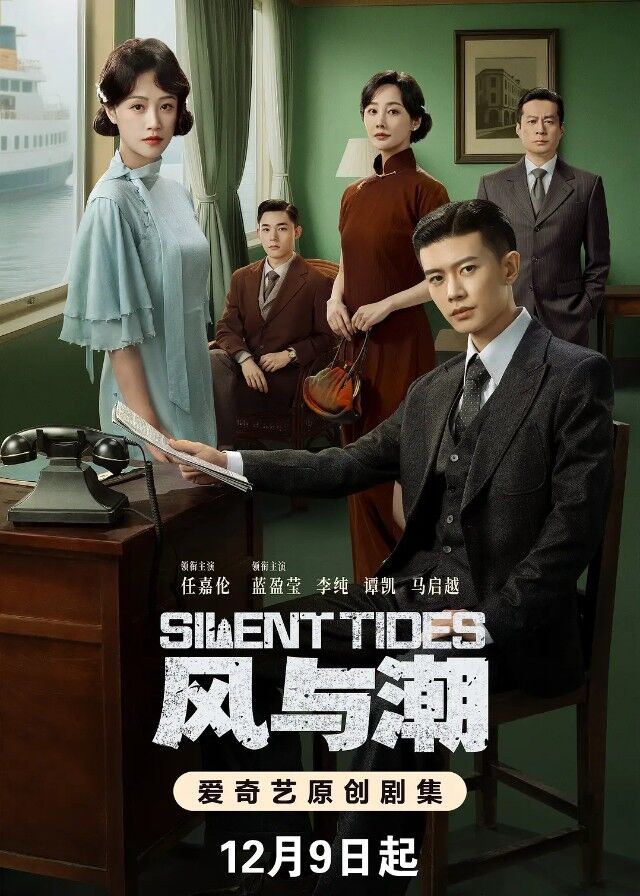



Silent Tides Episode 6 Recap
> Silent Tides Recap
Ze Rongzuo gave Huang Gongjie two critical orders: first, to intensify the search for Chinese dignitaries and British prisoners of war hiding in Macau, as intelligence suggested organized help from Chongqing or Yan'an; second, to immediately lead forces to Zhongshan to seize control of the local rice market, thereby completely cutting off Macau's food supply.
Huang Gongjie acknowledged the difficulty of the first task, noting that despite Japanese Imperial Army surrounding Macau and round-the-clock monitoring of the British Consulate, the British had cut their phone lines to prevent POWs from calling. He understood they must lie in wait for the hidden individuals to reveal themselves. He then accepted the more urgent mission to Zhongshan.
In Zhongshan County, Magistrate Zhao Dinghua, under duress, announced the immediate closure of the rice market and the suspension of all grain transactions. He ordered all rice merchant inventories to be surrendered to the county authorities, with Captain Huang Gongjie responsible for exclusive sales. When merchants protested, Huang Gongjie brutally silenced them, asserting his military control over Zhongshan's rice.
He warned away anyone attempting to buy rice and instructed all sellers to register their stock, demonstrating a violent takeover of the local food source. News of the unfolding crisis swiftly reached the Government House in Macau. Officials reported that the population had soared to over 450,000, triple its pre-war size, largely due to the Japanese military's policy of sending Hong Kong refugees to Macau without allowing anyone to leave.
Macau's rice reserves, originally less than five thousand bags, were now nearly depleted. Adding to the catastrophe, the Japanese had blocked Gongbei Port, preventing any grain from Zhongshan from reaching Macau. An official confirmed that a grain ship ordered by the Portuguese Macau government from Vietnam had been seized by Japanese warships.
The lack of food caused prices to skyrocket, with rice reaching two dollars two cents per half kilogram, a massive increase from the previous forty cents or even ninety cents, leading to widespread public suffering. Returning home empty-handed, He Xian was overcome with guilt upon seeing his wife, Guo Qiwen, pawn her coat for a meager amount of rice. She reassured him that she was not cold and that the coat was unnecessary for the warmer weather to come.
He Xian tried to pawn his own suit to redeem hers, but Guo Qiwen gently but firmly stopped him, insisting that he needed a presentable suit to maintain his dignity and make a good impression while seeking employment. Meanwhile, De Solaire directly confronted Fukue and Ze Rongzuo, condemning their actions. Fukue denied Japanese involvement in the seizure of the grain ship, claiming it was the work of "damn pirates" whom the Japanese Navy was pursuing.
De Solaire angrily refuted this, citing the grain ship's radio transmission that reported Japanese interception and the presence of only Japanese warships at the scene. Unmoved, Ze Rongzuo warned De Solaire to halt all maritime trade, stating that the Imperial Navy would detain all suspicious vessels to eradicate pirate gangs, portraying this as a long-term benefit for Macau. De Solaire challenged the simultaneous blockade of Gongbei Port, asking why Zhongshan grain was blocked if no pirates were there.
Fukue claimed the Zhongshan blockade was an anti-smuggling measure by the Wang Jingwei government in Nanjing, unrelated to the Japanese. De Solaire passionately argued that by sealing off Macau, the Japanese were condemning hundreds of thousands to starvation. Ze Rongzuo, feigning sympathy, then presented a "cooperation plan" he claimed had been drafted just before De Solaire's arrival. Faced with the Japanese's escalating pressure to strangle Macau, De Solaire reluctantly accepted their proposal.
In her humble lodging, Qiao Yinwan struggled to cook a simple meal over a rudimentary, smoky stove due to the exorbitant food prices. Lok Pak visited her, expressing concern that her hands, meant for playing the violin, were engaged in such rough work. Qiao Yinwan explained she was trying to save money by cooking herself.
When Lok Pak attempted to offer her money and provisions, she firmly refused, asking him not to bring such things again, as she could not accept charity. Respecting her strong will, Lok Pak reiterated his previous invitation for her to play the violin at his Bachongtian Club, emphasizing it would be an honest way for her to earn a living. Qiao Yinwan, touched by his sincerity, promised to seriously consider his offer.
At an emergency meeting, Lok Pak announced a grain control order: all grain merchants in Macau were forbidden from hoarding. Seventy percent of their existing grain stock was to be surrendered to the General Chamber of Commerce for the establishment of soup kitchens to provide unified famine relief. Ma Wanqi, a member of the General Chamber of Commerce's Board of Directors, was tasked with overseeing the inspection and collection work alongside the General Economic Bureau.
The merchants erupted in protest, but Chairman Gao appealed for unity, emphasizing the dire situation and the need to cooperate to ensure everyone's survival. Ma Wanqi then stepped forward, declaring that his Hengfengyu Bank would immediately donate its entire grain inventory for disaster relief. Crucially, he pledged that all grain requisitioned from other merchants would be considered a loan from Hengfengyu, for which he would personally issue promissory notes and formal contracts, promising full repayment after the famine.
This bold declaration swayed the dissenting merchants, and the resolution was unanimously approved. Ma Wanqi asked his fiancée, Luo Baixin, to find He Xian, to whom he felt indebted. Luo Baixin reported that despite checking all decent hotels and inns, she couldn't locate him, and she knew he didn't own a house in Macau. Ma Wanqi, recognizing the difficulty of finding him among the tens of thousands who had poured into Macau, resolved to keep looking.
Back home, with their family's rice completely gone, Guo Qiwen comforted He Xian, reminding him about the newly established soup kitchens on the streets and her plans to find laundry work to support them. Despite their hardship, she assured him they would manage. Later, Fukue and Saito Kenichi, representing the Japanese Chamber of Commerce, presented a proposition to Lok Pak: for the Japanese to take a stake in Lyun Coeng.
Lok Pak explained that Lyun Coeng was a joint venture between the General Chamber of Commerce and the Portuguese Macau government, with Chinese merchants holding a 60% controlling stake and managing the company, especially its procurement of daily necessities from mainland China. He warned that any sudden change in control would severely impact Macau's supplies. Fukue dismissed the Chinese merchants' ability to provide supplies under the blockade.
Saito suggested a shared management model, but Fukue countered with an ultimatum: either the Chinese merchants fully withdraw from the board, allowing the Japanese to take complete control with Saito as chairman, or the Macau blockade would remain indefinitely. Lok Pak pressed for assurance that the blockade would be lifted if they agreed.
Fukue, however, could only promise to convey Macau's "sincerity" to Ze Rongzuo and headquarters, ensuring the supply of daily necessities for officials and their families, including Lok Pak's Bachongtian Club. Seeing no other option, Lok Pak reluctantly agreed to take them to Chairman Gao. He Xian arrived at Lyun Coeng for a job interview and once again encountered He Hongshen, who revealed he had been homeless for two nights after leaving his relatives' home and brought his bedroll with him.
He Hongshen admitted he felt He Xian, with his experience, was the preferred candidate. As they spoke, a heated argument erupted upstairs. Inside, Lok Pak and the government-appointed directors presented the Japanese proposal to Chairman Gao and the Chinese directors. Lok Pak explained the government's dire situation and their reluctant decision to approve the Japanese takeover.
When Chairman Gao insisted that any shareholding change required unanimous board approval, Lok Pak stated that Japanese entry was now a certainty and Saito's chairmanship had government approval. Infuriated, Chairman Gao declared that all Chinese directors of the General Chamber of Commerce were withdrawing from Lyun Coeng immediately. Downstairs, He Hongshen shared his mixed heritage, explaining his Dutch Jewish great-grandfather but his family's long-standing identification as Chinese from Bao'an.
Qin, the assistant manager, informed He Xian and He Hongshen that the board had been reorganized, and their interviews were now under the new management. Sakagami Jiro, the new Japanese assistant manager, summoned He Xian. During the interview, Saito praised He Xian's extensive business experience and vision, offering him a position. He Xian questioned the sudden changes, and Saito confirmed the Japanese had completely taken over Lyun Coeng, though original job terms would be honored.
Saito then explained the company's new focus on procuring special materials like tungsten, tin, hog bristles, and tung oil. He offered He Xian a promotion to Procurement Manager with double salary and year-end bonuses if he could source these materials. He Xian, recognizing the nature of the Japanese demands, firmly stated he knew nothing about such goods and could not procure them. He then decisively withdrew from the interview, telling He Hongshen that the job was not suitable for him.
On his way back from the interview, He Xian saw a recruitment drive for dock workers to carry grain bags. He signed up, taking on the physically demanding labor. To spare Guo Qiwen worry, he later told her he had secured a trainee position at Lyun Coeng, which included meals and half a catty of grain daily. Meanwhile, Macau's grain reserves were dangerously low, and Chinese merchants had almost exhausted their personal savings.
At an empty soup kitchen, Chairman Gao and Ma Wanqi discussed the city's dire situation. Gao suggested that Macau's strength was too limited and proposed engaging Hong Kong merchants who had fled to Macau, as they possessed greater financial resources and broader connections. He believed that by mobilizing them, Hong Kong and Macau could jointly find new ways to overcome the famine, emphasizing the power of collective effort.
Elsewhere, Yang Chang saw Mary attempting to pawn her family's turquoise brooch, which the pawn shop dismissed as having little value. He warned her against lingering on the streets and angrily lamented William's irresponsibility in providing for his family. Yang Chang offered Mary some money, but she, maintaining her dignity, politely refused. Meanwhile, Ma Wanqi sought out Huang Sanhe of the Tai Ho Brotherhood to arrange for more grain transportation.
Huang Sanhe revealed the immense risks involved, including two of his men killed and one injured while navigating the Zhongshan blockade, and stated that the Tai Ho Brotherhood would be discontinuing grain transport after this trip due to the heavy toll. He warned of the dangers of transporting grain from Zhongshan, emphasizing that money was no longer the issue, but the blood and sacrifice involved.
Ma Wanqi, in turn, expressed to Huang Sanhe that he was determined to hold on for Macau's hundreds of thousands of starving people, inspired by a friend who taught him the importance of keeping one's word and acting with conscience, even if he didn't know if he could succeed. He also mentioned that this friend was someone he knew only by reputation, never having met in person. At the docks, He Xian was struggling to unload grain bags alone.
Huang Zixia and Yang Chang, present due to their recent losses and frustration, deliberately targeted He Xian, ordering him to unload the entire cargo of two boats by himself for the pay of five men. He Xian silently accepted the challenge. Yang Chang, observing He Xian, remarked to Huang Zixia that He Xian, a former bank owner, had been reduced to such a state by Macau's desperate conditions.
As He Xian was about to collect his meager pay, Huang Zixia spitefully demanded he crawl between his legs. Just then, Ma Wanqi arrived, intervening and reminding Huang Zixia that everyone was struggling to feed their families and there was no need to humiliate the elderly laborer. Huang Zixia, yielding to Ma Wanqi's authority, backed down. Ma Wanqi then departed, unknowingly walking past He Xian, whom he failed to recognize despite having spoken to him on the phone.