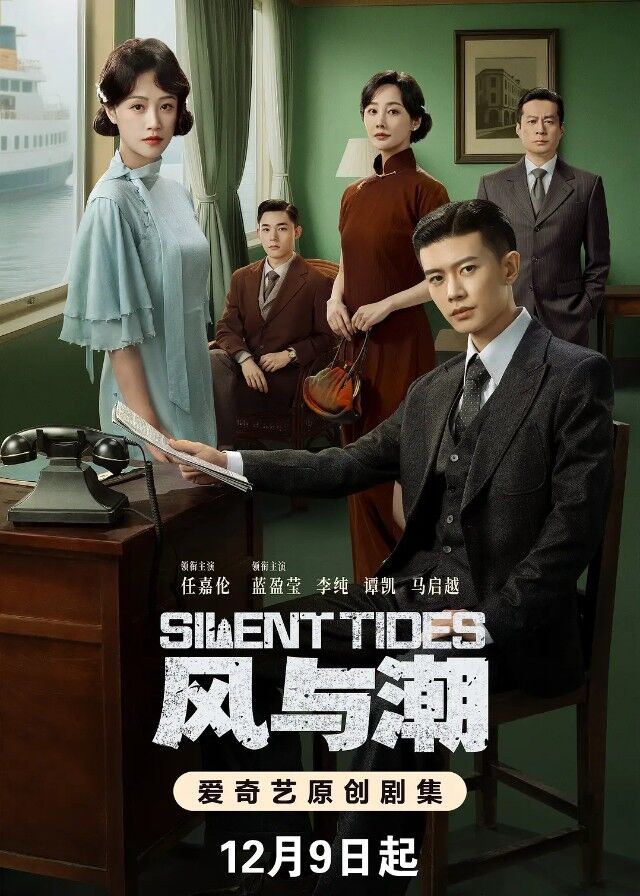



Silent Tides Episode 1 Recap
> Silent Tides Recap
In December 1941, He Xian, the manager of Hong Kong Huilong Bank, returned from a business trip and immediately joined his father, He Chengxi, wife Guo Qiwen, and children for early tea. During their meal, He Xian discussed the shifting political landscape and his plan to move the family to Macau. As a first step, he intended to travel to Macau to obtain a financial services operating license.
Guo Qiwen expressed her anxiety about another relocation, recalling their difficult escape from Guangzhou in 1938. He Xian reassured her that it was a precautionary measure, not an immediate move, and that having a backup plan for the family was wise. He also mentioned that Hong Kong, being British territory, was currently safe, especially with ongoing negotiations between the Americans and Japanese. Later that winter, He Xian and Lyu Xiuyuan sailed to Macau.
Onboard, He Xian noted the absence of German reports on the Eastern Front, which raised his suspicions. Upon arrival, after securing his financial license, He Xian and Lyu witnessed a patriotic charity gala for national salvation, where Tanka fishermen were donating money through a young girl named Yu. However, strict old customs in Macau prohibited Tanka people from stepping ashore. Suzuki, the manager of the Yokohama Specie Bank's Macau branch, seized the opportunity to disrupt the event.
He had already expressed displeasure over the gala's anti-Japanese songs and now demanded Yu's arrest for illegally coming ashore, insisting that her collected donations were "illegal funds" and should be confiscated. Liang Yanming, Ke Lin, and Qiao Yinwan stepped forward to defend Yu and the donations, leading to a heated argument. Lok Pak, the Deputy Director of the Macau Economics Bureau, attempted to mediate, even offering to cover Yu's donation if she returned to her boat.
However, Qiao Yinwan refused, asserting that the matter concerned Yu's dignity and the patriotic spirit of all Tanka fishermen. She vowed that the donations must be accepted and Yu protected. Suzuki remained resolute, threatening that if the Portuguese-Macau police failed to enforce the custom, the Japanese would no longer adhere to Macau's laws. The Inspector General regretfully announced the suspension of fundraising and the temporary confiscation of funds.
Yu, distressed, apologized and offered to leave, begging them not to confiscate the public's donations. Suzuki cruelly mocked the Chinese for losing their own land and attempting patriotism in Macau. At this critical moment, He Xian stepped forward. He asked the Inspector General whether custom or law held greater authority in Macau.
Citing Macau's commercial law, which guaranteed free movement for anyone engaged in international activities as an international free port, regardless of their background, He Xian presented his newly acquired financial license. He declared Yu his client and proposed an immediate foreign exchange trade with Yokohama Specie Bank on her behalf. Suzuki challenged this, pointing out Yu's limited funds compared to the 100 patacas minimum margin. He Xian countered by offering to lend Yu the necessary funds, combining her 28.
57 patacas with his 131. 6 patacas. He promised that he would bear any losses, while all profits would go to Yu. Yu agreed to this arrangement. He Xian then placed a short order on the German Mark, demanding same-day settlement with twenty times leverage, a bold move given Germany's ongoing advance on Moscow and the Mark's rising value. Qiao Yinwan, concerned, warned him against such a risky trade, but He Xian remained confident.
He then invited anyone who trusted him to join the trade against the Japanese, to which Ke Lin immediately responded, followed by others, pooling a total of 9,755 patacas. Suzuki, confident of German victory, saw this as an easy win and instructed his Hong Kong branch to relay Mark prices every five minutes via a public telephone. Initially, the Mark rose, seemingly confirming Suzuki's confidence and causing He Xian's partners to lose a quarter of their initial investment.
But He Xian remained calm. Five minutes later, the Mark unexpectedly dropped. Everyone cheered at the sudden profit. Suzuki dismissed it as a "technical correction" and predicted a rebound. However, in the next five minutes, the Mark crashed dramatically. He Xian explained his reasoning: Germany, which typically trumpeted its victories, had been silent on the Eastern Front for three days, while the Soviet TASS news agency had announced it would release a major war update.
This suggested the Red Army had launched a successful counteroffensive in the Battle of Moscow three days prior, effectively collapsing the German offensive. The news of the Soviet victory would surely trigger a market panic and a further Mark crash. Indeed, as He Xian finished speaking, the Mark had fallen by over thirty percent, prompting Yokohama Specie Bank's headquarters to issue an urgent order for immediate liquidation. Suzuki, in a panic, admitted defeat.
He Xian, however, prolonged the settlement, insisting on a 45% return, which resulted in a tenfold payout, and demanding that Suzuki and all Japanese present bow and apologize to Yu for their derogatory remarks against the Chinese, and shut down their promotional activities. Faced with He Xian's unwavering resolve and the threat of further losses, Suzuki relented, bowing with his staff and agreeing to a payout that resulted in a loss of 97,000 patacas for the bank.
Before He Xian's departure, he gave Yu 1,600 patacas, her principal and profits, without taking commission or repayment for his loan. Yu, deeply moved, immediately placed the money into the donation box. Ke Lin then presented Yu with a commemorative medal, acknowledging the Tanka people's contribution to national salvation. Inspired by Yu's generosity, Ke Lin proposed that everyone donate their winnings from the Japanese to the fund, which they enthusiastically agreed to do.
When they turned to thank He Xian, he had already quietly boarded his ship with Lyu Xiuyuan. Lyu Xiuyuan was delighted but regretted settling too early. He Xian explained that the Mark's rapid fall was a temporary market shock due to breaking news; the Soviet-German front was vast, and a single victory would not overturn the entire war, so the market was bound to recover somewhat by closing.
He Xian had shrewdly maximized his advantage when Suzuki was in a state of panic. Meanwhile, in Hong Kong, Huang Gongjie, the Second Helmsman of the Tai Ho Brotherhood, attempted to withdraw all funds from his anonymous account at Huilong Bank. The large sum required a week's prior notice, and with He Xian in Macau and markets closed, he was told he couldn't get the money until the next day.
As Huang Gongjie left, Greedy Gambler Rong spotted a wanted poster for him, prompting them to flee. However, they were ambushed by Liang Zhong, the master of the Hai Feng Hall, and other gang members. Liang Zhong accused Huang Gongjie of betraying the brotherhood by colluding with the Japanese to smuggle tungsten. Huang Gongjie swallowed his bank deposit receipt and was seized by the gang. Qiao Yinwan recounted the day's events in Macau to her brother, Qiao Renyu.
Qiao Renyu was impressed by He Xian's remarkable financial acumen and courage, especially his precise prediction of the Soviet-German war's outcome, something few experts had foreseen. He admired He Xian's boldness and expressed a desire to meet such a "hero from humble beginnings." Qiao Yinwan offered to introduce them at the next anti-Japanese event.
However, Qiao Renyu then urged his sister to reduce her public involvement in such activities, citing concerns for her safety due to the Japanese secret service's history of kidnappings, assassinations, and bombings. Qiao Yinwan passionately rebuked him, arguing that in a nation with half its territory occupied, promoting national salvation was not "provoking" but a duty. She asserted her determination to continue her efforts, leading to a tense disagreement between the siblings.
Back in Hong Kong, He Xian returned home and, with his father, He Chengxi, offered incense to their ancestors, assuring them that his business dealings had been conducted with integrity and a clear conscience. Guo Qiwen again expressed her worries about moving to Macau, fearing a Japanese attack on Hong Kong, noting the Japanese troops stationed across the Shenzhen River.
He Xian reiterated that their planned relocation to Macau was merely a contingency plan, not an immediate move, and that they would continue to observe the situation closely. Guo Qiwen hoped Hong Kong would remain peaceful. At the Tai Ho Brotherhood Grand Hall, Huang Sanhe presided over Huang Gongjie's public trial. Huang Gongjie was condemned for treason and tarnishing the brotherhood's name.
The traditional punishment for such an offense was "three stabs, six wounds," and his followers were to have an arm severed and be expelled. Huang Gongjie desperately pleaded with Fifth Master, reminding him of his family's sacrifices for the gang. Fifth Master interceded, successfully persuading Huang Sanhe to reduce Huang Gongjie's sentence to merely losing both arms and expulsion.
However, as Fifth Master approached, Huang Gongjie, unrepentant, suddenly drew a dagger, stabbed Fifth Master, and escaped with his men in the ensuing chaos, despite attempts by Huang Zixia and others to stop him. In the early hours of December 8, 1941, the Japanese Navy launched a surprise attack on Pearl Harbor, igniting the Pacific War. News of this reached the Headquarters of the Japanese Expeditionary Army to Southern China in Guangzhou.
Yazaki Kanju, the chief of the Japanese Special Service Organ, celebrated with Ze Rongzuo and Fukae. He declared that with the Pearl Harbor attack, the Empire of Japan now faced no rivals in the Pacific, and the Imperial Army's advance would be unstoppable, sweeping across Southeast Asia. He revealed that Commander Sakai Takashi had issued "Operation Eagle," and at dawn, a full-scale assault on Hong Kong would commence. The officers raised a toast to the "Greater East Asia Holy War," as one of them then pondered the fate of Macau.