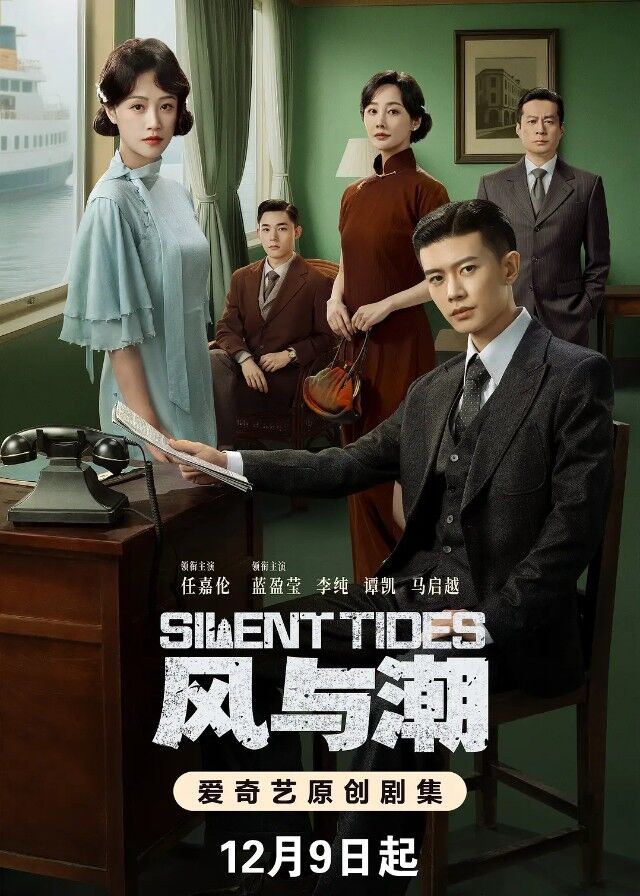



Silent Tides Episode 9 Recap
> Silent Tides Recap
Ke Lin, a renowned doctor and medical director, found himself questioned by Ze Rongzuo at the cemetery while transporting bodies. Ze Rongzuo, suspicious of the two-hour delay in his journey, interrogated him, asking why a doctor of his standing was performing such a task. Ke Lin calmly explained that he was on duty, and as an epidemic prevention doctor, he had to assist Tongshan Hall with plague victims found in the shantytown, including disinfection.
He presented official handover documents as proof. Despite this, Ze Rongzuo insisted on inspecting the vehicle's cargo. Ke Lin warned him that the bodies were highly contagious, but Ze Rongzuo, undeterred, opened the vehicle himself. Confronted by the sight of the corpses, Ze Rongzuo recoiled, then apologized to Ke Lin and departed.
Unbeknownst to Ze Rongzuo, an hour earlier, Ke Zhengping had orchestrated a body swap in the shantytown with Yang Chang, ensuring the vehicle contained only plague victims, leaving no trace of the actual target Ze Rongzuo was searching for. Later that night, He Xian and Qiao Yinwan arrived at the cemetery, desperately searching for Yu and her mother. Despite warnings about the unsanitary conditions, Qiao Yinwan insisted on entering.
Ke Lin, who was already there, directed them to the specific area where the most recent plague victims from Tongshan Hall were buried. Amidst the horrifying sight of mass graves, they tirelessly searched through the bodies, calling out Yu's name, until they discovered her barely clinging to life with a faint pulse. They rushed Yu to the hospital, where Ke Lin confirmed she was suffering from severe starvation rather than plague and would recover with proper nourishment.
Ke Lin urged He Xian to return home for his family's New Year's Eve dinner, while Qiao Yinwan volunteered to stay by Yu's side. He Xian, deeply moved, decided to walk with Ke Lin to clear his head. At the Bachongtian Club, Ma Wanqi addressed an assembly of Hong Kong and Macau Chinese merchants, revealing a grave development. He announced that the Government House had received war dispatches confirming Japan's full-scale military assault on Portuguese Timor, a Portuguese colonial territory.
This act proved Japan's utter disregard for Portugal. Consequently, the Portuguese government had left the decision of whether to sign an agreement and accept all of Japan's terms entirely to Macau's discretion. The merchants reacted with outrage, condemning the Portuguese as "cowards" who "only pick on the weak," equating signing the agreement to Japanese occupation.
Ma Wanqi emphasized that the critical issue was grain, explaining that failure to resolve the famine would lead to more deaths, regardless of whether the agreement was signed or delayed. He revealed that Governor De Solaire would hold an Executive Council meeting the next afternoon to vote on signing the agreement, stressing that even if the vote failed, the final deadline was only four days away, leaving Macau in a desperate situation without food.
When asked for solutions, the merchants expressed despair, noting that money cannot buy grain. Amidst this, one merchant asked about He Xian, whom another quickly branded a "traitor." Ma Wanqi, however, vehemently defended He Xian, recounting his unwavering integrity and courage in protecting crucial funds and upholding his word, despite facing severe personal hardship. This revelation finally cleared He Xian's name, particularly for figures like Lü Xiuyuan, who were filled with remorse for their past misjudgment.
Ma Wanqi led the sympathetic merchants to the Flower-Stern Ferry, where He Xian's family resided in a dilapidated cabin, eagerly awaiting his return for New Year's Eve dinner, despite their hunger. The merchants present the New Year's gifts they brought, suggesting they share them for the family's dinner. Lü Xiuyuan, deeply apologetic for his past accusations, repaid a short-term loan to He Xian with interest, an act followed by other merchants.
Upon seeing the unexpected generosity and the collected funds, He Xian was overwhelmed with grief. Qiao Yinwan explained that He Xian wasn't crying for himself; his tears were for the countless suffering people after they had just visited the horrific mass graves at Taipa Cemetery to rescue Yu, a sight that traumatized them both. Everyone present was profoundly moved by He Xian's sorrow.
As Mary and the other British escapees prepared their belongings, Yang Chang sensed a peculiar shift in their mood. He learned that the British Consulate had received a confidential cable from MI6. The message requested that one or two of the military officers who escaped from Hong Kong volunteer to remain in Macau to establish a British Military Service Station.
The station’s dual purpose would be to receive any further British personnel fleeing from Hong Kong and to exploit Macau’s neutral port status as an "outpost intelligence station" to covertly gather intelligence on Japanese forces across Guangdong, Hong Kong, and Macau. Yang Chang bluntly interpreted this as asking them to "stay behind as spies," which Mary confirmed.
Yang Chang expressed disbelief at MI6's audacity, pointing out that all the officers were on Japanese wanted lists and agreeing to such a mission would be a "death wish." Mary countered that with the Allies currently having "zero presence" in the region, intelligence gathering was crucial for future counteroffensives. The rescue efforts orchestrated by the Communist Party intensified throughout the night, with a large-scale operation successfully transferring patriotic democratic figures, cultural elites, and international friends to safety.
Yang Chang personally accompanied Mary to the pier, and before her departure, he surprised her by returning a piece of jewelry she had pawned, remarking that he knew how important it was to her. Their recent interactions had clearly stirred feelings in Yang Chang. After seeing her off, he returned to his lodging. Looking at a photograph of Mary with William, he silently tore off William's image, keeping only Mary's silhouette. Moments later, Mary unexpectedly returned.
Yang Chang was initially relieved, thinking perhaps the evacuation failed, but his relief turned to shock and anger when Mary declared her decision to remain in Macau and establish the British Military Service Station. Yang Chang vehemently protested, calling her decision "nonsense" and a "death wish," highlighting the extreme danger of spying under Japanese occupation. He challenged her lack of experience, resources, and contacts, arguing that a "society lady" like her was ill-equipped for such a perilous undertaking.
Assuming she was staying out of loyalty to William, Yang Chang urged her to abandon such a "dream." Mary fiercely refuted this, emphasizing that William was not a factor in her decision. She maintained that as a military dependent, she was less likely to be noticed by the Japanese, and her past experience at the telegraph office was an asset.
While not fully disclosing her true motivations, Mary firmly asserted that from that day forward, she was the station chief of the newly formed British Military Service Station in Macau. He Xian, Ma Wanqi, and Ke Lin engaged in a crucial discussion to analyze the true motives behind the Japanese actions in Macau. He Xian posited that Japan's refusal to militarily occupy Macau, despite the ease with which they could, suggested a deeper objective beyond the surface-level blockade.
Ma Wanqi then elaborated, explaining that Japan was primarily interested in maintaining Macau as an "international free port" because, before the fall of Hong Kong, Japan utilized disguised British and Chinese enterprises to procure China's strategic specialties and Anglo-American industrial goods. With these routes now severed, Japan desperately needed a new trade channel.
He Xian further clarified, from a wartime financial perspective, that with Hong Kong's status as an international financial hub effectively defunct since the Pacific War began, Macau remained Japan's sole option for an "international financial foothold" to handle foreign currency transactions for these imports. Understanding this hidden agenda, and recalling Huang Gongjie's prior offer, He Xian declared his resolute decision to cooperate with Huang Gongjie to buy grain, prioritizing the urgent need to feed Macau's starving population.
He Xian confronted Huang Gongjie, who, seeing He Xian's change of heart, initially questioned his motives. He Xian presented the meager "pig slop" that constituted his family's New Year's Eve dinner, explaining that without the generosity of friends, their situation would have been dire. This emotionally powerful demonstration swayed Huang, who acknowledged that "no one says no to money." He Xian, however, clearly separated personal sentiment from business, demanding Huang disclose his "bottom line."
Huang revealed that his 10 million kilograms of rice from Zhongshan cost 6 million patacas, including all overheads. He then stated his selling price: 4 patacas per kilogram, a total of 40 million patacas, justifying it by declaring that "whoever has grain calls the shots" in Macau. He Xian agreed to seek buyers at this steep price but highlighted the difficulty of finding someone capable of paying such a massive sum upfront.
Huang then insisted on 6 million patacas in cash at contract signing, with the remaining 34 million to be paid via Banco Nacional Ultramarino post-dated checks, "cashed upon delivery." Crucially, Huang revealed a major constraint: the deal can only proceed after 6 PM on the 18th, Japan's final deadline to the Portuguese Macau government, as "not a single grain of rice can enter Macau" before the blockade is lifted.
He Xian initially despaired, declaring the deal impossible, but quickly countered that if they waited until the blockade was lifted, grain prices would plummet as supplies flooded the market, eroding their profits. He proposed a tactical solution: transport the rice from Zhongshan to waters just outside Macau "before" the deadline, keeping the grain barges anchored.
The moment the agreement was signed and the blockade lifted, He Xian, being the first to know, would notify Huang to "bring the boats in and unload." This strategy, which Huang praised as "brilliant," allowed them to profit without violating Japanese orders. Ma Wanqi and He Xian successfully contacted two influential Hong Kong merchants.
Upon learning that the grain was destined to alleviate Macau's famine, the merchants immediately agreed to the terms and signed the contracts, accepting the 6 million patacas upfront cash risk, knowing the post-dated checks for the remainder would not be cashed. Back with Huang Gongjie, his associate, Rotten Gambler Rong, voiced deep suspicion of He Xian, recalling how he previously spilled grain to aid a foreign woman.
While Huang Gongjie had initially explained that He Xian was needed as a "trusted middleman" to manage the merchants and conceal their dealings and true profits from the Japanese, Rong's warning prompted Huang to acknowledge the need for an additional "backup plan" due to He Xian's perceived unpredictability. Simultaneously, Ke Lin discovered that the Portuguese Macau government was scheduled to vote that very afternoon on whether to sign the agreement prematurely, a move that would completely derail their intricate plan.
He Xian realized they needed a "discreet channel to pass the message" to the government, as solving the famine would surely appeal to them. Qiao Yinwan was identified as the ideal intermediary. She arranged a meeting with Lok Pak, who had previously hosted her at the Bachongtian Club. During their meeting, Lok Pak apologized to Qiao Yinwan for the earlier incident.
Qiao Yinwan, acting on behalf of He Xian and Ma Wanqi, passionately conveyed the urgency and the immense risks of He Xian’s plan, which she described as "walking a tightrope over a cliff," emphasizing that a single misstep could lead to the ruin of all Macau. She expressed her unwavering faith in He Xian, prompting Lok Pak to ask about her strong confidence. Qiao Yinwan eloquently responded that if a man like He Xian cannot be trusted, then who can?
Moved by their earnest plea, Lok Pak intervened with Governor De Solaire just before the crucial vote. After a brief but intense appeal, the Governor officially announced the cancellation of the day's vote, assuring that the government would not consider signing the agreement prematurely before the February 18th deadline. With buyers secured and the Portuguese Macau government's vote on early signing postponed, the immediate challenge shifted to arranging the "shipping fleet" capable of transporting the massive grain supply.
Ma Wanqi asserted that only the Tai Ho Brotherhood possessed the necessary resources and audacity to execute such a large-scale, clandestine operation under the watchful eyes of the Japanese and their collaborators. He then brought He Xian to meet Huang Sanhe, the leader of the Tai Ho Brotherhood, at their Hengqin headquarters. While Huang Sanhe expressed admiration for their "integrity and courage," he was deeply concerned about the "immense risks" involved, fearing "ruin for the entire gang."
At this critical juncture, Huang Zixia, the Master Huang, stepped forward. He knelt before He Xian, making a personal apology for his past "blindness" and repeated misunderstandings of He Xian's true character, offering him "apology tea" as a gesture of profound remorse. After He Xian accepted his apology, Huang Zixia shifted to the matter of "gang business," invoking the Tai Ho Brotherhood's core principle of "righteousness" and its motto, "Loyalty lasts forever."
He declared that for the Haifeng Hall, led by himself, to shrink back now would be a betrayal of their values. He pledged that "all my hall's brothers" would "follow Xian and Mr. Ma" through any hardship, even "fire and water." Following his impassioned declaration, Liang Zhong, the master of Haiyun Hall, also stepped forward.
He vehemently condemned Huang Gongjie, asserting that the Macau famine was orchestrated by him in complicity with the Japanese, branding him "our Tai Ho Brotherhood's traitor." Liang Zhong asked how the "jianghu" would judge them if they stood idly by. He then pledged that his "Haiyun Hall's brothers" were willing to transport the grain for Macau, aiming "to atone for the sins of our gang's traitor." Inspired by their conviction, other hall masters quickly voiced their full support, ready to join the cause.