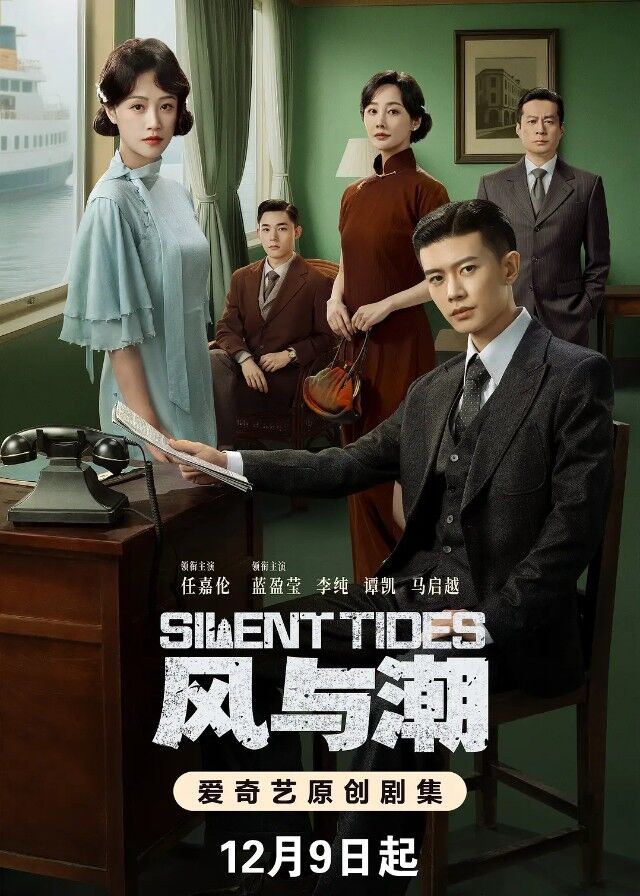



Silent Tides Episode 3 Recap
> Silent Tides Recap
Guo Qiwen urged He Xian not to go to the Huilong money changer the following day, reminding him that the last outstanding deposit was their family's remaining savings, which they would need for their father and two children when they moved to Macau, where expenses would be high. She pointed out the chaotic state of Hong Kong, with people fleeing or dying, and suggested the last depositor might have already left the city and wouldn't appear.
He Xian didn't respond immediately, grappling with his sense of obligation and responsibility, but then quietly asked what if the person hadn't left. Meanwhile, Qiao Renyu advised his sister, Qiao Yinwan, to prepare her luggage and avoid the orphanage the following day, predicting Hong Kong's fall within "just a day or two at most," despite the British Governor's claims of a six-month defense. He believed transport to Macau would be among the first links to resume.
Qiao Yinwan, trying to lighten the mood on Christmas Eve, offered to play a tune, and he responded by singing "Moonlight shines on the threshing floor." In another part of the city, Mary confronted her husband, William, about his involvement in a smuggling operation. William admitted he sought "extra money" but claimed he wouldn't have participated had he known Huang Gongjie was smuggling "tungsten ore," a "critical strategic material" for military vehicles, urgently sought by warring nations.
Mary realized William had trafficked strategic materials to the Japanese, calling it "treason." William pleaded with Mary to use her distant relation to Colonel Lyons, the investigating officer, to frame Yang Chang, the Chinese sergeant who frequently visited their home with bribe money, arguing that as a Chinese man, Yang Chang's fate wouldn't hinder the case's resolution. Mary was troubled by her conscience but ultimately yielded to her husband's pleas, making him promise to rescue Yang Chang.
At Stanley Prison, Yang Chang was denied food by a guard who mocked him, calling him a "Japanese collaborator" for smuggling "undeclared goods." Yang Chang vehemently denied being a traitor, insisting he only took "bribe money" and hadn't exposed William. He spotted Mary visiting Colonel Lyons and desperately cried out for help.
Mary quickly turned away, her conscience clearly troubled, especially after Lyons had just told her that Yang Chang, as a Chinese prisoner, would likely be sent to the most dangerous front lines and not survive. At HSBC, Qiao Renyu urgently warned Chief Manager Mr. Quiver that the Hong Kong dollars and printing plates in the vault needed immediate disposal to prevent a "historical mistake."
Mr. Quiver, however, dismissed his concerns with a condescending and racist remark, stating that the Japanese were only "fit to bully the Chinese" and insisting Hong Kong, the "crown jewel of the British Empire," was safe. Offended, Qiao Renyu, who identified himself as Chinese, immediately resigned, calling the items "financial time bombs" before leaving.
Just as he was leaving, Mr. Quiver rushed after him, apologizing and revealing that Governor Sir Mark Young had just called to announce the British government's formal surrender to the Japanese, with the signing scheduled for 6 PM. He begged Qiao Renyu to stay and assist with transferring the crucial assets, which Qiao Renyu agreed to, determined to keep them out of Japanese hands.
Almost simultaneously, Qiao Renyu called Qiao Yinwan, urging her to pack her things and find out if there was a boat to Macau. William also called Mary, instructing her to quickly pack their valuables as the British were surrendering and Hong Kong was doomed. Mary reminded him of his promise to save Yang Chang, which William reiterated, assuring her he would rescue him before they left.
After a night of deep reflection, He Xian decided to honor his commitment to the last depositor and wait for them at the money changer. Guo Qiwen supported his choice without complaint, and together with the children, began selling her jewelry and other valuable household items in preparation for their move. Meanwhile, Huang Gongjie, destitute and in hiding, was informed by his subordinate, Qiu, that Huilong Money Changer was still open for withdrawals, but today was the final day.
Huang Gongjie despaired, revealing that his deposit slip had been destroyed when he was captured by the Tai Ho Brotherhood, which had issued a "kill-on-sight order" against him and his men. Desperate and without proof of deposit, he decided they would "rob it." British forces began evacuating prisoners and sensitive materials. Qiao Renyu confronted William for using "serious criminals" (who Qiao Renyu mistakenly believed were civilians) for such a critical task, but William insisted they were criminals.
Amidst a Japanese air raid, the convoy was bombed and scattered. William found Yang Chang and, at gunpoint, forced him to help load cargo onto a boat. However, Japanese warplanes strafed the beach, forcing William to flee with his men, abandoning the cargo despite Qiao Renyu's protests. Yang Chang was thrown into the sea but miraculously survived. He Xian recognized Huang Gongjie as the anonymous depositor.
Huang Gongjie, discovering that the ledger page containing his account details had been destroyed in the bombing, prepared to use force. To his surprise, He Xian, recalling the precise deposit amounts, handed him 31,100 Hong Kong dollars, representing the principal amount without investment returns. Overwhelmed, Huang Gongjie was deeply grateful and pledged loyalty, declaring them brothers.
Soon after, Yang Chang, having escaped the sea, stormed into a local club, brandishing a pistol and holding Huang Zixia , a member of the Tai Ho Brotherhood, at gunpoint. He demanded Huang Gongjie. Huang Zixia revealed that the entire Tai Ho Brotherhood was hunting Huang Gongjie, whom they considered a "bastard traitor" who had been "raising travel expenses" for an escape.
Realizing Huang Gongjie had used his retrieved funds for an escape, Yang Chang confronted He Xian, accusing him of aiding a traitor. He Xian calmly explained that as a banker, it was his duty to honor withdrawals. Yang Chang, along with the Tai Ho Brotherhood members, rushed to intercept Huang Gongjie but he had already departed. A city-wide radio broadcast abruptly shattered the remaining sense of calm.
Governor Sir Mark Young formally announced the British government's surrender to the Japanese forces, transferring all sovereign authority over Hong Kong to the Japanese military. He ordered all police and military personnel to lay down their weapons and citizens to maintain order, cooperate, and accept the "peaceful takeover" of Hong Kong. The city descended into despair and indignation.
Japanese forces swiftly occupied HSBC, seizing "unsigned new banknotes" worth over one hundred million Hong Kong dollars, which Qiao Renyu had attempted to destroy. Qiao Yinwan watched helplessly as Japanese soldiers led her brother away, suppressing her grief. Huang Zixia learned that Huang Gongjie had escaped to Macau on Fearless Biao's opium speedboat. The Tai Ho Brotherhood, seeing an opportunity in the desperate refugee exodus, dispatched boats to Tsim Sha Tsui Beach to profit from transporting people to Macau.
Yang Chang borrowed a gun from Huang Zixia and headed to William Jones's residence to seek revenge. That same night, the Communist Party of China's underground organization held an urgent meeting to plan the immediate transfer of "high-priority, publicly recognizable individuals" to Macau, fearing their easy identification by the Japanese and traitors. Ke Zhengping was appointed to lead this escort mission.
Liu Shaowen, his superior, instructed him that upon arrival in Macau, a seasoned comrade code-named "Buddha's Hand" would assume command for their concealment and further relocation, trusting his experience for accurate judgment and suitable arrangements. Yang Chang confronted William, Mary, and Colonel Lyons at their home. Despite his burning rage, he chose not to shoot William, recognizing that leaving them behind would doom them to certain death at the hands of the Japanese.
Mary pleaded with him to take them to Macau, believing he would not abandon them to die under Japanese guns. Meanwhile, He Xian returned home, filled with remorse for the loss of their family's last savings. Guo Qiwen reassured him, mentioning the 470 Hong Kong dollars she had raised by selling her jewelry, which she hoped would be enough for their boat tickets.
His father, He Chengxi, encouraged him, reminding him of their family's humble beginnings and emphasizing that as long as they remained together and upheld their integrity, they could overcome anything and rebuild. Inspired by their resolve, He Xian decided their family would go to Macau together to forge a new future.