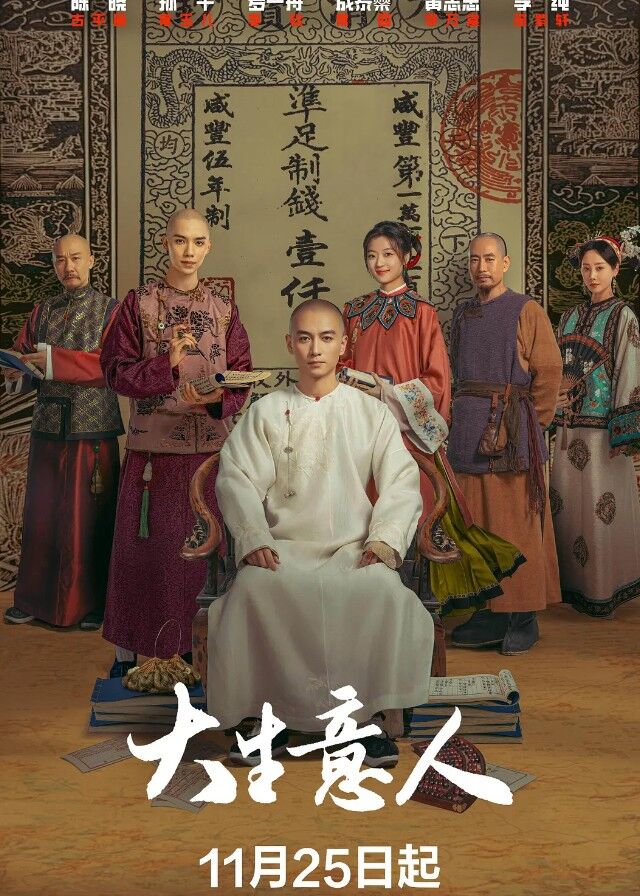



Legend of the Magnate Episode 39 Recap
> Legend of the Magnate Recap
Viceroy Rui Lin dispatched Gu Pingyuan to negotiate with the foreigners after Li Qin mortgaged his salt fields to them. Rui Lin brought Su Yuhua to the British warship, where Mr. Richard insisted on speaking only with Rui Lin. Gu Pingyuan, representing Rui Lin and granted full authority over Liangjiang's external negotiations and financial affairs, asserted his right to act, prompting Richard to relent. During the negotiation, Richard demanded all shares of the Lianghuai salt industry.
Gu Pingyuan firmly rejected this, citing the "Elements of International Law," which recognized government shares in state-monopoly industries. He suggested resolving the dispute through official channels, warning that a protracted legal battle could jeopardize Richard's position and potentially turn Li Qin's mortgage into a bad debt. Richard then asserted his right to the mortgaged salt fields and shops.
Gu Pingyuan countered that entering the Qing market with such an aggressive stance was a mistake; the salt fields would be useless "flat rocks" and the shops "empty buildings" without local cooperation, rendering Richard's efforts futile. Richard threatened to sell the collateral to other nations or the Qing court, confident that the Chinese concern for dignity would prevent delay.
Gu Pingyuan retorted that when cannons are at one's doorstep, any action is justified, and the cannons would not withdraw until their objective was met. Richard proposed a month's delay, hinting that Gu Pingyuan's imperial deadline might lead to his downfall. Li Qin, present during the discussion, acknowledged Richard's point about compromise.
Gu Pingyuan then brought up his expiring bet with Li Qin regarding the profitability of the Lianghuai Salt Industry Guild versus the Li family's business, whose outcome would determine the salt industry's ownership, and requested a fair audit. Richard, surprised by this "commercial competition" from a Chinese individual against an international company, agreed to sign a preliminary agreement.
Before signing, Gu Pingyuan asked Li Qin if he had any last words, reminding him that this act would mark the end of the powerful Li family. Li Qin, unmoved, declared he no longer wanted the family business. Richard then signed a preliminary agreement with Gu Pingyuan. After Gu Pingyuan's successful negotiation, Viceroy Rui Lin praised him and instructed all Liangjiang officials to follow his directives as if they were his own, warning against any collusion with foreigners.
Gu Pingyuan emphasized that the Lianghuai salt industry was Liangjiang's economic lifeline, and its loss to foreigners would be catastrophic. He ordered officials to vigorously procure raw silk and encourage the production of high-quality silk embroidery, requesting a rapid inventory of all available silk and local specialties, regardless of existing stock. Rui Lin, curious about Gu Pingyuan's plans for such vast quantities of silk, asked him directly, but Gu Pingyuan cryptically replied that "heaven's secret cannot be revealed."
He then left to meet other important guests. Gu Pingyuan journeyed to Shanxi to purchase medicine from the Eight Families, where Manager Li warmly welcomed him. First Madam Jin inquired about Chang Yu'er's pregnancy, to which Gu Pingyuan admitted, promising to have the child recognize her as a godmother. He spoke of his recent studies of the "Elements of International Law," which supported free international trade.
His ambition was to export Chinese silk, tea, medicine, and porcelain (though he admitted less familiarity with porcelain) directly to countries like India, Britain, and America, bypassing the East India Company. He questioned why foreigners could trade in China but Chinese could not trade abroad. Both Manager Li and First Madam Jin expressed skepticism, highlighting the difficulty of fighting the East India Company alone.
First Madam Jin reminded him of his ongoing bet with Xianghe Trade House and the saturation of the domestic salt market, explaining that the East India Company's immense market allowed them to absorb vast quantities of salt.
She warned that such an endeavor was "one man against a whole country," requiring decades to build a commercial foundation, tying up huge capital, violating Qing law, facing customs opposition, and lacking overseas infrastructure, all of which could lead to perishable goods and financial ruin. She speculated that Gu Pingyuan's true aim was to "send a warning shot" to force the East India Company to relinquish the salt field ownership.
Gu Pingyuan explained that his father, a scholar, had become a merchant because he believed officialdom had become useless, marking the end of the "once-proud Qing Dynasty." Meanwhile, Rui Lin, under imperial decree, raided Li Qin's house and attempted to arrest him for mortgaging the salt fields, which had severely damaged Liangjiang's economy. Richard intervened, presenting a certificate from the British envoy confirming Li Qin as a partner of Xianghe Trade House, thus preventing his arrest.
Rui Lin, furious, denounced Li Qin as a traitor to his ancestors, but Li Qin remained indifferent, stating he felt no connection to ancestors, lamenting that he didn't even know his true family lineage or where his ancestors were buried, and that he had been alone since his father's death, reiterating that his home was already gone when his father lied to him. He vowed to become a different person. Rui Lin then ordered the confiscation of Li Qin's property.
Richard, observing Li Qin's resolve, tried to entice him to join the East India Company, promising control over Qing's most vital industry and a better future, questioning if Gu Pingyuan, despite his cunning, could stand against the company's strength and cannons. Gu Pingyuan then traveled to Hangzhou to meet Wu Caishen, a prominent silk merchant. Wu Caishen welcomed him, joking about how much he had heard about Gu Pingyuan's recent exploits.
He showcased exquisite silk embroidery, explaining the meticulous craftsmanship and trade secrets, such as special hand care for embroiderers who had served in the imperial palace, which Gu Pingyuan greatly admired. Wu Caishen mentioned his own rivalry with Xianghe Trade House in the silk business and Richard's cunning. Gu Pingyuan sought Wu Caishen's assistance in his fight against the foreigners who sought to control Lianghuai's salt industry.
He proposed a partnership: he would source the highest quality tea, silk, and medicine at the lowest prices, and Wu Caishen would help him find a competing British company to handle sales abroad, directly challenging the East India Company's market dominance. Gu Pingyuan outlined his "Besiege Wei to rescue Zhao" strategy, stating that he intended to use foreign warships, not ordinary merchant ships, to transport goods directly to India or Britain, cutting down on costs.
He requested Wu Caishen accompany him to Shanghai to meet Customs Commissioner Hart, leveraging Wu Caishen's connections to secure transport. Wu Caishen expressed doubts about securing such ships but agreed to help. Rui Lin, hearing of Gu Pingyuan's expanding business ventures, summoned Tu Ying, head of the Salt Industry Guild, who knew little about Gu Pingyuan's plans beyond a vague understanding of his tea business in Anhui.
Rui Lin warned Tu Ying to safeguard the Salt Industry Guild, urging him not to follow Gu Pingyuan's potentially reckless path. He highlighted the East India Company's vast power, pointing out their control over all merchant ships on the river, and questioned how Gu Pingyuan could possibly transport goods without their vessels. Gu Pingyuan and Wu Caishen met with Hart in Shanghai.
Hart, aware of the Empress Dowager's directive for Rui Lin to reclaim the salt fields, questioned Gu Pingyuan's audacious plan to challenge the East India Company. Gu Pingyuan explained that his strategy was not about favors but about economic leverage. He asserted that he could secure all the best tea from Anhui, silk from Liangjiang, and medicine from Shanxi at the absolute lowest prices, ensuring ample profit.
He clarified that for this specific venture, neither he nor his merchant friends sought personal profit; their goal was to prevent foreigners from controlling China's economic lifelines. He declared that though the Qing Dynasty was weak, its merchants, even without gunboats, could fight economic battles to serve their nation. Wu Caishen affirmed that the Jiangnan silk business this year would operate without profit to support this cause.
Gu Pingyuan articulated his vision: Chinese commerce should compete globally, utilizing people's talents and facilitating trade to find a way out for the nation. Hart was impressed, eventually agreeing to assist Gu Pingyuan in his ambitious endeavor.
After Gu Pingyuan and Wu Caishen left the meeting with Hart, Wu Caishen questioned Gu Pingyuan's true intentions, asking if this audacious plan was merely a "fit of pique" or a genuine endeavor, highlighting the unprecedented nature of Chinese merchants venturing into international trade in three thousand years. He expressed concern about violating Qing law, which prohibited merchants from freely trading abroad, and the potential repercussions from the imperial court if such a precedent was set.
Gu Pingyuan, in response, articulated a broader vision for Chinese commerce, emphasizing that merchants, even without gunboats, could engage in economic warfare to serve their nation. He believed that only by competing globally, utilizing people's talents, and facilitating the free flow of goods could China find a way out of its current predicament.