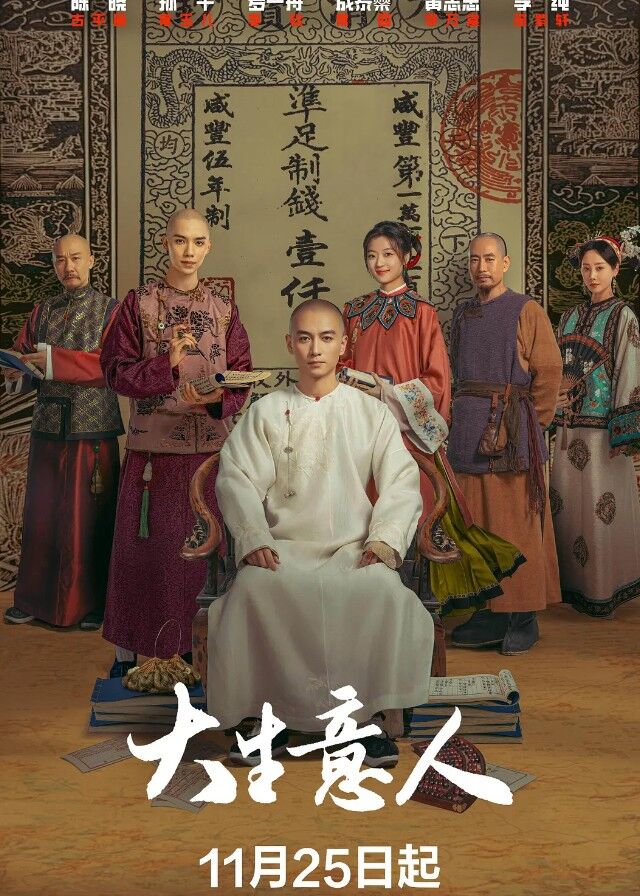



Legend of the Magnate Episode 31 Recap
> Legend of the Magnate Recap
Li Qin offered Rui Lin 200,000 taels of silver to help alleviate his current difficulties, with the sole aim of securing exclusive rights to the Lianghuai salt fields. Rui Lin expressed concerns that granting a monopoly to the Li family would lead to public criticism and impeachment due to fears of price gouging by merchants. He stated that if Li Qin achieved a significant merit, others would have no grounds to object.
To test Li Qin, Rui Lin proposed a competition: both Li Qin and Gu Pingyuan were to repair the collapsed coastal embankment in Nantong. If Li Qin won, the salt industry matter could be discussed; if Gu Pingyuan won, the Li family could not dominate the Jiangnan salt industry, ensuring other merchants had a chance to thrive. Li Qin questioned the fairness of the competition, as his family would self-fund, while Gu Pingyuan would supposedly rely on imperial court funds.
Li Qin, aware that imperial funds would not arrive in time, scornfully agreed to go to Nantong and assess the damage. After Li Qin left, Rui Lin stopped Gu Pingyuan, explaining that he had mortgaged his properties in the capital to secure funds for Gu Pingyuan's embankment repairs. He stressed that this money was clean and must be used with integrity. Gu Pingyuan solemnly accepted the funds, promising not to fail Rui Lin.
Later, as they inspected the coastal embankment, Li Qin, still annoyed, vented to Gu Pingyuan, accusing Rui Lin of deliberately trying to create animosity between them. Gu Pingyuan relayed Rui Lin's earlier accusation that the Li family was "taking advantage of others' misfortune." Li Qin argued that buying low and selling high was a fundamental principle of business and not exploitation.
Driven by his desire to prove himself to his father and secure the salt field rights, Li Qin declared he would win at any cost. He then proposed to Gu Pingyuan that they should not only meet the imperial standard of 11 meters for the embankment height but exceed it by an additional 3. 3 meters. Gu Pingyuan agreed to this, expressing gratitude on behalf of the people of Nantong.
Gu Pingyuan and Li Qin then sought out Marshal Jiu, explaining their need for manpower due to Nantong being largely deserted after the floods. Marshal Jiu, who was struggling to pay his soldiers and feared a mutiny, eagerly offered his troops for hire, outlining daily wages for stonemasons, carpenters, and laborers, plus food and lodging. However, the two men hesitated to use potentially unruly soldiers.
Marshal Jiu then suggested releasing 5,000 to 6,000 rebels captured during the fall of Nanjing to work on the embankment. These rebels would only require food, not wages. To ensure compliance, Marshal Jiu would assign two firearms units to supervise them, with the soldiers' wages to be covered by Gu Pingyuan and Li Qin. He warned Gu Pingyuan that if any rebel escaped, he would be accused of aiding the enemy.
At the construction site, Gu Pingyuan immediately ordered medical attention for the injured rebels and provided them with clothes before allowing them to begin work that afternoon. The Nantong County Magistrate, Su Yuhua, inspected both construction sites and praised the diligent efforts of Gu Pingyuan and Li Qin, noting the use of high-quality stones from Wolf Hill.
Gu Pingyuan expressed his hope that the embankment would last a hundred years and that, once the rice prices stabilized, the people of Nantong would return. Meanwhile, Li Wantang, who had purchased the position of Salt Transport Commissioner of Lianghuai, arrived at Rui Lin's office. Rui Lin sarcastically noted Li Wantang's acquisition of the post and pointed out that most Lianghuai salt fields were already under the Li family's control, implying his "donation" was a waste.
Li Wantang, in his official capacity, listed Rui Lin's pressing problems: the volatile situation in Nanjing with Zeng Xiangxiang's troops, the unpaid salaries of Lianghuai officials, and the widespread disaster in Nantong. Rui Lin countered by stating he had already submitted a memorial praising Li Qin for volunteering to fund the embankment repairs.
Li Wantang dismissed this, revealing he knew Rui Lin's true intention was to lure him out, as Li Qin, being a commoner, would receive no tangible reward for his merits. Rui Lin appealed to Li Wantang to allow some economic vitality in Jiangnan by ensuring that a portion of the revenue generated in Lianghuai remained for local use.
Li Wantang retorted, asserting that the revenue from Lianghuai should remain solely within his purview for Lianghuai and warned Rui Lin to refrain from interfering in salt affairs. Li Wantang then delivered an ultimatum from Prince Gong: if Rui Lin could ensure three years of peace in the region and refrained from interfering in salt affairs, Prince Gong would arrange his transfer back to the capital for a comfortable life. Late that evening, Gu Pingyuan returned home.
Su Yuhua, who had traveled hundreds of miles on foot, rushed in, exhausted and famished, consuming six large apples in one sitting. Su Yuhua presented a petition to Gu Pingyuan, detailing the severe suffering in Nantong, where many residents were resorting to selling their children due to the disaster and profiteering grain merchants from five provinces had inflated rice prices. Su Yuhua pleaded for Rui Lin to issue an order prohibiting grain hoarding.
Gu Pingyuan acknowledged the severity of the situation but pointed out the practical difficulties of such an order, as merchants could simply move their grain. He offered Su Yuhua lodging for the night and promised to deliver the petition to Rui Lin and talk to the merchants. Gu Pingyuan, infuriated by the profiteers, resolved to find a way to punish them. The next morning, Gu Pingyuan and Li Qin presented Su Yuhua's petition to Rui Lin.
Rui Lin deemed the request to suppress the rice market impractical and beyond his authority, stating he had no funds to intervene. Li Qin argued that repairing the embankment was futile if the people starved, as many in Nantong were already trading their children for food.
With Rui Lin offering no financial solution, Gu Pingyuan proposed a plan to lower rice prices without spending their own money, and potentially even making a profit, using a strategy of "using nothing against nothing." Rui Lin, intrigued, decided to "invest" 20,000 taels from his own salary into their scheme, clarifying it as an investment for profit rather than a donation.
Su Yuhua, informed that Rui Lin had reviewed his petition and would find a solution, returned to Nantong to pacify the populace. Gu Pingyuan and Li Qin then sought out the leading rice merchant, Yang Qianwan. Yang Qianwan greeted them with scorn, calling Gu an "exile from death row" and Li Qin "Li Million's prodigal son." Gu Pingyuan respectfully asked him to lower rice prices to help Nantong.
Yang Qianwan arrogantly refused, asserting his right to set prices and claiming even the Viceroy of Liangjiang couldn't control him. Li Qin denounced Yang Qianwan's unscrupulous business practices and boldly offered to buy all the rice in Yang Qianwan's warehouses. Yang Qianwan scoffed, boasting control over merchants from five provinces and challenging Li Qin's ability to buy such a vast quantity. Gu Pingyuan warned Yang Qianwan that if he didn't lower prices, he would be considered an adversary.
Yang Qianwan, confident in the backing of Prince Chun, dismissed their threats. Li Qin then proposed a bet: the rice price would drastically drop within ten days. The stake for this bet was a rare great freshwater pearl from Joseon, valued at two million taels of silver. Following the confrontation, Gu Pingyuan and Li Qin refined their "empty vs. empty" strategy. Gu Pingyuan aimed to make ten million taels from Yang Qianwan.
Li Qin was tasked with traveling to Hunan, Hubei, and Anhui, loudly proclaiming that Li Million's son was commissioned by the Viceroy to collect rice in Nantong due to high prices, but strictly forbidding him from buying a single grain. With over a million taels available from Li Qin, Gu Pingyuan affirmed it was sufficient for their plan.
Meanwhile, Yang Qianwan, hearing about Li Qin's pearl bet, rallied other merchants to buy up any rice that appeared in Nantong to prevent prices from falling and ensure Li Million's defeat. To execute their plan, Gu Pingyuan had Chang Si disguise himself as a Shanxi merchant, along with Gu Pingwen as his attendant. Chang Si, after a convincing portrayal, was instructed to sell 200,000 "shi" of rice at three taels of silver per "shi", cash only.
This initial transaction successfully netted 600,000 taels of silver, which Gu Pingyuan proudly announced as their first profit. He explained that this was a tactic to punish Yang Qianwan, who had hoarded all the rice in Nantong.
Gu Pingyuan then prepared Mr. Liao to enter the market, dressed in a new, more impressive costume, instructing him to sell 600,000 "shi" of rice the next day, and a million "shi" the day after, all at the same price of three taels per "shi". Gu Pingyuan believed Yang Qianwan, despite his intelligence, was too greedy and would eventually be overwhelmed by the influx of rice. Mr. Liao mentioned that friends in Anhui could supply another two million "shi".
Gu Pingyuan generously offered Mr. Liao 500,000 taels to buy jewelry for Miss Liao as a reward for his role. Soon, news reached Yang Qianwan that another merchant, from Anhui, had arrived in Nantong with 600,000 "shi" of rice, with rumors of an additional two to three million "shi" on the way. Yang Qianwan was astonished, wondering how the small city of Nantong could possibly absorb such an immense quantity of grain.