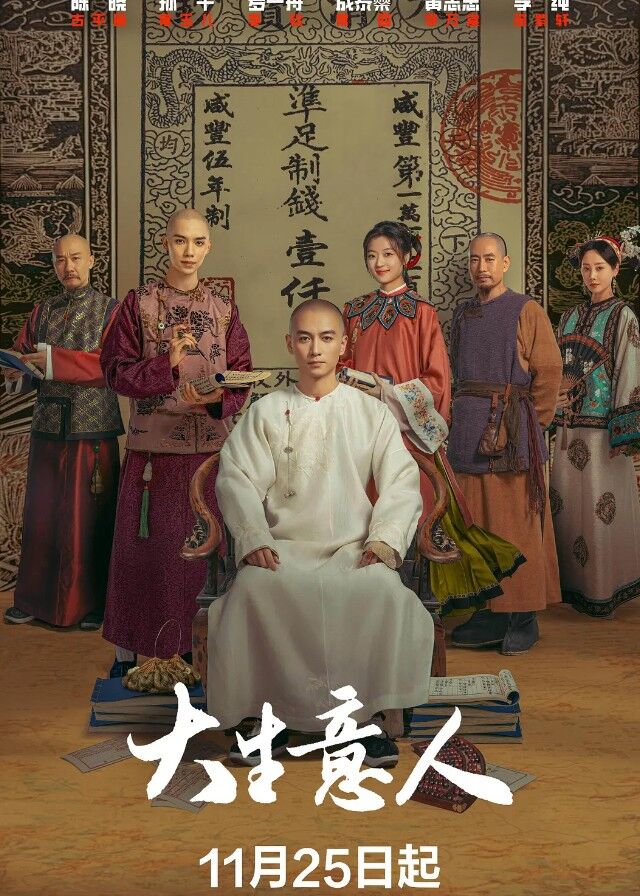



Legend of the Magnate Episode 40 (Ending) Recap
> Legend of the Magnate Recap
Gu Pingyuan, disillusioned by the Qing government's incompetence and its officials' weakness, resolved to confront the foreign powers himself. He believed the nation's survival depended on competing with foreigners in their own territories, making the best use of people and resources, even if the path ahead was unclear. He envisioned selling Chinese tea, medicine, and silk globally, circumventing the East India Company's control.
To this end, he instructed the Anhui Tea Merchants' Association to reserve the year's spring tea, chose Wu Caishen's silk, and sourced medicinal herbs from the Eight Families in Shanxi. The final piece of his plan was to secure a military ship from Su Zixuan. Wu Caishen expressed his support for Gu Pingyuan's ambitious endeavor, even helping him connect with British buyers.
However, he cautioned Gu Pingyuan to "quit while you're ahead," fearing for his well-being given the immense challenges and the doubt that the Qing could achieve such feats. Su Zixuan, having heard of Gu Pingyuan's plan to export goods, sought him out. She explained her personal history, revealing that her father's family had been executed and her nine clans exterminated. After this tragedy, her adoptive father, a Western bishop, helped her escape to Hong Kong.
She had served the Heavenly King, gathering intelligence, but seeing the Qing Dynasty's decline after the Heavenly King's failure, she began moving talented individuals out of the country, believing any change would be better than the current state. Su Zixuan confirmed she had a Portuguese gunboat available for rent, but Gu Pingyuan, as a Chinese merchant, would need a foreign merchant to formally captain the vessel, while he would act as the Chinese master.
Gu Pingyuan revealed his intention to ship the goods directly to Britain to bypass the East India Company, having already secured British buyers through Wu Caishen. Su Zixuan agreed to arrange a meeting for Gu Pingyuan to sign the contract with the captain and the British merchant, recognizing it as potentially the first contract of its kind for a Chinese merchant conducting overseas business in a personal capacity. She then playfully warned him about protecting his "foolish head."
After making all necessary arrangements, Gu Pingyuan returned home briefly to see Chang Yu'er. She asked about his recent ventures, and he assured her things went fine, expressing how much he missed her and their unborn child, wishing for their safety. Just as they were having a tender moment, a messenger from the Liangjiang Viceroy's Office arrived, urgently summoning Gu Pingyuan to Viceroy Rui Lin's residence.
Gu Pingyuan, noting how quickly word of his return had spread, promised Chang Yu'er he would be back soon, before being taken away in the pouring rain. Upon his arrival, Gu Pingyuan was brought before Rui Lin, who immediately began a harsh interrogation, threatening torture if Gu Pingyuan didn't reveal the source of the vast sum of silver used to procure his goods. Gu Pingyuan vaguely replied it came "from a friend," prompting Rui Lin to order his torture.
Rui Lin then laid out the immense scale of Gu Pingyuan's purchases: seven million taels for Anhui tea, over one million for Shanxi medicine (mainly rhubarb), and a colossal seven million for raw silk and embroidery from the Wu family in Hangzhou, totaling over 20 million taels.
He pointed out that Gu Pingyuan had used banknotes and paid cash, questioning how his "shady friends" in Shanxi could suddenly acquire such vast quantities of gold and silver to convert into so much silver, demanding the location of King Li's treasure. Rui Lin stated that even the Empress Dowager Cixi was aware and had ordered an investigation due to a report from someone else, not him, claiming he was merely following orders.
Unable to get answers, Rui Lin ordered Gu Pingyuan imprisoned and prepared for transport to the capital. Rui Lin’s officials promptly arrived at Gu Pingyuan’s residence to confiscate his property. They declared Gu Pingyuan a fugitive who had accumulated dubious wealth in violation of commercial laws, and stated he would be sent to the capital with his property confiscated. Chang Yu'er, Heizi, and Chang Si watched helplessly as the house was searched.
Chang Yu'er, though worried, found solace in Chang Si's report that Gu Pingyuan was thinking of her and their unborn child, wanting to name the baby himself. Chang Si reassured her that only confiscation was ordered, not the family's arrest, and that arrangements were being made to return to Anhui. A messenger then delivered shares of the Salt Industry Guild to Chang Yu'er, which she initially refused, calling it "money to buy his life."
The messenger insisted she keep them, stating Gu Pingyuan would return to make his own decisions, even to name his child. Chang Yu'er, choosing hope, decided to go back to Anhui with Heizi. Meanwhile, Richard was furious upon learning from a telegram that Gu Pingyuan had hired Su Zixuan's Portuguese warship to transport his goods to Britain.
The telegram confirmed the details, fueling Richard's fear that if Gu Pingyuan mastered these shipping routes, he would become a formidable rival to the East India Company, potentially costing Richard his career. He expressed frustration that Gu Pingyuan, by using a competing company's name to collect goods, was too cunning and hard to stop, which would cause him great trouble.
Richard, accompanied by Li Qin, protested to Viceroy Rui Lin, demanding the ship be stopped immediately, claiming it disrupted international commercial order. Rui Lin feigned ignorance, asking what "Far East" and "commercial order" were, stating the Qing Dynasty had no ships bound for sea and redirected Richard, suggesting he approach the British-hired Portuguese warship directly as he had no authority over it. Richard, unconvinced of Gu Pingyuan's imprisonment, demanded proof.
Rui Lin then arranged for Richard to visit Gu Pingyuan in prison. In the prison, Li Qin mocked Gu Pingyuan, pointing out the dire consequences of his loyalty to the Qing, as his home was confiscated and he was now in prison, worse off than Li Qin. Richard, through a translator, offered to purchase Gu Pingyuan's cargo from the ship. Gu Pingyuan, however, refused to discuss it, stating it was meaningless.
Instead, he demanded the return of his salt fields' title deeds within two days, threatening that if they weren't, the ship would sail as planned. Richard realized he had fallen into a "trap set by the Viceroy and you!" Desperate, Richard sought help from Hart, the Inspector General of Customs employed by the Qing government.
Richard complained about Rui Lin and the "property mortgage dispute," asserting that Qing officials were "quibbling and denying" responsibility and asked Hart to address the issue objectively and fairly. Hart, maintaining his impartiality as a Qing official, stated he hadn't ignored the East India Company's influence or interfered with their normal transactions, asking where such a charge came from. Richard countered, accusing Gu Pingyuan of unilaterally violating government law and wantonly provoking them, implying Hart's "connivance."
Hart dismissed the commercial impact of Gu Pingyuan's cargo on the East India Company, but subtly suggested it affected Richard's "status." Later, Rui Lin visited Gu Pingyuan in prison, revealing their "self-sacrifice act" was a ploy to outmaneuver the foreigners. Rui Lin admitted he "had to use some force" during the torture because Richard was "complaining everywhere like a mad dog." He offered Gu Pingyuan a significant reward if their plan succeeded.
Gu Pingyuan only requested to return to Anhui, stating he wouldn't stay in Liangjiang much longer. Rui Lin then proposed that Gu Pingyuan be recommended for the new position of Minister of Commerce, part of a new Ministry the imperial court was establishing, reasoning that Gu Pingyuan's philosophy of "business serving the nation" made him ideal. Gu Pingyuan rejected the offer, explaining that while "business serving the nation is true," it only works "if the nation can be served."
He argued that if Rui Lin, as Viceroy, couldn't handle the foreign merchants, he couldn't either. Rui Lin pressed him again about the money's origin, as the court needed a detailed report, but Gu Pingyuan avoided answering, calling the Minister of Commerce position a "death warrant." He concluded that only his days growing tea in Anhui had brought him true peace and happiness, having handled plenty of silver in his life, but those days were the most grounded and joyful.
Ultimately, Hart mediated a resolution: Gu Pingyuan's cargo was sold to the East India Company. In return, Richard relinquished the salt fields and shops that Li Qin had transferred, returning them to Rui Lin. Rui Lin visited Gu Pingyuan in prison with the good news that the salt fields had been reclaimed.
He probed one last time about the money's source, but Gu Pingyuan remained silent, merely commenting on his own neck's "sturdiness" and his desire to keep it for more years of drinking. Rui Lin then ordered him to be escorted to the capital.
However, once they left the Liangjiang territory, Rui Lin, who was being transferred from Liangjiang, composed a memorial to the imperial court, falsely reporting that Gu Pingyuan, the "imperial convict," had died from a severe illness in prison and that his body had been cremated. He claimed Gu Pingyuan's "confession" proved that the rumors of enormous wealth were "baseless gossip" and unreliable hearsay, accepting blame for "negligence" in his supervision.
He dismissed his subordinate's concerns about the report being "absurd," pointing out that the imperial court's desperate demand for money was "even more absurd." Rui Lin then secretly handed Gu Pingyuan over to Su Zixuan, telling Gu Pingyuan that as far as the world knew, he was "already dead" and that when Rui Lin handed him over, he was "a corpse." Soon after, Gu Pingyuan was reunited with Chang Yu'er, who had been waiting for him at a bridge.
Though unspoken words hung between them, they shared a knowing smile. Li Qin arrived to bid farewell to Gu Pingyuan. Disheartened by the Qing Dynasty, he decided to travel abroad to "see something new and learn something new," promising to tend to Gu Pingyuan's parents' graves. The two brothers reconciled, shaking hands before parting ways.
Gu Pingyuan, looking forward to his new life, expressed a desire to travel with Chang Yu'er or perhaps resume business under a new name, prioritizing his child seeing him upon opening their eyes, as nothing was more important now. He declared that he was not disheartened, and that there was "still work to be done," hoping for a future where everyone could live "proudly and freely" without fear or betraying their dignity.
When Su Zixuan asked about King Li's treasure, Gu Pingyuan remarked that it would emerge "when the time comes," concluding that "wealth is like the sea, and people are like boats. Though we rise and fall in life, we are merely passing by. Why care too much?" Years later, in 1903, Su Xiaohu, the head of the Shengxing United Chamber of Commerce, received a letter and a check from Gu Pingyuan.
In the letter, Gu Pingyuan encouraged Su Xiaohu's fundraising efforts for the revolution, reflecting on how their previous struggles had "sacrificed blood for our homeland and crushed our enemy's courage." He acknowledged the Qing Dynasty's decline and China's inability to stand among world powers, stressing the urgent need for "great ability" to "change our fate" and guide their "400 million compatriots to discard the old and embrace the new, become self-reliant and independent" to escape being "carved up and slaughtered."
He warned that if "our divine land sinks, and our civilization is lost, even dying nine times would not redeem us." Gu Pingyuan pledged his full support to the revolution, should it face difficulties.