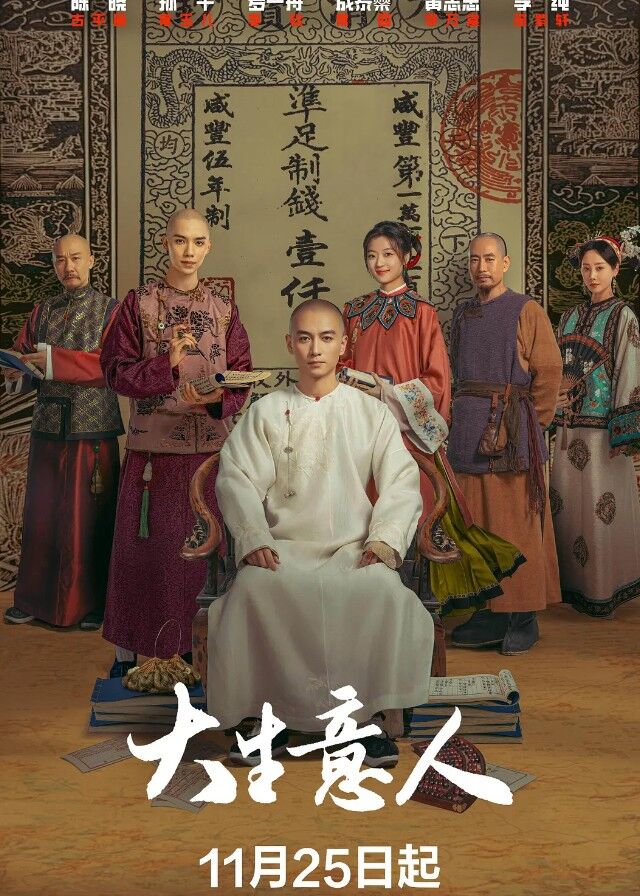



Legend of the Magnate Episode 30 Recap
> Legend of the Magnate Recap
Gu Pingyuan had previously brought Viceroy Rui Lin to the Qinhuai River to find business opportunities. He proposed that Viceroy Rui Lin allocate 100,000 taels to clear the river silt and provide clothes and jewelry for the brothel courtesans. Additionally, another 100,000 taels were to be used for establishing academies and examination halls to select talents in both civil and military fields. Viceroy Rui Lin proceeded with Gu Pingyuan's suggestions.
Following these events, Chang Yu'er confronted Gu Pingyuan about rumors of him frequently visiting brothels along the Qinhuai River. She questioned if he believed his own explanation that he was there on official business, especially after people from the brothels appeared at their home to thank him. Gu Pingyuan admitted to visiting five or six establishments, not over ten as rumored, and clarified he wasn't completely drunk.
He tried to defend himself, stating that "the way of pen and sword demands a balance between tension and relaxation," and that "visiting courtesans is a common thing for a real man," a phrase he claimed to have heard from a brothel madam. Angered, Chang Yu'er struck him, knocking him to the floor, and eventually banished him to sleep outside. The following morning, Gu Pingyuan found himself shunned by his family, including his mother, Chang Si, and Mr. Liao.
His mother, concerned for his safety, warned him against becoming a scapegoat for officials, comparing him to minor characters in an opera who do all the stunts while the emperor and prime minister remain static. She emphasized that one's actions should match their status. Mr. Liao and Chang Si cautioned him to think carefully before acting to avoid being exploited by high-ranking officials who might sacrifice him to save their own reputations if scandal arose.
Gu Pingyuan recognized the seriousness of their warnings. Chang Yu'er, however, intervened, declaring that she would face any consequences with him, be it execution, exile, or confiscation of property, as she could not bear to see him idle. Meanwhile, Li Qin presented Viceroy Rui Lin with 200,000 taels in banknotes, expressing his desire to help resolve Rui Lin's urgent financial problems and hinting at his own need for a favor.
Rui Lin issued a formal receipt with his official seal, promising imperial rewards and public recognition for such "benevolent merchants." Li Qin subtly praised Rui Lin's perceived self-sacrifice for the country by attending brothels, implying he saw through Rui Lin's scheme of deliberately tarnishing his reputation. Rui Lin acknowledged Li Qin's astuteness, confirming that his own actions were a deliberate attempt to gain political maneuvering room.
Li Qin then presented land deeds and operating rights for salt fields, seeking Rui Lin's assistance in solidifying his control over the salt industry, which he argued would provide much-needed funds for the military. Later, Gu Pingyuan visited Viceroy Rui Lin, complaining about being cast out of his room and chastised by his family due to the Qinhuai River incident. Rui Lin, trying to console him, mentioned Li Qin's donation.
Rui Lin then outlined his plan for the funds: 100,000 taels for printing the "Complete Library of the Four Treasuries," and the remainder for Qinhuai River renovations and repairing examination halls and roads. He then surprised Gu Pingyuan by assigning him to manage the salt administration, despite Gu Pingyuan's protestations of ignorance and reluctance to deal with Li Wantang.
Rui Lin explained his apprehension about consolidating the entire salt industry under one merchant, Li Wantang, fearing it would give too much power to a private individual. He warned Gu Pingyuan that refusing the assignment would be considered desertion punishable by death. Rui Lin also tasked both Gu Pingyuan and Li Qin with handling negotiations with foreign powers who, following the Treaty of Nanjing, were demanding equal trading rights and the right to establish businesses and churches.
Rui Lin instructed them to be firm, avoid arrogance, and ensure China would "win, not lose." Gu Pingyuan and Li Qin, realizing Rui Lin was pitting them against each other to prevent either from gaining too much power, discussed their precarious situation. They saw Rui Lin's strategy as a "cockfight," intended to exhaust them both.
They then met with a British envoy who, citing the Treaties of Nanjing and Wangxia, demanded independent investment rights for British merchants in China's silk, textile, tea, and medicine industries. The envoy demonstrated the "Spinning Jenny," a new machine capable of spinning 80 spindles simultaneously, fueled by steam power, and operating continuously. He boasted about its high-density, inexpensive, and beautiful fabric production, and the hundreds of such factories in Cape Town.
Li Qin expressed outrage, questioning if the intention was to render Jiangnan's silk workers jobless and turn them into foreign laborers. Gu Pingyuan challenged the envoy, stating that China already had established industries in these sectors and there was no room for foreign investment. He emphasized that the two representatives before the envoy were not just officials but genuine Qing merchants.
Reporting back to Viceroy Rui Lin, Gu Pingyuan and Li Qin conveyed their concerns about foreign encroachment, warning that if foreign factories were permitted, it would devastate local industries and force Chinese workers into servitude. Li Qin proposed buying the foreign machines and hiring foreign technicians to learn their methods. Rui Lin quickly dismissed the idea, fearing severe repercussions from the imperial court.
Suddenly, news arrived of a major disaster: a coastal embankment in Nantong had collapsed, causing widespread flooding and countless casualties. That evening, Li Zhongdeng, a manager who had just returned from India, visited Gu Pingyuan. Dressed in Western attire, which amused Gu Pingyuan's family, Li Zhongdeng discussed the dire situation with Gu Pingyuan.
He revealed that Westerners were cultivating green tea in Darjeeling using stolen Chinese seedlings and processing it simply, which, despite its inferior quality, was cheap and widely preferred by Western buyers. He shared his alarm about foreign agents already acquiring 70-80% of the silk cocoons in several Chinese provinces, signifying their intent to control pricing and entire industries like tea, silk, and medicine.
Gu Pingyuan expressed his deep concern for the nation, despite his disillusionment with the imperial court, stating his determination to act, to which Li Zhongdeng, moved by Gu Pingyuan's patriotism, pledged his support. Separately, Li Wantang, leading the Four Major Banks, met with other bank managers. He revealed his plan to consolidate the salt industry of Lianghuai and later monopolize tea, silk, and medicinal materials.
He urged the other bank managers to invest for greater profits, with the Four Major Banks demanding at least a 30% share in the salt profits. The next day, Li Qin again approached Viceroy Rui Lin, offering to raise funds to repair the damaged coastal embankment in exchange for Rui Lin's support in securing his salt field acquisitions.
Rui Lin, citing the political pressure of appearing to favor a single merchant with such a lucrative monopoly, proposed a competition: both Li Qin and Gu Pingyuan would be tasked with repairing a section of the coastal embankment. The winner would then receive Rui Lin's full backing for their salt-related endeavors.