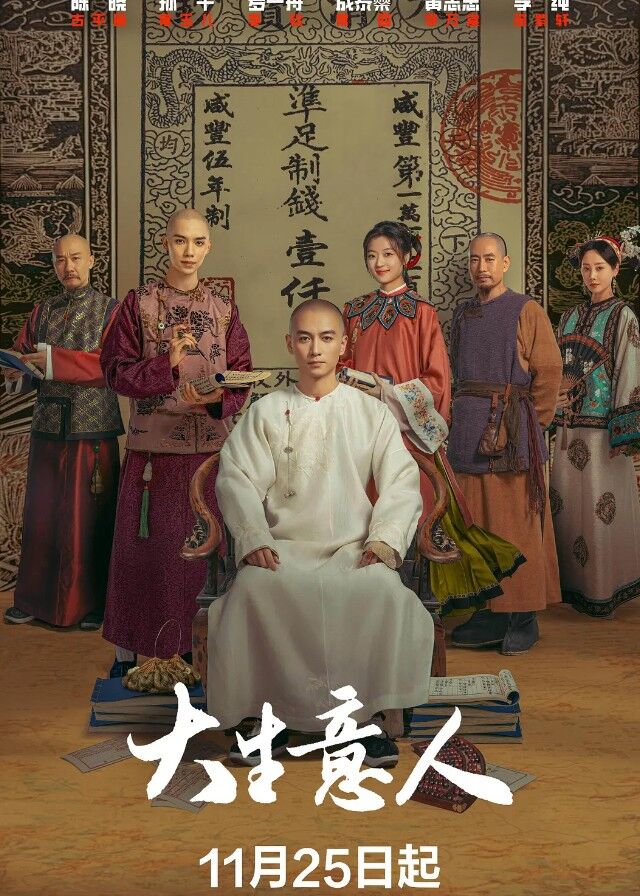



Legend of the Magnate Episode 25 Recap
> Legend of the Magnate Recap
Li Wantang, having secured the imperial court's exclusive tea trade rights and paid off foreign merchant house compradores, had effectively blocked the sale of Anhui tea. Gu Pingyuan, unwilling to surrender, traveled to Shanghai. Although his initial attempt to collaborate with Richard, the compradore for Xianghe Trade House, was met with a flat refusal due to Richard’s partnership with Li Wantang, Gu Pingyuan quickly devised an alternative strategy.
He and Gu Pingwen approached a British warship docked at the pier, where Captain Tod explained that his vessel belonged to the British Empire's Indian Navy, whose primary role was protecting Indian Ocean trade routes, and was not for sale. Captain Tod also mentioned his imminent return to India for official duties. Gu Pingyuan skillfully used this opportunity to gather information about India, sparking a new idea.
After leaving the ship, Gu Pingwen, confused by Gu Pingyuan's seeming distraction, questioned his brother's methods. Gu Pingyuan, however, affirmed he was indeed addressing the tea crisis and instructed Gu Pingwen to immediately return to Anhui. Gu Pingwen was to inform Old Master Hu to wait "one more day and night," assuring him that a solution would be found.
Gu Pingyuan worried that Old Master Hu might capitulate and sell the accumulated tea at a low price to Li Wantang if he didn't receive an update soon. Concurrently, Li Wantang was aggressively expanding his salt business in Anhui. He met with Zhang Guangfa from Lu'an Salt Shop, who reluctantly offered to sell his ancestral salt field, lamenting that it felt like betraying his forebears.
Li Wantang, feigning understanding, then revealed his precise knowledge of Zhang's financial distress, remarking on his recently pawned clothing. He offered Zhang a proposition: he would provide funds to establish a salt shop, allowing Zhang to retain the deed, and they would share profits on an 80/20 basis.
Overwhelmed by what he perceived as generosity, Zhang Guangfa hailed Li Wantang as a "living Bodhisattva" and accepted the terms, after which Li Wantang directed his servant to finalize the exchange of money and the salt license. Li Qin, growing increasingly discontent with his father's cutthroat business practices and seeking to independently manage the salt business, found his efforts overshadowed when Li Wantang arrived and aggressively began acquiring salt fields.
Dissatisfied and lacking his father's trust, Li Qin was pressed by Li Wantang to quickly finalize matters with the Anhui Tea Merchants' Association. Confident of success, Li Qin gave Old Master Hu, the head of the association, a three-day ultimatum: either sell their tea at 20% of its value, or face a complete blockade on sales. Li Qin later confronted Li Wantang, expressing his frustration at the lack of trust and his desire for independence.
Li Wantang, however, was dismissive, accusing Li Qin of undermining family interests by advising Gu Pingyuan to seek foreign contacts in Shanghai. Li Qin passionately argued that business should not entail driving others to ruin and that such confrontational tactics were fundamentally wrong. Li Wantang, with a dismissive smirk, explained that his severity was not a personal choice but a direct order from Prince Gong, who was infuriated by Gu Pingyuan's disruption of the Grand Tea Competition.
He then sternly told Li Qin that his soft heart made him unsuitable for business and advised him to return to the capital to pursue his studies. A deeply disappointed Li Qin pleaded with his father not to push Gu Pingyuan too far, but Li Wantang reiterated his precarious position, stating that his own power was intrinsically linked to the Prince's.
Li Qin defiantly rejected the notion of abandoning the family business, criticizing the proposed 20% acquisition price as sheer bullying and sarcastically suggesting that if his father possessed troops, he might as well simply plunder the tea. Li Wantang countered with the ancient wisdom, "a kind man can't command troops, and a righteous man can't manage wealth," asserting that any show of mercy would lead to his downfall within the Qing Empire's brutal commercial landscape.
Exasperated, Li Qin declared he would abandon the family business and return to the capital if his father continued to interfere with his salt ventures. Li Wantang, after a brief pause, conceded. At the Anhui Tea Merchants' Association, Old Master Hu, trusting Gu Pingyuan would find a solution, had purchased all the spring tea, as was the association's practice, but their treasury was severely depleted, and the warehouses were full.
With no word from Gu Pingyuan, Hou Er urged Old Master Hu to surrender to Li Wantang to prevent greater losses. A messenger arrived with an invitation from Li Wantang for a dinner at Baixiang Restaurant. Despite the other tea merchants' advice to accept, Old Master Hu remained hesitant. Li Wantang, however, chose to deliberately miss the dinner to exert further pressure.
He sent his manager to Old Master Hu with an apology for his absence, subtly shifting blame for the low tea prices onto Li Qin and the foreigners. The manager falsely conveyed that Li Wantang's spring tea quota was already met and he had no desire to antagonize his business peers further.
Faced with mounting pressure from the desperate tea merchants, Old Master Hu, feeling cornered, agreed to sell their tea at the demanded 20% of its value and offered a formal apology on behalf of Gu Pingyuan. The manager, satisfied with this concession, instructed Old Master Hu to present the goods list at Tianfu Inn the following morning.
Li Wantang, upon receiving this report, was pleased, convinced that Old Master Hu was at his wits' end, and planned to return to the capital with Li Qin. Meanwhile, Gu Pingwen faced a difficult journey back to Anhui. Unable to find any regular boats, he stumbled upon a dragon boat race. Explaining his urgent need to reach Anhui before dawn, he offered the racing team 500 taels for a ride.
The team's leader agreed, provided Gu Pingwen would beat the drum to inspire their efforts. Gu Pingwen readily accepted, and the team paddled with all their might through the night, fueled by Gu Pingwen's drumming. They arrived at the Anhui Tea Merchants' Association at dawn, utterly exhausted. Gu Pingwen delivered Gu Pingyuan's message to Old Master Hu: they only needed to hold out for one more day and night. Despite this glimmer of hope, the tea merchants remained anxious.
They continued to press Old Master Hu to sell the tea, openly criticizing Gu Pingyuan for the predicament. In a private moment, Li Qin expressed his disdain for his father's tyrannical business methods to a subordinate, believing such practices were unethical. The subordinate, however, countered that Li Wantang's strategies consistently proved successful.
Later, a second, more personal invitation from Li Wantang arrived for Old Master Hu, inviting him to lunch at Baixiang Restaurant as a direct apology for the previous missed engagement. The tea merchants, seeing another opportunity, urged Old Master Hu to accept. However, Old Master Hu, remembering how Li Wantang's earlier arrogance nearly forced him to sell all of Anhui’s tea for a pittance, dramatically tore up the invitation.
He declared himself unwell with a headache and refused to receive any visitors, further instructing all his staff not to sell a single ounce of tea that day. Informed of Old Master Hu's renewed defiance, Li Wantang realized his strategic error in missing the previous dinner. He suspected Gu Pingyuan was behind this renewed resistance and immediately dispatched men to Shanghai to investigate.
Li Qin, witnessing Old Master Hu's unexpected resolve, felt a flicker of relief and retired to his room. Li Wantang, however, remained captivated, eager to observe how Old Master Hu, bolstered by Gu Pingyuan, intended to "turn things around," acknowledging that "this world belongs to young people now." On his arduous journey to Shanxi, Gu Pingyuan was caught in a severe downpour. He pressed on despite the rain, eventually collapsing from exhaustion at the gates of Jinyang Villa.
He was rescued by the Eight Families and warmly received by First Madam Jin and Manager Li at a celebratory banquet. Gu Pingyuan explained the desperate situation of the Anhui tea merchants and sought their aid. Both First Madam Jin and Manager Li agreed to help. Gu Pingyuan proposed a daring plan: to circumvent Li Wantang by selling Anhui tea directly to India. First Madam Jin enthusiastically endorsed the idea.
Gu Pingyuan then specifically requested Manager Li to purchase all the tea from the Anhui Tea Merchants' Association and arrange its transport to India, intending to deliver a significant blow to Li Wantang. Manager Li then drew Gu Pingyuan aside for a private discussion, explaining the intricate dynamics of their business.
He expressed apprehension about antagonizing the imperial court and the potential financial risks of engaging in overseas trade, describing such ventures as akin to "a human stepping into a beast's den," and questioning their long-term viability. Gu Pingyuan, understanding Manager Li's concerns, presented a compelling counter-argument: he asserted that if Li Wantang successfully monopolized the entire Southeast tea market, he would inevitably become a formidable rival to Manager Li's own Northwest tea business.
He highlighted the diminishing control of the Qing court over local affairs, suggesting Li Wantang's reliance on imperial power was an outdated strategy. Instead, Gu Pingyuan advocated for cooperation among merchant associations to collectively profit from foreign markets. He offered to provide Anhui tea at its lowest possible price, guaranteeing a consistent annual supply. Convinced by Gu Pingyuan's insightful arguments, Manager Li agreed to forge a partnership, eager to collaborate in expanding their reach and generating wealth from foreign trade.