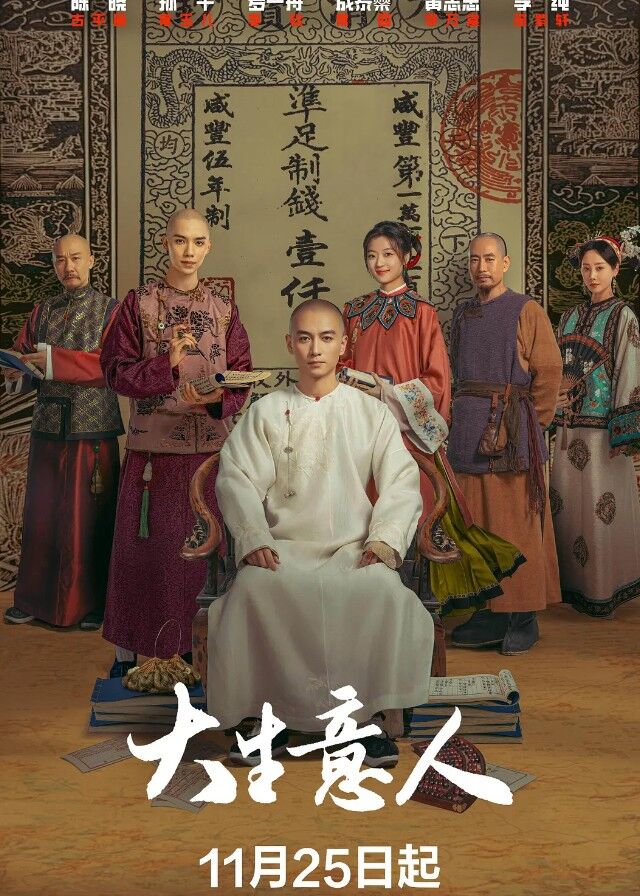



Legend of the Magnate Episode 23 Recap
> Legend of the Magnate Recap
During a banquet, Gu Pingyuan directly confronted Qiao Song and Bao Qing, asking if they had intended for him to die when they sent him into Hefei city earlier that day. Gu Pingyuan explained that he was aware that being appointed Pacification Commissioner after offending the Sixth Prince by giving the Empress Dowager the Orchid Snow tea was a clear plot to send him to his death.
Qiao Song nervously tried to deny it, questioning why Gu Pingyuan would still go if he knew the risks. Gu Pingyuan responded that even knowing the danger, he had to go, hoping to save whoever he could. He then announced his intention to resign his post and return to his Shanjian Village to grow tea, promising never to challenge their authority again. After a self-punishment drink, he quickly left.
Qiao Song and Bao Qing tried to stop him, but Gu Pingyuan, firm in his decision, mounted his horse and rode off. While Qiao Song worried about explaining Gu Pingyuan's departure to the court, Bao Qing reassured him that tomorrow's attack on Hefei would bring such significant merit that even the Empress Dowager could not punish them. Later that night, Qiao Song and Bao Qing ordered their troops to surround the Resistance Army soldiers who had surrendered and left Hefei.
They opened fire without warning, brutally slaughtering them. Bao Qing gleefully remarked on the great merit of eliminating so many rebels without shedding their own blood. Gu Pingyuan, riding home, heard the intense gunfire and, sensing something was wrong, galloped back to the Qing army camp. He was horrified to find 461 surrendered Resistance Army soldiers all dead. Overcome with guilt, believing their deaths were his fault for convincing them to surrender, Gu Pingyuan fainted from the shock and rage.
When Gu Pingyuan regained consciousness, Qiao Song approached him with medicine. Gu Pingyuan furiously knocked the medicine away, condemning the act of killing surrendered soldiers as bringing misfortune. Qiao Song dismissed his concerns, revealing Empress Dowager Cixi's imperial decree which explicitly ordered the execution of the Resistance Army, "whether they surrender or not."
He argued that if he didn't carry out the order, someone else would, and urged Gu Pingyuan to accept the reality that the Qing court would never spare these rebels. He tried to convince Gu Pingyuan that staying and participating in the capture of Hefei would be a great service, potentially saving hundreds of thousands of civilians, rather than selfishly retreating to grow tea. However, Gu Pingyuan was deeply disillusioned by the imperial court's cruelty.
Meanwhile, the Qing army launched a full-scale assault on Hefei. Li Cheng and Bai Yimei fiercely defended the city, repelling wave after wave of attacks. Li Cheng attempted to send Bai Yimei out of the city for her safety, but she refused, vowing to share his fate, whether in life or death. Ultimately, the Resistance Army was overwhelmed, and the south gate fell.
Li Cheng sustained severe injuries, and both he and Bai Yimei were captured along with over a thousand of their remaining soldiers. A Qing officer announced that the uninjured prisoners would be detained, while Li Cheng and his family would be held separately, awaiting further imperial orders. In the prison, Bai Yimei frantically called for help as Li Cheng lay gravely wounded and feverish. Gu Pingyuan arrived with trauma powder, urging them not to give up.
Li Cheng, still bitter about the 461 surrendered soldiers who were killed, accused Gu Pingyuan of betraying their trust. Gu Pingyuan somberly accepted the blame and any retribution, reiterating his prior promise to protect Bai Yimei. He then revealed the grim news that Nanjing had fallen on June 16th; after nine gates collapsed, the city endured ten days of burning, killing, and looting, becoming a city of utter devastation.
He urged Li Cheng and Bai Yimei to abandon their royal aspirations and strive to live for themselves, promising to do everything in his power to save them if they didn't lose hope. Li Cheng, believing his end was near, tried to convince Bai Yimei to leave with Gu Pingyuan. She adamantly refused, declaring she would rather die with him.
It was then that Li Cheng revealed Bai Yimei's pregnancy, imploring her to live for their unborn child, as the child's life would be a continuation of his own. Despite her shock and grief, Bai Yimei still insisted on staying by Li Cheng's side. Distraught by the situation and deeply disappointed in the corrupt Qing court, Gu Pingyuan sought out Su Zixuan. He expressed his need for a more influential figure to help save Li Cheng and Bai Yimei.
Gu Pingyuan explained that to the self-serving officials, Li Cheng and his men were mere "merchandise" to be traded for personal gain or political advancement. He proposed enlisting Marshal Jiu, the powerful "First Fierce General" under the Viceroy of Liangjiang. Initially skeptical that such a formidable figure could be reached, Su Zixuan eventually revealed that Marshal Jiu owed her a favor and agreed to arrange a meeting.
Soon after, Marshal Jiu sent a forceful letter, demanding all thousand-plus Resistance Army prisoners to bolster his own forces. Qiao Song and Bao Qing were enraged by this blatant appropriation of their spoils but dared not provoke Marshal Jiu, whose army was renowned as the most powerful. They grudgingly prepared a lavish banquet to welcome him. Noticing Gu Pingyuan's absence, Bao Qing, wary of his potentially conflicting loyalties, sent someone to summon him to the banquet.
To Qiao Song and Bao Qing's astonishment, Marshal Jiu arrived in a distinctive foreign-style carriage, with Gu Pingyuan accompanying him, whom he introduced as a "descendant of an old friend" who had kept him company on the road. At the banquet, Marshal Jiu insisted on taking all the Resistance Army prisoners. Bao Qing attempted to negotiate, suggesting the prisoners were too wounded and offering to "reorganize" them before sending them to Jiu.
Marshal Jiu, however, saw through the ploy, accusing Bao Qing of trying to substitute the elite soldiers with weak ones or to claim a share of his military success. He then shocked them further by declaring he wanted Li Cheng as well. Bao Qing vehemently protested, arguing that without Li Cheng, they would have no credit for their hard-won victory.
Marshal Jiu scornfully rebuked them for their insatiable greed, pointing out their prolonged siege of Hefei and the vast sums of money they had demanded, yet they still craved more credit. As Bao Qing grew increasingly agitated, Marshal Jiu physically removed him from the banquet. Qiao Song tried to intervene, also hoping to use Li Cheng for his own advancement, but Marshal Jiu sharply put him in his place.
Asserting his power, Marshal Jiu told Gu Pingyuan that he was not a businessman but was there precisely to take what he wanted, reminding Gu Pingyuan that he would have to repay this favor. Marshal Jiu then went directly to the prison and ordered Li Cheng and Bai Yimei to be brought out, much to the silent frustration of Qiao Song and Bao Qing. Li Cheng expressed his disbelief that Gu Pingyuan could persuade the notoriously ruthless Marshal Jiu.
Gu Pingyuan explained Marshal Jiu's terms: all the Resistance Army soldiers would be spared and incorporated into Jiu's formidable Tiger Battalion. In exchange, Li Cheng and Bai Yimei would join Jiu's camp, with Li Cheng serving as a military advisor until the war's conclusion, after which they would be released. Weighing the options, Li Cheng reluctantly agreed to save his men. Marshal Jiu's vice commander, Zha Lanchai, presented Li Cheng with a Qing official's uniform to wear.
Zha Lanchai expressed admiration for Li Cheng's martial prowess despite his humble origins, lamenting that they could not meet as opponents on the battlefield. He then provocatively questioned Marshal Jiu's ambition, suggesting that with the Qing Empire's fate sealed, perhaps he was interested in "claiming the Central Plains," a suggestion Marshal Jiu dismissed as "delusion." Wearing the Qing uniform, Li Cheng addressed his surviving soldiers.
He acknowledged that donning the enemy's attire betrayed their fallen comrades, but added that not doing so would betray the friend, Gu Pingyuan, who had risked his life to save them all.