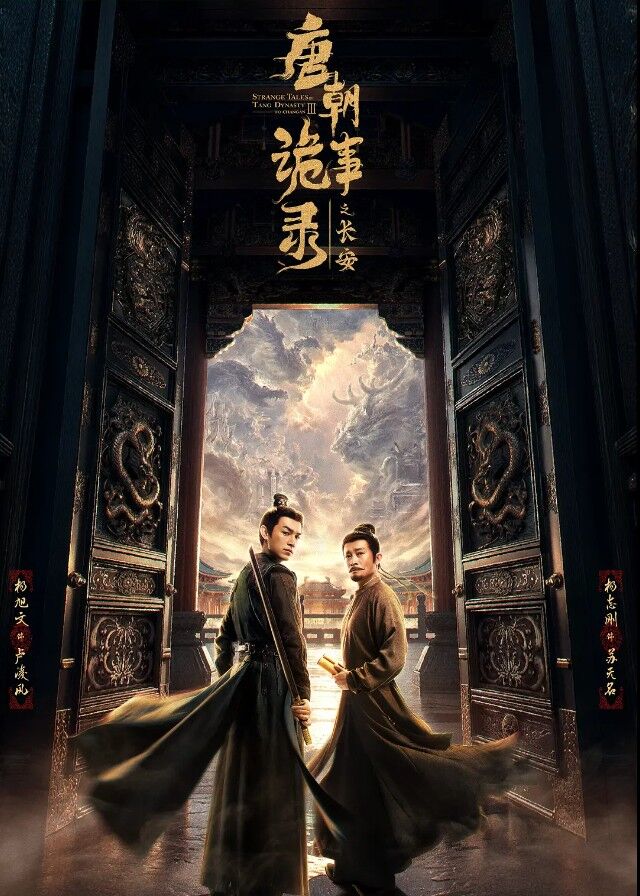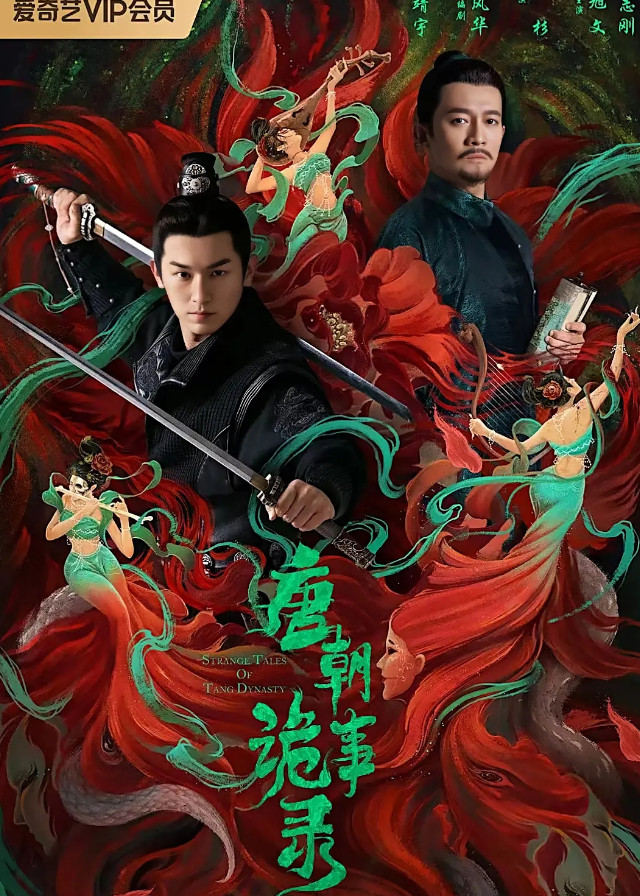



Strange Tales of Tang Dynasty Ⅲ: To Changan Episode 28 Recap
> Strange Tales of Tang Dynasty Ⅲ: To Changan Recap
Su Wuming, following a clue from his mentor Master Di's book, located the Sifang Cane Shop. The shop, filled with old furnishings and a strong medicinal aroma, was run by the white-haired Song Weng. Though initially unwelcoming, Song Weng became eager to sell "Fengli canes," claiming their magical properties were a myth but the Fengli fluid itself was genuinely potent.
He produced a sealed jar of the fluid, asserting it could cure ailments like rheumatism, which caused numbness and paralysis, making the user "walk swiftly." He boasted that this fluid cost 10,000 coins per tael, in contrast to the cheap, fake Fengli canes that were merely "peed on by a Fengli beast." When Su Wuming inquired about Fengli beasts, Song Weng grew suspicious, believing they were officials trying to extort him since Fengli beasts were on a prohibited sales list.
Chu Yingtao then revealed her Yongzhou Prefecture token, intimidating Song Weng into honesty. He confessed that for decades after his shop opened (which he claimed was a hundred years ago, making him 180, though Su Wuming noted his mentor's records suggested the shop was at least seventy or eighty years old, making Song Weng well over 100), wealthy customers indeed purchased Fengli fluid.
However, business had dried up over the past decade after Chicken Fei developed an effective cure for rheumatism, leaving his inventory untouched. Doubting his story, Su Wuming and Chu Yingtao feigned taking Song Weng to the Yongzhou Prefecture Office for questioning. Song Weng pretended to retrieve ledgers but instead fled through a hidden tunnel in his shop, leading them into the bustling Ghost Market.
Su Wuming observed that such "extraordinary people" with secret passages were common in Chang'an, while Chu Yingtao speculated that Song Weng might be an ancient demon. Meanwhile, Lu Lingfeng and Pei Xijun attended a lavish evening banquet hosted by Wei Tao at the Wei family mansion. Inside, prominent figures like Chancellor Cui and many others from the illustrious Five Clans and Seven Families were gathered.
After taking their seats, the guests introduced themselves, revealing their noble origins, including members of the Cui, Lu, Pei, Wang, Zheng, Li, Yang, Liu, Xiao, and Gao families. Master Cui of Qinghe delivered a speech celebrating the historical achievements of noble families, highlighting how many rulers came from humble origins while crucial state officials consistently hailed from prestigious clans, especially the Cui and Lu families.
He mentioned historical figures like Yuan An, Yang Zhen, Sima Yi, Zhuge Liang, and Lu Xun. Chancellor Cui then continued the speech, adding praise for Chen Qun before noting that during the Eastern Jin Dynasty, power was shared between the imperial family and noble clans. He bemoaned how the Sui Dynasty’s introduction of imperial examinations had diminished the glory of noble families, forcing their descendants to abandon their ancestral homes for official careers.
He declared that this banquet and the viewing of the Wei family's newly unearthed merit-record pillar served as a powerful reminder of their shared heritage and a warning against further decline. Wei Tao and his wife, Ju Niang, then unveiled the family’s merit-record pillar. Pei Xijun recognized it as an ancient relic from the Northern Dynasties. Wei Tao expressed regret that a piece bearing the "Wei" character was missing but remained hopeful for its return.
When asked by Chancellor Cui, Ju Niang deferred to her husband to read the inscription, which detailed the Wei family’s long and distinguished history, boasting generations of high-ranking officials and scholars and asserting their unparalleled prominence among noble clans. Amidst the celebratory atmosphere, Wei Jia, Wei Tao's sister, suddenly rushed into the courtyard in distress, loudly proclaiming that a noblewoman like herself should not marry a merchant and attempted to harm herself by striking the pillar.
Wei Tao intervened, and Pei Xijun helped Ju Niang take Wei Jia away. Ju Niang explained that her sister-in-law suffered from a "madness" that was exacerbated by strong emotions and had not responded well to traditional medical treatment. Pei Xijun kindly offered to invite Chicken Fei, a renowned physician and disciple of the Medicine King Sun Simiao, to treat Wei Jia, an offer Ju Niang gratefully accepted. Later, Chancellor Cui drew Lu Lingfeng aside for a private conversation.
He revealed that he had suggested Wei Tao host the banquet and stressed the superior standing of the Cui and Lu families over others. He cautioned Lu Lingfeng about Su Wuming, portraying him as a cunning and hypocritical individual who manipulated people by invoking the interests of the state and Master Di to achieve his personal agenda. Chancellor Cui emphasized that as elite nobles, they should remain true to their core ideals, unlike Su Wuming.
He expressed his view that the Emperor's role was secondary, disclosing that he had known the current Emperor personally but chose not to seek power through him. He stated his ambition to establish a new "noble court" where scholarship and high office were unified, similar to what Cui Hao of Northern Wei had envisioned.
In such a system, the Emperor would be a mere figurehead, and distinguished noble families like Cui, Lu, Zheng, and Wang would take turns governing, as their centuries of experience made them far more capable rulers. He asserted that the names Cui and Lu held more weight than even the Tang Emperor or the influential Princess he currently served, believing that noble families, unlike fleeting dynasties, would eternally stand firm.
Lu Lingfeng acknowledged agreement with many of Chancellor Cui’s points but questioned his motives for sharing such thoughts. Chancellor Cui explained that the Emperor mistrusted and sought to marginalize the noble families, whereas the Princess, Lu Lingfeng’s own birth mother, might empower them if she ascended the throne.
He urged Lu Lingfeng to choose a side, emphasizing that his current position as a Judicial Official was beneath a man of his lineage, and his true calling was to become a high-ranking official who governed the realm. He also suggested that Wei Tao, despite his current humble rank, would prove to be a valuable asset in their future endeavors. After the intense conversation, Lu Lingfeng and Pei Xijun bid farewell to Wei Tao and departed.
Back in the Ghost Market, Su Wuming and Chu Yingtao, dragging a grumbling Chicken Fei along, headed towards the Earth God Temple in search of Song Weng. To their surprise, the usually bustling temple was deserted. Chicken Fei learned from a local that a new Zoroastrian temple had been built nearby, drawing all the crowds away. The trio then proceeded to the new temple, where they found a masked high priest leading a crowded ritual.
Su Wuming identified the high priest as Shi Qiansui. Su Wuming confronted Shi Qiansui, initially accusing him of exploiting the new Zoroastrian temple for wealth. Shi Qiansui calmly explained that the temple was not his creation but rather built by the Ghost Market merchants themselves, who believed the market's strong "yin energy" made it easier to communicate with the spirits of the dead.
He clarified that all offerings collected were donated to the An Society to cover funeral expenses for merchants who had met tragic ends. This revelation alarmed Su Wuming, who pressed for more information, asking if there were other deceased merchants besides Hua Fu, Ma Kui, and He Qian. Shi Qiansui promptly produced a secret record from the Sabao Office.
This document detailed the disappearance of six merchants within the past ten days, including their names, occupations, times of disappearance, and last known districts. Shi Qiansui explained that he had withheld this information earlier because he distrusted "nobles like Lu Lingfeng," whom he believed inherently disdained merchants. Su Wuming, borrowing a lamp from a nearby vendor, then plotted the last known locations of the six missing merchants on a map of Chang'an's districts.
To his astonishment, the pattern of these locations formed the Chinese character "士," meaning "noble" or "scholar." Realizing the grave implications, Su Wuming immediately instructed Chu Yingtao to proceed to Tongji District, informing her that he had already dispatched three constables (Liu, Jia, and Luo) to investigate other districts indicated on the map for potential bodies. As they hurried through the night, they were stopped by a patrol. Su Wuming identified himself as being from the Yongzhou Prefecture Office.
One of the patrol officers recognized him from the "Red Tea case," revealing he was a former junior soldier who had since become a captain. Su Wuming dismissed them, but then remembered their need for speed and asked to borrow two horses.