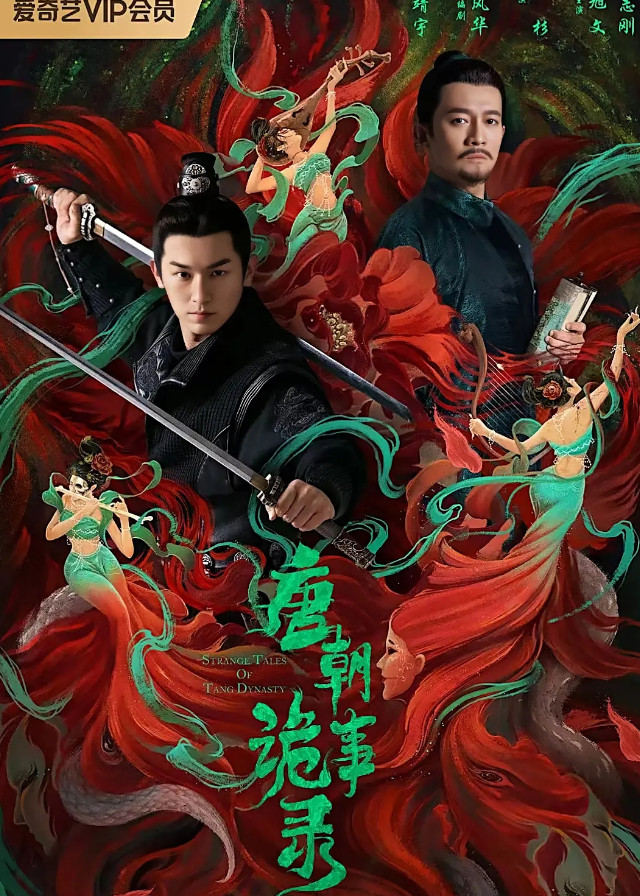



Strange Tales of Tang Dynasty Ⅲ: To Changan Episode 27 Recap
> Strange Tales of Tang Dynasty Ⅲ: To Changan Recap
Su Wuming elaborated on the administrative structure of Chang'an, explaining to Lu Lingfeng that the city was divided into two counties by Zhuque Avenue: Wannian County to the east and Chang'an County to the west. He noted that Wannian County Sheriff Du Yu, much like Chang'an County Sheriff Wei Tao, hailed from a prominent family in the capital and entered officialdom through family connections.
Both were considered "twin stars" due to their comparable talents, and a local proverb claimed, "south of the city live the Weis and the Dus—only 5 feet from Heaven." Su Wuming expressed a desire to observe Du Yu's investigative approach, and Lu Lingfeng, despite Su Wuming's concern that it might overstep their authority given Du Yu's earlier remarks, readily agreed, asserting that he was not one to shy away from trouble.
At the county office, Du Yu was interrogating six individuals, including the Shi brothers, in connection with Ma Kui's murder. He had them wear coverings and draw their positions during the Seven-Saint Blades ritual. One suspect revealed that while He Bi had initially selected the members, Ma Kui had bribed High Priest Shi Qiansui to secure a spot.
The Shi brothers, Shi Qian and Shi Wan, claimed close friendship and business ties with Ma Kui, stating they had helped establish his pepper business and held shares in his shop. Du Yu, employing a theatrical method, feigned accusing a passerby as the killer before abruptly dismissing the suspects. Su Wuming observed that Du Yu’s seemingly playful demeanor in fact concealed a deeper investigative strategy. Later that night, the Shi brothers, laden with luggage, attempted to flee.
Du Yu, having anticipated their escape, intercepted them. They turned aggressive, attempting to assault Du Yu, but Du Yu proved to be a skilled fighter. While Shi Qian engaged Du Yu, Shi Wan tried to slip away into an alley but was swiftly apprehended by Lu Lingfeng. With the Shi brothers brought back to the public court, Du Yu exposed their true intentions.
He revealed that the brothers had built their pepper business by acting as loan sharks in the East Market, taking pleasure in having numerous debtors. Five years prior, they had lent money to Ma Kui for his initial venture. However, Ma Kui's business acumen led him to prosper and eventually surpass them, becoming the largest pepper merchant in the East Market. Feeling resentful, they converted his outstanding debt into shares.
Shi Qian, however, grew overly greedy and demanded a larger stake, which Ma Kui refused. Harboring a grudge, they plotted to assassinate Ma Kui during the chaos of the deity procession. Under Du Yu's instruction, the coroner initially reported that Ma Kui died from a single knife wound to the throat, about five fen deep. Based on this, the Shi brothers confessed to the murder. However, Su Wuming sensed something amiss and insisted on a re-autopsy.
During the re-examination, he discovered two distinct knife wounds on Ma Kui's neck, differing in length and depth. He deduced that the shorter, shallower wound (less than five fen) was inflicted by Shi Wan and was not fatal. The deeper wound, measuring one inch and seven fen, had severed the esophagus and trachea, causing immediate death.
Su Wuming concluded that Ma Kui must have already been incapacitated when Shi Wan struck him, and the fatal wound was caused by an external force striking the wooden sickle with immense precision, driving it deep into his neck. This proved that the true killer was still at large. Du Yu was taken aback and humbly sought Lu Lingfeng's advice on how to proceed.
Lu Lingfeng suggested investigating Ma Kui's enemies, particularly the person he had replaced in the Seven-Saint Blades ritual. Du Yu promptly went to He Bi's residence, where the priest reluctantly revealed that his younger brother, He Qian, who resided in Yanzuo District, was the one supplanted by Ma Kui. Meanwhile, an unknown assailant had already infiltrated He Qian's study. The killer suffocated He Qian by covering his face with wet paper before brutally smashing his face with a heavy object.
By the time Lu Lingfeng and his team arrived, He Qian was dead, and the perpetrator had vanished. Su Wuming noticed a peculiar water stain on a calligraphy copybook on He Qian’s desk, finding its scent oddly familiar. As the murder occurred within Chang'an County's jurisdiction, Wei Tao soon arrived, expressing his displeasure at Du Yu’s presence and sternly ordering unrelated personnel to leave. To defuse the tension, Su Wuming quickly presented his preliminary autopsy findings to Wei Tao.
Back at the sushan shop, Chicken Fei examined the water stain from He Qian's study and identified it as Fengli beast urine, also known as Fengli fluid. He explained that this rare substance was once highly prized for treating rheumatism, especially stubborn headaches, a condition his own medicinal formula could not alleviate. This suggested that the killer might be carrying the fluid for such an ailment.
Lu Lingfeng, pondering the fact that all victims were merchants, focused their investigation on the merchant community. He and Su Wuming decided to visit Shi Qiansui, the Sogdian merchant who also served as the leader of the An Society and the High Priest (Da Sabao), given his significant influence over Zoroastrian merchants and his role in securing Ma Kui's place in the ritual. Pei Xijun and Chu Yingtao also expressed a desire to visit the Zoroastrian temple.
To appease Chicken Fei, who was reluctant to be left alone to mind the shop, Pei Xijun promised to bring him back a special roasted chicken from Buzheng District, a dish known for its unique preparation with fruit and honey. At the Zoroastrian temple, Shi Qiansui was questioned by Lu Lingfeng and Su Wuming.
He admitted to advocating for Ma Kui's inclusion in the Seven-Saint Blades but denied taking any bribes, emphasizing his role as a protector of Chang'an's merchants, a duty bestowed upon him by the Emperor. Shi Qiansui explained that members of the Seven-Saint Blades were chosen for being influential Zoroastrians.
While some doubted Ma Kui's true piety, suspecting he sought to exploit divine power for financial gain, Shi Qiansui believed Ma Kui's recent success as the East Market's biggest pepper merchant warranted him a chance. Shi Qiansui, relying on intuition, stated his firm belief that Ma Kui's killer was not a merchant. Lu Lingfeng affirmed his commitment, as a Yongzhou Judicial Official, to protect all citizens, including merchants. Later, Wei Tao unexpectedly encountered He Bi at the temple.
Despite being relatives, their interaction was noticeably distant. Wei Tao invited Lu Lingfeng to a celebratory banquet at his home, marking the discovery of his ancestral merit-record pillar during recent construction. Given the prominence of the Hedong Pei family, Pei Xijun was also invited to accompany Lu Lingfeng. Su Wuming, however, was explicitly excluded, as the gathering was reserved for esteemed noble families. Accepting this, Su Wuming, along with Chu Yingtao, visited a bookshop to research Fengli beast lore.
There, they learned that the Fengli, a shy, ape-like creature from Lingnan, produced urine (Fengli fluid) with medicinal properties for rheumatism and headaches. They also read about the mythical "Fengli cane," capable of felling bird nests, conjuring treasures, or even inflicting instant death. During their research, they met a young boy, Yan Zhenqing, who, despite his humble origins, declared his ambition to study diligently not for personal glory, but to serve the common people and the country. Su Wuming was deeply impressed by the boy's noble aspirations.