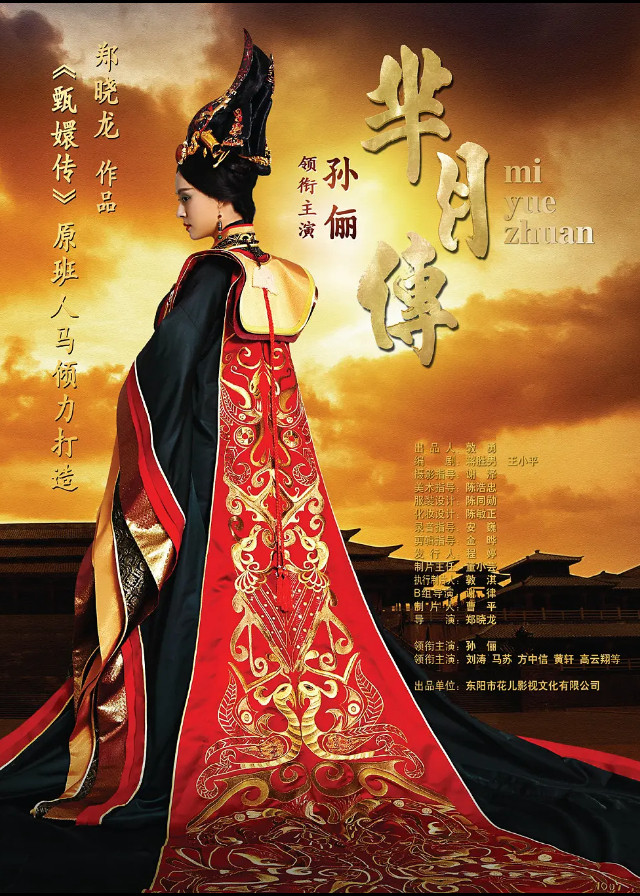



Resumen del episodio 15 de The Legend of Mi Yue
> Resúmenes de The Legend of Mi Yue
- 1
- 2
- 3
- 4
- 5
- 6
- 7
- 8
- 9
- 10
- 11
- 12
- 13
- 14
- 15
- 16
- 17
- 18
- 19
- 20
- 21
- 22
- 23
- 24
- 25
- 26
- 27
- 28
- 29
- 30
- 31
- 32
- 33
- 34
- 35
- 36
- 37
- 38
- 39
- 40
- 41
- 42
- 43
- 44
- 45
- 46
- 47
- 48
- 49
- 50
- 51
- 52
- 53
- 54
- 55
- 56
- 57
- 58
- 59
- 60
- 61
- 62
- 63
- 64
- 65
- 66
- 67
- 68
- 69
- 70
- 71
- 72
- 73
- 74
- 75
- 76
- 77
- 78
- 79
- 80
- 81
On the day of Princess Mi Shu’s wedding, Princess Mi Yin burst into the bridal chamber, demanding to see Huang Xie. She had been told that he was in the room, but when she addressed a figure as her husband, it was revealed to be the Crown Prince, who had stopped by to offer congratulations before Mi Yin's intended groom, Huang Xie, had fled.
Realizing she had been deceived, Mi Yin angrily rushed into the grand hall of the wedding ceremony, loudly denouncing Mi Yue as a “slut.” Before King Huai and Empress Wei, Mi Yin accused Mi Yue of orchestrating Huang Xie’s escape, claiming Mi Yue had poisoned her. Empress Wei sternly questioned Mi Yue about Huang Xie’s whereabouts, but Mi Yue maintained her innocence, stating she had no knowledge of his plans since he disappeared during his own wedding to Mi Yin.
Enraged, Empress Wei ordered Mi Yue’s arrest. Princess Mi Shu intervened, defending Mi Yue and pointing out that Huang Xie had been confined for days while Mi Yue was always by her side. Mi Shu further stated that Huang Xie was unwillingly forced into the marriage with Mi Yin, and thus Mi Yin should not blame others for the outcome. Empress Wei, suspicious of Mi Yue’s intentions to accompany Mi Shu to Qin, ordered Mi Yue detained.
Mi Shu then declared that if Mi Yue, her dowry maid, was not allowed to accompany her, she would refuse to marry and go to Qin herself. Seeing the auspicious hour for departure approaching, Jin Shang urged King Huai to proceed, warning that any delay would be unfavorable for the princess’s marriage.
Nan Hou, seizing the opportunity to oppose Empress Wei, seconded Jin Shang, emphasizing that while Huang Xie's broken engagement was a small matter, the alliance between Chu and Qin was paramount. She also highlighted that the Qin escort party had a list of dowry concubines, and a missing person would cause misunderstanding and suspicion. Prioritizing the state’s affairs, King Huai ordered the bridal procession to depart.
Empress Wei tearfully told Mi Shu that everything she did was for her daughter’s good, to which Mi Shu responded with promises to take care of herself in Qin and wished her mother well. As the procession moved, Mi Yin continued to scream accusations against Mi Yue, but was quickly removed. The bridal procession soon reached Xiangcheng, a border town between Chu and Qin.
General Tang Sui of Chu and General Meng Ao of Qin formally greeted Princess Mi Shu and her entourage at the Xiangcheng palace. General Tang Sui outlined the travel plan: General Meng Ao would lead the advance party, while Tang Sui would escort the princess out of Xiangcheng, after which General Meng Ao would take over for the journey into Qin. In her private chambers, Mi Yue confessed to Aunt Kui that she felt unsettled about leaving Chu.
Aunt Kui comforted her, reminding Mi Yue that they had survived much, and that her mother and Ju Ji’s sacrifices would not be in vain if Mi Yue lived. Mi Yue then revealed her secret plan: she hoped to meet Huang Xie in Wu Guan City and elope with him. She intended to inform Princess Mi Shu beforehand to avoid causing her pain. Later that night, Mi Yue heard a knock at her door.
Upon opening it, she found a white-haired, emaciated old man with no eyes. He introduced himself as Tang Mei, the elder cousin of General Tang Sui, and claimed to be an astrologer who, sixteen years prior, before Mi Yue’s birth, had observed the prophecy of a "supreme star" that would bring great changes to the world. He had reported this to King Huai, who, initially pleased, later became enraged when the child was born a girl.
As punishment, Tang Mei’s eyes were gouged out, and he was exiled to the border. Mi Yue, realizing the connection to her childhood nickname “supreme star,” vehemently denied being anything more than an ordinary woman. She blamed Tang Mei’s prophecy for the suffering endured by her mother and her brother. Tang Mei countered that destiny could not be avoided, saying that those destined to lead must first suffer to build strength.
Dismissing his words, Mi Yue tried to close the door, but Tang Mei, sensing danger, said it was too late to escape. An arrow struck him as he shielded Mi Yue, mortally wounding him. With his dying breath, Tang Mei told Mi Yue that if she still blamed him for the past, he had now repaid her with his life. Mi Yue cried out for help, and guards quickly arrived, capturing two black-clad assassins.
General Meng Ao intended to interrogate the captured assassins, but General Tang Sui swiftly killed them, declaring they had brought it upon themselves. Princess Mi Shu rushed to Mi Yue’s room, expressing concern for her safety and demanding an explanation. General Tang Sui reported that two audacious thieves had disturbed their rest and he had killed them. Mi Yue clarified that Tang Mei, General Tang Sui’s cousin, had taken a fatal arrow for her.
Mi Shu inquired about the missing guards and patrolling soldiers, but Tang Sui offered evasive answers, promising a thorough investigation the next day. Dai Mao quickly interjected, explaining that Xiangcheng, being a bustling border town, was notorious for bandits, and this incident was likely just a random act of a confused thief. She advised Mi Shu not to dwell on it, urging her to prioritize the journey. Later, Dai Mao discreetly warned General Tang Sui to heighten his vigilance.
The following morning, Mi Yue discussed the incident with Aunt Kui. Both believed the attack was no accident and suspected Empress Wei’s involvement. Aunt Kui worried for Mi Yue’s safety, while Mi Yue, yearning for a definitive escape, looked forward to reaching Wu Guan City and reuniting with Huang Xie. The procession eventually arrived at the Qin-Chu border. General Tang Sui formally bade farewell to Princess Mi Shu, and the Chu escort party turned back.
Mi Shu performed a ceremony, bidding farewell to her ancestors and deities, praying for a safe journey to Qin. As a keepsake, Mi Yue collected a handful of soil from her homeland. Continuing their journey, Mi Shu’s party soon encountered the harsh realities of the long trek, and the princess became gravely ill with motion sickness. General Meng Ao, impatient with the delays, insisted they continue immediately.
Dai Mao, in defense of Mi Shu, retorted that the princess’s delicate health necessitated rest, reminding Meng Ao that his duty was protection, not escorting prisoners. Meng Ao, however, stood firm, stating that once in Qin territory, all must adhere to Qin law, and delays would incur punishment regardless of status. Mi Yue intervened, diplomatically reminding Meng Ao that Qin had extended a courteous invitation for the marriage, and he, as a Qin official, should extend courtesy in escorting.
She reasoned that a brief rest would allow Mi Shu to recover slightly, enabling them to travel faster afterward. Meng Ao conceded, agreeing to a half-hour respite. During the break, Mi Shu, feeling weak and nauseous, refused to drink water, fearing she would only vomit it up. Dai Mao complained about the coarse food, the constant movement of the carriage during meals, and the lack of proper bathing facilities and comfortable inns in Qin, calling the journey torture.
Mi Shu expressed deep regret and homesickness. Mi Yue encouraged her to eat and drink, reminding her of the long journey ahead that required strength. She pointed out that having even coarse food was better than starving, recounting her own childhood experiences. Dai Mao scoffed at Mi Yue’s pragmatism, labeling it as “lowering oneself.” Mi Yue retorted that Dai Mao was free to starve for honor, but should not encourage Mi Shu to do the same.
Mi Shu, persuaded, agreed to try to eat. Mi Yue then informed Mi Shu about Qin’s four main passes—Wu Guan, Hangu Pass, Xiao Guan, and Dasan Pass—explaining that Wu Guan City was the first important frontier town, and beyond it, a smooth, well-established road led directly to Xianyang, where proper inns would be available. This news lifted Mi Shu’s spirits, and she decided to eat, acknowledging her responsibility to stay strong for the sake of the many people accompanying her.