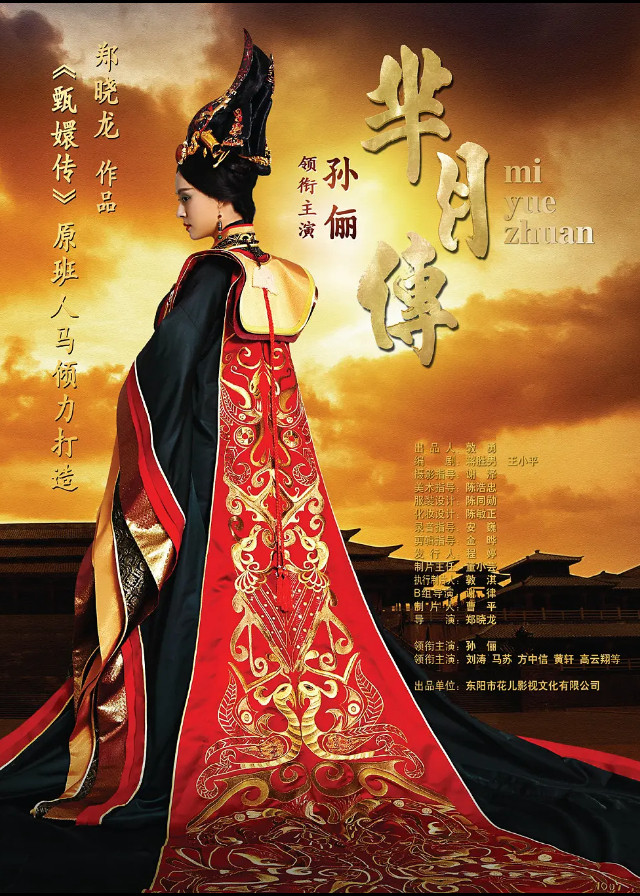



Resumen, trama, sinopsis de The Legend of Mi Yue
Sinopsis de The Legend of Mi Yue
During the Warring States period, Mi Yue was the favorite young princess of King Wei of Chu.
But her status fell to pieces when King Wei of Chu went to war and her mother Xiang was expelled from the palace by Queen Wei of Chu. They returned to the palace years later, her mother took revenge with her life.
Mi Yue and Huang Xie were childhood sweethearts and fell in love with each other. In order to run away with Huang Xie, Mi Yue volunteered to go to Qin as the maid of the first princess, Mi Shu.
On the way to Qin, Mi Yue and Mi Shu supported each other. In the middle of the journey, the Chu courtesy carriage was robbed by the army led by Lord Yiqu.
Huang Xie fell into a valley to save Mi Yue and his life was not yet known. In order to find out the mastermind behind the crime, she accompanied Mi Shu into the Qin palace.
Mi Shu became the queen of the Qin Empire. Mi Yue was framed by Lady Wei for kidnapping her brother Wei Ran. She had no choice but to turn to the King of Qin to become a favorite concubine.
The sisterhood is divided when Mi Yue gives birth to her son Ying Ji.
The sons competed for the throne and the King died of regret. Mi Yue and her son were sent to the distant state of Yan.
However, King Wu of Qin, Ying Dang, died by raising his tripod and the Qin Empire was in chaos.
Mi Yue returned to Qin with the help of the Yiqu army and put an end to the civil unrest in Qin.
Her son, Ying Ji, was crowned King of Qin and became King Zhaoxiang. She became the first Empress Dowager of Qin, known as Empress Dowager Xuan.
Resúmenes de The Legend of Mi Yue
- 1
- 2
- 3
- 4
- 5
- 6
- 7
- 8
- 9
- 10
- 11
- 12
- 13
- 14
- 15
- 16
- 17
- 18
- 19
- 20
- 21
- 22
- 23
- 24
- 25
- 26
- 27
- 28
- 29
- 30
- 31
- 32
- 33
- 34
- 35
- 36
- 37
- 38
- 39
- 40
- 41
- 42
- 43
- 44
- 45
- 46
- 47
- 48
- 49
- 50
- 51
- 52
- 53
- 54
- 55
- 56
- 57
- 58
- 59
- 60
- 61
- 62
- 63
- 64
- 65
- 66
- 67
- 68
- 69
- 70
- 71
- 72
- 73
- 74
- 75
- 76
- 77
- 78
- 79
- 80
- 81
Resumen del episodio 1
In 338 B. C. , the 24th year of Duke Xiao of Qin, Shang Yang, facing accusations of rebellious intentions from Prince Fu Ying Qian and others, fled Qin. While attempting to find refuge at an inn on the Qin-Wei border, he was ironically turned away by the innkeeper. The innkeeper, fearful of being implicated under Shang Yang's own strict Collective Punishment law, refused to shelter him without a permit.
Shang Yang, lamenting that he was suffering the consequences of his own laws, revealed his identity before being captured by pursuing soldiers. Back in the Qin palace, the newly ascended King Huiwen of Qin condemned Shang Yang for his brutal and corrupt ways. When asked if he had anticipated such an end when he previously punished the King’s tutor, Shang Yang defiantly stated that the past punishment must have been too lenient.
He expressed pride that his laws were still upheld by commoners, ensuring their survival even after his death, though he regretted not seeing Qin unite all lands. King Huiwen of Qin then ordered Shang Yang to be executed by being torn by five horses and his entire tribe extinguished.
Around the same time, in the third year of King Wei of Chu, discussions in the Chu court revolved around Qin’s political instability following Shang Yang’s demise, with some like Qu Yuan suggesting Chu adopt similar reforms while Zhao Yang cautioned against them. Amidst this, the astronomer royal Tang Mei observed a celestial phenomenon from the Stargazers' Platform.
He excitedly reported to King Wei of Chu that a "supreme star" had appeared, signifying great changes in the world and the destined rise of Chu. Tang Mei predicted that a pregnant woman in the King’s harem would give birth to a supreme leader. Overjoyed, King Wei immediately summoned Yong Xiang Ling, a harem steward, to inquire about any pregnancies.
Yong Xiang Ling reported that while no principal concubines were pregnant, Xiang Shi, a lady-in-waiting serving Ju Ji, was six months along. Believing this child to be the prophesied supreme star, King Wei was ecstatic and immediately elevated Xiang Shi to a lady. The Queen, furious at this development and fearing for her son Mi Huai’s claim to the throne, began to challenge Ju Ji, under whose patronage Xiang Shi served.
She discovered that Xiang Shi’s physician was Female doctor Zhi, a skilled doctor who had studied under the renowned Qinyue, also known as Bian Que. The Queen threatened Female doctor Zhi by taking her to the hidden palace, the place for castrations, and mentioning her seven-year-old son, Jin Er. She demanded Female doctor Zhi ensure Xiang Shi had a miscarriage, vaguely promising not to blame her if "anything happens" and implying Jin Er’s safety depended on her compliance.
Female doctor Zhi, pressured and knowing the Queen’s power, brought a medicinal concoction to Xiang Shi. When Xiang Shi’s attendant, Kui Gu, noted the medicine smelled different and suggested delaying it, Female doctor Zhi insisted it be taken immediately. Just as Xiang Shi was about to drink, Ju Ji arrived, having rushed from seeing the King.
Ju Ji announced that she had secured a royal decree: all of Xiang Shi’s medicines would now be prescribed by all royal doctors and their preparation personally supervised by Yong Xiang Ling. Ju Ji then deliberately knocked over the bowl of medicine. Analyzing its contents, she revealed that the concoction contained Dan Zhu Ye, also known as Sui Gu Zi, a herb with powerful abortifacient properties.
Xiang Shi was horrified, and Ju Ji confessed that five years prior, the Queen had forced her to drink the same medicine, implying she too had suffered a miscarriage. To protect Xiang Shi, Ju Ji moved her to the main hall of Yunmeng Platform, her own residence. Three months later, as Xiang Shi’s delivery approached, the Queen orchestrated another plot. She magnanimously offered her own residence, Gao Tang Tai, for Xiang Shi’s confinement, arranging shamans to pray outside for auspiciousness.
However, she secretly ordered that only Female doctor Zhi and herself be allowed to attend the birth, excluding Ju Ji and other palace staff. The Queen again pressured Female doctor Zhi, reminding her of her son Jin Er and declaring that the "opportunity has come" to fulfill her unspoken task during the birth, hinting at inducing an "obstructed labor" or "stillbirth." Ju Ji, suspecting foul play, bravely rushed into the royal court, disregarding the guards, to plead with King Wei.
She urged him to personally oversee Xiang Shi’s delivery, stressing its profound importance for Chu’s destiny and the King’s ambition to unite all lands. King Wei, swayed by Ju Ji’s impassioned plea, agreed. King Wei arrived at Gao Tang Tai amidst the birthing cries. The Queen claimed Female doctor Zhi reported obstructed labor and feared for the worst, but the King commanded them to save the supreme star at all costs. Moments later, a baby's cry echoed from within.
Female doctor Zhi emerged, announcing the birth of a princess. King Wei’s face clouded with immense disappointment. He questioned how a female infant could be the prophesied supreme star, seeing it as a deception. He angrily confronted Tang Mei, who maintained that he only interpreted the stars regardless of gender, but warned that a female supreme star could bring both fortune and disaster, and that defying heaven’s will was perilous.
Enraged by what he perceived as deception and insolence, King Wei ordered Tang Mei's eyes to be gouged out and banished him permanently from Yingdu. Seizing the moment, the Queen suggested that since the infant’s fate was uncertain, it should be left to heaven. She advised placing the baby in a bamboo basket and setting her afloat on the water. Following the Queen’s cruel decree, Xiang Shi's baby was taken away in a basket.
Distraught, Xiang Shi frantically searched the palace for her child, her cries of "my child" echoing through the gardens. She found an overturned bamboo basket by the garden pond, her heart sinking in despair. Meanwhile, King Wei and the Queen were strolling in the garden, the Queen remarking on the perceived insignificance of a female child, when they unexpectedly heard a baby’s cries.
Following the sound, Xiang Shi discovered her baby, miraculously alive, nestled among the lotus leaves near a statue of Shao Si Ming, a deity of fertility and destiny. King Wei, witnessing the infant's remarkable survival, saw it as a sign of great blessing and declared that such a child, despite being a girl, possessed remarkable fortune and should live. Gazing at the brilliant moonlight, King Wei decided to name the resilient little princess "Yue Er," meaning Moon.
Her formal name became Mi Yue. Four years passed quickly. Young Mi Yue often saw her mother, Xiang Shi, gazing wistfully towards the great hall in the south and learned that her father, King Wei, resided there. One day, Mi Yue, determined to see her father, slipped away from her chambers and tried to enter the great hall. She was stopped by stern guards, but her playful struggles and loud demands eventually caught King Wei's attention from inside.
Informed that a child was at the entrance, King Wei, curious, ordered them to let her in. Mi Yue, with her natural innocence and fearlessness, engaged King Wei in a lively conversation. She initially thought her father was a "big tiger" and playfully confirmed that a tiger’s various parts could indeed be touched.
Touched by her sincerity, Mi Yue then pleaded with King Wei to visit her lonely mother, revealing that Xiang Shi stood at her door daily, gazing towards his hall, silently longing for him. Though King Wei initially mentioned a prior dinner commitment with the Queen, he was deeply moved by Mi Yue’s words and promised to visit Xiang Shi that very night.
Before she left, King Wei shared a secret: a side door behind the main hall that Mi Yue could use to enter and exit freely, without being stopped. True to his word, King Wei visited Xiang Shi at Yunmeng Platform. Xiang Shi, surprised and unadorned, was deeply emotional, shedding tears of joy as King Wei gently admitted he had "neglected you in the past."
News of King Wei’s visit soon reached the Queen, who, informed by Dai Mao, realized with resentment that it was not the location but Xiang Shi herself, through her child Mi Yue, who had managed to reclaim the King's attention.
Resumen del episodio 2
Mi Yue’s quick thinking helped her mother, Xiang Shi, regain favor with King Wei of Chu, and Mi Yue herself frequently visited her father, deepening their bond. The Queen, however, grew increasingly agitated, lamenting that King Wei, after half a month away from the harem, had broken his promise to dine with her, choosing instead to visit Xiang Shi, whom she derisively called a "cheap maid" and accused of using "fox charm."
Meanwhile, Mi Yue innocently told King Wei that her mother worried his frequent visits to her might displease "someone," but King Wei dismissed the concern, stating only his happiness mattered. Mi Yue also shared her mother’s advice against eating others’ food, but concluded it was acceptable from her own father. King Wei was amused and cherished his time with Mi Yue, later sending her off to her palace before going to spend the night with Xiang Shi.
Soon after, King Wei was informed that the states of Qi, Wei, and Yue had formed an alliance to attack Chu. Enraged, King Wei declared his intention to personally lead the army to first strike Yue, then move north. He instructed his officials, including Zhao Yang and Qu Yuan, to make swift preparations for the grand campaign. Just as he finalized his plans, a palace attendant announced that Xiang Shi was pregnant again.
King Wei was overjoyed, deeming it an auspicious sign for his upcoming war, and expressed particular affection for Xiang Shi. The Queen was furious upon hearing of Xiang Shi’s pregnancy, viewing it as a blatant attempt to secure greater favor through a child.
Recalling how Mi Yue's favor had previously elevated Xiang Shi, and despite her servant Daimao's attempts to reassure her that Xiang Shi’s low birth meant she could never compare to the Queen, the Queen resolved to imitate this success by visiting King Wei with her own daughter, Mi Shu, bringing his favorite desserts.
Mi Shu, however, was terrified of her father, describing his face as "fierce," which earned her a scolding from the Queen about the proper demeanor of a first Princess. Before they could reach King Wei, Ju Ji intercepted them, proudly announcing that King Wei had decreed she would manage all of Xiang Shi’s affairs during her pregnancy, effectively preventing the Queen from interfering.
Inside the palace, Mi Yue was playfully massaging King Wei’s back, when the Queen entered and sternly reprimanded Mi Yue for her "imprudent" behavior in front of the King. King Wei, however, defended Mi Yue, praising her for her filial piety. The Queen presented Mi Shu's desserts, subtly complaining about King Wei's infrequent visits to the harem and hinting at discontent among other concubines. King Wei saw through her veiled accusations.
Attempting to get Mi Shu to greet him, King Wei noticed her fear, observing that she was unlike Mi Yue. Mi Yue, realizing Mi Shu was her older sister, eagerly invited her to play. King Wei, finding the idea delightful, gave his permission. Outside, Mi Yue and Mi Shu had a joyous time playing.
Mi Yue, after mimicking farting sounds with Mi Shu, explained the concept of "reciprocity is proper etiquette," insisting that if she was to bow to Mi Shu as the "first Princess," then Mi Shu should also bow to her. The Queen, witnessing this playful exchange, was horrified. She deemed Mi Yue "cunning and ill-mannered," ordering her to kneel and apologize to Mi Shu.
But King Wei intervened, dismissing it as innocent child’s play and praising Mi Yue's fearless and charming nature, remarking that she would have an extraordinary future if only she were a boy. The day before King Wei’s departure for war, Xiang Shi successfully gave birth to a healthy baby boy.
King Wei was ecstatic, immediately naming the child Rong, promoting Xiang Shi to the rank of Fei (concubine), granting her Zhang Hua Terrace, and showering her with luxurious silks and fine clothes. Before leaving, King Wei advised Mi Yue to be a "good little tiger" and entrusted the entire management of the harem to the Queen, who vowed to uphold her duty. The Queen, however, harbored dark intentions.
She ordered her trusted servant, Daimao, to apply a substance to the King’s gift of new clothes for Xiang Shi. The next morning, Xiang Shi awoke to a severe rash on her neck. The Queen quickly arrived, dramatically declared it a "foul disease," and, over Xiang Shi’s desperate protests and Mi Yue’s cries, had her forcibly removed from the palace, claiming it was to prevent further infection.
Xiang Shi awoke to find herself in a squalid, dimly lit hut, realizing with despair that she was no longer in the palace. Her attendants were gone, replaced by a disheveled ruffian named Wei Jia, who brazenly claimed the hut as his home. Wei Jia, despite Xiang Shi’s protests that she was the King’s concubine and her warnings about her supposed "foul disease," was undeterred, dismissing her threats and asserting his own "rotten life."
He then assaulted her, leaving Xiang Shi to weep in silent humiliation. Three years passed. Mi Yue had grown into a tall, lively girl, though her free-spirited nature and lack of formal supervision meant she hardly fit the image of a typical princess. One day, Aunt Kui found Mi Yue playfully climbing a tree, scolding her for her un-princess-like behavior and warning of potential punishment.
Mi Yue, however, found court life stifling, wishing for the freedom of birds that flew beyond the palace walls. Meanwhile, she snuck into the kitchen to steal some pastries. There, she encountered Huang Xie, a polite and intelligent disciple of Qu Yuan, who was waiting to collect offerings. When the cook discovered Mi Yue's theft and chased her, Huang Xie subtly tripped the cook, allowing Mi Yue to escape.
Mi Yue thanked Huang Xie for his help, admiring his "gentlemanly" refusal to tolerate bullying. Huang Xie, in turn, was impressed by Mi Yue’s ingenuity, particularly her innovative whip, which she had modified with a small pouch to launch stones at targets both near and far. Mi Yue taught Huang Xie how to wield the whip. Huang Xie then introduced Mi Yue to his revered master, Qu Yuan, whom he described as "the best in the world, omnipotent."
Mi Yue, with her characteristic wit, declared herself Qu Yuan's disciple, reasoning that such a man must naturally be her master. Amused, and recalling the palace rumors of Mi Yue being a "supreme star" (though Mi Yue corrected him, saying she was the "moon, not a star"), Qu Yuan accepted her as his student. Later, Mi Yue and Huang Xie joined a group of princesses playing a pot-throwing game for honey pastry stakes.
The other princesses, however, refused to acknowledge Mi Yue's victory and outright cheated. When the daughter of Princess Qi began to insult Mi Yue, calling her a "wild child" because her mother was a "dowry maid" who had been "driven out" due to a "nasty disease," Mi Yue retaliated by striking the girl with a small stone from her whip, calling the girl and her mother "wild dogs."
Mi Shu intervened, reprimanding the Princess of Qi's daughter and defending Mi Yue as her own sister. Mi Yue confided in Aunt Kui about her longing for her mother. Moved by Mi Yue’s persistent sadness and her constant questioning of her mother's mysterious absence, Aunt Kui secretly took Mi Yue to visit Xiang Shi.
They found Xiang Shi living in desperate poverty in the small, filthy hut, having borne another son, Xiao Ran, to Wei Jia, and enduring years of brutal abuse. Xiang Shi, worn and resigned, told Mi Yue that she could not return to the palace, having lied that her illness was cured.
She explained to Aunt Kui that she had to "endure for the children" and thanked them for the aid that kept her and Xiao Ran alive, especially since Xiao Ran was currently ill and she had no money for a doctor. Just then, Wei Jia burst in, cursing Xiang Shi for his gambling losses and trying to snatch the money Aunt Kui had brought for Xiao Ran’s medical treatment.
Mi Yue fiercely tried to protect her mother, even biting Wei Jia, but Aunt Kui, realizing their powerlessness, forcibly pulled Mi Yue away, leaving Xiang Shi to suffer at Wei Jia’s hands. News of King Wei's triumphant return from the Xu campaign soon reached the palace. He was met by a grand procession of his family and court officials.
King Wei acknowledged the Queen's efforts in managing the palace during his absence, and while he learned that the other concubine, Yue Meiren, had given birth to a beautiful princess, the Queen falsely informed him that Xiang Shi had contracted a "foul disease" shortly after his departure, was sent out of the palace, and tragically "soon passed away." King Wei expressed sorrow over Xiang Shi’s supposed demise. Later, as King Wei was drinking alone, Mi Yue appeared.
Overjoyed to see his "little tiger" grown so tall, he reiterated his regret about her mother’s death. But Mi Yue corrected him, revealing that her mother was, in fact, "still alive." She recounted how she had recently seen Xiang Shi living in a small, wretched hut, being beaten by an evil man. Shocked by this revelation, King Wei immediately ordered a thorough investigation into the matter, promising to uncover the truth. Following his command, palace guards located Wei Jia’s dwelling, swiftly executed Wei Jia, and brought Xiang Shi back to the palace.
Resumen del episodio 3
King Wei of Chu had ordered Xiang Shi back to the palace. Ju Ji's servant swiftly informed her of Xiang Shi's return and her request to meet at Zhang Hua Palace. Ju Ji, undeterred by potential interference from the Queen, decided to go immediately. Upon meeting, Xiang Shi knelt to pay respects, but Ju Ji quickly bade her rise, reminding her that she was now a consort.
Xiang Shi, however, insisted on expressing her deep gratitude for Ju Ji's devoted care for Mi Yue and Mi Rong over the years, proclaiming she was willing to repay such kindness with her very life. Ju Ji, reflecting on Xiang Shi's past suffering after being unjustly cast out of the palace, expressed her sorrow.
Xiang Shi confessed that during her years away, she had often contemplated death but was held back by her three children and her burning desire for revenge. She revealed that although she hadn't met King Wei of Chu yet, he would be coming to Zhang Hua Palace that evening. Ju Ji optimistically believed that with the King's favor, Xiang Shi and her children would easily reclaim their former glory.
However, Xiang Shi remained apprehensive, fearing the Queen's continued power and the King's inability to provide long-term protection, especially given her defilement and the child she carried from Wei Jia. Meanwhile, the Queen, furious upon learning of Xiang Shi's return and the existence of her child with Wei Jia, believed Xiang Shi was now even more dangerous.
She schemed to use this child to ultimately disgrace Xiang Shi in the King's eyes, believing that even if the King was temporarily captivated, the child would eventually serve as a reminder of Xiang Shi's "filth" and lead to her downfall. Her immediate concern was how to silence Xiang Shi. Unaware of the Queen's machinations, Xiang Shi confided in Ju Ji that she saw only one path forward: a desperate sacrifice to secure a bright future for her children.
Feeling she could not survive against the Queen's power without a drastic measure, she expressed a heartfelt wish to see Mi Yue and Mi Rong one last time before enacting her plan. Despite her reluctance, Ju Ji, moved by Xiang Shi's determination, agreed to arrange the meeting. She rushed to bring Mi Yue and Mi Rong to Xiang Shi, emphasizing the urgency of the visit. The Queen arrived at Zhang Hua Palace, imperiously demanding Xiang Shi bow.
Feigning sympathy for Xiang Shi's hardships, the Queen offered lavish gifts, but Xiang Shi coldly rejected them, attributing her past suffering to "wicked people." Dismissing all the attending servants, Xiang Shi then accused the Queen directly of causing her misery, claiming to possess irrefutable evidence. The Queen vehemently denied the accusation, demanding proof and dismissing Xiang Shi as a madwoman making baseless claims. Xiang Shi, however, warned the Queen that evidence would soon surface, and retribution would surely follow.
The Queen scornfully labeled Xiang Shi a "humble servant" and "overestimating herself," to which Xiang Shi retorted that even a lowly person could challenge the Queen. The Queen then tried to humiliate Xiang Shi by reminding her of her "filthy" status after her illicit relations with Wei Jia. Xiang Shi acknowledged her diminished status but cryptically stated that even a humble body could serve a purpose. With a final angry exchange, the Queen stormed out.
Alone, Xiang Shi poured a cup of wine. Lamenting that she couldn't wait any longer for Mi Yue and Mi Rong, she drank the poisoned concoction, urging her children to remember her sacrifice and seek justice from their father. Shortly after, Ju Ji arrived with Mi Yue and Mi Rong, only to find Xiang Shi dying. Mi Yue was devastated. With her last breaths, Xiang Shi instructed Mi Yue to take care of Mi Rong and, notably, Wei Ran.
Just then, King Wei of Chu burst in, demanding to know what had transpired. Xiang Shi, with her final effort, pointed to the poisoned wine and, accusing the Queen by name as her killer, begged the King for justice before collapsing. The King was utterly distraught. Consumed by rage, King Wei of Chu confronted the Queen, disbelieving her fabricated story about Xiang Shi's death from illness.
He presented a gold pitcher, distinctly unique to the Queen's Gao Tang Tai palace, which had been found at Zhang Hua Palace. The Queen, flustered, claimed it must have been stolen to frame her. However, a palace maid, under interrogation, confirmed that the Queen had indeed visited Xiang Shi alone. While the Queen admitted to the meeting, she denied poisoning Xiang Shi, insisting they had only argued.
The King declared that Xiang Shi, known for her pure and honest nature, had explicitly named the Queen as her killer before she died, scolding the Queen for her manipulative and murderous actions. Crown Prince Mi Huai then intervened, pleading with his father to forgive his mother, appealing to their long-standing marital and paternal bonds. The King, however, harshly dismissed Mi Huai's pleas, revealing his deep-seated knowledge of the Queen's numerous "dirty deeds" in the palace.
He accused Mi Huai of being willfully blind and defending a "wicked woman" merely because she indulged his weaknesses – his incompetence, lust, and self-righteousness. Overwhelmed by anger, the King banished the Queen to Gao Tang Tai and furiously ordered Mi Huai to leave, disowning him as a son and declaring him unfit to rule Chu.
A eunuch attempted to calm the distraught King, who, after reading a letter from a Wei envoy, expressed his profound despair over the Queen's treachery and Mi Huai's unworthiness. He lamented that Chu would be utterly ruined if left in their hands. When the eunuch tentatively asked if he intended to dethrone both the Queen and the Crown Prince, the King dismissed him, then called for more wine, seeking solace in drink.
Mi Yue and Mi Rong mourned their mother deeply. Ju Ji, attempting to explain the harsh realities of the harem, reassured them that their mother's sacrifice, though tragic, would pave the way for their future. Despite her own sadness, Ju Ji felt a sense of triumph, anticipating Mi Huai's downfall and Mi Rong's ascendance, believing their long-sought goals were finally within reach. Mi Yue, however, struggled to comprehend why her mother had to die.
Meanwhile, in her own palace, the Queen, in a state of utter despair, confessed to her maid Daimao that she had lost everything despite meticulously navigating palace intrigues for two decades. She realized that her downfall would inevitably lead to the Crown Prince's ruin. She resolved to seek death from the King, hoping her ultimate sacrifice would appease his wrath and secure Mi Huai's position as Crown Prince.
However, shocking news then swept through the palace: King Wei of Chu (personal name Mi Shang) had died suddenly from excessive drinking, exacerbated by unhealed old wounds and a relapse of his illness. The entire nation was plunged into mourning. Crown Prince Mi Huai ascended to the throne, becoming Chu Huai Wang, and the Queen once again rose in power as Wei Hou. Chu Huai Wang held court.
Wei Hou, the former Queen, entered and performed a deferential bow, acknowledging her new status. She then requested permission from Chu Huai Wang to be buried alongside the deceased King Wei of Chu. She claimed the late King had appeared to her in a dream, expressing profound loneliness. Chu Huai Wang initially refused, suggesting that the pre-prepared roster of male and female slaves would suffice to accompany his father.
Wei Hou, however, insisted, adding that in her dream, King Wei of Chu had specifically asked for Mi Yue and Mi Rong, his most beloved children, to accompany him. Reluctantly, Chu Huai Wang agreed to add Mi Yue and Mi Rong to the burial roster. When Ju Ji learned of this horrifying news, she immediately sought an audience with Wei Hou. Wei Hou, wanting to speak to Ju Ji alone, dismissed Kui Gu, Ju Ji's attendant.
Ju Ji bowed to Wei Hou, acknowledging her triumph and new position, stating, "You win." Wei Hou, basking in her victory, gloated about the immense satisfaction of having no one above her and being free from the constant fear of rivals and plots against her and her children. Ju Ji, bewildered, questioned why Wei Hou, if her hatred was so profound, had spared her life. Wei Hou chillingly explained that granting Ju Ji death would be too easy.
Her intention was for Ju Ji to endure "a life worse than death," witnessing Mi Yue and Mi Rong—her cherished hopes—being taken to the tomb, ensuring that every subsequent day would be an agonizing torment. Wei Hou observed that their fate had been decided by a mere hair's breadth; a slight shift in fortune could have seen their positions reversed. She attributed Ju Ji's current plight to sheer bad luck.
Ju Ji, desperate, pleaded for the lives of Mi Yue and Mi Rong, emphasizing their youth and innocence. Wei Hou stated there was only one way to spare them: someone must personally ask the deceased King Wei of Chu, and he must explicitly declare that he no longer required their companionship. Knowing this was an impossible condition, Wei Hou concluded that if no one could fulfill it, she was powerless to help.
Ju Ji returned to Mi Yue and Mi Rong, who were distraught upon learning they were to be buried alive. Helpless, Ju Ji admitted she could do nothing more. Kui Gu, however, bravely volunteered to die in their place, promising to beg Wei Hou for their release. Mi Yue, accepting her grim fate, thanked Ju Ji for her love and upbringing, and offered Ju Ji her most cherished possession as a keepsake, acknowledging it would soon be useless to her.
Resumen del episodio 4
Following the former King's passing, Ju Ji, in a desperate act to save Mi Yue and Mi Rong from being buried alive with the late king, meticulously orchestrated her own death. She carved the character "否" (no) onto a turtle shell and used a white silk sash to take her life. On the silk, she inscribed a message: "Concubine asks the former King if he wishes to see Mi Yue and Mi Rong or not."
The next morning, her body was discovered along with the silk and the turtle shell, which had been cracked by fire, revealing the "no." Those present interpreted this as the former King's spirit manifesting, effectively sparing Mi Yue and Mi Rong. Wei Hou, seemingly convinced by this divine sign, reluctantly allowed Mi Yue and Mi Rong to live, stating that since the former King felt anguish at leaving them, he wished to keep two talents to assist.
Before her death, Ju Ji left a final message for Mi Yue and Mi Rong. She confessed that she had once used them as pawns in her struggle against Wei Hou, but ultimately came to love them as her own children. She explained that without them, every day of her life would be torture, emphasizing that the former King had a purpose in leaving them behind: to serve at his tomb and repay him there.
Thus, Mi Yue, Mi Rong, Wei Ran, and Aunt Kui were banished by Wei Hou to the former King's mausoleum to stand vigil. Mi Yue, deeply affected, vowed to care for both her brothers. In contrast to their exile, Princess Mi Yin, Qi Fei's daughter whose mother had tragically taken her own life years prior following the Xuzhou War, ingratiated herself with Wei Hou.
Wei Hou found Mi Yin sensible and decided to keep her in the palace as Mi Shu's companion. Life in the secluded cemetery proved to be a harsh but freeing experience for Mi Yue. Despite the meager provisions, she thrived, learning basic etiquette, music, and medical knowledge from Aunt Kui and Female Doctor Zhi.
Her mentor, Qu Yuan, also arranged for Huang Xie to regularly visit and deliver educational scrolls, promising a new section of the "Rites of Zhou" every ten days. During his visits, Huang Xie often discussed the merits of palace education, arguing that her informal learning was superficial compared to the comprehensive Six Classics taught in the court, which encompassed subjects like the Great Cloud Gate, Big Shao Summer, Big Wu, and Big Hu music.
Mi Yue, however, cherished the wide-open spaces and her unconstrained lifestyle, often playfully challenging Huang Xie's views. One day, Mi Yue experienced her first menstrual cycle. Terrified by the blood and pain, she feared she was dying. Aunt Kui, however, gently explained that Mi Yue was simply growing up and becoming a woman. Mi Yue initially resisted this, connecting womanhood to the plight of her mother, Xiang Fei, who had suffered in the palace.
Aunt Kui assured her that such matters were determined by fate and beyond their control. Huang Xie, though concerned, could not help. Despite the challenging environment, Mi Yue developed a keen understanding of medicinal herbs, often identifying plants and their uses, much to Aunt Zhi's admiration. Huang Xie continued his visits, bringing books and sharing stories, and their bond deepened, hints of affection growing between them. Meanwhile, King Huai began selecting new concubines.
He harbored an insecurity about his unusual body odor, which caused many candidates to distance themselves or feign ignorance. During the selection, Shang Rong'er claimed to smell only incense and was quickly dismissed. Another woman, Yunzhu, hesitated and struggled to answer, leading to her dismissal. However, a clever woman named Zheng Xiu approached the King.
When asked about his scent, she artfully described it not as an odor, but as a "special scent," an "imposing" and "captivating" aroma unique to the King, making all other men seem dull in comparison. Delighted by her flattering words, King Huai immediately favored her, offering her wine and engaging her in a game, which she eagerly accepted. Zheng Xiu quickly rose in favor, was later granted the title of Nan Hou, and bore the King a son.
Later that year, during the annual memorial for the former King, Zheng Xiu, having been reprimanded by Wei Hou for her lax observance of the rituals, wandered away from the solemn ceremony. She stumbled upon Mi Yue's humble dwelling near the cemetery and was stung by a plant she identified as "big scorpion grass," known for a bite worse than a scorpion's. Mi Yue, hearing her cries, rushed to help.
Recognizing the plant, Mi Yue recounted how her own mother, Xiang Fei, had once been harmed by it, and applied a soothing herb to Zheng Xiu's hand. During their conversation, Zheng Xiu realized that Mi Yue, despite her simple attire, was also a princess. Touched by Mi Yue's warmth and generosity, Zheng Xiu promised to repay her kindness someday. Unbeknownst to them, Mi Shu had secretly left the memorial procession to search for Mi Yue.
When she found her, the two princesses embraced, overjoyed at their reunion after so many years. Mi Yue expressed her deep longing for Mi Shu. Mi Shu, in turn, shared her efforts to convince Wei Hou to allow Mi Yue and Mi Rong to return to the palace, also mentioning that Qu Yuan was working towards the same goal.
However, Mi Yue, having grown accustomed to the "wide and vast sky" and the freedom of the cemetery, refused to return, not wanting to live like the common people. Mi Shu argued vehemently, explaining that Mi Rong, now ten, needed formal education in the Six Classics and a proper title and manor to "settle down" when he came of age, lamenting their current life devoid of proper royal instruction.
Their reunion was soon discovered by Mi Yin, who immediately seized the opportunity to malign Mi Yue to Wei Hou. During the ongoing memorial, Mi Yin falsely accused Mi Yue of "forcibly calling Shu meimei away" from the sacred ceremony, labeling her as an "uneducated" and "shameless" influence who was leading Mi Shu astray. Enraged, Wei Hou stormed to Mi Yue's dwelling, condemning her as "unworthy" and accusing her of "dragging down Shu-er."
Mi Shu attempted to defend Mi Yue, taking responsibility for being late, but Wei Hou was unmoved. Aunt Kui then bravely stepped forward, asserting that as a slave, she should bear any punishment meant for the princess. Infuriated by this perceived insubordination, Wei Hou ordered Aunt Kui to be flogged twenty times with a staff, a severe punishment.
Both Mi Yue and Mi Shu pleaded for Aunt Kui, but Wei Hou coldly stated that enduring the flogging was Aunt Kui's "duty." After the brutal punishment, Mi Yue was filled with guilt and expressed deep hatred for Wei Hou. Aunt Kui, however, consoled her, explaining that the flogging was an inevitable display of Wei Hou's power, not a direct consequence of Mi Yue's actions.
She urged Mi Yue to choose "endurance" over "hate," emphasizing that their only path to safety was to return to the palace. Aunt Kui revealed her belief that Wei Hou was responsible for the deaths of both Mi Yue's mother and Ju Ji, and wished for Mi Yue and Mi Rong to "fend for themselves" in exile.
She impressed upon Mi Yue the urgency of seizing any opportunity to remind the clan courtiers and the King that they were still alive, thereby securing Mi Rong's future with a title and land, which would then provide a safe manor for them all. Mi Yue, finally understanding the gravity of their situation, resolved to endure for the sake of Mi Rong and their collective future. Soon after, Zheng Xiu, recalling Mi Yue's kindness, fulfilled her promise.
During a private moment with King Huai, she discreetly brought up the matter of Mi Yue and Mi Rong. She noted that Qu Yuan had already suggested their return, though Wei Hou strongly opposed it.
Zheng Xiu cunningly presented the argument that six or seven years of "watching over the coffin" was more than sufficient and that leaving "the King's flesh and blood" uneducated and living like "common people" outside the palace was an "improper" act that would make the Chu royal family a "laughing stock" among other states. King Huai, convinced by her reasoning and swayed by her charm, agreed to allow Mi Yue and Mi Rong to return.
Wei Hou, though displeased, had no choice but to yield to the King's decision. As a punitive measure, she assigned Mi Yue to Mi Shu's palace for menial labor. Mi Yin, upon hearing the news, expressed her satisfaction that Mi Yue would now be under Wei Hou's direct supervision in the palace, believing the "troublemaker" would no longer "stir up trouble."
Resumen del episodio 5
Life in the secluded cemetery for Mi Yue was simple, requiring her to hunt for food to supplement the meager provisions for herself, her brother Mi Rong, Aunt Kui, and Wei Ran. Though it was a stark contrast to the sheltered life of a princess, Mi Yue found a sense of freedom there.
Huang Xie frequently visited, bringing books like the 'Rites of Zhou' and continuing her education, building upon the shallow rituals, music, and medical knowledge she had already acquired from Aunt Kui and Lady Zhi. He often expressed his regret that she couldn't learn the formal "six arts" of the palace, but Mi Yue, ever practical, pointed out her skills in using a soft whip, riding, and playing panpipes, appreciating the hands-on lessons from Aunt Kui.
Huang Xie, however, stressed that such practical skills were superficial compared to the profound understanding of etiquette and music gained through palace rituals and grand performances. Despite his reservations, Mi Yue maintained she preferred her current life to the constraints of the palace. One day, after an outing, Mi Yue experienced her first menstrual period, mistaking the blood for a serious injury and fearing for her life. Huang Xie, finding her in distress, carried her back to Aunt Kui.
Aunt Kui gently explained that Mi Yue was simply growing into a woman, but Mi Yue was upset, declaring she did not want to become a woman. She recalled how women in the palace constantly vied for the King's attention and how her own mother stood foolishly waiting by the door each day. Aunt Kui gravely reminded her that such matters were beyond their control; it was fate.
During this time, Huang Xie also shared news of the palace, remarking that it was once again selecting concubines for the King. He noted how women in the palace fought each other fiercely, while Mi Yue wondered why so many would choose such a life. Huang Xie explained that for girls reaching marriageable age at fifteen, the palace offered a safer alternative to marrying ordinary men in a time of constant war, where brides could quickly become widows.
Meanwhile, in the palace, the King held his concubine selection. Zheng Xiu, a young woman, approached the King despite rumors of his peculiar body odor. Unlike other candidates who were either too afraid to speak or held their breath in his presence, Zheng Xiu boldly affirmed she detected a unique, captivating scent, one that was "imposing" and "eclipsed all others."
Her clever flattery instantly endeared her to the King, and she quickly became a favored consort, later elevated to Nan Hou after giving birth to a prince. As the annual memorial for the former King approached, Mi Yue continued her studies with Huang Xie, often reading poetry together. Aunt Zhi, a local, warned Mi Yue to be careful during the memorial, as many people from the palace with "mixed feelings" would be present.
During the ceremony, Nan Hou, now Zheng Xiu, was reprimanded by Wei Hou for not adhering to proper etiquette. Disgruntled, Zheng Xiu wandered away and was stung by scorpion grass near Mi Yue's residence. Mi Yue, hearing her cries, rushed to her aid and used a medicinal herb to treat the sting.
During their conversation, Zheng Xiu learned that Mi Yue was a princess, the daughter of the late Xiang Fei, and that she and her brother had been sent to guard the former King's coffin as punishment by Wei Hou. Touched by Mi Yue's kindness, Zheng Xiu promised to repay her if she ever had the chance. Soon after, Mi Shu, who had slipped away from the memorial procession, found Mi Yue's residence.
The two sisters, separated for years, shared a joyful reunion. Mi Shu expressed her longing for Mi Yue and her desire to help her and Mi Rong return to the palace. She mentioned her efforts to persuade Wei Hou, noting that Qu Yuan was also trying to find ways for their return. However, Mi Yue, accustomed to the freedom of the cemetery, initially resisted, cherishing her unrestrained life.
Mi Shu, concerned for Mi Rong's future, emphasized that at ten years old, he couldn't remain in the cemetery forever, deprived of proper education in poetry, literature, government, and military arts. Without a title, his adult life would be unsettled, a point that resonated deeply with Mi Yue. Mi Yin, having observed Mi Yue and Mi Shu's reunion, maliciously reported to Wei Hou.
She claimed that Mi Yue had forcibly called Mi Shu away from the memorial procession, portraying Mi Yue as rude, uneducated, and potentially leading Mi Shu astray, and worrying about the delay to the memorial. Enraged, Wei Hou confronted Mi Yue, accusing her of disrespect. When Aunt Kui stepped forward to defend Mi Yue, Wei Hou coldly stated that a slave should not interrupt. She then ordered Aunt Kui to be flogged twenty times.
Mi Yue desperately pleaded for Aunt Kui, offering to take the punishment herself, but Wei Hou dismissed her, reminding her that the former King's protection no longer applied, and forced Mi Yue to offer incense at the memorial. After the ordeal, a heartbroken Mi Yue tended to the injured Aunt Kui. Aunt Kui, despite her pain, urged Mi Yue to put aside her hatred for Wei Hou and focus on enduring their hardship.
She revealed that Mi Yue's mother and Ju Ji had both died at Wei Hou's hands, and that Wei Hou was eager for Mi Yue and Mi Rong to disappear. Aunt Kui emphasized that for Mi Rong's future and for their own safety, Mi Yue must seize the opportunity to return to the palace, make her presence known to the clan courtiers, and secure a title for Mi Rong.
Mi Yue, finally understanding the gravity of their situation, resolved to endure for the sake of her brother and their future. True to her word, Zheng Xiu used her influence with King Huai. She reminded him that Mi Yue had once helped her and that keeping his own flesh and blood exiled in the cemetery for six or seven years, preventing them from learning the Six Classics, was improper and a laughing stock to other nations.
Qu Yuan had also spoken on their behalf. King Huai confirmed that he wanted Mi Yue and Mi Rong to return to the palace to study, though he knew Wei Hou would strongly disagree. Swayed by Zheng Xiu's logical arguments and her charm, he promised to bring Mi Yue and Mi Rong back to the palace. Wei Hou, though displeased, had to comply. Mi Yue was then sent to Mi Shu's palace to perform hard labor.
Mi Yin, ever the schemer, comforted Wei Hou by suggesting that bringing Mi Yue back into the palace would make her easier to control than if she remained unrestrained outside. Mi Yin was then assigned to be Mi Shu's companion. Back in the palace, preparations were underway for a grand sacrifice ceremony, with princesses practicing their dances. Mi Yin practiced diligently but her performance was deemed superficial and criticized for "buying the caskets and returning the pearls."
Mi Shu, though not as proficient, was praised for capturing the true essence of the dance, deepening Mi Yin's jealousy and sense of injustice towards the female teacher. Another year brought the Pan Gong Grand Competition, where talented scholars from Chu gathered at Yang Ling Tai. Princesses from the palace attended to watch. Huang Xie, with his refined manners and literary grace, impressed the assembled officials and captivated the princesses, ultimately winning the competition.
Afterward, Mi Yin, smitten with Huang Xie, approached him in the garden under the pretext of having lost her sachet, hoping to flirt and get closer. However, Huang Xie remained a steadfast gentleman, politely disregarding her advances, leaving Mi Yin to retreat in disappointment. The court was then abuzz with news of Zhao Ji's pregnancy. Wei Hou, eager to see the King produce more heirs, encouraged King Huai to spend his nights with Zhao Ji.
This development greatly displeased Nan Hou, Zheng Xiu. In an attempt to reclaim the King's favor, Nan Hou falsely reported that Prince Lan was ill, hoping to draw King Huai's exclusive attention. Instead, King Huai and Wei Hou both went to see Prince Lan. Wei Hou, aware of Nan Hou's transparent ploy to incite rivalry, dismissed her theatrics, but Nan Hou persisted, escalating the tension between them.
Meanwhile, Mi Yue was deeply concerned about Aunt Kui, whose eyes had developed a growth from overwork. Mi Yue vowed to find a cure. She learned that Coptis chinensis was known for its eye-brightening properties and searched for it throughout the palace without success. Coincidentally, Huang Xie informed her that King Huai, to please Nan Hou, had recently collected many rare and exotic plants from various kingdoms and housed them in Nan Hou's Lan Gui Tai palace.
He suggested that Coptis chinensis might be among them. That night, Mi Yue and Huang Xie decided to secretly enter Lan Gui Tai to look for the herb. Their search for Coptis chinensis in Lan Gui Tai was cut short when they accidentally disturbed Baoguan, Nan Hou's dog. Mi Yue quickly used her soft whip to ward off the dog, but guards were already closing in. Mi Yue managed to escape, but Huang Xie was captured.
Later, in the main hall of Lan Gui Tai, Huang Xie attempted to take full responsibility for trespassing. However, Mi Yue bravely intervened, claiming the entire plan was her idea. Wei Hou considered punishing Mi Yue, but Nan Hou, still eager to undermine Wei Hou, shrewdly persuaded King Huai to pardon Mi Yue. Consequently, both Mi Yue and Huang Xie were spared from punishment.
Looking ahead, envoys from five kingdoms were preparing to visit Ying Du, the capital of Chu, to form alliances and propose marriages. Wei Hou, with the kingdom's interests at heart, planned to marry Mi Shu to the ruler of a powerful nation. For Mi Yue, she intended for her to follow in her late mother's footsteps, serving as a dowry girl accompanying Mi Shu to her marriage.
Resumen del episodio 6
In the Qin capital of Xianyang, King Ying Si secluded himself in the Shu Fang Dian, the former bed-chamber of his beloved Queen Ling, whose death anniversary it was. He had spent the entire day there, refusing food or drink, reminiscing about her. His brother, Chu Li Zi, arrived, expressing concern for the King, who had been withdrawn for over a year due to his grief.
The King confided that he had been so consumed by the responsibilities of ruling Qin that he had only allowed himself this one day to mourn and speak with Queen Ling. He revealed that the world was aligning against Qin, with Chu's Qu Yuan rallying five other states to form an alliance. He knew Qin could not remain idle. Furthermore, the country needed a Queen, and his harem had been empty for a year.
He declared his intention to journey to Chu, disrupt their alliance, and marry a Chu princess. Meanwhile, in Chu, Qu Yuan proudly reported to King Huai about his successful diplomatic mission. He had secured agreements with Qi, Yan, Zhao, Wei, and Han to meet in Ying Du in four months, form a united front against Qin, and consider marriage alliances with Chu, unanimously electing Chu as the leader of the coalition.
King Huai praised Qu Yuan and assigned him to oversee the upcoming alliance meeting, suggesting Ling Yin Zhao Yang, Gong Yin Zhaoju, and Dafu Jin Shang as assistants. Qu Yuan, however, advised against including Jin Shang due to his busy schedule, suggesting that Gong Yin Zhaoju alone would suffice, which King Huai accepted. At the palace, Mi Yin visited Huang Xie while he tutored the Crown Prince.
She attempted to flirt with him, offering him a valuable jade accessory—a piece of her mother's dowry—to adorn his whip, having observed his skill. Huang Xie politely declined, stating the item was too precious and should be cherished by her. He excused himself, citing the Crown Prince's summons, leaving Mi Yin vexed. Her maid, Ling'er, noted the resemblance between Mi Yin and Mi Yue from behind, further irritating Mi Yin, who angrily dismissed her.
Mi Yue and Aunt Kui secretly left the palace to visit Mi Yue's brother, Wei Ran, who was staying with Zheng Bo. On their journey, they encountered a severely injured old man clutching their carriage. The man, barely coherent and collapsing from emotion, was identified by Mi Yue as Zhang Yi after they took him to Zheng Bo's home for treatment.
Zhang Yi explained he was a follower of Ling Yin Zhao Yang but was falsely accused of stealing Ling Yin Zhao Yang’s lost Jade annulus and brutally tortured because of his humble attire. Mi Yue felt pity for him, offering him a temporary sanctuary and new clothes. Zhang Yi, despite his current plight, proclaimed his ambition to conquer the world with his eloquence, believing that fate had granted him a glib tongue for this purpose.
Aunt Kui remarked that Zhang Yi seemed to have "lost his mind," making him all the more pitiable. Before leaving, Mi Yue encouraged Wei Ran to study hard and entrusted Zhang Yi to Zheng Bo's care. King Ying Si and Chu Li Zi continued their journey to Chu.
The King observed the varying road widths and carriage tracks between Qin and Chu, envisioning a future where all tracks were unified and a grand road connected Qin directly to Chu via Wei, reflecting his ambition for unification and care for his people. Chu Li Zi inquired about the appearance of the Chu Princess Di, fearing she might be unsightly.
The King, however, seemed indifferent, stating that if she were ugly, he would simply confine her to the harem, implying that political gain outweighed personal preference. The two then playfully raced their horses. Back in the Chu palace gardens, Mi Shu was bitten by a snake while picking flowers. Mi Yue, passing by, swiftly used her soft whip to drive the snake away and then applied a medicinal cow tongue herb to Mi Shu's wound.
When Wei Hou learned of Mi Yue's brave act and life-saving intervention, she felt a rare moment of compassion. She decreed that Mi Yue would no longer perform menial chores but would instead stay by Mi Shu's side to learn proper etiquette. Noting Mi Yue's rough attire, Wei Hou instructed her maid Coral to provide Mi Yue with proper clothes. Days later, Mi Shu, bored from being confined indoors recuperating from the snake bite, summoned Mi Yue.
She revealed that new ceremonial robes for an upcoming palace ritual were being made at an outside weaving square and that Wei Hou had granted her permission to inspect them. Mi Yue, discerning Mi Shu's true desire to escape the palace for some fun, agreed to accompany her.
Mi Yue suggested they swap their formal attire for common clothes and slip away from their escorts to explore the bustling East Market near the weaving square, despite Mi Shu's concerns about recent unrest caused by Yue people. At the East Market, Mi Yue and Mi Shu, disguised as commoners, delighted in the vibrant atmosphere.
Unbeknownst to them, King Ying Si and Chu Li Zi were also there, observing the market, with Chu Li Zi playfully noting its chaotic nature compared to the orderly Qin markets, a sentiment the King agreed with. Chu Li Zi informed the King that the Chu Princess Di, Mi Shu, was renowned for her virtuousness, dignity, and beauty. Suddenly, Mi Yue and Mi Shu were accosted by a group of Yue people, who recognized their royal status and drew swords.
Just as danger loomed, King Ying Si, still disguised as a merchant, intervened with masterful swordplay, repelling the attackers but sustaining a minor injury to his hand. Mi Shu, deeply grateful for his heroic act, carefully bandaged his wound and felt a growing admiration for him. King Ying Si, having recognized Mi Shu as a princess, found himself captivated by her graceful and virtuous demeanor. To maintain their respective disguises, he presented himself as a merchant seeking a marriage alliance.
Mi Yue and Mi Shu hastily departed to avoid further detection by palace guards, who were alerted by the commotion. After the encounter, Chu Li Zi congratulated King Ying Si, having confirmed the woman's identity as Princess Mi Shu through her own words and the earlier intelligence gathered. Back in her chambers, Mi Shu, though shaken, was surprisingly cheerful, telling her servant that "bad things can lead to good results," hinting at her newfound admiration for the Qin merchant.
Mi Yue playfully teased her about possibly having feelings for Huang Xie, but Mi Shu emphatically denied it, confessing her attraction to the "powerful romantic type" like the "old man" who had saved them. King Ying Si, reflecting on being called an "old man" by Mi Yue, trimmed his beard. He contrasted the Chu men, whom he saw as lacking valor, valuing slimness and poetry over strength and military achievement, with the Qin men.
He confidently predicted Chu's eventual defeat against Qin. Upon receiving intelligence about the five-nation alliance planning to meet in Ying Du to unite against Qin, King Ying Si remained unfazed. He decided to extend his stay, gather Chu's cultural knowledge, recruit local talents, and still marry the Chu Princess. He envisioned playing a long game, using cunning strategies.
Recalling Jin Shang Dafu, whom Chu Li Zi described as ambitious and greedy, the King instructed Chu Li Zi to cultivate their old acquaintance further, seeing Jin Shang's avarice as a useful tool. He desired the marriage to Mi Shu to blossom naturally, not be forced, referencing their opportune meeting in the market. He advised Chu Li Zi to keep a close watch on the palace's developments concerning Mi Shu.
King Huai, receiving news of Qin King Ying Si's arrival in Ying Du, consulted his ministers. Qu Yuan urged him to immediately expel King Ying Si to demonstrate Chu's resolve against Qin and solidify the alliance with the five states. Jin Shang, however, argued that expelling a king who had come seeking a marriage alliance would be discourteous and that an alliance with powerful Qin could benefit Chu.
King Huai acknowledged the dilemma, not wanting to appear impolite but also needing to secure the alliance. Jin Shang then proposed a strategy of "dragging it out," advising King Huai to feign illness or busyness, postponing a meeting with King Ying Si until the five-nation alliance was firmly established. If King Ying Si then persisted, he would be at Chu's mercy. King Huai agreed to this delaying tactic.
When King Ying Si learned of King Huai's evasiveness, he realized it was a calculated move by a strategist. He reiterated to Chu Li Zi his plan to use Jin Shang, a man he believed could be tempted with a large "bait" to "catch the biggest fish in Chu" for Qin. He also emphasized his desire for a "naturally ripe" marriage with the Chu Princess, reminding Chu Li Zi to monitor her movements.
Resumen del episodio 7
Anxious to form a marriage alliance between Qin and Chu, Chu Li Zi offered numerous gifts to Jin Shang, seeking his help in influencing Nan Hou. Jin Shang, though feigning humility, eagerly accepted the promise of "great wealth." He lamented his subordinate status compared to other powerful Chu families and expressed frustration that King Huai was swayed by Qu Yuan, preventing him from achieving his potential.
Chu Li Zi reassured Jin Shang, stating his talent only needed an opportunity, and suggested that Nan Hou, being a favorite of King Huai and an ally of Jin Shang, could be instrumental in promoting the Qin-Chu marriage alliance, overcoming King Huai’s indecision. Jin Shang, realizing the potential, gratefully accepted this advice. Following Chu Li Zi's suggestion, Jin Shang visited Nan Hou, who initially downplayed his familial ties but granted him an audience.
Jin Shang explained that with the upcoming Ying Du meeting, there was much activity surrounding Princess Mi Shu's marriage proposals. He noted that while Queen Wei favored Zhao Hou Yong of Zhao, the King of Qin was also keenly interested in a Qin-Chu alliance and had sent a substantial gift for Nan Hou. Although Nan Hou dismissed gifts from "poor Qin," Jin Shang insisted she behold a rare "luminous pearl" from the Western Regions, captivating her with its brilliance.
Later, King Huai arrived, tired and troubled by the ongoing discussions about the five-nation alliance and Qin's persistent marriage proposal. Nan Hou, eager to please, presented the luminous pearl to him, subtly suggesting he should show some respect to the King of Qin. King Huai, however, complained about the awkward timing, as Chu was planning to ally against Qin, and the King of Qin specifically demanded the first Princess, Mi Shu.
Nan Hou, ever the strategist, proposed a clever solution: to substitute a different woman for Princess Mi Shu, hoping the King of Qin would be deterred. King Huai was greatly impressed by her plan, praising her as his "embroidered strategist" and promising generous rewards. Unaware of their conversation, Mi Yue and Mi Shu discussed the flurry of envoys arriving to seek marriage with the Chu Princess.
Mi Yue encouraged Mi Shu to observe the suitors, but Mi Shu expressed her fear of marrying an unknown man. Mi Shu then confessed her admiration for the "Qin businessman" who had saved them, noting his honorable demeanor. Mi Yue teased her about being smitten with "that old man."
Suddenly, a servant rushed in with news: King Huai had commanded the "Salt woman," a notoriously unsightly palace cook, to impersonate Princess Mi Shu for the King of Qin's blind date in the main hall. Mi Shu and Mi Yue, hiding, watched the proceedings. Mi Shu was astonished to realize the King of Qin was their former rescuer, now clean-shaven and appearing remarkably youthful and distinguished. During the audience, King Huai and the King of Qin exchanged formal greetings.
The King of Qin, despite having met the real Mi Shu previously, feigned ignorance and expressed his long-standing admiration for Princess Mi Shu's renowned beauty. King Huai then summoned the disguised "Princess Mi Shu." Mi Yue couldn't help but laugh, describing the impostor as having a "fat face, wide nose, thick arms and legs, a head as big as a bucket," and "no chin." Mi Shu, however, was mortified. The fake Mi Shu, the Salt woman, bowed awkwardly.
The King of Qin, playing along with the charade, declared that he was "enlightened" and that Princess Mi Shu possessed "four excellent virtues." When King Huai proudly assumed he referred to the traditional virtues of women, the King of Qin clarified that he meant she was "full, hungry, hot, cold," implying her robust physique and resilience.
He humorously noted her loud voice, her strong, calloused hands—uncommon for a palace lady—and her scent of "firewood smoke," proclaiming her a culinary master even greater than the legendary Yi Ya. King Huai, though humiliated, acknowledged the King of Qin's sharp discernment and dismissed the fake princess.
To King Huai's utter astonishment, the King of Qin reiterated his firm intention to marry King Huai's "sister Mi Shu," insisting she was the one he desired, and King Huai, bound by his public declaration, agreed. After witnessing the bizarre spectacle, Mi Yue revealed to Mi Shu that the King of Qin was indeed their handsome rescuer. Mi Shu was distraught, lamenting that he had been so foolishly deceived into choosing an ugly woman.
Mi Yue playfully teased Mi Shu, suggesting the King of Qin might genuinely value the "princess's" cooking skills. Mi Shu accused Mi Yue of heartlessly mocking her distress, but Mi Yue quickly offered comfort, asking how she could help. Mi Shu pleaded for someone to leave the palace and inform the King of Qin of the deception, a task Mi Yue readily agreed to undertake.
Mi Yue then sought out Huang Xie, who was initially sulking because of a past slight. Mi Yue, however, put aside their quarrel, explaining that Mi Shu was in trouble and needed their help to leave the palace to see "a person." Huang Xie, though hesitant, eventually agreed. Along the way, they encountered Zhang Yi, a dishevelled scholar, arguing with palace guards.
Zhang Yi was trying to submit a policy paper to the King but was dismissed due to his unkempt appearance. Huang Xie, recognizing Zhang Yi's intellect, offered to deliver his writings to King Huai. Zhang Yi introduced himself, revealing he was once a doorkeeper for Zhaoyang, but now considered Zhaoyang an enemy, having been accused of stealing a jade and treated like a slave.
Mi Yue, noticing Zhang Yi's desperation, invited him to join them on their journey to see the King of Qin, suggesting he could present his policy to the Qin monarch. Zhang Yi initially refused, claiming his policy was specifically for King Huai and irrelevant to the King of Qin, but Mi Yue persuaded him to come along. Meanwhile, in the King of Qin's residence, Chu Li Zi delivered an urgent letter from Gongsun Yan in Xianyang.
The letter reported political turmoil in the Yiqu kingdom: the old King had died, and Zhai Li had become the new King, sparking discontent among Yiqu's royal uncles, one of whom was heading to Xianyang with gifts to seek an audience with the King of Qin. The King of Qin, troubled by Yiqu's constant border harassment, saw this internal strife as a prime opportunity, as suggested by Gongsun Yan, to "exterminate their arrogance."
He decided he must immediately return to Xianyang. However, with King Huai having agreed to the marriage with Princess Mi Shu, the King of Qin decided he would first prepare a lavish dowry before the six-nation alliance could form, intending to challenge King Huai's intentions.
When Chu Li Zi expressed his revulsion at the "fake Mi Shu," the King of Qin confidently stated that if King Huai had the courage to offer her, he would have the courage to marry her. Just then, a guard announced visitors connected to the Chu Princess, and the King of Qin agreed to see them. Mi Yue, Huang Xie, and Zhang Yi were ushered in.
Mi Yue, addressing the King of Qin, expressed her surprise that their rescuer was none other than the King of Qin, complimenting his youthful appearance without a beard. She then introduced Huang Xie and Zhang Yi. The King of Qin, recognizing Huang Xie as Qu Yuan's esteemed student and the Crown Prince's tutor, expressed his long-standing admiration. Huang Xie, in turn, praised the King of Qin and Qin's growing national power.
The King of Qin then openly inquired if Qu Yuan, known throughout the Nine Provinces, would consider joining Qin. Huang Xie politely declined on Qu Yuan's behalf, stating that Chu was Qu Yuan's homeland, which he could not betray.
The King of Qin countered that while Qu Yuan held a high position and King Huai's trust, many in the Chu court were jealous, few supported his reforms, and King Huai himself was indecisive, potentially putting Qu Yuan in a precarious position. He argued that a truly talented man should not be a "mediocre official under a mediocre ruler," but rather one who can "gallop across the world" and "move princes" for "happiness."
Huang Xie maintained that the King of Qin only partially understood the complexities of the Chu court. The King of Qin conceded that Qin could offer Qu Yuan what Chu could, but Qin could provide "happiness," which Chu could not. Mi Yue interjected, stating that while the King of Qin's words might be true for others, they were not for Qu Yuan. Huang Xie elaborated, saying Qu Yuan would offer the King of Qin one word: "loyalty."
He explained that "a son disloyal to his father is a rebellious son; a minister disloyal to his lord is a disloyal minister." The King of Qin, impressed, accepted this, stating that "each person has their own ambition," and extended an offer of refuge in Qin should Qu Yuan ever face injustice in Chu. Huang Xie expressed his gratitude. With that matter settled, the King of Qin turned to Mi Yue, intuiting she had another purpose for her visit.
Mi Yue confirmed, revealing she was entrusted to inform him that the "Princess Mi Shu" he had met earlier was not the true Princess. When the King of Qin asked who entrusted her, Mi Yue subtly indicated he already knew. He then inquired why the real princess had not come herself, to which Mi Yue replied that a distinguished lady could not freely meet with strange men.
The King of Qin then produced a handkerchief, stating he had long wanted to return the item to its owner (the one Mi Shu had used to bandage his hand). Mi Yue promised to ensure its return. As Mi Yue and Huang Xie prepared to leave, they urged Zhang Yi to join them. Zhang Yi, however, refused, stating he did not want the King of Qin to miss a talented individual and a crucial opportunity.
The King of Qin asked Zhang Yi why he was troubled. Zhang Yi explained his concern that the Qin-Chu marriage alliance might fail due to the tumultuous Chu court, citing King Huai's lust, Jin Shang's treachery, Zhaoyang's obstinacy, and the power struggles within the harem. He argued that while the King of Qin understood the strategic value, he was currently "at a loss" due to his unfamiliarity with Chu's inner workings and lack of a reliable intermediary.
Zhang Yi then boldly declared his willingness to be that person, to "clear obstacles and build bridges" to ensure the Qin-Chu marriage and bring the King of Qin his "beauty." The King of Qin, skeptical, challenged Zhang Yi, asking how he could make such a grand claim. Zhang Yi confidently asserted it would be "by my glib tongue." The King of Qin, initially unimpressed, offered Zhang Yi twenty gold to "make a living for himself."
Zhang Yi, offended, rejected the money, declaring he served "virtuous and enlightened rulers" and sought to shape "rivers and mountains," not mere wealth. As he began to leave in a huff, the King of Qin stopped him. Acknowledging Zhang Yi's "high ambitions," he set a test: Zhang Yi had two months to prove his abilities by ensuring the "five-nation alliance meeting in Ying Du comes to naught."
Zhang Yi eagerly accepted the challenge, and the King of Qin provided him with ten gold for suitable attire. Later, as Huang Xie and Mi Yue walked away, Huang Xie commented on the King of Qin's formidable presence. Mi Yue wondered why Zhang Yi hadn't presented his policy paper to the King of Qin. Huang Xie reminded her that Zhang Yi had stated it was exclusively for King Huai.
Curiosity piqued, Mi Yue insisted on reading Zhang Yi's "Theory of Jade Maidens," a detailed exposition on various types of beautiful women. Huang Xie found it "unbearable," but Mi Yue was amused. She decided she would still deliver it to King Huai, upholding her promise, leaving Huang Xie to wonder what King Huai's reaction would be to such a peculiar document.
Resumen del episodio 8
Mi Yue returned a handkerchief to Mi Shu, playfully remarking on her earlier meeting with the King of Qin. Mi Shu, examining the handkerchief, realized it was embroidered with the King of Qin's name and was not her own, confirming it as a token of his affection. Mi Yue teased Mi Shu about her burgeoning feelings, to which Mi Shu, though flustered, acknowledged her interest.
They playfully bickered over the handkerchief, with Mi Yue continuing to tease Mi Shu about her connection with the King. Mi Yue then brought up that other kings were sending envoys to seek Mi Shu's hand, prompting Mi Shu to subtly return the teasing, asking about Mi Yue's own suitors. Zhang Yi expressed profound gratitude to Aunt Kui and Mi Yue for making him new clothes, which he deemed essential for his upcoming audience with the King of Chu.
He shared that the King had reviewed his policy and would summon him the following day. Meanwhile, Wei Ran was disheartened after seeing a desirable sword at the East Gate market that cost ten gold, a sum his family, struggling financially, could not afford. Wei Ran’s sword master had praised his talent, making him yearn for a suitable weapon.
Overhearing their plight, Zhang Yi grandly promised to secure not just ten, but a hundred gold from the King of Chu the following day, ensuring Wei Ran could have his sword and offering further financial relief to the family. Aunt Kui and Mi Yue attempted to refuse the hundred gold Zhang Yi offered, insisting their kindness was minor. Zhang Yi, however, was resolute, explaining his promise was a token of deep gratitude.
He lamented how society often judged individuals by their attire, noting that his new clothes had effortlessly facilitated his recent gains, unlike his previous struggles. Mi Yue, concerned for his upcoming travels, urged him to keep the money for his journey, as Wei Ran's sword wouldn't cost that much. Zhang Yi confidently declared he would soon acquire even greater wealth. Mi Yue then challenged him, revealing she had overheard his manipulative tactics and accusing him of ungentlemanly conduct.
Zhang Yi defended his actions, asserting they were a necessary, temporary humiliation endured to achieve his grand aspirations, which he believed made him a true gentleman. He provocatively suggested Mi Yue should be praising him, not criticizing him. Meanwhile, Zheng Xiu, having secretly overheard Zhang Yi's plan to travel the states collecting beauties, became concerned about her own position in the harem.
She summoned Zhang Yi and offered him a substantial bribe of five hundred gold, hinting that he should take the money and never return to Chu. Zhang Yi accepted the initial sum and, agreeing to her terms, proposed a "double act" for the following day in front of the King to secure the remaining payment and solidify his departure.
The next day, during a royal feast, Zhang Yi, in a pre-arranged performance with Zheng Xiu, dramatically feigned astonishment upon seeing her. He declared Zheng Xiu to be the unparalleled beauty of the world, making his previous discourse on collecting beauties obsolete, as all true beauty resided within Chu and specifically in Zheng Xiu. This elaborate flattery greatly pleased both King Huai, who was delighted to learn his concubine was the world's most beautiful, and Zheng Xiu.
Zhang Yi thus cleverly secured the full bribe and the King's approval for his mission, ensuring he could leave Chu with abundant wealth and honor. At Gao Tang Tai, Empress Wei displayed the rare luminous pearl, a Western treasure known for its cooling properties and mosquito-repelling scent, to the gathered princesses. The princesses expressed their awe, and Mi Yin lavishly flattered both Empress Wei and Mi Shu.
Later, Mi Yue, after hearing about the pearl, with her keen intellect, offered a speculative explanation to Mi Shu for the pearl's unique fragrance, suggesting it might contain foreign spices. Still later, Mi Shu, struggling with her ceremonial dance, sought Mi Yue's advice, and Mi Yue suggested observing the natural movements of wind over lotus leaves at the pond for inspiration the following morning.
After everyone left Gao Tang Tai, Mi Yin surreptitiously returned and, disregarding her servant's apprehension, took the luminous pearl, convinced that Empress Wei, who she believed favored her, would not reprimand her for borrowing it. Later, Mi Yin encountered Lu Luo, who was carrying Mi Yue and Mi Shu’s needlework basket. Feigning distress over a lost earring—a precious memento from her mother—Mi Yin enlisted Lu Luo's help in searching.
While Lu Luo was distracted, Mi Yin covertly slipped the luminous pearl into Mi Yue's needlework basket, planting evidence to frame her. The King of Chu, while teasing Zheng Xiu about her beauty, noticed her distress, as she complained of suffering from insomnia and a haggard appearance due to the summer heat. She explained that Empress Wei had taken her luminous pearl, which possessed cooling and mosquito-repelling properties.
Sympathizing with her, the King promised to retrieve the pearl for her the next day. Zheng Xiu thanked him for his consideration. Empress Wei, upon being informed of the King's request to return the pearl, reluctantly agreed, not wishing to create conflict. However, when her servant went to retrieve it, the pearl was discovered to be missing.
Zheng Xiu, hearing of this, arrived and openly challenged Empress Wei, accusing her of falsely claiming the pearl was lost to avoid returning it. Empress Wei, insulted, asserted her integrity, stating her vast collection of treasures meant she had no need to covet Zheng Xiu's. Unconvinced, Zheng Xiu pressed for a thorough investigation, implying that Empress Wei was either protecting a culprit or concealing the truth.
Angered by these accusations, Empress Wei declared her intolerance for injustice and ordered the Yong Xiang official to interrogate every servant in her palace, threatening severe punishments, including mutilation or death, to uncover the thief. The terrified servants were then led away to Yong Xiang for interrogation. Mi Yin, lurking outside Empress Wei's chambers, overheard the harsh decree for severe punishment if the thief was found, and secretly left without returning the luminous pearl.
Later, she went to Empress Wei and falsely accused Mi Yue, claiming to have seen Mi Yue nervously entering and exiting Gao Tang Tai. Despite Mi Yue's vehement denials, stating she had spent the entire afternoon with Mi Shu at the lotus pond, Empress Wei, already prejudiced, found the pearl in Mi Yue's room, declaring her caught "red-handed."
Furious, Empress Wei sentenced Mi Yue to imprisonment in Yong Xiang, a hundred strokes, and the amputation of her feet the following day, aiming to enforce strict discipline. Mi Shu's desperate attempts to vouch for Mi Yue's innocence were dismissed. Upon learning of Mi Yue's plight from Lu Luo, Huang Xie immediately suspected a frame-up.
He confronted Mi Yin, who, after initial evasiveness, confessed to taking the pearl and framing Mi Yue out of jealousy for Huang Xie's affection towards Mi Yue. Huang Xie was appalled, vehemently rejecting her and reaffirming his unwavering loyalty to Mi Yue. He then sought the Crown Prince's aid, explaining Empress Wei's stubbornness and requesting the Crown Prince convince the King of Chu and Empress Wei to intervene and order a re-investigation.
As the King of Chu and Zheng Xiu arrived, announcing they had found the true culprit, Empress Wei confronted Mi Yin, recounting the King's information about her confession to Huang Xie. Mi Yin, however, completely denied any wrongdoing, insisting she was being slandered and had no motive to harm Mi Yue. Huang Xie reiterated Mi Yin's prior confession, but Mi Yin, admitting her affection for him, accused him of trying to make her take the blame. With conflicting testimonies, the King of Chu and Zheng Xiu were perplexed, prompting Huang Xie to earnestly appeal for a thorough re-investigation, asserting his honesty.
Resumen del episodio 9
In Gao Tang Tai, Empress Wei conducted a strict inquiry into the theft of the luminous pearl. Mi Yin falsely accused Mi Yue, twisting the facts and presenting a convincing tale. Huang Xie also spoke up, accusing Mi Yin of framing Mi Yue. Empress Wei, unable to discern the truth, threatened to punish both Mi Yue and Huang Xie.
Sensing the dire situation, Mi Shu intervened, claiming she had taken the pearl herself to share with Mi Yue, who was not permitted to see it. Her maid, Lu Luo, corroborated her story. Although Empress Wei remained suspicious, Nan Hou, the pearl's owner, adopted a benevolent stance and declared she would no longer pursue the issue, suggesting that the dispute was becoming a joke and harming the royal family's reputation. King Huai agreed with Nan Hou.
Left with no choice, Empress Wei reluctantly dropped the case. Mi Yin remained resentful and privately continued to incite Empress Wei to punish Mi Yue. However, Empress Wei angrily rebuked her, stating that she had long seen through Mi Yin's true intentions regarding the pearl theft and her jealousy over Huang Xie's affection for Mi Yue.
She advised Mi Yin against any further mischievous acts, adding that Mi Yin should observe Mi Shu closely, as Mi Yue might lead her astray. One day, Mi Yin confronted Mi Yue, threatening her to stay away from Huang Xie. Mi Yue, realizing Mi Yin's foolishness, deliberately declared her mutual affection with Huang Xie, infuriating Mi Yin.
Mi Yue later happily recounted her confrontation with Mi Yin to Huang Xie, who, delighted by her words, declared his intention to ask Qu Zi to arrange their marriage with the King's approval. Mi Yue playfully responded, expressing her hesitation. Driven by her personal grudge and earlier instruction from Empress Wei, Mi Yin visited Empress Wei again.
She reported that Mi Yue had helped Mi Shu meet with the King of Qin and instigated Mi Shu to secretly pledge marriage to him, offering a man's handkerchief as proof, which she claimed was a token of love from the King of Qin. Enraged, Empress Wei ordered a search of Mi Shu's room.
When interrogated, the maids vaguely mentioned Mi Shu and Mi Yue entering the weaving square but not exiting through the main door, hinting at a back exit. Empress Wei ordered Mi Shu's maid, Lu Luo, to be tortured for the truth. Shortly after, the search indeed confirmed the presence of a man's handkerchief in Mi Shu's makeup box. Empress Wei fiercely reprimanded Mi Shu for her unladylike conduct, expressing her profound disappointment in her daughter's perceived degradation.
Mi Yue interjected, defending Mi Shu and praising the King of Qin, explaining that he had saved Mi Shu from an attack. Empress Wei, however, shifted her anger to Mi Yue, accusing her of corrupting Mi Shu and calling her despicable and shameless. Mi Yue countered by asserting that the King of Qin had proposed marriage to Mi Shu and that the King of Chu had initially agreed before attempting to substitute an "ugly cook."
She insisted that the King of Qin would return to honor his promise. Further angered by Mi Yue's defiance, Empress Wei labeled her a "nemesis" and ordered her to be flogged twenty times and confined to Yue Hua palace. Mi Yue was dragged away, shouting that she would continue to speak the truth. Mi Shu pleaded with her mother to spare Mi Yue and herself.
Empress Wei remained resolute, confining Mi Shu to Gao Tang Tai and threatening severe punishment for anyone who aided her. She also revealed that Lu Luo had died during interrogation. In another part of the palace, King Huai openly admired Wei Mi Ren, a stunning beauty presented by the State of Wei to secure an alliance. He praised her exquisite beauty, declaring he now understood what true beauty was.
King Huai was delighted and secretly housed Wei Mi Ren in Zhang Hua palace, located outside the main palace, visiting her often and doting on her. Meanwhile, Nan Hou lamented to Jin Shang that King Huai had not visited her in days. Jin Shang presented her with a peculiar carved jade piece made from the bone of a thousand-year-old nine-tailed fox.
He explained that this exquisite piece, more delicate than jade, not only illuminated a room like daylight (when used with a lamp) but, when exposed to candlelight, released a sweet fragrance that "warmed male and female affection." Nan Hou, realizing its ineffectiveness if the King didn't visit, pressed Jin Shang for the real reason behind the King's frequent absences from the palace.
After much hesitation and promises of protection and rewards from Nan Hou, Jin Shang secretly revealed that King Huai had been spending his time at Zhang Hua palace, a secluded residence outside the main palace, where he secretly housed Wei Mi Ren, the stunning beauty from Wei. Jin Shang described her as an "immortal fairy" whose beauty left men "restless," and explained that King Huai kept her hidden to avoid upsetting Nan Hou. Hearing this, Nan Hou's anger flared.
Wei Mi Ren, despite her luxurious surroundings in Zhang Hua palace, felt isolated and bored. She admired the various plants and birds in the garden, which her servant explained were planted by King Huai's order. She expressed how empty the palace felt with only servants for company. Noticing a derelict palace to the southwest, she inquired about it. Her servant identified it as Yue Hua palace, describing it as desolate and rundown, and warned her against visiting.
Wei Mi Ren, however, chose to explore it, reflecting on how her life, like her servant's, was not her own. Confined to the desolate Yue Hua palace, Mi Yue defiantly declared her intention to stay there. She searched her room for an escape and, finding no obvious exit, eventually discovered a hidden window. Following the vines growing outside, she slipped out and found herself in the palace gardens. There, she encountered Wei Mi Ren.
Mi Yue was struck by Wei Mi Ren's ethereal beauty, suggesting even heaven would be jealous. Wei Mi Ren, however, expressed sadness, saying her beauty had left her friendless. Mi Yue, after a moment of contemplation, offered her friendship, which Wei Mi Ren gratefully accepted, feeling their unexpected meeting was a stroke of fortune. Wei Mi Ren lamented her fate, which felt predetermined, like the moon's unchangeable path.
Mi Yue encouraged her, noting that even the moon had different phases, suggesting that within life's determined course, there were still unexpected opportunities and encounters. Mi Yue then gave Wei Mi Ren a small flower as a token of their newfound friendship. Later, as Nan Hou sat down for dinner, she rejected the rich meal, asking for lighter fare, assuming the King was busy with affairs of state. She then asked if the King would visit her that night.
A servant inadvertently revealed that the King had gone to Zhang Hua palace and was still there. Realizing her servants had known about the King's secret mistress all along, Nan Hou exploded in a fit of rage and despair.
Resumen del episodio 10
Mi Yue marveled at Wei Mi Ren's beauty, and Wei Mi Ren, in turn, appreciated Mi Yue's honesty. Their hearts connected, and they swore to be sisters. Mi Yue noted she was older and should look after Wei Mi Ren, but Wei Mi Ren clarified that mutual care was not dependent on age. Wei Mi Ren expressed her profound loneliness and how meeting Mi Yue was her greatest fortune.
Mi Yue reciprocated the sentiment, explaining that being confined made her feel suffocated without Wei Mi Ren's company. This tender moment was, however, secretly witnessed by Mi Yin. Soon after, Mi Yin approached Wei Hou with a complaint. She accused Mi Yue of climbing out of her bedroom window, disrespecting the rules of confinement, and wandering around. Mi Yin urged Wei Hou to inflict a double punishment, portraying Mi Yue as wild and rebellious.
This enraged Wei Hou, who then commanded her trusted attendant, Daimao, to chain Mi Yue in Yue Hua palace to prevent any further escape attempts. Meanwhile, Nan Hou, distressed by King Huai's neglect, fumed alone in her chambers. Zhang Yi arrived to visit her, observing her symptoms of agitation and loss of appetite. He declared that her troubles stemmed from a "ghost" that had invaded the palace, causing her to lose the King's favor.
Zhang Yi claimed to have a miraculous remedy but remained vague about its exact nature, hinting that it required a crucial "primer drug." When pressed by Nan Hou, Zhang Yi dramatically revealed that the King himself was this essential ingredient. Concerned by rumors of Mi Yue's punishment and unable to find her through inquiries, Huang Xie resolved to personally plead with Wei Hou.
He insisted that despite Mi Yue's playful nature, she possessed a pure heart, begging Wei Hou to show leniency. Wei Hou vehemently rejected his plea, reminding him that Mi Yue was the late King's daughter and the current King's sister, thus subject to strict palace rules. She accused Huang Xie, a mere Crown Prince's reading teacher, of overstepping his bounds by interfering in harem affairs and disrespecting her authority.
Huang Xie, however, remained resolute, declaring his unwavering love for Mi Yue and stating that as long as she lived, no one else mattered to him. He vowed to stand by her, regardless of the consequences. Wei Hou, seeing no reason to continue the argument, dismissively told him that if not for Mi Yin, she would have already thrown him out. Unbeknownst to Huang Xie or Mi Yue, Mi Yin had overheard parts of their heated exchange with Wei Hou.
Driven by her deep-seated jealousy and malice, she secretly followed a passing servant to the kitchen. There, she subtly inquired about how meals were delivered to Yue Hua palace, learning that food was prepared in the main kitchen and sent over daily since the Yue Hua palace kitchen was long abandoned. Armed with this information, Mi Yin seized an opportunity to tamper with Mi Yue's meal, adding a harmful substance that caused Mi Yue to fall seriously ill.
Elsewhere, Nan Hou began her calculated campaign to win over Wei Mi Ren. Bearing lavish gifts, she visited Zhang Hua palace, showering the newcomer with flattery. Nan Hou showered Wei Mi Ren with compliments, declaring her beauty unrivaled, and offering precious hair and beauty remedies, including a special hair-care formula once used by Queen Xuanjiang. She then offered a ready-made version of the product, claiming it was too complicated for Wei Mi Ren to prepare.
When King Huai arrived, Nan Hou staged a display of utmost care and magnanimity towards Wei Mi Ren, portraying herself as a loving "sister" committed to serving the King alongside her. This act not only charmed the naive Wei Mi Ren, who found comfort in Nan Hou’s apparent kindness amidst her isolation, but also greatly impressed King Huai, significantly boosting Nan Hou’s standing in his eyes. After her confinement was lifted, Mi Shu began searching for Mi Yue.
While wandering through the palace one day, she inadvertently overheard a servant's slip of the tongue, hinting that Mi Yue was no longer within the main palace walls. Connecting the dots, Mi Shu deduced that Mi Yue must be held in one of the remote annex palaces outside. Despite the servants' desperate attempts to deny knowledge of Mi Yue's precise location for fear of punishment, Mi Shu was determined to find her and decided to go looking for her.
Meanwhile, Wei Mi Ren discovered Mi Yue's critical condition in Yue Hua palace. Mi Yue, suffering from the poison, explained her symptoms and the lack of a doctor. She recognized her affliction as poisoning and guided Wei Mi Ren to identify and dig up the roots of Smilax plants, which grew in the garden outside her window. Mi Yue explained that Smilax was a known antidote and had been used by her Aunt Kwai in her childhood.
Wei Mi Ren and her servant diligently gathered the roots. Subsequently, Wei Mi Ren brought Mi Yue daily green bean soup and other food, aiding her recovery. During one of their conversations, Wei Mi Ren spoke of Nan Hou's exceptional kindness towards her, believing her to be a genuine and caring sister.
Mi Yue, however, cautioned Wei Mi Ren, explaining that in the treacherous environment of the Chu Palace, Nan Hou was likely the one who least wished for King Huai to favor her. Mi Yue advised Wei Mi Ren to always be vigilant and, most importantly, to keep their secret meetings in Yue Hua palace from everyone, especially Nan Hou. One day, Nan Hou visited Zhang Hua palace, presenting Wei Mi Ren with a new jar of specially prepared rouge.
While applying the rouge and showering Wei Mi Ren with compliments, Nan Hou orchestrated a deceptive scheme with her personal attendants. They subtly "gossiped" about Wei Mi Ren’s beauty having "one flaw" – her nose. When Wei Mi Ren pressed them, after Nan Hou pretended to scold them, they reluctantly claimed her nose was "crooked." Nan Hou then elaborately embellished the lie, claiming King Huai had also noticed this "slight imperfection" and hinting that it might diminish his affection.
She then offered "helpful" advice, demonstrating how Wei Mi Ren could strategically use a fan, accessories, or a handkerchief to obscure her nose when in King Huai's presence. The unsuspecting Wei Mi Ren, thoroughly convinced by the intricate deception, gratefully accepted Nan Hou's suggestion and resolved to follow her advice.
Resumen del episodio 11
During a birthday celebration for Wei Mi Ren, Nan Hou, feigning kindness, presented her with generous gifts. Prior to King Huai's arrival, Nan Hou suggested that the hall was too dim for a feast. She advised Wei Mi Ren to light the magnificent Nine-Tailed Heavenly Fox Lamp, subtly implying it would also help mask any "deficiencies" Wei Mi Ren might have by placing it behind her. Trusting Nan Hou, Wei Mi Ren went to retrieve the lamp from her chambers.
Just as Wei Mi Ren left, King Huai entered. Nan Hou, feigning distress, vaguely mentioned that Wei Mi Ren was fetching the Nine-Tailed Heavenly Fox Lamp, which, she implied, Wei Mi Ren had forcefully demanded from her. Nan Hou then maliciously divulged Wei Mi Ren's supposed reason for wanting the lamp: "for odor removal," painting it as a profound disrespect towards King Huai.
The King, recalling Wei Mi Ren's recent peculiar gestures and nose-covering during their intimate moments, including her earlier remark about liking "to flirt with my eyes" while holding a fan, grew furious. Later, during the banquet, the oblivious Wei Mi Ren continued to shield her nose with her fan and flowers, neither eating nor drinking. King Huai's rage boiled over.
He directly accused her of being bothered by a "stench" and, in a fit of uncontrollable anger, commanded his guards to seize Wei Mi Ren and cruelly cut off her nose, despite her pleas of innocence. The following morning, after court adjourned, Huang Xie met Qu Yuan. Qu Yuan courageously addressed the brutal punishment inflicted upon Wei Mi Ren in court.
He argued that such an act would severely damage relations between Chu and Wei and urged King Huai to consider the broader diplomatic consequences, insisting that an explanation be offered to the Wei envoy. However, another minister, Jin Shang, scornfully dismissed Qu Yuan's suggestion, deeming it an unnecessary humiliation for the King over a mere nose injury.
King Huai, deaf to Qu Yuan's reasoning, angrily declared the matter a private affair of his harem, irrelevant to state politics or the six-nation alliance, and abruptly adjourned the court. Qu Yuan informed Huang Xie that the King was in no mood to listen, and Mi Yue's rescue would have to be postponed. Meanwhile, Aunt Kui discovered Mi Yue was gravely ill and imprisoned in Yue Hua palace. She quickly informed Huang Xie and went to notify Mi Shu.
Upon hearing the news, Huang Xie immediately rushed to Yue Hua palace, forcing his way past guards who stated they were acting on Wei Hou’s orders. He drew his sword and fought his way into Mi Yue’s chambers. Simultaneously, Mi Shu sought an audience with Wei Hou, who spoke of Mi Shu's auspicious marital prospects with Zhao Hou Yong.
Mi Shu subtly leveraged this, appealing to Wei Hou's maternal affections and warning of the reputational damage to the Chu royal family if Mi Yue, a princess, were allowed to die alone and unattended. Mi Yin, eavesdropping, brazenly interrupted, accusing Mi Yue of being a troublemaker who had bewitched Huang Xie and corrupted Mi Shu, suggesting Mi Yue's death would be a relief. Mi Shu, infuriated, vehemently silenced Mi Yin, suspecting her involvement in Mi Yue's current plight.
Inside Yue Hua palace, Huang Xie found Mi Yue barely clinging to life. As he attempted to carry her out, more guards appeared, leading to a struggle in which Huang Xie was wounded. Just in time, Mi Shu arrived and imperiously commanded the guards to retreat. Mi Yue weakly informed Mi Shu that the water offered to her was poisoned. When Mi Shu demanded a female doctor, her maid hesitated, fearing Wei Hou's wrath.
In a desperate act of solidarity, Mi Shu defiantly drank the poisoned water herself. Terrified, the maid immediately reported the alarming events to Wei Hou: Huang Xie's intrusion, Mi Shu's presence, and her consumption of the tainted food and drink. Enraged, Wei Hou interrogated Mi Yin, who confessed to poisoning Mi Yue’s food to eliminate what she saw as a troublesome influence on Wei Hou and Mi Shu.
Realizing the gravity of the situation, Wei Hou immediately dispatched Female doctor Zhi to Yue Hua palace to attend to Mi Shu, and by extension, Mi Yue. Female doctor Zhi, observing Mi Yue, noted her extraordinary resilience despite the severe poisoning, attributing it to "God's will" that her life should continue. She provided Mi Yue with a potent antidote, cautioning that it would induce fever and blood vomiting but ultimately aid in recovery.
Mi Shu then declared her unwavering commitment to Mi Yue, stating she would remain in Yue Hua palace, sharing Mi Yue's food and lodging to deter any further assassination attempts. Informed of Mi Shu's resolute decision, Wei Hou, concerned for her daughter's safety, ordered the servants to meticulously attend to both Mi Shu and Mi Yue, threatening severe punishment for any lapses, and discreetly instructed them to monitor Mi Yin's actions.
Over the next two months, with the dedicated care of Huang Xie and Mi Shu, Mi Yue gradually recovered. During this time, Huang Xie tenderly nursed Mi Yue, providing her with water and staying by her side. Mi Shu also diligently fed Mi Yue nourishing porridge. As Mi Yue regained her strength, she began to make a sachet for Huang Xie.
She expressed her profound gratitude to Mi Shu, acknowledging her sister's self-sacrifice in drinking the poisoned water, and recalling how Mi Shu had also saved her life in the past. Mi Shu, in turn, complimented Mi Yue and Huang Xie as a "perfect match." One day, in a moment of tender intimacy, Huang Xie confessed his deep devotion, proclaiming Mi Yue was his very life and promising to always be by her side.
Mi Yue, moved, vowed to repay him for a lifetime, to which Huang Xie replied that a single lifetime was "too little." They then solemnly pledged to be together "next life and next life and next life," reciting the ancient vow, "We will hold hand and grow old." Two months after King Huai’s initial proposal, Qin King Ying Si returned to Ying Du, determined to marry Princess Mi Shu.
He acknowledged Zhang Yi's successful manipulation in estranging Chu and Wei through the Wei Mi Ren incident, declaring that Zhang Yi had passed his test and proved his strategic brilliance, remarking that "sometimes a person's nose is stronger than tens of thousands of soldiers and horses." Zhang Yi informed Qin King that Zhao Hou Yong had also sent an envoy, residing in the same Post, to propose to Princess Mi Shu.
Recognizing the challenge, Zhang Yi advised Qin King to prioritize "love" over mere gifts and subtly suggested that their mutual affection for Mi Shu should be publicized, especially to the Zhao envoy, to deter Zhao Hou Yong. He urged Qin King to act swiftly and decisively to secure the marriage.
Back in the Chu court, ministers debated the fragility of the six-nation alliance, with Jin Shang arguing that the alliance was built on hypocrisy and that nations like Han were secretly negotiating with Qin. He championed Zhao Hou Yong's proposal for Mi Shu as a means to solidify the alliance, but King Huai remained undecided, stating he needed more time to deliberate.
Resumen del episodio 12
Mi Yue expressed her gratitude to Mi Shu for saving her life, and the two sisters shared their feelings. Mi Shu playfully remarked that if they both fell for the same man, she would surely lose him to Mi Yue. However, Mi Yue responded that she would never contend for a man Mi Shu loved. During a court assembly, Qu Yuan urged the King of Chu to prioritize a five-nation alliance and mend ties with the State of Wei.
Conversely, Jin Shang argued that the five nations, despite appearing united, harbored ulterior motives and were disloyal to each other, making an alliance with Qin the wiser choice. As ministers debated fiercely, the King of Chu remained indecisive, failing to reach a resolution.
From Huang Xie, Mi Yue learned that Wei Mi Ren had been disfigured by having her nose cut off by the King of Chu, a cruel punishment orchestrated by the South Empress as a result of palace rivalry. Mi Yue lamented Wei Mi Ren's misfortune and expressed her profound aversion to such a perilous life within the palace. She told Huang Xie that she did not want to live a life where others had to die for her to survive.
Mi Yue inquired about Wei Mi Ren's whereabouts but found no clear answers. A palace aunt scoffed at the mention of "Wei Mi Ren," remarking that her nose was gone, leaving her an "ugly monster," and that once-favored beauties often end up in "cold palaces" like fallen flowers. Mi Yue then decided to visit Wei Mi Ren's former chambers, where she unexpectedly encountered Zhang Yi.
Zhang Yi informed her that Wei Mi Ren had committed suicide in the cold palace and that he had come to pay his respects. He offered Mi Yue Wei Mi Ren's pan pipes, which she accepted. Mi Yue questioned Zhang Yi's connection to Wei Mi Ren, and he admitted that Wei Mi Ren's death was a consequence of his schemes, confessing to advising the South Empress.
He revealed that Wei Mi Ren was merely a pawn in Qu Yuan and Zhaoyang's broader political game of forming a vertical alliance against Qin, and he "had to use Wei Mi Ren's nose" due to a previous agreement. Enraged, Mi Yue denounced Zhang Yi as despicable. Zhang Yi, however, remained unapologetic, stating that he merely acted expediently, and expressed a hope that Mi Yue would eventually understand his difficult position. Mi Yue, rejecting his words, declared their friendship over.
Before leaving, Zhang Yi informed Mi Yue that the King of Qin had returned to Ying Du with gifts to propose marriage to Mi Shu. Mi Yue relayed this news to Mi Shu, who was overjoyed, believing the King of Qin to be a man of deep emotion. Mi Shu asked Mi Yue to deliver a jade pendant, a token of her affection, to the King of Qin.
Mi Yue, though teasingly referring to the King of Qin as an "old man," agreed to her sister's request. She visited the King of Qin at the Post, giving him the pendant and urging him to formalize the marriage quickly, warning that others were vying for Mi Shu's hand, including an envoy from Zhao for Hou Yong Zhao. Unbeknownst to them, the Zhao envoy, also staying at the Post, observed Mi Yue leaving the King of Qin’s chambers.
Chu Li Zi, a minister from Qin, seized the opportunity to deceive the Zhao envoy, falsely claiming that Mi Yue was Princess Mi Shu and that her discreet visit demonstrated her private affections for the King of Qin, implying a secret affair.
Meanwhile, the King of Chu, swayed by some of his advisors including Zhaoyang, decided to host a banquet for the King of Qin with the sinister intention of assassinating him and then marrying Mi Shu to Hou Yong Zhao. Mi Yue, learning of this plot from Huang Xie, who heard it from Qu Yuan, immediately informed Mi Shu. Horrified by her brother's treachery, Mi Shu resolved to go with Mi Yue to warn the King of Qin.
Together, they obtained Wei Hou's travel pass to leave the palace. At the Post, Mi Yue entered the King of Qin's room first, where he, mistaking her for Mi Shu, acted with intimate familiarity, which Mi Yue quickly rebuffed before Mi Shu entered. Mi Shu explained the King of Chu's assassination plot and urged the King of Qin not to attend the banquet.
However, the King of Qin, unwavering in his resolve to marry Mi Shu honorably as Queen, declared he would face the King of Chu directly. Mi Shu, though worried, found her admiration for the King of Qin's courage and integrity deepening, dismissing any concern for Wei Hou's potential anger, given his willingness to risk his life for her.
At the banquet, the King of Chu had arranged for hidden assassins, giving them the signal to strike upon the smashing of a cup. When a guard asked the King of Qin to surrender his sword, he refused, stating that a king's sword is an inseparable part of his being.
During the meal, the King of Qin, feigning a dull dining knife, subtly drew his personal Fish Intestine dagger, making it clear he was armed and ready, thereby intimidating the King of Chu and preventing an immediate attack.
He then spoke to the King of Chu about a "hidden disease" he supposedly suffered from, reinterpreting it as an "extraordinary gift" and describing it as a unique "scent of power" like that of a male musk deer, and presented him with musk to enhance his "virility," momentarily distracting him. As the King of Chu reached for his wine cup, the King of Qin rose and approached him, placing the dagger at his chest.
He sternly warned that assassinating him would make Chu an eternal enemy of Qin and bring disgrace from other nations. Panicked, the King of Chu spilled his wine, signaling his hidden guards to rush forward. With the dagger still at the King of Chu's chest, the King of Qin forced him to order his guards to retreat.
With the immediate threat defused, the King of Qin offered to cede the Shang and Yu lands to Chu if the marriage alliance proceeded. The King of Chu, now wavering, was interrupted by Jin Shang, who reported that the Zhao envoy had left Ying Du. The envoy claimed to have witnessed the King of Qin and Mi Shu in several private meetings at the Post, concluding that since Qin and Chu were so friendly, outsiders like Zhao should not interfere.
The King of Chu, enraged by this perceived slight to Mi Shu's reputation, demanded an explanation from the King of Qin, yet remained undecided on the marriage. At that very moment, Mi Shu, accompanied by Mi Yue, burst into the hall. Ignoring the traditional custom of parental consent, Mi Shu declared her willingness to marry the King of Qin, leaving her brother with no other choice.
The King of Qin then confidently toasted to their hundred years of marriage and many heirs. Upon hearing of Mi Shu's public declaration and her alleged secret meetings with the King of Qin, Wei Hou was furious and placed the blame squarely on Mi Yue. The South Empress visited Wei Hou, subtly fanning her anger by portraying Mi Shu's actions as a reckless disregard for her mother's reputation and causing the King of Chu great embarrassment.
Jin Shang then requested an audience with Wei Hou. Despite initial reluctance, Wei Hou agreed to see him. Jin Shang eloquently argued that a marriage with Qin, a formidable power, would create an "invincible" alliance, far superior to a weak five-nation confederacy whose members were disunited. He further emphasized that the position of Queen of Qin held significant power, unlike that of a lesser allied state.
Appealing to Wei Hou's desire for her daughter's happiness, he highlighted Mi Shu and the King of Qin's genuine affection, stressing the importance of "fate" in marriage and picturing a harmonious future for them. Though still concerned about Qin's "wild" nature and rough people, Wei Hou agreed to meet the King of Qin in person at the Si Ming Ying Du ritual ceremony in five days, where Mi Shu was scheduled to perform a dance. She declared that she would judge his character and demeanor for herself.
Resumen del episodio 13
During the grand celebration, Mi Shu, intending to arrange a marriage for Mi Yue and Huang Xie, expressed her desire for them to marry on the same day as her own wedding to the Qin King. Mi Shu was confident that Chu Huai Wang would approve, believing he owed Mi Yue a favor. She brushed aside Mi Yue's concerns about Wei Hou's potential disapproval, stating that Wei Hou could not dictate the King's decisions regarding princesses, only the King could.
Mi Yue was deeply touched by her sister's kindness and expressed her gratitude, promising she would never forget it. Mi Shu reflected on how she envied Mi Yue's carefree life and hoped for similar happiness in the Qin palace, to which Mi Yue reassured her that the Qin King would treat her well. Meanwhile, Mi Yin, determined to humiliate Mi Yue, practiced her own dance routine. When Wei Hou arrived, she praised Mi Yin's talent.
Seizing the opportunity, Mi Yin subtly suggested to Wei Hou that Mi Yue had also been secretly practicing dance, feigning concern that Mi Yue might embarrass herself. Wei Hou, knowing Mi Yue's usual prowess lay in activities like hunting and martial arts, questioned her dancing ability. Later, during the feast to welcome the Qin King, Chu Huai Wang asked if anyone else wished to perform.
Mi Yin again proposed Mi Yue, falsely claiming she had been practicing diligently and possessed hidden talents, effectively forcing Mi Yue onto the stage despite her protests that she was not skilled in dance. Chu Huai Wang, however, insisted she perform for her sister's wedding. As Mi Yue hesitated, Huang Xie stepped forward, confirming Mi Yue's diverse talents but clarifying that her true skill was in the sword dance, which required musical accompaniment.
He offered to play the zither for her, a proposal Chu Huai Wang accepted, much to Mi Yin's visible displeasure. Huang Xie reassured Mi Yue, urging her to perform the sword dance he had taught her. Mi Yue, relieved, quickly borrowed a long sword from a soldier after receiving the King's permission. She then performed a captivating sword dance, gracefully moving to Huang Xie's exquisite zither accompaniment. Their performance mesmerized everyone present, including the Qin King, drawing universal praise.
Mi Yin, still fuming, voiced her anger to Wei Hou, vowing to make Mi Yue pay for outshining her. Following the triumphant performance, Huang Xie approached Chu Huai Wang, highlighting Mi Yue's graceful display and expressing his long-standing love for her. He formally requested permission to marry Mi Yue. However, King Wei of Wei immediately intervened, praising Mi Yue's dance and offering a toast to her.
After Mi Yue accepted and drank, King Wei surprised everyone by directly proposing to Chu Huai Wang for Mi Yue's hand in marriage. Mi Shu attempted to intercede, reminding the King about her own upcoming marriage and suggesting Mi Yue already had a betrothal, but Chu Huai Wang dismissed her, asserting that marital decisions were the prerogative of parents, not children. Wei Hou observed the unfolding events with a secret smile, pleased that Mi Yue might be sent away to Wei without her having to lift a finger.
Resumen del episodio 14
Huang Xie, who had been happily preparing for his marriage, suddenly discovered from an official that Mi Yue's birth characters were incorrect. Realizing he had been deceitfully set up with Mi Yin instead of Mi Yue, he angrily forced his way into Empress Wei's presence at Gaotang palace. He accused her of using ambiguous words to arrange a false marriage despite knowing his heart belonged to Mi Yue.
Empress Wei, however, maintained that the King and she had always intended for him to marry Princess Mi Yin, dismissing his feelings for Mi Yue as mere "wishful thinking" and even implying Mi Yue had illicitly promised herself to him, which she deemed an "outrageous royal shame." Huang Xie countered that the King had previously agreed to his marriage with Mi Yue and questioned the sudden reversal.
Empress Wei firmly stated that royal weddings were solely decided by parents and matchmakers, declaring his marriage to Mi Yin, a virtuous and beautiful princess, was his "fortune." Refusing to obey, Huang Xie declared he did not seek such "high status." Empress Wei then sternly stated that his marriage to Mi Yin was irreversible, dismissing him and ordering him to be expelled from Gaotang palace, calling him an ungrateful fool who did not know his place.
Empress Wei later confided in Dai Mao that she wanted Mi Yue to suffer a heartbroken life, believing "some people suffer alive more than dead," and instructed Dai Mao to keep a close eye on Huang Xie to prevent him from causing further complications. Mi Shu was deeply saddened by Empress Wei's scheme to separate Mi Yue and Huang Xie.
When a servant came to discuss her dowry list, Mi Shu, distraught, told her to inform Empress Wei that she desired no dowry items at all. Mi Yue tried to console Mi Shu, but Mi Shu expressed guilt, believing her previous attempt to help Mi Yue and Huang Xie dance together during a ritual had backfired, only increasing Empress Wei's resentment towards Mi Yue. Seeing Mi Yue's despair, Mi Shu asked how she could help.
Mi Yue requested one last meeting with Huang Xie. Mi Shu promised to find a way. Mi Yue arrived at Ping's residence under the pretext of helping Mi Shu select books for her dowry. She conversed with the steward about the difficulty of finding enough copied books, as many originals had not been properly maintained for years. During her selection, Mi Yue discovered a discarded, ancient copy of "The Art of War."
The steward explained its unique history, having been passed from Wu to Yue and then to Chu, but lamented that it had been neglected since the former King's death. As Mi Yue began to read, captivated by its profound wisdom, Huang Xie appeared. They shared an emotional reunion, confessing their fears of being separated forever.
Huang Xie proposed they die together to defy the forced marriage, but Mi Yue sagely advised against it, warning that such an act would only satisfy their adversaries. Instead, she suggested Huang Xie flee the forced marriage. He agreed, though Mi Yue realized an immediate escape together would be too risky under Empress Wei's watchful eyes. She resolved to continue visiting Ping's residence to "organize dowry books" as a cover for their meetings while devising a more concrete plan.
Soon after their meeting, a decree from the King, influenced by Empress Wei, confined Huang Xie to Jinhua palace under the guise of preparing for his wedding to Mi Yin. The Crown Prince's attempt to intervene was swiftly rebuffed with a warning from Empress Wei not to get involved and to return to his studies. Mi Yue was quickly informed of Huang Xie's confinement, realizing he was safe for the moment but also that Empress Wei's control remained absolute.
Reflecting on "The Art of War" and the phrase "be flexible like water and take advantage of the enemy's weaknesses," Mi Yue was inspired by the idea of finding a "legitimate" way to escape. She recalled Mi Shu's earlier offer for her to join the dowry retinue to Qin. She concluded that becoming a dowry girl would allow her to leave Chu legitimately, providing a chance for her and Huang Xie to escape while safeguarding her family from any repercussions.
Mi Yue decided to accept Mi Shu's offer but resolved to keep her true intentions a secret from Mi Shu to protect her from potential danger. She then spoke with Aunt Kui about her decision to go to Qin. Mi Yue had planned to leave Xiao Ran with Zheng Bo, but due to his poor health, she decided to take Xiao Ran with her.
Aunt Kui immediately volunteered to accompany Mi Yue and Xiao Ran as her attendant, emphasizing that she would endure any hardship to stay with Mi Yue. Later, Aunt Kui, under the pretense of offering wedding cakes for Mi Yin's marriage, secretly delivered a message to Huang Xie at Jinhua palace, conveying the coded instruction "to escape in a sly way."
Mi Shu was overjoyed that Mi Yue had agreed to join her retinue, envisioning a future where Mi Yue would become a respected Princess in Qin with a life free of worries and noble children. Mi Yue, however, simply expressed her desire to leave Chu, having no concern for titles or status. Mi Shu then went to Empress Wei to seek approval, only to be met with furious refusal.
Mi Shu, frustrated, questioned why her mother was so unyielding regarding Mi Yue, especially after being generous with all other dowry items. She argued that only Mi Yue could truly understand her and alleviate her homesickness in the distant Qin state, and that Mi Yue's presence would also quell the gossip surrounding her failed marriage. Empress Wei maintained her refusal.
Mi Shu, undeterred, accused her mother of years of cruel treatment towards Mi Yue and pressed for the true reason, suggesting that any old resentments towards Mi Yue's deceased mother should have long dissipated, and that it was unfair to make children pay for their parents' grudges.
Under pressure, Empress Wei reluctantly divulged the prophecy made by Tai Shi Ling Tang Mei before Mi Yue's birth: that Mi Yue was a "Tyrant Star" destined to bring "great changes to the world" and cause chaos. Empress Wei confessed her fear that Mi Yue, with her unusual intelligence and behavior, would pose a threat to her own children, which fueled her vigilant surveillance.
Mi Shu scoffed at the prophecy as "preposterous nonsense," chastising her mother for her baseless suspicions and cruelty towards an innocent girl. She firmly declared her intention to take Mi Yue to Qin, threatening to appeal directly to the King if denied. Faced with Mi Shu's unwavering resolve, Empress Wei reluctantly conceded. Before Mi Shu's departure, Empress Wei summoned her, expressing profound concern for her innocent nature as she prepared to marry into the "tiger-wolf" state of Qin.
She revealed the results of her private inquiries into the Qin harem: the former Qin Queen, a Wei princess, had been accompanied by her sister, Wei Yan. Since the Queen had no sons, Wei Yan's son, Hua, was adopted by the Queen and was now effectively the Crown Prince. Following the Queen's death, Wei Yan had ascended to a powerful Madame status, wielding significant influence.
Empress Wei warned Mi Shu that her kind heart would make her vulnerable against such shrewd rivals. Mi Shu, however, reassured her mother, relying on the Qin King's promise of lifelong protection. Empress Wei scoffed at this, cautioning that a husband's promises were "unreliable" and one must learn to rely on oneself. Later, Empress Wei confided in her loyal aide, Dai Mao, reiterating her worries about Mi Shu's inability to navigate the treacherous Qin harem.
Dai Mao, expressing unwavering loyalty, volunteered to accompany Mi Shu. Empress Wei agreed, revealing her ulterior motive: she had already made "arrangements" for Mi Yue. If Mi Yue survived the journey to Qin, she might become Mi Shu's downfall, and Dai Mao's mission would be to "play it by ear" and deal with Mi Yue accordingly. Dai Mao affirmed her understanding of the covert plan.
On the eve of the wedding, Mi Yin proudly displayed her extravagant dowry to her maids, boasting that it rivaled that of a legitimate Princess and that she was more fortunate than the Princess Di who had to marry far away. She expressed disdain for the Princess Di's fate of marrying far away and rarely returning.
Mi Yin then visited Mi Yue, pointedly remarking that Mi Yue was the only dowry girl without accompanying servants, still engaged in needlework for Xiao Ran. Mi Yue explained she preferred not to have servants and was making clothes for her brother as a gesture of sisterly affection. Mi Yin, with a sneer, suggested that Mi Yue would be ridiculed in the Qin harem for such humble tasks.
When Mi Shu joined them, Mi Yin continued to boast about her own wedding preparations, detailing her numerous jewels and her earlier wedding time. She then turned her attention back to Mi Yue, cruelly stating that some people were "born cheap" and destined to be "dowry maids," just like their mothers. Feigning discomfort with the "filthy air" in Mi Yue's room, Mi Yin suggested they all take a walk outside.
The next day, on the designated wedding day, Mi Yin arrived at Jinhua palace for her marriage to Huang Xie. However, Huang Xie was nowhere to be found, having barricaded himself in the bridal chamber and refusing to come out to greet his bride. Anxious about the ceremony, Mi Yin resolved to personally fetch him.
Resumen del episodio 15
On the day of Princess Mi Shu’s wedding, Princess Mi Yin burst into the bridal chamber, demanding to see Huang Xie. She had been told that he was in the room, but when she addressed a figure as her husband, it was revealed to be the Crown Prince, who had stopped by to offer congratulations before Mi Yin's intended groom, Huang Xie, had fled.
Realizing she had been deceived, Mi Yin angrily rushed into the grand hall of the wedding ceremony, loudly denouncing Mi Yue as a “slut.” Before King Huai and Empress Wei, Mi Yin accused Mi Yue of orchestrating Huang Xie’s escape, claiming Mi Yue had poisoned her. Empress Wei sternly questioned Mi Yue about Huang Xie’s whereabouts, but Mi Yue maintained her innocence, stating she had no knowledge of his plans since he disappeared during his own wedding to Mi Yin.
Enraged, Empress Wei ordered Mi Yue’s arrest. Princess Mi Shu intervened, defending Mi Yue and pointing out that Huang Xie had been confined for days while Mi Yue was always by her side. Mi Shu further stated that Huang Xie was unwillingly forced into the marriage with Mi Yin, and thus Mi Yin should not blame others for the outcome. Empress Wei, suspicious of Mi Yue’s intentions to accompany Mi Shu to Qin, ordered Mi Yue detained.
Mi Shu then declared that if Mi Yue, her dowry maid, was not allowed to accompany her, she would refuse to marry and go to Qin herself. Seeing the auspicious hour for departure approaching, Jin Shang urged King Huai to proceed, warning that any delay would be unfavorable for the princess’s marriage.
Nan Hou, seizing the opportunity to oppose Empress Wei, seconded Jin Shang, emphasizing that while Huang Xie's broken engagement was a small matter, the alliance between Chu and Qin was paramount. She also highlighted that the Qin escort party had a list of dowry concubines, and a missing person would cause misunderstanding and suspicion. Prioritizing the state’s affairs, King Huai ordered the bridal procession to depart.
Empress Wei tearfully told Mi Shu that everything she did was for her daughter’s good, to which Mi Shu responded with promises to take care of herself in Qin and wished her mother well. As the procession moved, Mi Yin continued to scream accusations against Mi Yue, but was quickly removed. The bridal procession soon reached Xiangcheng, a border town between Chu and Qin.
General Tang Sui of Chu and General Meng Ao of Qin formally greeted Princess Mi Shu and her entourage at the Xiangcheng palace. General Tang Sui outlined the travel plan: General Meng Ao would lead the advance party, while Tang Sui would escort the princess out of Xiangcheng, after which General Meng Ao would take over for the journey into Qin. In her private chambers, Mi Yue confessed to Aunt Kui that she felt unsettled about leaving Chu.
Aunt Kui comforted her, reminding Mi Yue that they had survived much, and that her mother and Ju Ji’s sacrifices would not be in vain if Mi Yue lived. Mi Yue then revealed her secret plan: she hoped to meet Huang Xie in Wu Guan City and elope with him. She intended to inform Princess Mi Shu beforehand to avoid causing her pain. Later that night, Mi Yue heard a knock at her door.
Upon opening it, she found a white-haired, emaciated old man with no eyes. He introduced himself as Tang Mei, the elder cousin of General Tang Sui, and claimed to be an astrologer who, sixteen years prior, before Mi Yue’s birth, had observed the prophecy of a "supreme star" that would bring great changes to the world. He had reported this to King Huai, who, initially pleased, later became enraged when the child was born a girl.
As punishment, Tang Mei’s eyes were gouged out, and he was exiled to the border. Mi Yue, realizing the connection to her childhood nickname “supreme star,” vehemently denied being anything more than an ordinary woman. She blamed Tang Mei’s prophecy for the suffering endured by her mother and her brother. Tang Mei countered that destiny could not be avoided, saying that those destined to lead must first suffer to build strength.
Dismissing his words, Mi Yue tried to close the door, but Tang Mei, sensing danger, said it was too late to escape. An arrow struck him as he shielded Mi Yue, mortally wounding him. With his dying breath, Tang Mei told Mi Yue that if she still blamed him for the past, he had now repaid her with his life. Mi Yue cried out for help, and guards quickly arrived, capturing two black-clad assassins.
General Meng Ao intended to interrogate the captured assassins, but General Tang Sui swiftly killed them, declaring they had brought it upon themselves. Princess Mi Shu rushed to Mi Yue’s room, expressing concern for her safety and demanding an explanation. General Tang Sui reported that two audacious thieves had disturbed their rest and he had killed them. Mi Yue clarified that Tang Mei, General Tang Sui’s cousin, had taken a fatal arrow for her.
Mi Shu inquired about the missing guards and patrolling soldiers, but Tang Sui offered evasive answers, promising a thorough investigation the next day. Dai Mao quickly interjected, explaining that Xiangcheng, being a bustling border town, was notorious for bandits, and this incident was likely just a random act of a confused thief. She advised Mi Shu not to dwell on it, urging her to prioritize the journey. Later, Dai Mao discreetly warned General Tang Sui to heighten his vigilance.
The following morning, Mi Yue discussed the incident with Aunt Kui. Both believed the attack was no accident and suspected Empress Wei’s involvement. Aunt Kui worried for Mi Yue’s safety, while Mi Yue, yearning for a definitive escape, looked forward to reaching Wu Guan City and reuniting with Huang Xie. The procession eventually arrived at the Qin-Chu border. General Tang Sui formally bade farewell to Princess Mi Shu, and the Chu escort party turned back.
Mi Shu performed a ceremony, bidding farewell to her ancestors and deities, praying for a safe journey to Qin. As a keepsake, Mi Yue collected a handful of soil from her homeland. Continuing their journey, Mi Shu’s party soon encountered the harsh realities of the long trek, and the princess became gravely ill with motion sickness. General Meng Ao, impatient with the delays, insisted they continue immediately.
Dai Mao, in defense of Mi Shu, retorted that the princess’s delicate health necessitated rest, reminding Meng Ao that his duty was protection, not escorting prisoners. Meng Ao, however, stood firm, stating that once in Qin territory, all must adhere to Qin law, and delays would incur punishment regardless of status. Mi Yue intervened, diplomatically reminding Meng Ao that Qin had extended a courteous invitation for the marriage, and he, as a Qin official, should extend courtesy in escorting.
She reasoned that a brief rest would allow Mi Shu to recover slightly, enabling them to travel faster afterward. Meng Ao conceded, agreeing to a half-hour respite. During the break, Mi Shu, feeling weak and nauseous, refused to drink water, fearing she would only vomit it up. Dai Mao complained about the coarse food, the constant movement of the carriage during meals, and the lack of proper bathing facilities and comfortable inns in Qin, calling the journey torture.
Mi Shu expressed deep regret and homesickness. Mi Yue encouraged her to eat and drink, reminding her of the long journey ahead that required strength. She pointed out that having even coarse food was better than starving, recounting her own childhood experiences. Dai Mao scoffed at Mi Yue’s pragmatism, labeling it as “lowering oneself.” Mi Yue retorted that Dai Mao was free to starve for honor, but should not encourage Mi Shu to do the same.
Mi Shu, persuaded, agreed to try to eat. Mi Yue then informed Mi Shu about Qin’s four main passes—Wu Guan, Hangu Pass, Xiao Guan, and Dasan Pass—explaining that Wu Guan City was the first important frontier town, and beyond it, a smooth, well-established road led directly to Xianyang, where proper inns would be available. This news lifted Mi Shu’s spirits, and she decided to eat, acknowledging her responsibility to stay strong for the sake of the many people accompanying her.
Resumen del episodio 16
Mi Shu, suffering from the arduous journey, fell increasingly ill and developed a fever upon reaching Wu Guan City. Female doctor Zhi performed acupuncture to alleviate Mi Shu's symptoms and provided a prescription. However, Zhenzhu was unable to fill the prescription at local pharmacies because the Qin doctors could not understand the Chu script, which they derisively referred to as "bird characters."
Frustrated by the Qin people's refusal to recognize Chu customs and writing, Mi Yue decided to seek General Meng Ao's help. General Meng Ao initially refused, stating his duty was merely to escort the Princess to Qin's capital and that he was not a mere servant. He told Mi Yue that if she needed medicine, she should ask her own Chu people to get it and not bother him.
However, he subtly provided directions to Yong's Pharmacy, describing its owner as the most learned man in Wu Guan. At Yong's Pharmacy, the shop's attendant initially refused to fill the prescription, claiming the dosage was incorrect. Fortunately, Yong Rui, the owner, happened to pass by. He recognized the Chu bird characters and explained that the discrepancy in dosage was due to different measurement systems used in Qin and Chu.
Having studied in Chu himself, he understood the different systems and personally prepared the herbs for Mi Yue. When Mi Yue inquired if her Chu money would be accepted, Yong Rui explained that it could be used by weight but suggested exchanging it for Qin currency at his silver house for convenience, as she would be staying in Qin.
He also reflected on his family's lost Yong State, situated between Qin and Chu, and noted the severe discipline of Qin's Shang Yang law, which, though harsh, compelled people to strictly abide by it. He added that the oppressive nature of the law often drove restless individuals to join the military, where rewards for merit were exceptionally high, enabling Qin soldiers to often overcome forces many times their own.
Upon Mi Yue's return with the medicine, a tearful Mi Shu expressed her fear of being abandoned in a foreign land and relief that Mi Yue had come back. Dai Mao interjected, reminding Mi Yue that as a dowry maid, it was her duty to endure hardships and that she was accustomed to rough work due to her "strong" body.
Mi Shu, however, chastised Dai Mao, defending Mi Yue and declaring that from that day forward, they would be sisters, without distinction of rank. Mi Yue, seeing Mi Shu's frail appearance, was deeply moved by her sister's words. Later, Aunt Kui handed Mi Yue a strange bamboo slip.
Mi Yue immediately recognized the message, “a yellow bird stops on a thorny tree”, as a coded message from Huang Xie, instructing her to meet him at the largest jujube tree nearby at dusk that evening. As dusk settled, Mi Yue secretly went to the largest jujube tree near the inn, where she found Huang Xie. They were overjoyed at their reunion. Huang Xie expressed his relief that Mi Yue had deciphered his message correctly, marveling at her cleverness.
He proposed that they, along with Aunt Kui and Xiao Ran, should leave in three days, as he had already arranged for a carriage to wait for them at his inn. Meanwhile, a cook, taking over from a sleepy Zhenzhu who was preparing Mi Shu's porridge, furtively added a red powder from her sleeve into the pot.
Mi Shu's condition worsened daily, causing General Meng Ao to repeatedly urge them to depart to avoid missing the auspicious date for the wedding. He firmly stated they would leave in two days, even if it meant carrying Mi Shu onto the carriage.
Mi Yue pleaded with him, offering herself in Mi Shu's stead if necessary, but Meng Ao remained unyielding, declaring he would return to Xianyang to apologize to the King if they did not leave, and would no longer be responsible for their safety. Dai Mao grew suspicious of Mi Shu's prolonged illness, noting that everyone else had recovered after resting at the inn. Female doctor Zhi also found Mi Shu's pulse to be unusually erratic.
They recalled that all of Mi Shu's food and medicine had been prepared by their own people from start to finish, yet they couldn't identify any opportunities for tampering. Mi Yue met Huang Xie again, explaining that she couldn't leave with him yet because Mi Shu was critically ill and needed her by her side until they reached Xianyang. Huang Xie, touched by her loyalty, agreed to wait for her.
Mi Yue then cut a lock of her hair and placed it in a sachet, giving it to Huang Xie as a token, and he pledged his lifelong devotion, promising to wait until they could be properly wed. Returning to the inn, Mi Yue noticed a cook suspiciously burning something. When confronted, the cook fled. Mi Yue called for help, and Xiao Ran chased after her but failed to catch her in the dark.
However, Aunt Kui, who was also present, managed to bite the cook's hand. From the smoldering pile, Mi Yue recovered the burned items, which Female doctor Zhi identified as ephedra. She explained that while ephedra was part of Mi Shu's prescription to relieve chills, an overdose could cause insomnia, headaches, and palpitations—symptoms Mi Shu was currently experiencing. If consumed in large, increasing quantities, it could lead to madness or even death by "burning out."
Mi Yue also found that the handkerchief wrapping the ephedra was not an ordinary item but seemed to belong to someone of palace status. Dai Mao immediately linked this discovery to Wei Hou's earlier warnings about court politics in Qin and concluded that the attempt on Mi Shu's life was orchestrated by Wei Yan, the powerful Madam Wei of Qin's inner palace, whose son was a contender for the Crown Prince. Mi Shu was terrified, realizing the danger she faced.
She reflected on her earlier secret wish that Mi Yue would not have returned that day, hoping she would escape her own suffering, and expressed happiness for Mi Yue if she were to find a better path. Mi Yue reassured her, promising to stay by her side.
Resumen del episodio 17
The bridal procession encountered a fierce attack from the Rong tribe. General Meng Ao and his soldiers bravely defended the Princess, suffering heavy casualties. Recognizing the danger within the carriage, Dai Mao suggested disembarking. Meng Ao informed Dai Mao that in this critical situation, one person must be sacrificed to divert the Rong's attention, thereby creating an opportunity to protect Princess Mi Shu. Mi Yue, upon hearing this, volunteered without hesitation.
She decided to don Mi Shu's lavish red cloak to draw the enemy away. Despite Mi Shu's attempts to stop her, Mi Yue quickly boarded another carriage with a small group of Qin soldiers. Zhai Li spotted Mi Yue, clad in the distinctive red cloak, fleeing in the carriage. Mistaking her for the Queen of Qin, he ordered his men to capture her and personally pursued her on his horse.
Mi Yue expertly used her soft whip to strike Zhai Li, enraging him. He then killed the driver of Mi Yue's carriage, causing her to fall. In a perilous moment, Huang Xie suddenly arrived on horseback from a distance. Huang Xie desperately fought the Rong to protect Mi Yue. However, he was outnumbered and outmatched. He quickly succumbed, losing his sword and falling off a cliff. Mi Yue, devastated, was captured by the Rong and taken back to their camp.
As night fell, a groggy Mi Yue awoke in a tent within the Rong army camp. Overcome with grief and rage, believing Huang Xie was dead, she quietly slipped out, intending to take a knife and attack Zhai Li. Zhai Li, however, apprehended and restrained her. Mi Yue, heartbroken and despairing, attempted to take her own life, wishing to die with Huang Xie. Zhai Li's men tied her hands to stop her.
Zhai Li mocked her for being so distraught over a "frail little man." He then revealed that the cliff where Huang Xie fell led into a lake, suggesting there was still a chance he might be alive. This news offered Mi Yue a glimmer of hope, stabilizing her emotions. The next morning, Mi Yue woke early and, seizing an opportunity when no one was watching, mounted a black horse named Heizi, attempting to escape.
Zhai Li noticed her but did not order his men to pursue. Instead, he simply whistled, and the horse immediately turned back, refusing to obey Mi Yue's commands. Her escape plan was thwarted. Zhai Li then offered Heizi to Mi Yue, telling her not to whip it or pull the reins too hard, explaining that Yiqu horses are good friends to their people and choose their riders.
Zhai Li found Mi Yue's straightforward and bold nature appealing, unlike the women he usually encountered. During their conversations, Mi Yue learned that Zhai Li's Rong people were from the Yiqu kingdom. They were suffering from a severe drought on the grasslands, leading to a scarcity of food. They had attacked the Qin procession, hoping to capture the Queen of Qin and ransom her for wealth and provisions.
Zhai Li's men even suggested she marry him since she was not the true Queen. Mi Yue defiantly retorted that she was a Chu princess and Qin Queen's sister, warning them not to be rude. She vowed to kill herself if they dared to disrespect her, reaffirming her loyalty to Huang Xie, who they had pushed off the cliff. Zhai Li was both intrigued and frustrated by her spirit.
Meanwhile, Mi Shu, having been safely escorted by Meng Ao, finally met the King of Qin. She tearfully pleaded with him to rescue Mi Yue, explaining Mi Yue's heroic act of wearing her cloak to divert the Yiqu. The King of Qin, who remembered Mi Yue as the girl with the soft whip, agreed to send help. He initially considered Gongsun Yan but noted his opposition to the alliance with Chu, realizing he wouldn't be enthusiastic.
Instead, he appointed Keqing Zhang Yi, who had volunteered, to lead the negotiation mission. He also assigned Yong Rui, who was familiar with the Yiqu, and Prince Ying Hua to accompany Zhang Yi. Zhang Yi's delegation arrived in Yiqu. Zhang Yi, with his sharp intellect, immediately pointed out Yiqu's dire situation due to the drought and internal strife. He informed Zhai Li that Qin was aware of his uncle's previous attempt to seek Qin's aid to reclaim the throne.
Zhang Yi skillfully threatened that if Yiqu continued its hostile actions, Qin might support Zhai Li's uncle, potentially causing further chaos during their famine. He also insinuated that the Old Witch was the true power behind Zhai Li. Zhai Li dismissed the provocation, stating he regarded the Old Witch as a father.
Zhang Yi then directly offered a substantial amount of jewels as ransom for Mi Yue, clarifying that the offer came from the new Qin Queen, Mi Shu, out of sisterly love, not directly from the King of Qin. Zhai Li was hesitant to part with Mi Yue, but his chief advisor, the Old Witch, advised him to consider the practical benefits of the ransom given their tribe's plight. Confined to her tent, Mi Yue suddenly heard a commotion outside.
Guards had captured a "sheep thief" who was rumored to have been raised by wolves and stole with a wolf pack. Intrigued, Mi Yue expressed a desire to go outside and see.
Resumen del episodio 18
Mi Yue left her tent and saw Yiqu tribesmen brutally beating a dishevelled boy, who was accused of being a sheep thief and a "wolf cub." The tribesmen explained that the child, though small, was fierce, stealing their sheep and even leading wolves to attack their people, particularly during a year of grass shortage. Mi Yue, moved by pity and noting the boy's resemblance in age to her own brother, Xiao Ran, intervened.
She condemned their cruelty and suggested the child might be stealing out of desperation. After calming the boy, Mi Yue offered her valuable hairpin as ransom, which the sheep owners accepted. Ying Hua, a Qin Gongzi, arrived and criticized Mi Yue for her compassion, but Mi Yue retorted and instructed her attendants to bring the boy to her tent. Back in her tent, Mi Yue tenderly cared for the boy. Mi Shu visited, commenting on the "wolf cub."
Mi Yue explained her empathy, connecting the boy's plight to her brother's potential hardships. An Yiqu tribesman observed the boy, noting his intelligence and human-like understanding, suggesting he likely grew up among people before joining a wolf pack, and could be reintegrated into human society. Mi Yue, touched, named him Xiao Lang due to his small size and white, wolf-like hair. Zhai Li later interacted with Xiao Lang, tossing him food, showing Zhai Li's developing interest in the boy.
Zhai Li, after extensive negotiations with Zhang Yi, decided to prioritize the survival of his Yiqu tribe. Initially, Zhai Li was determined to keep Mi Yue as his queen, but Zhang Yi skillfully highlighted the severe consequences of defying Qin, including a looming famine and political instability, by explaining economic strategies like the "light and heavy technique" and the "iron and salt method," demonstrating Qin's power to cripple Yiqu.
After intense discussions, they settled on 600 carriages of grain for the return of Mi Yue and the dowry. Zhai Li, though still reluctant, released Mi Yue but insisted on keeping Xiao Lang, asserting that the child belonged to Yiqu. He urged Mi Yue to leave quickly before he changed his mind. As a parting gift, Zhai Li gave Mi Yue the black horse she had ridden during her captivity, a gesture Zhang Yi viewed with suspicion.
Mi Yue had a tearful reunion with her brother, Xiao Ran, and Aunt Kui, both of whom expressed deep concern over her disappearance. Mi Yue reassured them she would never leave them again. Mi Shu joined them, extending sympathy to Mi Yue and noting that the King had dispatched Zhang Yi to rescue her. Mi Yue then revealed that Huang Xie had fallen off a cliff while saving her, and his fate was unknown.
She desperately asked Mi Shu for any information. Mi Shu recounted that a search party had found only fragments of Huang Xie's clothing at the base of the cliff, suggesting that local wolves, known for scavenging bodies, had likely devoured him. Distraught, Mi Yue insisted on personally searching the cliff, to which Mi Shu agreed, dispatching guards to accompany her. Mi Shu also informed her that the wedding ceremony had been postponed.
Mi Yue, accompanied by guards, traveled to the cliff. Despite a meticulous search, she found no sign of Huang Xie. Overcome with anxiety, she discovered the sachet she had given him lying on the ground. Opening it, she found her hair still tucked inside, confirming it belonged to Huang Xie. This discovery overwhelmed her with grief, and she broke down in tears, convinced of his death.
Believing Huang Xie was dead, Mi Yue buried his sachet and resolved to fulfill their shared dream of traveling the various states. She planned to leave the very next morning with Xiao Ran and Aunt Kui. As preparations were underway, Zhang Yi arrived unexpectedly.
He observed her intention to depart without saying farewell, then playfully suggested their previous mutual aid now made them "even," though Mi Yue attributed his recent rewards from Mi Shu and the Dawang to his own talent. Zhang Yi then expressed concern about the wasted 600 carriages of grain if Mi Yue were to leave. He presented her with a choice: a "bright and smooth" path or one with "winding and dark twists."
Mi Yue outlined her plan to travel north via the Guan road, through Hangu Pass, to Zhao and then Qi. Zhang Yi immediately warned her against this perilous journey, recalling Laozi's mythical departure and Confucius's struggles. He highlighted the dangers of war-torn lands, wild animals, bandits, and passing armies, emphasizing the vulnerability of a lone woman traveling with an old person and a child.
Zhang Yi continued to press Mi Yue, asserting that her planned journey would be fraught with peril. He then revealed a crucial detail: the murder of Huang Xie was not solely the act of the Yiqu people, but orchestrated by a hidden mastermind. Zhang Yi challenged Mi Yue to consider how the Yiqu could have known the wedding convoy's precise schedule and route, or how they could have so easily penetrated Qin territory and escaped.
He suggested that someone within Qin must have collaborated with Yiqu, using the robbery as a diversion, with the true target being Mi Shu, the new Queen. Mi Yue recalled the Yiqu troops primarily pursuing Mi Shu, not the dowry, and remembered the earlier assassination attempt on Mi Shu at the Wu Pass inn. She realized that Mi Shu was still in grave danger within the palace.
Zhang Yi further explained that without concrete evidence or witnesses for the Wu Pass poisoning, and with potential accomplices still hidden, Mi Shu would be vulnerable and "fighting alone" in the palace. Despite Aunt Kui's fears about entering the "tiger's den" of the Qin palace, Mi Yue, moved by her loyalty to Mi Shu and a burning desire to avenge Huang Xie, agreed to enter Xianyang with her sister to uncover the truth.
Mi Yue informed Mi Shu of her decision to accompany her to Xianyang. Mi Shu was overjoyed, readily agreeing to any conditions Mi Yue might have. Mi Yue then presented three demands. First, her brother Xiao Ran must be allowed to accompany her as a small attendant, which Mi Shu quickly granted. Second, Mi Yue stipulated that while she would assist Mi Shu in the harem, she would not serve the Dawang.
Mi Shu initially protested, warning that such a choice would leave Mi Yue without status, proper provisions, or a foundation in the palace. However, Mi Yue insisted she followed her heart, and Mi Shu eventually conceded, promising to make further arrangements if Mi Yue changed her mind in the future. Finally, Mi Yue asked Mi Shu to promise that if she were to "suffer an accident," Mi Shu would care for Xiao Ran and Aunt Kui.
Alarmed, Mi Shu pressed for details. Mi Yue then revealed the shocking truth: the same individuals who ambushed Mi Shu's convoy on the Guan road were responsible for Huang Xie's death, confirming that the Yiqu were merely tools of a higher power likely residing within the Qin palace. Realizing the gravity of the situation, Mi Shu was deeply concerned. Mi Yue reaffirmed that her purpose in entering the palace was to uncover the true culprit and avenge Huang Xie.
Resumen del episodio 19
The grand wedding ceremony for King Ying Si and Mi Shu began with a performance of the Qin warriors' dance. Mi Shu watched intently, impressed by its bravery, remarking that "dance" and "martial arts" share the same origin. Lady Wei (Wei Yan) then seized the opportunity to subtly provoke Mi Shu, asking if she knew of Chu’s songs and dances. Lady Wei insinuated that Chu’s dances involved "pretending to be gods and ghosts."
Mi Yue quickly rose to Mi Shu's defense, retorting that there are also "half-human, half-ghost" witches who stir up trouble, implying Lady Wei might be one. She then offered to present a Chu mountain ghost dance, cleverly diffusing the tension. The King granted her request. Later that night, King Ying Si presented Mi Shu with the imperial seal, symbolizing her status as Queen and tasking her with managing the entire harem.
Mi Shu expressed that she treasured his sincere heart more than the seal. Ying Si reaffirmed his love, recalling how she captured his heart when he rescued her in the East Market. He advised her to be a virtuous and self-restrained role model for Qin women, prioritizing Qin's interests above all, and to maintain a harmonious harem, as he detested the infighting and jealousy among palace women.
Mi Shu pledged to follow his wishes and not let the harem trouble him. They embraced. Outside, Mi Yue, Meng Zhao shi, and Jing Shi, as accompanying maids, knelt by the door as custom dictated for the first three nights. Meng Zhao shi proposed taking shifts, subtly vying for the second half of the night, hoping for a chance to serve the King after he concluded his time with the Queen.
Jing Shi confronted her, but Mi Yue intervened, remarking that the King likely wouldn't call any of them in to serve. She volunteered for the first half, allowing the others to rest. As dawn broke, Mi Yue found King Ying Si already up, practicing swordsmanship with Supervisor Mu (Mu Xin), a long-standing routine even on his wedding day. Mi Yue complimented his formidable martial arts skills, but the King gently told her to return to rest with Mi Shu.
When Mi Shu awoke and asked for the King, Mi Yue explained his early morning habits. Mi Shu confessed her inner turmoil; despite becoming Queen, she felt anxious. She had wanted to inform the King about the poisoning incident in Wu Guan but feared displeasing him with talk of harem conflicts. Mi Yue reassured her that there would be ample time in the future. Mi Shu, feeling her duty as Queen, then got ready to serve the King.
However, Ying Si, on his way to handle government affairs, declined her offer of breakfast, promising to dine with her at noon before attending the ancestral temple. He also mentioned that the concubines would pay their respects the following day. In her quarters, Mi Yue introduced her newly chosen personal maids, Xiang Er and Hui Er, to Aunt Kui and her brother, Wei Ran.
She instructed them to uphold the Qin Palace rules, emphasizing that "prosperity for one is for all, a loss for one is a loss for all." Mi Yue then explained her choice of young and inexperienced maids, anticipating Aunt Kui's unvoiced concerns. She explained that while cleverness was good, honesty and sincerity were paramount.
She believed that while clumsiness could be taught, a lack of integrity could not be remedied, especially given the cunning nature of maids in the Chu Palace. Preparing for the concubines’ official greetings, Mi Shu discussed the daunting power of the Wei clan within the Qin court and harem with Mi Yue. Lady Wei was the former Queen's sister and mother to the King's eldest son, Gongzi Yinghua.
Wei Shaoshi was also Lady Wei's clan sister, and even the Grand Mentor Gongsun Yan was from Wei. Mi Yue advised Mi Shu to treat all concubines equally in her upcoming rewards, specifically recommending against giving Lady Wei preferential treatment. To do so, Mi Yue argued, would be perceived as fear and would create gossip. Mi Shu agreed, deciding that all gifts would be identical to establish her authority as the new Queen and demonstrate impartiality.
Mi Yue also advised Mi Shu to observe concubines like Madam Tang (mother of Gongzi Huan, a senior figure who served the King since his princely days) and Wei Liangren (known for her cautious demeanor) carefully. The concubines assembled in Jiaofeng Hall to greet Mi Shu. Lady Wei, ostensibly leading the introductions, subtly tried to undermine Mi Shu by reminiscing about the hall's former occupant, her sister, the deceased Queen.
She highlighted how every item in the hall, and even the specific "thousand core incense" burnt, was a relic of her sister, and lamented how "things are the same but the people have changed." Mi Yue interjected, pointing out Lady Wei's apparent confusion, reminding her that today was for greeting the new Queen, not worshipping the deceased. Lady Wei then proceeded with the introductions, presenting Madam Tang, Wei Liangren, Lady Guo, Fan Shaoshi (who was pregnant), and Wei Shaoshi.
Mi Shu, in turn, introduced her own accompanying maids: Mi Yue, Meng Zhao shi, and Jing Shi. As gifts were presented, Wei Shaoshi openly questioned the equal distribution, arguing that Lady Wei, given her former status, deserved more. Mi Shu firmly countered that the allocation of gifts was solely the King and Queen's prerogative, not for others to dictate.
Lady Wei then offered Mi Shu a cup of exquisite tea in a fragile, broken teacup, a cherished relic of the former Queen. Mi Yue, seeing through the veiled disrespect, deliberately knocked the cup to the ground, shattering it. When Wei Shaoshi accused Mi Yue of disrespecting the deceased, Mi Yue retorted that bringing out a sacred relic for casual use was the true act of disrespect.
Mi Shu further reinforced Mi Yue's stance, asserting that different individuals possess different forms of leadership, and a new Queen must be amiable yet impartial to prevent chaos. Lady Wei, now cornered, apologized. Seizing the opportunity, Mi Shu requested King Ying Si, who arrived at that moment, to grant all of the former Queen's belongings in Jiaofeng Hall to the Wei sisters, fulfilling their "longing for her by seeing her things."
Mi Shu then declared her intention to renovate and redecorate the hall according to her own preferences. Ying Si readily agreed, leaving the Wei sisters visibly shocked and dismayed. Later, in Qingliang Hall, Mi Shu praised Mi Yue’s intelligence, admitting she would have struggled against the Wei sisters without her help. Mi Yue humbly attributed the Wei sisters' deference to Mi Shu's new status.
Mi Shu expressed her desire for a peaceful harem, stating she wasn't jealous but simply loathed those who schemed against her. Mi Yue, however, warned that the Wei sisters' ambitions were boundless. Mi Shu then light-heartedly recounted the list of hundreds of items being moved to the Wei sisters' quarters, anticipating their forced mourning. Mi Yue suggested that Mi Shu should find concrete evidence of their malicious intent to fully eliminate them.
Mi Shu also expressed a wish to brighten the austere Qin Palace with a touch of Chu culture. Mi Yue proposed distributing Chu silk brocades to the concubines and having new clothes made for everyone, and redecorating Jiaofeng Hall in the Chu style. She also advised Mi Shu to use these gifts to build alliances with more trustworthy concubines like Madam Tang and Wei Liangren. Mi Shu once more asked if Mi Yue would consider serving the King.
Mi Yue responded by recounting the story of Zhuangzi’s divine turtle, which preferred to live freely in the mud rather than be preserved as a revered bone in a temple. She expressed her desire to be a "turtle in the mud," seeking freedom, and reiterated her wish to leave Qin with Aunt Kui and Wei Ran in three years. Mi Shu, though disappointed by Mi Yue's choice to not pursue a higher position, accepted her decision.
After Mi Yue left, Dai Mao attempted to sow discord, accusing Mi Yue of overshadowing Mi Shu. Mi Shu, however, defended Mi Yue, stating that Mi Yue helped her and did not seek favor or status.
Resumen del episodio 20
After the former Queen's belongings were sent to the palaces of Wei Yan and Wei Shaoshi, both felt humiliated and enraged by the King's directive. Wei Shaoshi complained that the items were useless and cluttered her living space. Wei Yan acknowledged their misjudgment of the situation, admitting they had underestimated their opponents. She then summoned Ms. Tang, Wei Liang Ren, Fan Shaoshi, Guo Meiren, and other concubines to discuss their predicament.
Guo Meiren vehemently agreed that the Chu women were disrespectful and that they should not tolerate such humiliation, asserting that the new Queen needed to know who truly ruled the harem. Ms. Tang, however, advised acceptance, believing that as the Queen, Mi Shu ultimately had the final say. Fan Shaoshi, being pregnant and unwell, expressed her indifference, stating she would simply follow Wei Yan's lead, her only wish being a peaceful pregnancy.
Wei Liang Ren, taking a more diplomatic stance, suggested that as the new Queen, Mi Shu might make missteps and should be guided. She emphasized that the harem truly belonged to the King, and only he held ultimate authority. Wei Yan found wisdom in Wei Liang Ren's words. Later, Wei Liang Ren offered private counsel to Wei Yan. She advised Wei Yan to shift her focus from petty squabbles with the new Queen and Mi Yue.
Instead, she urged Wei Yan to concentrate on securing her son, Gongzi Hua's, position as Crown Prince. Wei Liang Ren argued that with her son as Crown Prince, Wei Yan's authority in the harem would be unquestionable, making any conflict with the new Queen trivial.
She suggested Wei Yan adopt a strategy of patient observation, letting the new Queen navigate the complexities of the palace, as any mistake made by Mi Shu would only elevate Wei Yan in the King's eyes. Wei Liang Ren's maid, Cai Lu, questioned her mistress's involvement in palace disputes, noting Wei Liang Ren's usual avoidance of such matters and the risk of offending the new Queen.
Wei Liang Ren explained that her home country was weak and dependent on Wei, forcing her to maintain good relations with powerful figures like Wei Yan, though her advice to Wei Yan was merely superficial. Mi Shu, seeking insight into the inner workings of the palace, presented a gift to Mu Supervisor.
She inquired why Ms. Tang, despite her long service to the King since his time as Prince and having a son, had never overseen the harem, allowing Wei Yan to hold significant sway. Mu Supervisor explained that Ms. Tang had never been truly favored. He revealed that the King's true confidante was his elder sister, Lady Ying. Their mother had passed away early, and Lady Ying had raised the King, fostering a profound, mother-like bond.
Lady Ying had once been married to the Wei Crown Prince. However, during the Battle of Maling, when Qin seized Wei's land, Lady Ying secretly sent vital information to her home country. Upon discovery, the Wei Crown Prince (who later became the King of Wei) annulled their marriage and expelled her back to Qin.
Lady Ying never remarried, instead dedicating herself to raising the Princesses and managing certain palace affairs, earning the King's deep respect, even from the late former Queen. As Lady Ying's health declined before the former Queen's death, she moved to a palace in the northern suburbs. After the former Queen's passing, Wei Yan, as her sister and a capable administrator, naturally assumed management of the harem.
Mi Shu then asked if she should visit Lady Ying, but Mu Supervisor advised against it, stating that Lady Ying valued her peace and quiet. At her residence, Lady Ying was informed of Yong Rui's arrival. She was overjoyed and warmly welcomed him, noting how abundant her pears were that year and how she had just been thinking of sending him some.
Yong Rui, who was Lady Ying's male lover, apologized for his delayed visit, citing the King's recent wedding and numerous palace affairs. Lady Ying, teasingly, said she would have been angry if he hadn't come. She offered him a pear, remarking that even if pears (li) are given away, their connection (li) would remain. She expressed her happiness at his presence.
Yong Rui then commented on the new Queen's apparent favor with the King, but Lady Ying revealed her higher regard for Mi Yue, recalling her as an articulate young woman from the wedding ceremony. Meanwhile, Huang Xie, who had fallen off a cliff and into a river, was rescued by a beekeeping couple. As he recovered, he realized he had lost all his memories. The old beekeeper told him he was found injured in Qin.
Misunderstanding, Huang Xie concluded he must be from Qin, unaware of his true identity or past. The old man remarked on Huang Xie's good fortune in being found, or he would have been lost to the wolves in such tumultuous times. Later, a messenger delivered a letter and gifts from Wei Liang Ren's parents, along with her copper pass. Mi Yue arrived at Wei Liang Ren's courtyard, bringing silk fabrics as gifts from the Queen.
She noticed the messenger presenting a copper pass and immediately recognized it, stirring a memory. Wei Liang Ren explained that these passes were granted by the King to high-ranking concubines from different countries, allowing them and their convoys free passage through Qin's checkpoints for communication and gift exchange with their home countries. She clarified that only the most esteemed concubines—Wei Yan, Ms. Tang, Guo Meiren, Wei Liang Ren herself, Wei Shaoshi, Fan Shaoshi, and now the Queen—possessed these passes.
Mi Yue then revealed that she had seen a similar pass in Yiqu territory. She pressed Wei Liang Ren to explain how to differentiate them, learning that each pass was engraved with a character representing the bearer's home country, such as "Wei" on Wei Liang Ren's. However, Mi Yue could not recall the character on the pass she saw with the Yiqu.
Wei Liang Ren, sensing danger, warned Mi Yue to disengage from such sensitive matters, advising caution and silence for self-preservation in the intricate palace. Mi Yue then informed Mi Shu about the passes. Mi Shu confirmed she also possessed one given by the King. Mi Yue explained that these passes were evidence of collusion between someone within the palace and the Yiqu, a crucial lead to identify the mastermind behind the ambush.
They immediately went to report this to Ying Si. Ying Si was gravely concerned that a Qin copper pass was found in Yiqu hands, deducing it must belong to either a high-ranking official or a concubine. He speculated on who would benefit most from harm befalling the new Queen. Mu Supervisor suggested Wei Yan, who stood to become Queen if Mi Shu had not arrived, but Ying Si dismissed it, believing Wei Yan lacked the capability for such a scheme.
Chu Li Zi then voiced his suspicions about Gong Sun Yan, noting his strong opposition to the alliance with Chu and his close ties to Wei Yan. He warned that Gong Sun Yan, despite his achievements, held immense power and could be colluding with his home country, meddling in harem affairs. Ying Si, while acknowledging Gong Sun Yan's talents and loyalty, decided to postpone any public investigation and handle the matter discreetly.
In Hui Courtyard, Mi Yue sculpted mud figurines, explaining to her young brother, Mi Ran, that she was making "passes" to help find their hidden enemy. Mi Ran, enthusiastically, offered to help. Mi Yue then tested his understanding of a poem about Qin warriors' unity. Meanwhile, Wei Shaoshi informed Wei Yan that Mi Yue was crafting passes from mud, presumably to recall the symbol on the Yiqu pass.
Wei Yan, seeing an opportunity, sent her maid, Cai Fan, on an urgent task. Simultaneously, Mi Shu diligently embroidered a ceremonial robe for Ying Si. Guo Meiren arrived, declining a seat, and declared her intention to assist Mi Shu in investigating a grave matter to restore order. She displayed a real copper pass, detailing its significance and the severe penalties for unauthorized possession or manufacturing, which included dismemberment by carts.
Guo Meiren then accused an individual in the palace of secretly making such passes and urged Mi Shu to investigate. Mi Shu, unaware of the trap, demanded proof. Guo Meiren insisted Mi Shu accompany her to witness the evidence. As Guo Meiren led Mi Shu and a retinue towards Hui Courtyard, Mi Yue continued shaping her mud passes, suddenly recalling that the pass she saw in the Yiqu leader's hand was engraved with the character "Wei."
Just then, Mu Supervisor appeared in Hui Courtyard. Feigning poor eyesight, he "accidentally" swept all of Mi Yue's mud passes into the nearby water, destroying them, and suggested she focus on feminine pursuits like embroidery rather than playing with mud. Moments later, Guo Meiren arrived with Mi Shu, triumphant. She presented a small mud duck, falsely claiming it was Mi Yue's illegally made pass, and accused Mi Yue of rebellion, a capital offense. Mi Shu was confused, questioning the accusation.
Mu Supervisor, feigning impartiality, suggested Mi Shu order Guo Meiren to thoroughly search Hui Courtyard for more evidence, implying that if no solid proof was found, Mi Yue would be slandered, and Guo Meiren's "loyalty" would be discredited. Realizing her scheme had backfired due to the lack of evidence and Mu Supervisor's intervention, Guo Meiren stammered, admitting she had "heard wrong" and mistook children's mud play for illicit activity.
Enraged by Guo Meiren's malicious attempt to frame Mi Yue, Mi Shu severely rebuked her for baseless accusations and causing discord. Mi Shu punished Guo Meiren with a month of confinement for reflection and vowed to report the incident to the King.
Resumen del episodio 21
With the help of Supervisor Mu, Mi Yue narrowly escaped danger. Later, she confided in Mi Shu, revealing she had finally recalled the character "Wei" inscribed on the copper pass held by the Yiqu King during her abduction. Mi Yue felt compelled to report this significant discovery to the King of Qin. Mi Shu, however, expressed doubts about whether the King would believe Mi Yue's sudden recollection.
Mi Yue insisted that the details connected, forming compelling evidence, and suggested Mi Shu present the information to the King. Mi Shu declined, concerned it might make the King suspicious of her. Meanwhile, Wei Yan was informed that Guo Meiren had been confined by the King. Wei Yan noted Guo Meiren's "brainless" actions in attempting to expose Mi Yue, regretting that they weren't caught by her instead.
Gong Sun Yan's associate shared that Wei’s monarch had sent envoys with lavish gifts and was still requesting Gong Sun Yan to return and serve as Prime Minister in Wei. Gong Sun Yan, viewing Zhang Yi as a cunning and money-driven individual, advised his associate on a plan to use Zhang Yi. He suggested Wei Yan offer a hefty bribe to Zhang Yi to advocate for Ying Hua to be named Crown Prince, with Gong Sun Yan himself providing support.
Wei Yan agreed to this plan. Mi Yue, determined to uncover the truth, sought an audience with the King of Qin, reiterating her memory of the "Wei" character on the copper pass. The King, displeased by her persistence and previous disruptions in the harem, dismissed her recollection as possible memory confusion. He accused her of blindly stirring up trouble and interfering in state affairs, questioning why she hadn't mentioned it sooner. He even suspected Wanghou of sending her.
Mi Yue denied Wanghou's involvement and boldly suggested examining the copper passes of all concubines to find the truth. Angered by her defiance, the King of Qin ordered Supervisor Mu to escort her out, instructing him to keep a close eye on her. Confused by the King's reaction, Mi Yue spoke with Supervisor Mu, who offered a philosophical analogy about letting things go, implying that some matters are best left undisturbed.
Mi Yue then conveyed her frustration to Mi Shu, who advised her to set the matter aside to avoid further trouble. Mi Shu also expressed gratitude that Mi Yue had not implicated her in the incident with the King. Later, Wanghou visited the King, diverting his attention with new Chu songs and dances, reinforcing the King's view that women should focus on entertainment and domestic duties rather than state affairs.
Upon learning that Wei Yan was heavily bribing Zhang Yi to lobby for Ying Hua's elevation to Crown Prince, Mi Shu convened with Mi Yue to strategize. Mi Shu suggested they simply offer Zhang Yi a larger bribe. However, Mi Yue cautioned against this, explaining that Zhang Yi, despite his reputation for greed, was a complex and conceited man who would not be easily swayed by mere money.
She volunteered to personally approach Zhang Yi, believing a direct appeal would be more effective. Mi Yue visited Zhang Yi, presenting him with small gifts of dried osmanthus flowers and dogwood berries. Zhang Yi, despite his playful complaints about the humble offerings, first alluded to Mi Yue's previous attempt to expose the "Wei" character on the copper pass. He then advised her against rash actions, emphasizing that true wisdom lies in adaptability and indirect influence, rather than head-on confrontation.
Mi Yue then broached the subject of the Crown Prince, directly mentioning Wei Yan's attempts to bribe him. She implored Zhang Yi not to lend his talents to the wrong cause. Zhang Yi, understanding her unspoken request to work against Ying Hua, demanded five thousand gold. He justified the exorbitant fee by explaining that such a price would not only validate his extraordinary capabilities but also ensure Wanghou's profound gratitude and recognition of Mi Yue's persuasive efforts.
Mi Yue, after some consideration, agreed. At the subsequent court meeting, Gong Sun Yan and his faction formally proposed Ying Hua as Crown Prince, citing his age, talent, military achievements, and the King's tutelage. Many loyal ministers voiced their support. Zhang Yi, arriving in a disheveled state, was criticized for his attire.
He defended himself by claiming his head was too "heavy" with important state plans to wear a formal hat, a clever retort that earned him the King's permission to go bareheaded in court. When the discussion turned to the Crown Prince, Zhang Yi countered Gong Sun Yan's proposal. He argued that appointing an heir too early would foster complacency among the other princes and prevent them from seeking military glory.
Furthermore, he emphasized that the King was in his prime, and it would be more appropriate to await the Queen's potential birth of a legitimate son before making such a crucial decision. Sima Cuo and Chu Li Zi found Zhang Yi's arguments compelling, suggesting that those pushing for an early decision might have ulterior motives.
The King of Qin, after weighing the arguments, decided to postpone the Crown Prince selection, emphasizing the need for careful consideration and maintaining harmony within the court. Mi Shu was overjoyed by the King's decision to delay the Crown Prince announcement, praising Mi Yue for her successful intervention. She lauded the effectiveness of the five thousand gold and Mi Yue’s strategic foresight in using Zhang Yi.
Mi Shu even offered Mi Yue to move into her residence, which Mi Yue respectfully declined, citing the inconvenience due to her younger brother. Meanwhile, Wei Yan, surprised by Zhang Yi's formidable talent, decided that rather than opposing him, she needed to find a way to incorporate him into her own plans to benefit Ying Hua. When Ying Hua visited, Wei Yan expressed her disappointment about the Crown Prince issue.
Ying Hua, however, appeared composed, asserting that he preferred to earn the position through genuine military accomplishments rather than through political maneuvering. Wei Shaoshi echoed Ying Hua's sentiments, suggesting that military prowess would ultimately make him the undisputed choice, far outweighing the claim of any "yellow-mouthed child" (referring to a potential future son of Wanghou). Mi Yue later revisited Zhang Yi, acknowledging his strategic genius.
Zhang Yi revealed that he initially had no intention of participating in the lobbying efforts, but when Gong Sun Yan attempted to manipulate him and Wei Yan indiscriminately bribed numerous officials, he decided to act. He explained that the current era was one of intense struggle and competition, where passivity led to ruin. He felt compelled to intervene when harem intrigues threatened to destabilize the court.
Mi Yue concluded that Zhang Yi was not merely conducting business for money but was in fact leveraging the "gifts" and political maneuvering to stir up a situation that aligned with his own strategic objectives, a point Zhang Yi readily affirmed.
Resumen del episodio 22
Mi Yue encountered King of Qin's eldest daughter, Meng Ying, in the stables. Meng Ying, recognizing Mi Yue by her attire and knowledge of the palace's residents, expressed her admiration for Mi Yue's riding skills. Mi Yue, in turn, correctly identified Meng Ying. The two bonded over their shared passion for horseback riding. Meng Ying spoke highly of her father, the King of Qin, as the most heroic ruler. Mi Yue, however, merely stated her respect for him.
Meng Ying questioned if Mi Yue didn't wish to become one of the King's women, to which Mi Yue replied that her heart was already taken by a man from Chu, and her presence in the palace was for revenge, not to serve the King. Messengers from Chu had repeatedly demanded the 600 li of Shangyu territory, claiming a promise made by the King of Qin during his proposal in Ying.
After the King's continuous rejections, Chu formed an alliance with Qi, signaling potential military action against Qin. During a court assembly, General Sima expressed concern that a joint attack from Qi and Chu would be difficult for Qin to handle, even with its full strength. Gong Sun Yan, however, strongly advocated for a military response, offering to lead the troops to teach Chu a lesson.
Chu Li Zi countered, arguing that despite the Shang Yang reforms, Qin's foundation remained weak, and years of continuous warfare had depleted manpower and agricultural resources. He proposed a period of recuperation before engaging in further conflict. Zhang Yi then boldly spoke up, criticizing the idea of immediate war, especially after the recent marriage between the King of Qin and the Chu princess Mi Shu. He asserted that wit was far more effective than brute force.
When pressed by the King to elaborate, Zhang Yi volunteered to travel to Chu alone, promising to dissolve the Qi-Chu alliance without Qin needing to deploy a single soldier. Gong Sun Yan scoffed at Zhang Yi's audacious claim, accusing him of merely speaking glibly. Zhang Yi challenged Gong Sun Yan to a bet: the loser would strip naked and crawl three times around the King's main hall.
Gong Sun Yan accepted, and with various officials as witnesses, the King of Qin granted Zhang Yi permission to undertake the mission. Zhang Yi confirmed he would depart the following day. Mi Shu meticulously decorated the Jiao Feng hall in the style of Chu, earning the King of Qin's praise for her unique taste and creation of an elegant, vibrant space within the otherwise austere Qin palace.
The King encouraged her to invite other concubines to celebrate the new hall and hoped she would soon bear him a legitimate son. He also clarified that as the Queen, all his children, including Gongzi Hua, were now considered hers. The King then presented a pan pipe, found on the battlefield, which Mi Shu immediately recognized as Mi Yue's. The King returned it to Mi Shu, stating that returning lost items was always good.
Mi Shu explained that Mi Yue preferred the quiet Hui courtyard over moving into the Jiao Feng hall, noting her sister's stubborn nature. The King cautioned Mi Shu, reminding her that as the palace's mistress, she should not let her sister's "troublesome" temperament cause issues in the future. Later, while Mi Yue and Mi Shu strolled in the garden, Mi Yue noticed a maid from Wei delivering items to Wei Yan, whose companion spoke disparagingly about the new Queen.
Mi Yue's Aunt Kui immediately recognized her, claiming she would know the cook who poisoned Mi Shu at the Wu Guan inn, even after a year, seeing her height and face. Observing Mi Shu's group, the Wei maid and her companion quickly departed. The maid, identified as Shen-er, then sought an audience with Wei Yan. Shen-er revealed she was the twin sister of Sang-er, the former cook who had attempted to poison Mi Shu.
She explained that she had taken the opportunity to visit Wei Yan when Wei Wang sent her to deliver gifts. Wei Yan noted the sisters' striking resemblance and expressed concern for Sang-er, whom she had instructed to flee back to Wei after the Wu Guan incident was exposed. She told Shen-er to return to Wei immediately after delivering the gifts and to avoid drawing attention.
Mi Yue, overjoyed by the return of her panpipes, quickly shared her sighting of the "cook" with Mi Shu, asserting that the woman currently at Pixiang Hall, delivering gifts to Wei Yan, was the very person who had poisoned Mi Shu at Wu Guan. She urged Mi Shu to immediately use chamberlains to surround Pixiang Hall and arrest the cook to uncover the mastermind behind the assassination attempt.
Mi Shu, however, hesitated, citing the grave implications of searching a concubine's palace and arresting a visiting relative without the King's explicit decree. She feared acting rashly without irrefutable proof, reminding Mi Yue that such an action, especially given Mi Yue's status as a dowry maid, would hold Mi Shu responsible and could provoke the King's displeasure.
Mi Yue, fueled by a desire for justice for both Mi Shu and Zi Xie, pressed on, warning Mi Shu against indulging their enemies. Seeing Mi Shu's reluctance and noticing Shen-er attempting to leave the palace, Mi Yue, with Mi Shu's hesitant agreement, decided to report the matter directly to the King of Qin herself. At the court, Mi Yue, accompanied by Aunt Kui and the captured maid, presented her accusation to the King of Qin.
Wei Yan vehemently denied any involvement, claiming the maid was merely a messenger from Wei Wang and accusing Mi Yue of slandering her. Mi Yue insisted that the maid was the cook who poisoned Mi Shu in Wu Guan and implied Wei Yan was the mastermind, citing the maid's close ties to Wei Yan and her sudden disappearance before Mi Shu's arrival. The maid tried to clarify that she was Shen-er, Sang-er's sister, but her words were dismissed.
Wei Yan, however, maintained that Sang-er had left to care for sick parents, a story corroborated by her staff. Mi Yue retorted that Wei Yan was "calculating" and easily found an excuse. As the argument intensified, Mi Shu arrived, and the King asked her to arbitrate.
Mi Shu confirmed her poisoning in Wu Guan but stated she couldn't identify the attacker, nor could she conclusively link Wei Yan to the crime, expressing doubt that a "sister" in the palace would inflict such harm. Mi Yue criticized Mi Shu's perceived leniency and urged her to recognize Wei Yan's schemes. When asked for proof, Mi Yue presented Aunt Kui, who testified she had bitten the poisoner's left hand, leaving an imprint.
However, the Grand Supervisor, upon inspection, found no scar on Shen-er's hand. Mi Yue, disbelieving, checked herself but also found nothing. Enraged, the King accused Mi Yue of making trouble out of nothing and turning his harem upside down. Despite Mi Shu's plea for leniency, the King punished Mi Yue by ordering her to clean the garden paths for ten days as a deterrent to others. Mi Yue began her punishment of sweeping the garden paths.
Mi Shu, feeling guilty that Mi Yue was punished for her sake, prepared green bean soup to send to her, but her Aunt Kui cautioned against spoiling Mi Yue, suggesting her unruly nature caused trouble. Meanwhile, Guo Meiren, still harboring resentment for a previous month-long grounding, encouraged a pregnant Fan Shaoshi and other concubines to join her in watching Mi Yue work, describing it as a "rare sight."
Guo Meiren mocked Mi Yue for her lowly task, asserting that Mi Yue must regret her actions. Mi Yue retorted that she never regretted her actions and implied that Guo Meiren was being used as a pawn. When Guo Meiren, enraged, ordered her maid to slap Mi Yue, Mi Shu arrived, stopping the maid and forcing Guo Meiren to kneel. Mi Shu chastised Guo Meiren for disrespecting her authority and trying to punish her dowry maid.
Despite Guo Meiren's claim of unintentional remarks, Mi Shu, supported by her Aunt Kui, ordered Guo Meiren to slap herself twenty times, loudly and clearly, for her provocative words. As Guo Meiren reluctantly began her self-punishment, Lady Ying, the King's elder sister, intervened, urging Mi Shu to be more benevolent as the Queen and to show mercy to Guo Meiren, who had served the King for many years. Respecting Lady Ying, Mi Shu ceased the punishment.
During the commotion, the pregnant Fan Shaoshi stumbled down the stairs, experiencing severe abdominal pain that signaled imminent labor. She was rushed to her chambers, and a physician was summoned. Soon, she successfully gave birth to a prince. Elsewhere, humiliated by Mi Shu, Guo Meiren complained to Wei Yan, expressing despair and threatening to commit suicide if the King did not intervene on her behalf.
Wei Yan, seeing an opportunity, recounted how a previous concubine, Lady Tang, had gained the King's sympathy and protection after faking a suicide attempt. She suggested Guo Meiren feign hanging herself, ensuring her maid was present to "save" her, to draw the King's attention and undermine Mi Shu's authority. Guo Meiren readily agreed to the scheme.
The King of Qin, informed of Fan Shaoshi's premature labor caused by her fall down the stairs during the garden incident, angrily blamed Mi Shu. His fury intensified when a servant reported that Guo Meiren, unable to bear the humiliation from the Queen's punishment, had hanged herself. The King admonished Mi Shu, expressing his profound disappointment in her actions, which he believed directly led to both Fan Shaoshi's distress and Guo Meiren's suicide.
He then stormed off, leaving Mi Shu devastated. Overwhelmed by grief and stress, Mi Shu fainted. As Mi Shu lay unconscious, Mi Yue quickly summoned the imperial doctor. During the examination, the doctor made a surprising discovery: Mi Shu was pregnant.
Resumen del episodio 23
Mi Shu awoke from her faint to discover from Mi Yue that she was pregnant. Overjoyed, Mi Shu also recalled her recent transgressions that had angered the King of Qin and felt deep remorse. Dai Mao, her attendant, warned Mi Shu to be wary of Mrs. Win, who seemed to harbor no goodwill towards the Queen. Mi Shu acknowledged the need for greater caution. Meanwhile, Wei Yan discussed the recent incidents—Guo Meiren's suicide and Fan Shaoshi's fall—with Wei Changshi.
They gleefully anticipated that the King would surely blame Mi Shu. Wei Changshi mentioned that Mu Supervisor was investigating the matter, but Wei Yan confidently stated she had no cause for concern. Wei Yan revealed that Guo Meiren's "suicide" was merely a desperate attempt to scare Mi Shu and make her look bad, which accidentally resulted in her death when the bed she stood on jammed the door, preventing her rescue.
Wei Changshi worried that the truth might be revealed, but Wei Yan dismissed her concerns, stating they had not directly caused any harm. Wei Changshi then pondered whether Mi Shu's pregnancy, despite her current disfavor, might still lead to her son becoming the legitimate heir.
Wei Yan, however, saw a different opportunity, suggesting that if Mi Shu’s legitimate son were born while she was out of favor, it would pave the way for Wei Yan's own son, Ying Hua, to secure his position as Crown Prince. Later, Mi Yue visited Fan Shaoshi. She apologized for the commotion that led to Fan Shaoshi's premature delivery, bringing a small, intricately embroidered garment as a gesture of goodwill.
Fan Shaoshi, a skilled embroiderer herself who once embroidered a magnificent robe for the King of Wei, praised Mi Yue's use of the lock stitch technique. Mi Yue gently probed, asking how Fan Shaoshi, being pregnant, could have been so careless as to fall down the steps. Fan Shaoshi initially seemed ready to implicate someone but quickly retracted, claiming she panicked during the altercation between Mi Shu and Guo Meiren and her fall was due to her own carelessness.
Sensing a deeper secret, Mi Yue did not press further. Unbeknownst to Fan Shaoshi, Mu Supervisor reported Mi Yue’s observations to the King of Qin. He confirmed that Guo Meiren’s death was an accidental suicide, as her maid Cai Ai confessed she only intended to stage a scare. However, Mu Supervisor then relayed Mi Yue's suspicion that Fan Shaoshi's fall was not accidental, citing Fan Shaoshi's reluctance to fully explain the circumstances.
The King of Qin deduced that Fan Shaoshi must be hiding something. Mu Supervisor, impressed by Mi Yue's insight, praised her intelligence. Concerned by Mi Shu’s emotional distress and lack of appetite due to his prolonged absence, the King of Qin decided to visit her. Mi Shu had been lamenting his infrequent visits, and Dai Mao had attempted to sow discord, blaming Mi Yue for Mi Shu’s troubles.
However, Mi Shu refused to blame her sister, stating some things were unavoidable. When the King arrived, Mi Shu’s mood brightened. He showed her great affection, even personally feeding her the bitter medicine she had refused. Mi Shu informed him that Female doctor Zhi believed she was carrying a male child, delighting the King, who expressed his joy at the prospect of a legitimate heir. Mi Shu then presented him with a Chu-style fish soup, which he enjoyed.
After the King departed, Dai Mao advised Mi Shu to arrange for one of the other concubines to serve the King, as her pregnancy prevented her from doing so. This, Dai Mao argued, would prevent Wei Yan from seizing the opportunity. Though initially hesitant to send another woman to the King’s bed, Mi Shu eventually agreed to send Mengzhao Shi, citing her seniority.
Later that evening, during dinner with the King, Mi Shu felt unwell and had to excuse herself, asking Mengzhao Shi to continue serving him. The King, after considering, announced he had state affairs but would send a sedan chair for Mengzhao Shi in an hour, implying she was to spend the night with him. The King of Qin learned that Zhang Yi had returned victorious from his diplomatic mission to Chu.
Zhang Yi proudly reported that he had persuaded the King of Chu to sever ties with Qi and ally with Qin. However, the condition for this alliance was a promise of six hundred li of land from Qin. The King and his ministers were outraged, accusing Zhang Yi of acting without authorization and recklessly giving away Qin’s hard-won territory. The King, furious, ordered Zhang Yi’s tongue to be cut out.
As Zhang Yi was being led away, Mi Yue encountered him. She quickly understood Zhang Yi’s clever deception: the "six hundred li" was not a vast territory but a small six-li manor called "Six Hundred" that the King had previously awarded to Zhang Yi in the Shangyu region. Zhang Yi, despite facing severe punishment, defiantly refused to explain the trick, believing a wise ruler would understand his true intentions. Mi Yue rushed to the King, explaining Zhang Yi’s ingenious ruse.
The King, realizing he had been tricked by his own minister but now understood the brilliance of the plan, burst into laughter. He rescinded the order to punish Zhang Yi and ordered him to be richly rewarded. In court, the King publicly honored Zhang Yi with generous gifts. Zhang Yi then attempted to force Gong Sun Yan to fulfill their earlier bet, which would have required Gong Sun Yan to crawl naked in court.
The King intervened, preventing Gong Sun Yan's public humiliation but effectively diminishing his standing. Soon after, news arrived that the King of Chu, having discovered Zhang Yi's deception, was enraged and had mobilized an army of one hundred thousand soldiers to attack Wu Guan, a key pass into Qin. In the Qin court, ministers advocated for a strategic, defensive approach, allowing Chu to exhaust itself before striking. Sima Cuo and Gan Mao both volunteered to lead the Qin forces.
When asked for his opinion, Gong Sun Yan, still smarting from his recent humiliation by Zhang Yi and the King, aloofly left the decision to the King. The King ultimately appointed Sima Cuo to lead the army. Mi Shu, distraught by the news that Qin was attacking her home state of Chu, sought out Mi Yue. She pleaded with Mi Yue to persuade the King to withdraw and fulfill the promise of six hundred li of land to avoid war.
Mi Yue patiently explained that the "six hundred li" was a trick and that military confrontation was now inevitable, urging Mi Shu to accept the reality of the situation. Meanwhile, Wei Yan shrewdly visited the King, offering him newly concocted incense. She reminded the King of his deep affection for their eldest son, Ying Hua, who was born in the summer. Wei Yan then conveyed Ying Hua's desire to serve the King and join Sima Cuo in the campaign against Chu. The King, pleased by Ying Hua’s initiative, praised his son.
Resumen del episodio 24
King of Qin and Zhang Yi discussed the shifting dynamics of the states. Zhang Yi presented a map, explaining how the number of feudal princes had dwindled from three thousand to just seven powerful states over centuries. He noted that while borders changed, the stalemate among these great powers had persisted for over a hundred years.
He then proposed that now was the opportune moment for change, highlighting that only Qin, having maintained its new laws even after the death of Shang Jun, possessed the potential to reshape the world's destiny. King of Qin agreed, expressing his desire for them to leave a lasting legacy. As they toasted, a war report arrived, announcing a resounding victory at Danyang.
Led by Sima Cuo and Gongzi Hua, the Qin army had captured Chu generals Qu Gài and Grand General Jingcui, beheaded 80,000 soldiers, and secured Hanzhong. King of Qin was ecstatic and ordered immediate commendations for all who served meritoriously. The grand supervisor reported that Gong Sun Yan had briefly appeared and then left without a word, prompting the King to decide he would summon him later.
In her residence, Wei Yan was overjoyed by her son Ying Hua’s valor, calling him a "dragon-taming and tiger-subduing talent" whose standing with the King of Qin would undoubtedly rise. Wei Shaoshi, however, subtly reminded her of Zhang Yi's growing influence, jesting about how Zhang Yi had duped the King of Chu into losing Hanzhong over a misunderstanding of "six "li"" versus "six hundred "li"".
They discussed King of Qin's recent decision to create a new position, Xiangbang, for Zhang Yi, and appointed Sima Cuo as Shao Shang Zao Grand General. They realized this restructure had stripped Gong Sun Yan, the former Daliang Zao who once held both military and political power, of most of his authority, rendering him a mere figurehead. Wei Shaoshi worried that Gong Sun Yan’s decline would diminish their own influence, a concern Wei Yan shared.
Later, King of Qin paid a visit to the supposedly ill Gong Sun Yan, emphasizing his importance as a key minister and expressing worry over his absence. Gong Sun Yan, however, humbly downplayed his significance, stating he was now an "insignificant person." He offered congratulations for the Danyang victory, to which King of Qin responded by stressing the importance of unity between ruler and minister for Qin's success.
Meanwhile, a Chu envoy delivered a letter to Mi Shu, detailing her brother and mother's distress over the Danyang defeat and King of Chu’s subsequent illness. Mi Shu was deeply distressed, blaming herself for not protecting her home country and allowing “villains” like Zhang Yi to run rampant.
The envoy urged her to intercede with King of Qin to release the captured Chu generals and return Hanzhong, even if it meant Chu had to accept the loss of the Shangyu territory. Mi Shu resolved to do her best, hastily preparing to meet King of Qin. Dai Mao advised caution, but Mi Shu felt an urgent need to prevent further conflict between Qin and Chu.
As she prepared, Wei Yan and Wei Shaoshi arrived, ostensibly to offer date honey for Mi Shu’s pregnancy. Mi Shu rejected it, asserting she slept soundly and needed no calming remedies. Wei Shaoshi then subtly mocked Mi Shu, referencing a historical tale of a "Ba snake swallowing an elephant" before openly ridiculing Chu for losing Hanzhong by foolishly coveting six hundred "li" of land. Wei Yan added that King of Qin found this "joke" highly amusing.
Enraged, Mi Shu ordered the date honey discarded, calling it "poison." She explained to Dai Mao that her status in Qin was tied to Chu's strength, and Wei Yan's taunts were a direct result of Chu's defeat, threatening her unborn child’s future. Despite Dai Mao's warning about Mi Yue's closeness to Zhang Yi, Mi Shu initially wanted Mi Yue's advice, believing her sister would never wish harm upon their homeland.
However, she ultimately decided to go herself, brushing aside Dai Mao’s concerns about haste. Mi Yue intercepted Mi Shu, trying to persuade her not to rush to Xuanshi Hall. Mi Yue questioned whether Mi Shu would address King of Qin as a Qin Queen or a Chu Princess. When Mi Shu insisted she would speak as Queen, Mi Yue countered that a Queen should congratulate her husband on a victory, not lament it.
Mi Yue warned that openly favoring Chu would make Mi Shu appear disloyal to Qin and that as a woman in the harem, she should not interfere in state affairs. Mi Shu, however, stubbornly asserted that it was a family matter and continued on her way. At the celebration banquet, King of Qin and Zhang Yi discussed Qin's strategic gains, positioning them advantageously against other states. Mi Shu burst into the hall, interrupting the festivities.
She expressed her sorrow over the Qin-Chu conflict and pleaded for King of Qin to release the captured Chu generals and return Hanzhong to reconcile relations. King of Qin was displeased, stating Qin would not "cut its own flesh" to aid Chu and reminding her that Chu had initiated the war and would not have shown similar leniency. Mi Shu, in turn, angrily accused Zhang Yi of misconduct, calling him a "shameless villain" unworthy of standing in court.
Zhang Yi fiercely defended his loyalty to Qin, arguing that Chu's downfall was a result of its own greed and aggressive actions. Mi Shu denounced Zhang Yi as a "fickle villain" and warned that his appointment as prime minister would bring disgrace to Qin. King of Qin, furious, declared Mi Shu "daring" and reminded her that Qin forbade women from interfering in state affairs. He chastised her for disrespecting a minister and contradicting him, questioning her fitness as Queen.
Mi Shu persisted, urging him to "clear away corrupt officials and restore order." King of Qin roared at her, calling her "unconscious," and ordered her attendants to escort her back to her palace to "reflect," and for doctors to be summoned. Mi Shu, overwhelmed, collapsed, screaming for King of Qin as she was carried away. The royal physician reported that Mi Shu's pulse was unstable and her fetus was in danger.
He advised her to avoid all physical exertion, worry, and strong emotions. King of Qin then ordered Mi Shu confined to Jiaofeng Hall, forbidding her from leaving without his permission and restricting all visitors to the doorway. He officially transferred authority over the entire harem back to Wei Yan, with Tang Furen assisting. Confined to her palace, Mi Shu grew despondent, missing King of Qin and worrying about her unborn child's future if his anger persisted.
Dai Mao tried to console her, reminding her that if she gave birth to a son, the harem would once again be hers. Mi Shu, however, lamented that two months was ample time for political winds to shift, and King of Qin’s sustained anger would surely affect their child. She noted Mi Yue’s absence, and Dai Mao explained that King of Qin’s strict orders prevented anyone from entering.
Dai Mao also expressed frustration with Mengzhao Shi’s ineffectiveness in winning King of Qin's favor, relating how Mengzhao Shi, sent to pray for the King and Queen, was dismissed by the King for her elaborate attire and lack of sincere piety. Mi Shu conceded it wasn't Mengzhao Shi's fault, admitting King of Qin valued wit over beauty, like Mi Yue.
Dai Mao secretly thought it fortunate that Mi Yue was unwilling to serve King of Qin, as Mi Shu would surely not be happy otherwise. Mi Shu felt the King’s love for her was waning due to his absence. Earlier, Mi Yue approached King of Qin, subtly asking for his judgment on a parable about a woman torn between her husband's family and her own when they fought.
The King firmly stated that she must choose to fully support one side, as there could be no middle ground. Shortly after, the King ordered the release of the captured Chu generals. Mi Yue later met with Meng Ying in the stables, where Meng Ying suggested she try to become the King's concubine to gain status and protection. However, Mi Yue declined, stating her heart still belonged to someone else.
Meanwhile, Gong Sun Yan, forlorn, was urged by a Wei envoy to return to Wei. The envoy promised him the position of prime minister and military support from Wei King, arguing that Gong Sun Yan, a genius like Shang Yang, should not be constrained by loyalty to a single state or person. He encouraged Gong Sun Yan to "contend with Qin King" from Wei. Gong Sun Yan requested more time to deliberate and plan.
Soon after, King of Qin received an urgent message from Lady Ying. He informed Mu Supervisor that he would be leaving for the temporary residence in the northern suburbs the next day, staying with Lady Ying for several days, and entrusting the affairs of the harem to Wei Yan. Upon hearing this, Wei Yan immediately instructed Yongxiang Lingjing to "do what needs to be done."
Acting on Wei Yan’s orders, Yongxiang Lingjing and his guards stormed into Mi Yue’s residence while she was out. They accused Wei Ran of stealing Gongzi Zhuang’s sword (the rusty one Mi Yue had found earlier) and arrested him. Aunt Kui vehemently protested, stating that only the Queen had authority over Mi Yue’s household, but Yongxiang Lingjing asserted that Wei Yan was now in charge of the harem due to the Queen's confinement. As Wei Ran was dragged away, Aunt Kui frantically cried for someone to find Mi Yue.
Resumen del episodio 25
The King of Qin arrived at the temporary residence in the northern suburbs to meet Lady Ying. Lady Ying revealed that Yong Rui had spent a significant amount of money to acquire a copper tally bearing the character "Wei" from the Yiqu people.
She also presented a secret report from Wei, obtained from a trusted contact in the Wei palace, confirming that the King of Wei intended to recruit Gong Sun Yan and that Gong Sun Yan harbored disloyal intentions towards Qin. The King of Qin expressed his disbelief, recalling how he had once personally recommended Gong Sun Yan and honored him as Da Liang Zao for his past military successes, including conquering Hexi and capturing Gongzi Ang.
However, Lady Ying cautioned that human hearts are prone to change and greed. She pointed out that the ongoing rivalry between Zhang Yi and Gong Sun Yan, coupled with the King of Wei's persistent courtship, was fueling Gong Sun Yan's ambition and turning him against Qin. She advised the King to do what he could and leave the rest to fate. Meanwhile, back in the palace, Yong Xiang Ling, acting on Wei Yan's orders, apprehended Wei Ran.
Wei Ran cried out for his sister, Mi Yue, who rushed to his side. Yong Xiang Ling stated that Wei Ran was accused of stealing Gongzi Zhuang's sword and, according to Qin law, would either have his hands cut off or face castration, as men were not permitted to reside in the harem unless castrated. Mi Yue vehemently argued that Wei Ran had merely picked up a rusted, discarded sword and was not stealing.
She also asserted that as her younger brother, he had Queen Mi Shu's permission to be in the palace. Yong Xiang Ling dismissed Mi Shu's permission as a private matter, insisting that he was enforcing Qin law and palace rules regarding men in the harem. He further revealed that Wei Yan specifically wanted Mi Yue present for the punishment. Realizing Wei Yan was orchestrating this, Mi Yue, after promising Wei Ran she would save him, went to confront Wei Yan.
Mi Yue met Wei Yan, who was engaged in incense burning. Mi Yue accused Wei Yan of malice and demanded to know what it would take to free her brother. Wei Yan feigned kindness, offering to arrange a marriage for Mi Yue with Wei Cheng, a minor official's son from the former Queen's dowry, presenting jade hairpins as a betrothal gift.
Wei Yan’s condition was that Mi Yue willingly marry Wei Cheng, leave the Qin palace, and reside in Daliang with him. Mi Yue understood this was a scheme to expel her. Wei Yan then demanded that Mi Yue write a letter by dawn the next day, stating her love for Wei Cheng and her desire to marry him. She warned that if the letter was not delivered, Wei Ran would be castrated.
Desperate, Mi Yue hurried to Mi Shu’s palace, demanding an immediate audience. Dai Mao blocked her entry, claiming Mi Shu was asleep and that the King of Qin had forbidden outsiders from entering Jiaofang Palace. Mi Yue explained Wei Ran's plight and Wei Yan's threats, emphasizing Wei Yan’s true intention was to force her out.
Dai Mao, however, dismissed Mi Yue’s pleas, citing Mi Shu’s vulnerable state due to her pregnancy and house arrest, and stating that any intervention would only worsen Mi Shu’s situation. She advised Mi Yue to decide for herself and then ordered the doors closed, leaving Mi Yue distraught. Later, Mi Shu, after a walk, questioned Dai Mao about Mi Yue's visit, expressing disappointment that they were separated by a wall. Elsewhere, Ying Hua witnessed Mi Yue’s despair and felt sympathy.
He sought his mother, Wei Yan, to ask her to spare Mi Yue, whom he described as a beautiful and talented woman. He regretted that she would be married to an ordinary servant. Wei Yan sharply rebuked him, reminding him that Mi Yue was a dowry maid destined to serve the King of Qin, and such thoughts could jeopardize his claim to the Crown Prince position.
She reiterated that he, as the King's eldest son, should marry a princess from another state for political gain, not a lowly concubine. Wei Yan concluded that Mi Yue was a seductress and solidified her resolve to remove her from the palace. Meng Ying, having learned of Wei Ran's capture, found Mi Yue. She criticized the opportunistic actions taken against Wei Ran in the King's absence and urged Mi Yue not to sacrifice herself.
Meng Ying gave Mi Yue her out-of-palace pass, instructing her to ride quickly to the temporary residence in the northern suburbs and seek help from the King of Qin. Mi Yue initially hesitated to ask the King for help, but Meng Ying insisted, reminding her of the King’s admiration for her and his noble character, urging her to act swiftly to save Wei Ran.
As Mi Yue prepared to leave, a brief, haunting image of Huang Xie crossed her mind, but her determination to save her brother and sister quickly refocused her. At the temporary residence, while the King of Qin, Lady Ying, and Yong Rui were still discussing Gong Sun Yan, Mu Supervisor arrived. He informed the King that Wei Liangren's maid had reported Wei Ran's arrest and Wei Yan's intention to castrate him.
Lady Ying pressed the King to intervene, but he wondered if Mi Yue herself sought his help. Soon after, Mi Yue arrived, seeking an audience. The King of Qin, aware of her predicament, initially ignored her. In desperation, Mi Yue knelt before Mu Supervisor, asking him to arrange for her to serve the King that night, willing to sacrifice her body to save her brother. Mu Supervisor conveyed her request to the King.
When Mi Yue was brought to the King of Qin's chamber, he was surprised to see her. He angrily confronted her, stating he knew her intentions were solely to save Wei Ran and that he despised being used. Mi Yue, kneeling, admitted her desperation, stating she had no other choice. The King of Qin felt her lack of sincerity and ordered her to leave, asserting he would not force anyone and that her desperate actions were futile.
He declared that her intentions were her business, and his actions were his own. The next morning, Mi Yue, holding the letter, arrived at Wei Yan's palace. Wei Yan mockingly acknowledged Mi Yue's submission, confident that Mi Shu's confinement had left Mi Yue without recourse. Just as Mi Yue demanded to see Wei Ran before handing over the letter, a maid interrupted, reporting that Mu Supervisor had already taken "that little bastard" from the Hidden Palace, the detention area.
Mi Yue immediately went to investigate and found Wei Ran with Aunt Kui. Though Wei Ran had lost a finger, he was alive and recovering. Aunt Kui explained that Mu Supervisor had acted on the King of Qin's decree, sparing Wei Ran from castration due to his youth, but upholding Qin law by amputating one finger as punishment for theft.
Overjoyed and relieved, Mi Yue comforted Wei Ran, promising to protect him and ensure no one would ever harm them again. Furious, Wei Yan confronted Mu Supervisor, accusing him of interfering in harem affairs despite her appointed authority. Mu Supervisor calmly stated he was merely following the King of Qin's orders.
When Wei Yan expressed disbelief that the King, not in the palace, could issue such an order, Mu Supervisor reminded her that the King of Qin was "wise and discerning" and advised her to take her grievances directly to him. He then excused himself, citing numerous duties for the King's imminent return. Far away in the Qi market, Huang Xie, accompanied by a beekeeper, listened to children reciting "Jiaojiao Huangniao zhi yu ji" from the "Classic of Poetry."
This simple verse stirred something profound within him. He kept repeating "Yellow Bird" and "jujube tree" from fragmented memories. Suddenly, he remembered "Zixie" and "Yue'er," identifying "Yue'er" as the "Chu Princess." The beekeeper noticed his distress, asking if he was recalling something. Huang Xie, with a newfound clarity, declared, "I am Huang Xie," repeating his name and the names "Yue'er" and "Huang Xie" as his memories finally returned.
Resumen del episodio 26
To express her gratitude to the King of Qin, Mi Yue played the pan pipes outside his bedchamber. The King, captivated by the melody, inquired if it was a Chu love song, to which Mi Yue replied it was merely a country folk song. He noted her somber tone, suggesting she was mourning a sweetheart, and Mi Yue apologized for any impropriety.
The King then invited her to spend the night in his chamber, advising her to take an extra quilt to avoid the cold before he retired for the night. They shared the room, although Mi Yue later clarified that they had slept in the same room, but not the same bed. The following day, Mi Yue was seen leaving Chengming hall in the King's sedan chair, sparking widespread gossip among the palace staff.
Some whispered that even a crow could appear as a phoenix if it ascended the phoenix tree. Meanwhile, Mi Shu, feeling out of sorts and lamenting her confinement, found her appetite strange, complaining about the coarse Qin wheat and longing for Chu rice. Her maid, Zhenzhu, informed Mi Shu that Mi Yue had been seen in the King's sedan chair.
Dai Mao, already upset by this development, confirmed to Mi Shu that the King had "graced" Mi Yue the previous night. Mi Shu was astonished, reminding Dai Mao of Mi Yue's prior vow to only assist with palace affairs and never to serve the King. Dai Mao admitted she had prevented Mi Yue from seeing Mi Shu when Xiao Ran was in trouble, fearing Wei Yan's schemes against Mi Shu's unborn child.
She then painted Mi Yue as cunning and ambitious, one who overshadowed Mi Shu and would become a formidable rival. Dai Mao confessed her plan to use Wei Yan to drive Mi Yue from the palace had backfired, inadvertently pushing Mi Yue closer to the King. Mi Shu, however, resignedly accepted it as fate. Shortly after, eunuchs delivered opulent gifts from the King to Mi Yue, explaining that the King found her attire too plain.
Aunt Kui remarked on the King's evident affection for Mi Yue. Wei Changshi expressed concern to Wei Yan that Mi Yue's newfound favor might prompt her to revisit the issue of the copper pass. Wei Yan acknowledged the copper pass as a significant threat and vowed to retrieve it from Yiqu as soon as possible, noting previous attempts to reclaim it from Gong Sun Yan had failed.
Mi Yue, aware of the rumors, confided in Aunt Kui, clarifying that she and the King had only shared a room, not intimacy, but predicted no one would believe it. Her primary concern was Mi Shu's potential misunderstanding. The King granted her permission to visit Mi Shu. Opting for humility, Mi Yue chose simple attire and minimal jewelry, deliberately avoiding the lavish gifts from the King.
In Jiao Feng hall, Mi Shu spoke of her child kicking and her longing for the comforts of flowers and cushioned chambers, much like her mother, Weihou, enjoyed during her pregnancy. Dai Mao vehemently opposed Mi Yue's visit, suggesting a firm rebuke. However, Mi Shu, considering Mi Yue a potential ally against Wei Yan, decided to receive her.
As Mi Yue entered, Dai Mao demanded a formal bow befitting someone of Mi Yue's newly elevated status, but Mi Shu dismissed the need for such formality, though her tone was laced with sarcasm regarding Mi Yue's ride in the King's sedan chair. Mi Yue earnestly explained her desperate plea to the King to save Xiao Ran from castration, confessing she had been without options and willing to sacrifice herself.
She then clarified that the King, understanding her plight, had graciously allowed her to share his chamber but had not been intimate with her. Mi Shu, immensely relieved and delighted by this revelation, reprimanded Dai Mao for her concealment and embraced Mi Yue, reaffirming their sisterly bond. Mi Shu then presented Mi Yue with her most cherished purple jade gold jewelry, pledging her full support.
Mi Yue, in turn, expressed concern for Mi Shu's well-being during pregnancy and promised to intercede with the King to lift Mi Shu's confinement. As Mi Yue departed, Aunt Kui remained unconvinced of Mi Shu's sincerity, interpreting the expensive gift as a subtle assertion of Mi Shu's superior status. She recognized Mi Yue's modest appearance as a clever tactic to avoid aggravating Mi Shu's resentment.
Mi Yue, however, chose to believe in Mi Shu's good nature and focused on securing her sister's freedom, sensing the King's anger had begun to wane. Meanwhile, Dai Mao, misinterpreting the situation, told Mi Shu that the King's respect for Mi Yue's wishes meant Mi Yue now held complete sway over him. The King summoned Mi Yue to Chengming hall again. Mi Yue carefully selected two of the King's gifted hairpins and an elegant, understated yellow gown.
The King was engrossed in Qu Yuan's "Chu Ci: The Great Summons," praising its vivid portrayal of Chu beauties and acknowledging Qu Yuan's talent despite his animosity toward Qin. Mi Yue then spoke of Qu Yuan's "Ode to the Orange," highlighting its unwavering resolve, and suggested that while Chu's loyal talents might not serve Qin, its vast knowledge could certainly be utilized.
Mi Yue then, claiming it was Mi Shu's idea, offered to organize the dowry of 500 volumes of Chu books and a complete set of bronze instruments, which had remained untouched due to the language barrier. She explained that Mi Shu, despite her confinement, was eager to serve the King through this contribution. The King, pleased, mentioned Mi Shu's past transgression concerning Zhangzi.
Mi Yue compassionately argued that Mi Shu's initial actions were born from a natural longing for her homeland, likening it to a Chu plant struggling to take root in foreign soil. She assured the King that Mi Shu's roots in Qin would eventually strengthen, and her primary loyalty would reside with him.
Convinced, the King agreed he might have been overly severe and vowed to visit Mi Shu the next day, sending her new mink and white fox fur garments to keep her warm. The King visited Mi Shu, presenting her with the luxurious furs and expressing his desire for her to be the most glamorous queen. Mi Shu, though pleased, noted her pregnancy made the clothes unsuitable for immediate wear.
Mi Yue visited Mi Shu again, bringing ginger honey that Aunt Kui had prepared. Mi Shu was delighted, mentioning the King was dining with her that evening and her plans to make osmanthus lotus porridge. Mi Yue suggested serving the porridge that night and the ginger honey the following day to entice the King to return. Mi Shu, however, eagerly desired the ginger honey immediately, recalling her mother's fondness for chrysanthemum ginger honey.
Dai Mao interjected, implying Mi Yue wouldn't remember such specific details, to which Mi Yue conceded that such luxuries were never part of her life in Chu. Elsewhere, Wei Yan pressed Gong Sun Yan for the copper pass. Gong Sun Yan reported that Yiqu Jun was now demanding 500 carriages of grain in exchange, a sum too large to move discreetly.
Wei Yan instructed Gong Sun Yan to offer equivalent jewels and money instead, emphasizing the urgency of recovering the pass without alerting anyone. The King of Qin visited Mi Yue again, remarking on the simplicity of her living quarters. Sima Cuo then arrived with Xiao Ran. Sima Cuo praised Xiao Ran's fierce spirit and martial potential. The King proposed that Sima Cuo take Xiao Ran into the army for personal training.
Xiao Ran enthusiastically accepted, declaring his ambition to achieve military glory. Though hesitant to part with her brother, Mi Yue ultimately consented, recognizing that she couldn't protect him indefinitely and that a military career was his true calling. Sima Cuo pledged to diligently train Xiao Ran. Xiao Ran boldly declared he was no longer afraid and was ready to protect Mi Yue and Aunt Kui. The King set Xiao Ran's departure with Sima Cuo for two months later.
Mi Yue and Aunt Kui expressed their gratitude to the King and Sima Cuo. Later, the King showed Mi Yue different written forms of the character for "horse" from various states like Zhao, Wei, and Qin, illustrating the stark differences. He explained how the fragmentation of states after the Western Zhou Dynasty led to divergent scripts, currencies, and weights and measures, creating significant barriers.
Mi Yue shared her personal experience of nearly failing to procure medicine for Mi Shu due to conflicting standards of measurement. The King acknowledged the complexities, revealing his own struggles to unify such systems even within Qin's own territories. Mi Yue then drew a parallel to smaller states annexed by Chu, where people initially resisted but eventually adapted to a unified script and found advantages.
She concluded that unifying the territory would naturally pave the way for a unified script and measurements over time, as customs aligned and the people willingly submitted. The King affirmed this grand ambition and asked Mi Yue if she would accompany him in achieving it. Mi Yue wholeheartedly agreed.
Resumen del episodio 27
Mi Shu endured a difficult labor, eventually giving birth to a son. The King of Qin was overjoyed and decided to name his legitimate son Dang Er, explaining that the name commemorated Cheng Tang and symbolized the ambition to conquer all other nations. Upon hearing this, Wei Yan was deeply resentful.
She compared the profound meaning of Dang Er's name with her own son Gongzi Hua's name, which meant "dazzling brilliance," and felt that the King's intentions were clear: Dang Er was destined for the Crown Prince position. Wei Yan reflected on her past hopes of becoming Queen and seeing Gongzi Hua as the Crown Prince, now feeling foolish for her naive ambitions. Meanwhile, Huang Xie, having recovered and remembering his commitment to Mi Yue, decided to leave the beekeeper's home.
The old man, concerned about the long and treacherous journey to Tai Country, warned Huang Xie about the high mountains, bandits, and harsh weather. However, Huang Xie steadfastly declared that the person he sought was more important than his own life. The old man, seeing his unwavering resolve, offered some money and blessings for his journey, which Huang Xie accepted with deep gratitude, promising to repay the kindness if fate allowed.
Back in the palace, Mi Yue conversed with the King of Qin while serving him tea. She shared her observations, noting Mi Shu's happiness over Dang Er's name. Mi Yue also mentioned that Tang Furen, known for her thrift, had received ten catties of lamp oil from the household department after Mi Yue spoke of her to the King.
Furthermore, Mi Yue deduced that Wei Liang Ren was the palace's most skilled cook, as the King always dined at her residence. The King was impressed by Mi Yue's sharp insights. The King of Qin then expressed his desire to hear more stories about Huang Xie. Mi Yue initially hesitated, calling them "childish stories" unsuitable for a king, but the King insisted she treat him as a "neighborly old man."
She recounted a poignant memory from her childhood: on her birthday, she walked barefoot in the rain to protect new embroidered shoes made by Aunt Kui. Huang Xie, upon seeing her, was deeply distressed. He insisted on carrying her and promised that throughout their lives, he would ensure she always had new shoes and would carry her whenever it rained. The King sighed, remarking that they were "a heaven-made pair," expressing a sense of regret for what was lost.
Later, as Mi Yue helped the King undress, he embraced her tenderly, declaring her his "treasure" and assuring her he would never force her, allowing her to rest separately once more. Mi Yue, however, was still preoccupied with the past. She confessed to the King her burning desire to find the mastermind behind the Yiqu attack on Mi Shu's wedding procession and the poisoning. She questioned why the King, with his intelligence, had not yet acted.
The King explained his cautious approach using a chess analogy, emphasizing that one hasty move could ruin the entire game. He reassured her that justice would be served but at the opportune moment. He then asked if she had exhausted her stories about Huang Xie, to which Mi Yue replied that her heart, which once swelled with his memories, now felt empty.
The following day, the King of Qin brought Mi Yue to a new tomb he had ordered Mu Supervisor to build within the palace grounds. He explained that he had relocated Huang Xie's cliffside grave there, ensuring the contents were safe, so Mi Yue could visit at her convenience. He then asked her to personally place a cherished item of Huang Xie's into the new tomb.
Overwhelmed, Mi Yue tearfully placed the item, expressing her enduring love and gratitude, believing Huang Xie would no longer be alone. Later that evening, the King, weary from his studies, asked Mi Yue about her relationship with her father, noting her infrequent mentions of him. Mi Yue fondly described her father as her "big tiger" and herself as his "little tiger."
She shared cherished memories of playing in his hall, sharing his snacks, massaging his back, and him carrying her around when he was tired. Amused and touched, the King playfully offered to be her "big tiger" too, carrying her around the hall. Mi Yue teased him about his strength, enjoying the rare, intimate moment. Afterward, as she helped him prepare for bed, a significant shift occurred within her.
Despite her initial hesitation, the King’s unwavering tenderness and respect profoundly moved her. This time, instead of separate beds, Mi Yue willingly reciprocated his affections, and they finally shared an intimate night. In 318 BC, the King of Qin formally conferred the title of Bazi upon Mi Yue, a prestigious rank equivalent to Zhong Geng, with a salary of a thousand stone.
Mi Yue visited Mi Shu, who, while feigning happiness for her sister's elevated status, privately wept with deep sorrow later that night. Meanwhile, Wei Changshi complained to Wei Yan about Mi Yue's rapid ascent and the King's favoritism, noting that despite having sons and recent promotions, she and Fang Changshi still held lower ranks than Mi Yue. Wei Yan remained calm, however, observing that the real jealousy would stem from Mi Shu, who now had a legitimate heir.
She advised Wei Changshi to patiently watch the unfolding power struggle, believing Mi Yue's continued favor would ultimately create bigger complications for Mi Shu. Sometime later, Meng Ying found Mi Yue in the stables, jokingly lamenting Mi Yue's newfound busyness due to the King's frequent summons. Mi Yue apologized, assuring her she often thought of Meng Ying. After a playful reminder from Meng Ying about a past favor, Mi Yue expressed her sincere gratitude with a bow.
Meng Ying then asked Mi Yue for her true opinion of her father, the King. Mi Yue responded, saying the King was "of course, very good." Meng Ying was pleased, revealing her belief that her father genuinely valued Mi Yue, especially after Mi Yue's humble request regarding Wei Ran. Meng Ying then invited Mi Yue to accompany her to meet someone. They arrived at a hall where Yong Rui and Ying Furen were enjoying a performance.
Meng Ying introduced Mi Yue to Ying Furen, who recognized Mi Yue from the King's wedding and a prior incident when the Queen reprimanded Lady Guo. Ying Furen noted Mi Yue's changed demeanor and her new title as Mi Bazi. Yong Rui also greeted Mi Yue, acknowledging their previous encounters.
Resumen del episodio 28
Meng Ying and Mi Yue went to visit Lady Ying and Yong Rui. As they shared a drink, Meng Ying remarked on Lady Ying's free-spirited nature and her close bond with Yong Rui, who frequently visited. Yong Rui soon excused himself due to pressing matters, and Meng Ying offered to see him out.
Once they were alone, Lady Ying told Mi Yue that she had always found her to be the most ambitious among the Chu women King of Qin had married. She noted Mi Yue's rapid ascent in the palace and the King of Qin's continuous favoritism for over two months, which had sparked considerable gossip. Mi Yue, feeling anxious, asked Lady Ying for guidance.
Lady Ying explained that while the previous and current Queens were granted exclusive favor for over three months, it was their prerogative as principal wives. However, other concubines like Wei Furen, Guo Meiren, and Wei Liang Ren had rarely enjoyed such prolonged attention, usually for only about ten days. Lady Ying warned Mi Yue that her current level of favor, almost equaling the Queen's, was causing intense jealousy among the other palace women.
Mi Yue insisted her only intention was to serve the King of Qin faithfully. Lady Ying advised Mi Yue to avoid becoming complacent and making too many enemies. She pointed out that King of Qin's primary focus was on state affairs, leaving the harem vulnerable. To ensure her safety and well-being, Mi Yue must learn to "restrain her nature and know when to advance and retreat," always remembering the importance of "appropriate behavior."
Mi Yue thanked Lady Ying, promising to heed her advice. Lady Ying then suggested Meng Ying show Mi Yue around her northern palace. Later, Mu Supervisor arrived at Mi Yue's residence. Mi Yue's attendant claimed Mi Yue had been feeling unwell all morning. Mi Yue, feigning a minor illness, politely declined when Mu Supervisor informed her that King of Qin had summoned her for the night. She suggested another concubine could take her place, citing her own "thin fortune."
Meanwhile, Mi Shu, who had recently given birth to Gongzi Tong, lamented King of Qin's infrequent visits to Jiao Feng hall for dinner. Her maid noted that King of Qin had been spending most nights with Mi Yue. Mi Shu downplayed it, stating that Mi Yue had taken over attending King of Qin during Mi Shu's confinement and it was Mi Yue's duty to continue. However, Aunt Daimao expressed suspicion, hinting at Mi Yue overstepping her boundaries.
Mi Shu calmed her, reminding Aunt Daimao that King of Qin had restored her authority over the harem after Gongzi Tong's one-month celebration and that Mi Yue was busy organizing Mi Shu's dowry books in the library. Just then, a messenger arrived, announcing that King of Qin would dine with Mi Shu that evening, as Mi Yue was ill. Mi Shu immediately instructed Aunt Daimao to prepare a special Chu-style venison dish.
During dinner, King of Qin praised the dish, noting its unique flavors. Mi Shu seized the opportunity to suggest Mi Yue help her manage harem affairs, claiming she felt rusty and preoccupied with her newborn son. King of Qin acknowledged Mi Yue's intelligence but declined, stating Mi Yue was busy with the dowry books and that harem duties were Mi Shu's responsibility. He even suggested Meng Zhao Shi as an alternative helper. Mi Shu accepted his decision.
To her surprise, King of Qin then announced he would visit the "ill" Mi Yue before returning to Chengming hall for state matters. After he left, Aunt Daimao questioned Mi Shu's attempt to yield her authority, but Mi Shu clarified she was testing the King of Qin, whose response confirmed his intentions regarding her power.
When King of Qin arrived at Mi Yue's residence, he found her with her maids, admiring lanterns they had crafted from fireflies in coarse cloth bags. Mi Yue was planning to make more elaborate ones using thin gauze. King of Qin, seeing her active, immediately knew she was not ill. Mi Yue quickly had her maids bring honeysuckle water, then feigned a cough, blaming her "frequent headaches and low fevers" on the fluctuating weather.
King of Qin saw through her pretense and directly asked if she was tired of him or Chengming hall. Mi Yue denied any boredom, praising his kindness, but suggested he should spread his favor among the many other concubines in the palace. King of Qin deduced that Lady Ying must have advised Mi Yue during their recent visit, commenting that his sister, while good, had a tendency to meddle.
In court, King of Qin convened his ministers to discuss a marriage proposal from Yan. Gong Sun Yan argued against the alliance, citing Yan's small size, weak military, and meager resources, concluding it offered no benefit to Qin. Zhang Yi countered, asserting that Yan's very weakness made them eager for an alliance with Qin.
He proposed that a Qin-Yan marriage could help Qin resist Qi in the south and restrain the East Hu in the west, thereby mitigating Qin's geopolitical concerns. Chu Li Zi supported Zhang Yi's "befriend distant states and attack nearby ones" strategy, emphasizing Yan's distance and lack of direct conflict with Qin, unlike the long-standing enmity with East Hu and Qi.
King of Qin agreed, deeming the marriage beneficial and instructing his officials to invite the Yan envoy for further discussions the next day. Palace maids were heard gossiping, expressing concerns about Princess Meng Ying's marriage to a distant, harsh land. Meanwhile, Wei Changshi informed Wei Yan that Gong Sun Yan refused to return the copper tally.
When questioned about King of Qin's inevitable inquiry, Gong Sun Yan suggested they claim robbers had stolen it while transporting gifts to his home country. Wei Changshi proposed exposing Gong Sun Yan, but Wei Yan dismissed it as foolish, stating it wouldn't protect them from their own past transgressions, such as the Wu Guan assassination plot against the Queen. She decided to use the information to intimidate Gong Sun Yan.
Separately, Gong Sun Yan, expressing anger at Wei Yan, discussed the situation with an attendant. While he believed Wei Yan wouldn't immediately betray him due to her own severe crimes, he revealed that the Yiqu were deliberately complicating the copper tally matter. They were demanding food instead of treasure and even threatened to increase their grain demand from 500 to 800 carriages if negotiations dragged on.
Gong Sun Yan despaired, concluding the copper tally was likely lost and they needed a new plan. Mi Yue, wanting to prepare a valuable gift for Meng Ying's upcoming marriage, searched for a set of purple jade gold jewelry Mi Shu had given her. She also planned to embroider a wedding dress for Meng Ying. Then, selecting a delicate gold qilin piece, Mi Yue decided to gift it to Gongzi Tong for his 100-day celebration, noting its auspicious symbolism.
She visited Mi Shu, who was playing with her son. Mi Shu commented that Mi Yue's qilin was even more elegant than the gold piece King of Qin had given Gongzi Tong. Aunt Daimao, however, insinuated that the gift must have come from King of Qin due to Mi Yue's newfound favor. Mi Shu reflected on how their roles had reversed, as she used to be the one giving Mi Yue gifts.
Mi Yue briefly held Gongzi Tong, remarking on his unusual weight and naughtiness for a child of his age, comparing him to a one-year-old. After Aunt Daimao took Gongzi Tong away, Mi Yue informed Mi Shu that some of her dowry books were sorted and being translated into Qin script. She also mentioned recruiting new musicians through Yong Rui, as some from Chu had been lost. She invited Mi Shu to see the new musicians.
Mi Shu attempted to decline, citing her busy harem duties and care for Gongzi Tong. Mi Yue gently pressed, urging Mi Shu not to let minor matters create distance between them. Mi Shu eventually agreed to visit if time permitted. As Mi Yue continued organizing her books, Wei Liang Ren visited. Wei Liang Ren shared the news of Yan's marriage proposal for Meng Ying, clarifying that it was for the elderly Yan King, not the Crown Prince.
She revealed that the palace had kept this fact from Meng Ying, noting that Yan Crown Prince was already married with a child, while Yan King had recently lost his queen. Mi Yue was shocked, realizing Yan King was old enough to be Meng Ying's grandfather. Separately, Wei Changshi and Fan Changshi grumbled about being summoned by the Queen, before Meng Ying unexpectedly appeared.
Wei Changshi offered Meng Ying congratulations, then subtly mocked her by remarking that older men often know how to cherish wives more, implying Meng Ying would be well-loved by her aged future husband. Meng Ying, angered by their sarcasm, furiously left. Mi Shu then gathered the concubines to discuss Meng Ying's marriage, presenting it as beneficial for Qin.
The other concubines largely offered platitudes, agreeing with King of Qin and Mi Shu's decision, with some even suggesting the "sincere" Yan King and "beautiful" Meng Ying made a suitable match. Mi Yue, however, openly disagreed, calling Yan King "decrepit and old" and Meng Ying "young and youthful," deeming them an incompatible pair. She argued such a union would lead to emotional distance, not harmony, and questioned the notion of "fate" in this context.
She appealed to the other "experienced women" in the room. Wei Furen sarcastically suggested that only Mi Yue possessed such foresight. Mi Yue retorted that Mi Shu understood her frankness, unlike those with disingenuous intentions. In her room, Meng Ying was in a furious tantrum, refusing the marriage, revealing that Yan King was not only old but also had a "bad leg disability."
Mi Yue visited Meng Ying, assuring her that King of Qin had not yet issued a decree, leaving some room for change. Meng Ying, however, believed King of Qin was avoiding her out of guilt, convinced his past affection was false. Mi Yue promised to speak to King of Qin that night. True to her word, Mi Yue waited for Mu Supervisor to summon her to Chengming hall.
Her attendant returned with news that King of Qin had gone to Jiao Feng hall at dusk. Mi Yue realized King of Qin was intentionally avoiding her, anticipating her plea for Meng Ying. Despite her attendant's warnings, Mi Yue insisted on confronting King of Qin, stating she could not stand by while Meng Ying suffered.
Mu Supervisor blocked her entrance to the hall, explaining that King of Qin was busy with state affairs and would not see her, advising her to return. Mi Yue pleaded, emphasizing the urgency of her matter. Mu Supervisor reiterated that King of Qin was unwilling to see her. Pushing past him, Mi Yue entered the hall, calling out to King of Qin. He questioned why she was there when she should be organizing Mi Shu's dowry books.
Mi Yue apologized and explained her purpose regarding Grand Princess's marriage. King of Qin dismissed her, stating the marriage was already handled by the Queen and that Mi Yue should not "overstep her authority," ordering her back to the library. Mi Yue persisted, stressing that Meng Ying's lifelong happiness rested on his decision. King of Qin ignored her, and ordered his attendants to proceed to Chengming hall. Undeterred, Mi Yue visited Mi Shu, who was playing with Gongzi Tong.
After the child was taken away, Mi Shu revealed she had anticipated Mi Yue's visit about Meng Ying's marriage. Mi Yue recounted Meng Ying's distress, but Mi Shu stated she would visit Meng Ying herself. However, she argued that Meng Ying's defiance had already angered King of Qin, and her own intervention would only "add fuel to the fire."
Mi Yue reasoned with Mi Shu, reminding her that as a mother, she understood the importance of planning for a child's future. She questioned why Meng Ying should marry an old, crippled Yan King when younger, suitable princes were available, adding that she and Mi Shu would rather die than marry such a man.
Mi Yue acknowledged Mi Shu's past difficulties with King of Qin's anger when she "interfered with harem politics," but asserted that a child's marriage was a mother's rightful duty, and King of Qin should heed her advice. She appealed to Mi Shu's compassion, highlighting Meng Ying's pitiable situation and the irreversible impact of a bad marriage, drawing parallels to Mi Shu's own desire for a good marriage when she married King of Qin.
Mi Yue emphasized her desperation, stating she wouldn't bother Mi Shu if she had any other option. Visibly moved and worn down by Mi Yue's persistence, Mi Shu reluctantly agreed to "try" to speak to King of Qin if an opportunity arose, but warned Mi Yue not to blame her if it failed. After Mi Yue left, Aunt Daimao questioned Mi Shu's decision.
Mi Shu explained that Mi Yue, being fiercely independent and unwilling to owe favors, especially for others, rarely asked for help. By obliging, Mi Shu intended to make Mi Yue feel indebted to her.
Resumen del episodio 29
Servants busily prepared Mi Shu as the Grand Eunuch Mu Jian announced the King of Qin would soon arrive at Jiao Fang Hall. Mi Shu chose a LanTian Jade hairpin, a gift from the King, over her Chu gold hairpin. She reflected that people must learn to adapt, like water, which is soft but can grind stone. She sought to protect her motherland without displeasing the King, striving to act in accordance with the circumstances.
Her maids speculated that the King's affection for Mi Yue might be fading, but Mi Shu disagreed, believing the King's recent avoidance of Mi Yue indicated not disinterest, but a deeper, more deliberate concern, perhaps to avoid conflict with her. The King of Qin arrived, in high spirits from the Quartet Embassy. He shared an idea from Zhang Yi: copper boxes would be placed outside the embassy, and each advisor would receive bamboo sticks.
During daily debates, attendees would place their sticks in the box of the scholar they supported. The two scholars with the most sticks would then confiscate and equally divide the sticks from the two with the fewest, doubling their seats in future debates. The King found the results of this first day fascinating. Mi Shu, however, found this idea frivolous, likening it to gambling with matters of state.
The King countered that the world itself is a gamble, and philosophers often gamble with the fate of nations. He confessed his preference for bold and unconventional individuals, noting Mi Shu's rigid nature. Mi Shu retorted that the King always favored the unique and eccentric. The King observed that despite being sisters, Mi Shu and Mi Yue had vastly different temperaments, with Mi Yue being adventurous.
He predicted Mi Yue would be delighted by Zhang Yi's scheme and urged Mi Shu to support her sister. Mi Shu felt disheartened by the King's words. The King then informed Mi Shu of his impending 3-5 day absence for the summer sacrifice at Nanjiao, leaving her in charge of the harem, with a particular emphasis on managing Princess Meng Ying's marriage.
Mi Shu voiced her concern that Meng Ying did not understand the King's intentions, and that Mi Yue had openly challenged her on the matter, creating difficulties for her. When asked for her opinion, Mi Shu praised the King's foresight in choosing the King of Yan and dismissed Meng Ying's reluctance as typical pre-marital jitters, assuring him she would follow his commands. The King expressed his relief, noting Mi Shu's understanding.
Mi Shu stated her desire to ease the King's burdens. The King complimented her beauty and the LanTian Jade hairpin, but also noted her preference for Qin's jade over its coarse grains. Mi Shu explained her delicate constitution made the grains hard to digest. The King reassured her about the rice supply but admitted his own preference for the more filling grains.
Mi Shu offered him homemade snacks made from Qin produce: yam millet porridge and jujube cake, which she described as warming and soothing. The King, feeling hungry, asked for them to be served. Mi Yue found Meng Ying in despair, refusing to eat. She urged the princess to care for herself, but Meng Ying felt her father was trying to take her life and wished him to do so.
Meng Ying lamented that the Queen had promised to intercede but failed, leaving her with no one to help. Mi Yue encouraged her not to give up hope, believing someone could persuade the King. Meng Ying, after some thought, realized Lady Ying was her only hope and immediately requested food from her maid, Qing Qing. Meng Ying sought out Lady Ying, who was playing the zither.
Lady Ying invited her to sit, urging her to cast aside her sorrows and enjoy the music, reminding her that life's joys are fleeting, unlike endless sorrows. Meng Ying confessed her deep unhappiness. Lady Ying then led her to a secluded spot and allowed her to weep freely. Meng Ying tearfully pleaded with Lady Ying to speak to the King, convinced his respect for her would lead him to revoke the marriage decree.
Lady Ying explained that the King's respect stemmed from her role as his elder sister, a maternal figure, and his lingering guilt. She recounted her own forced marriage to the King of Wei by her father, King Xiao, for a political alliance. Later, during a war with Wei, she was forced by the King of Qin to betray her husband and provide Qin with Wei's military intelligence, which led to a Qin victory.
This act made her a traitor, punishable by death, but the King of Qin exchanged five cities for her life. Lady Ying stressed that kings, though capable of tenderness, never hesitate when the empire's welfare is at stake, viewing such sacrifices as unavoidable. Meng Ying felt that both her grandfather and father had never truly cherished them, seeing them only as sacrifices for their ambition.
Lady Ying corrected her, explaining that these "sacrifices" were the relinquishment of their most cherished bonds for the sake of the country. She emphasized that the King's affection for Meng Ying and his decision to marry her off both stemmed from her identity as his flesh and blood, vital for the state. Meng Ying defiantly refused to be a princess, wanting to live with Lady Ying.
Lady Ying replied that her own comfortable life was a gift from the King, and unlike herself who had Qin as a fallback when she left Wei, Meng Ying now had no escape. To advise retreat would be like telling her to jump off a cliff, urging her to consider her situation carefully. Afterwards, Mi Yue inquired why Lady Ying, the most insightful woman in Qin, would advise Meng Ying to accept such a fate.
Lady Ying explained that just as royal princes die on battlefields, royal women marrying into foreign states fight another kind of war, sacrificing themselves, their lives, and their emotions. Mi Yue asked if a king must be so heartless. Lady Ying replied that an empire and true feelings cannot be had at the same time.
Lady Ying questioned what kind of "heart" Mi Yue expected, citing historical examples of indulgent kings like King You of Zhou or King Zhou who lost their empires. She pointed out that those who lose their land cannot even protect their own lives, leaving no room for grievances. Mi Yue sensed a hidden reluctance in Lady Ying's words. Lady Ying responded that the King's duty was to protect his empire, and hers was to preserve her true nature.
Mi Yue praised Lady Ying's profound wisdom. Lady Ying, however, said such wisdom comes only from immense hardship and hoped Mi Yue would never have to experience it. Yong Rui later visited Lady Ying, noting Meng Ying's departure as merely another sorrowful event in the palace. Lady Ying commented that it was better to have no expectations than to suffer disappointment.
Yong Rui lamented Meng Ying's lost youth, but Lady Ying expressed confidence that Meng Ying, once she understood her duty, would align herself wholeheartedly with her father's will. Meng Ying knelt before the King of Qin, announcing she had thought everything through. The King asked what she had realized. Meng Ying stated that as a Princess of Qin, she held a revered position without contributing, enjoying privilege without labor, which left her uneasy.
The King asked if she was willing to marry the King of Yan. Meng Ying admitted her unwillingness but declared that if the empire required such an alliance, she would do so without hesitation. The King was pleased, calling her his true daughter who understood his heart. He recalled his own fear as a thirteen-year-old on his first battlefield, yet he pressed on without hesitation.
He instructed Meng Ying to be his "eyes, ears, and arms" in Yan, assuring her she would not be alone and that Qin would always be with her. He permitted her to weep before him but warned her never to show weakness to the Yan people. He proclaimed her his proudest daughter and promised unwavering support, asking her to send letters whenever needed. Meng Ying thanked her father. Meng Ying then bid farewell to Mi Yue.
She expressed uncertainty about when they would meet again, morbidly suggesting Mi Yue consider her dead if she didn't return, as being wed to an old king felt like a living death. Mi Yue urged her not to be so pessimistic and promised to visit if Meng Ying couldn't return. Meng Ying advised Mi Yue to take care of herself, observing that the Qin Palace was no less treacherous than Yan.
She revealed that she had taken Mi Yue to Lady Ying hoping they would bond and that Lady Ying could offer Mi Yue support after she was gone. She also gave Mi Yue an exit pass from the King, which she had specially requested, explaining it would make Mi Yue's life in the palace much easier. Mi Yue was deeply moved that Meng Ying, despite her own burdens, still thought of her.
Meng Ying concluded by saying she would no longer be able to help Mi Yue. Huang Xie, famished, wandered the streets, longing for rice cakes. He stumbled upon a commotion where a woman was arguing with a chicken seller. The woman had 50 coins and wanted 100 chickens, specifying fewer roosters, more hens, and the most chicks, but couldn't articulate the exact numbers. The seller, frustrated by the vague request, was on the verge of turning her away.
Huang Xie intervened, first clarifying the prices: roosters at 5 coins for two, hens at 3 coins for two, and chicks at 1 coin for six. He then swiftly calculated the precise order: 4 roosters, 18 hens, and 78 chicks, totaling 100 chickens for 50 coins. The woman and seller initially doubted him, but Yong Rui, who had been observing from a distance, stepped forward to confirm the calculation.
Impressed, the woman paid the seller and bought Huang Xie two rice cakes as he had requested. Yong Rui introduced himself and, recognizing Huang Xie's talent, invited him to his residence. Huang Xie, introducing himself as Huang Qian, accepted. At Yong Rui's mansion, Yong Rui urged Huang Xie to stay, highlighting Qin's need for talented individuals and mentioning Zhang Yi's rapid ascent to Prime Minister.
Huang Xie, however, politely declined, stating he was only in Qin to find someone and had no long-term plans, humbly calling himself a mere scholar. Yong Rui agreed to defer the discussion of a permanent stay. Later, Huang Xie inquired about the King of Qin's marriage to the Chu Princess several years prior, specifically asking about the ambush of the wedding party by the Yi Qu near Wu Guan.
Yong Rui explained that the Queen's dowry maid had bravely sacrificed herself to divert the attackers, allowing the Queen to escape. Huang Xie asked which of the three dowry maids had performed such a heroic act. Yong Rui identified her as Mi Yue, Mi Shu's half-sister, recounting how the King had ransomed her from the Yi Qu with 600 carriages of grain.
After her return to the palace, her intelligence and charm quickly won the King's favor, and she was conferred the title of Ba Zi. Yong Rui praised Mi Yue as an exceptional and rare talent. Huang Xie reacted with an incredulous "Impossible! She couldn't do such a thing!" When Yong Rui pressed him for an explanation, Huang Xie deflected and suggested they drink more wine.
Meng Ying departed for Yan, with the King of Qin, Lady Ying, and Mi Yue seeing her off. The King, seeing Meng Ying's melancholic state, felt a pang of sadness. He later visited Lady Ying at her temporary residence in the northern suburbs. Lady Ying noted his unusual detour, understanding that he only came to her when burdened with troubles.
The King admitted that only she truly understood his vulnerabilities, while others saw him as a ruthless ruler solely focused on power. Lady Ying acknowledged that marriage alliances were common and often involved mismatched partners, expressing hope that Meng Ying would eventually come to terms with her fate. The King confessed that Meng Ying's unhappiness pained him.
Lady Ying shared her own past hardships as the Queen of Wei, explaining that her current life of simple pleasures like fish, flowers, hunting, music, and winemaking was far happier. She even mentioned Yong Rui's praise for her fruit wine. The King fondly recalled her first, unpalatably sour wine as a child and how she had insisted he drink it, complimenting her improved skills now.
Lady Ying gently reminded him that no one dared to force the King to do anything anymore. The King mused on the swift passage of time, saying that although he now commanded an empire, he often yearned for those simpler bygone days. Mi Yue was working on clothes, wondering if they were too big. Aunt Kui reassured her that Wei Ran and Rong'er were growing quickly and would soon fit them.
Mi Yue expressed concern for Wei Ran, who had enlisted at a young age, but found comfort in knowing that General Sima Cuo was personally mentoring him, praising Wei Ran's ambition. She then worried about Rong'er, her older half-brother from Chu, who had grown into an adult but had not been granted a title by the King of Chu due to obstacles from Queen Wei. She fretted about his solitary and unsupported situation.
The Grand Eunuch Mu Jian arrived to deliver the King of Qin's decree: Mi Yue was summoned to Cheng Ming Hall to attend him that night. Mi Yue simply instructed her maids not to bother with elaborate preparations, stating that an ordinary dress would suffice.
Resumen del episodio 30
King of Qin summoned Mi Yue to his bedchamber, but she came reluctantly, admitting that while she dared not disobey his summons, she still felt unwilling. King of Qin found her stubborn, yet Mi Yue stated she merely spoke her mind and could learn to tell lies if he preferred. He observed that she was the only one in the palace who dared to speak back to him.
King of Qin then dismissed Mu Xin and invited Mi Yue to sit closer to him. He asked if she believed he liked her, to which she replied, "perhaps a little." He called her a "spoiled little girl" but explained his need to visit other concubines, stating that in Chengming Hall, he was her husband, but outside, he was the monarch of a nation, and she must understand the difference between personal and national interests.
Mi Yue insisted she was just an ordinary woman, but King of Qin countered that she possessed an extraordinary spirit, unique in his eyes. He then set aside their playful banter to discuss state affairs. King of Qin mentioned that Mi Yue had nearly finished organizing Queen Mi Shu's dowry books. Mi Yue explained she had been teaching newly recruited musicians and making good use of the bells and instruments brought from Chu to prevent time from being wasted.
King of Qin then offered her a new task: to organize his vast collection of books and memorials in Chengming Hall, granting her free access daily. Mi Yue was delighted, confirming that she would oversee all the texts and could read them at her leisure. She playfully addressed him as "old man," explaining she preferred him as a "neighboring old man" rather than a King. King of Qin remarked that her smile was more effective than her tears.
He then told her that on the first day of the seventh month, he planned to take her somewhere special, instructing Mu Xin to prepare a suitable set of men's clothes for her. Mi Yue, curious, asked where they were going, but he only promised she would find out tomorrow. Meanwhile, Huang Xie, who had been assisting Yong Rui with accounts, learned that Yong Rui was going to the palace to oversee the government grain transfer.
Using the name "Zi Qian," Huang Xie requested to accompany Yong Rui to see the grand Xianyang Palace. Yong Rui agreed but cautioned him to stay close and not wander. Yong Rui took Huang Xie to the Quartet Embassy, describing it as a vibrant hub where strategists from across the land gathered. Huang Xie later attempted to discreetly inquire about Mi Yue from a palace guard.
The guard, however, reprimanded him for using Mi Bazi's given name and questioned his relationship with her and his true intentions. Yong Rui intervened, explaining that Huang Xie was his companion, and they quickly departed. King of Qin soon brought Mi Yue to the Quartet Embassy, telling her he knew she would enjoy it. They observed various scholars passionately debating different schools of thought—Taoist, Legalist, Confucian, and Military.
Mi Yue noted that despite their fervent arguments, no single school truly dominated the others, prompting her to question the point of their contention. King of Qin explained that such debate was essential for making voices heard, fostering innovation, and driving progress. He contrasted this dynamic intellectual environment with the silent conformity that prevailed under the former Zhou Rites.
He further noted how the decline of the Zhou Dynasty's prestige led to the rise of nations like Qin and attracted talented individuals, culminating in the lively intellectual discourse within the Quartet Embassy. Mi Yue commented on her recent reading of Shang Jun's book in Chengming Hall, where other schools were dismissed as "thieves," despite Qin itself following Shang Jun's laws.
King of Qin elaborated that wise scholars continuously absorbed strengths from other philosophies to enrich their own, and a wise monarch would adopt one primary school of thought, supplemented by several others, to govern the state internally and expand its territory externally. Mi Yue found this a brilliant idea. King of Qin, observing her keen interest, granted her a pass to visit the Quartet Embassy in men's attire on the first and fifteenth of each month.
Mi Yue even suggested allowing students to understand common hardships and master practical skills of warfare through this. Later, Dai Mao delivered a letter from Chu to Queen Mi Shu, who was surprised as her brother and mother had not written in a long time. Upon reading the letter, Mi Shu burst into tears, revealing that Wei Hou, her mother, had passed away from illness. Dai Mao was equally heartbroken.
Dai Mao complained bitterly that Mi Yue had not even shown up for the memorial or offered condolences, despite being explicitly informed of Wei Hou's death. She noted Mi Yue's apparent indifference. Mi Shu then looked through her dowry list, deeply moved by the meticulous care Wei Hou had taken, worrying that Mi Shu might lack anything in the Qin palace. She regretted never having truly appreciated it before.
Dai Mao comforted her, recounting Wei Hou's profound love and worry for Mi Shu during her marriage, and swore to continue protecting Mi Shu in Wei Hou's stead, fulfilling her lifelong duty. Meanwhile, Mi Yue discussed Wei Hou's death with Aunt Kui. Mi Yue confessed her lingering resentment, citing Wei Hou's past actions: the death of Mi Yue's mother, the forced suicide of Lady Ju, and multiple attempts on Mi Yue's own life.
She bitterly remarked that everything she was now was "thanks to her," and how ironic it was that Wei Hou had died before her. Elsewhere, Gong Sun Yan received a secret report that his copper pass, which he had lent to the Yi Qu people before Mi Shu's marriage, had been bought back by Yong Rui with a large sum of money two years ago.
Gong Sun Yan was shocked, confused why King of Qin's attitude toward him hadn't changed despite this knowledge. His associate warned him that it was merely a "cat and mouse game" and that danger was imminent.
He revealed that Wei Wang had arranged for Gong Sun Yan's escape, providing a forged identity and a pass to leave the city, with a rendezvous scheduled outside Xianyang on August 1st. Gong Sun Yan lamented that he and King of Qin, once close, would likely meet next on the battlefield. He then attempted to leave Xianyang disguised as a merchant. However, at the city gate, many individuals suspected of being "Wei spies" were being arrested during document checks.
Chu Li Zi intercepted Gong Sun Yan's carriage, immediately recognizing him despite his disguise. Gong Sun Yan initially denied his identity, claiming to be a mere merchant, but Chu Li Zi challenged him, reminding him of their shared past under one monarch and questioning his cowardice. Gong Sun Yan conceded, admitting his desire to leave for a distant journey.
Chu Li Zi, however, chastised him for traveling in disguise and leaving without notice, accusing the high-ranking official of being disloyal and two-faced. Just as Chu Li Zi ordered his arrest, Mu Xin arrived with King of Qin's oral decree. The King, recognizing Gong Sun Yan's significant contributions to Qin, bestowed upon him a thousand pieces of gold for his journey and returned his copper pass, which King of Qin had redeemed from the Yi Qu King.
Mu Xin explained that the pass would simplify his travels to Wei. Humbled, Gong Sun Yan accepted the pass, and Chu Li Zi, as per the decree, allowed him to pass. As he departed, Gong Sun Yan vowed to return one day, leading an army into Xianyang, to prove himself the "true Warrior."
Chu Li Zi later questioned King of Qin about his decision to let Gong Sun Yan, who was bound to become a major threat, leave with gifts rather than being arrested. King of Qin explained that due to their past close relationship, he couldn't bear to punish him. Furthermore, doing so would make other strategists and scholars across the land perceive Qin as unappreciative of talent and lacking magnanimity.
King of Qin revealed he had weighed the pros and cons, concluding that since Gong Sun Yan could no longer serve Qin, his departure could be leveraged to gain the loyalty of other talented people in the empire. Chu Li Zi praised King of Qin's foresight. King of Qin then immediately ordered the arrest of all individuals in the palace connected to Wei.
Distressed by the crackdown, Wei Changshi went to Wei Yan's palace, warning her about Gong Sun Yan's escape and the intensifying investigations into those associated with Wei.
Wei Yan assured her she still had her own copper pass, which could save her life, but then instructed Wei Changshi to stop visiting her, stating that due to her own extensive dealings with Gong Sun Yan and the absence of the copper pass lent to Yi Qu (which King of Qin had reclaimed), she was now vulnerable and could only "wait for death." She believed someone had to take the blame for the copper pass issue.
Wei Yan then tearfully entrusted her son, Ying Hua, to Wei Changshi, recalling their deep bond from childhood and how Wei Changshi once covered for her when she broke the King's bowl. Wei Changshi, heartbroken, asked for the jade hairpin Wei Yan wore when she first entered the palace as a keepsake.
While Wei Yan went to retrieve the hairpin, Wei Changshi secretly placed her own copper pass in Wei Yan's jewelry box, effectively sacrificing herself for Wei Yan before bidding her farewell. Soon after, Mu Xin and his men stormed Wei Yan's bedchamber to search for the copper pass. Wei Yan vehemently denied having spies among her loyal servants and demanded to see King of Qin, but Mu Xin insisted she cooperate with the search.
Wei Yan feigned forgetting where her pass was, allowing the guards to search her room. Mu Xin revealed that Wei Changshi was already being interrogated and announced that all of Ying Hua's tutors and attendants from Wei were being replaced and taken for questioning. As Cai Fan and other Wei maidservants were led away, a subordinate reported to Mu Xin that the copper pass had been found in a jewelry box in the main hall.
Palace servants gossiped, noting that Wei Changshi was clearly a scapegoat, as Wei Yan's pass was found safe while Wei Changshi's was missing. Mi Shu, observing Wei Yan's downfall, felt a sense of dread rather than joy, reflecting on her own precarious position tied to the dwindling power of her motherland, Chu.
She feared making a single mistake could lead to a similar fate, realizing that King of Qin's actions were not necessarily to help her, but rather a strategic move following Gong Sun Yan's defection. Dai Mao, however, saw an opportunity, encouraging Mi Shu to leverage Wei Yan's misfortune to secure her son's claim to the Heir Appointment. Mi Shu hesitated, wary of King of Qin's suspicious nature.
Dai Mao then suggested letting Mi Yue, who now had free access to Chengming Hall, take the lead. Mi Shu admitted her relationship with Mi Yue had cooled since Wei Hou's death, due to her mother's past conflicts. Dai Mao brazenly blamed Mi Yue for Wei Hou's passing.
Mi Shu, dismissing Dai Mao's comment, instructed her to invite Mi Yue, along with Jing Shi and Mengzhao Shi, to Jiaofeng Hall for a gathering on the fifteenth of August, acknowledging Wei Yan's fall as a "blessing." Later, Wei Yan, disheveled and barefoot, sought an audience with King of Qin, pleading for him to punish her but spare the innocent. King of Qin, however, ignored her. Seeing his mother's desperate situation, Ying Hua approached Mi Yue, asking her to intercede on his mother's behalf with King of Qin. Mi Yue agreed.
Resumen del episodio 31
Wei Changshi, under torture for her role in the copper pass incident, bit her tongue and died by suicide rather than confessing further. Mu Supervisor later reported this to the King of Qin, recounting how Wei Changshi had previously taken responsibility for orchestrating Fan Changshi's fall to cause chaos for the Queen.
The King, acknowledging Mi Yue's earlier astute observation about Fan Changshi's suspicious fall, balanced Fan Changshi's past silence with her recent honesty, ordering a physician to tend to her. Despite his anger at Wei Changshi's actions, the King expressed a touch of sorrow, lamenting the loss of her unique skill in pickling fruits. Wei Yan was devastated upon learning of her "sister" Wei Changshi's suicide, and the earlier death of her maid Cai Fan due to torture.
Overwhelmed with grief and rage, she felt responsible for their fates. Wei Yan had been kneeling outside the King of Qin's hall for an entire day, repeatedly pleading for an audience, admitting her guilt, and begging that innocent people not be harmed. Mu Supervisor, however, refused to deliver her "blood letter," stating the King did not value such dramatic displays of sincerity. Wei Yan vowed to kneel until she died, but Mu Supervisor remained unmoved.
The King, eventually informed that both Wei Yan and Ying Hua had been kneeling for hours, ordered them to rise. He commanded Wei Yan to return to her palace, reflect deeply, and repent, warning that continued misconduct would result in him forbidding her from seeing Ying Hua. Ying Hua went to comfort his distraught mother, urging her to abandon her reckless schemes.
He promised to protect her and ensure her safety, declaring that she was the only beloved one left in his life. Wei Yan was deeply touched by her son's sincerity. During a gathering of concubines in the palace, including Mi Shu and Mi Yue, the conversation turned to recent events.
They discussed how the King of Qin seemed to have forgiven Wei Yan, largely because conclusive evidence against her regarding the copper pass was lacking, and her maid Cai Fan died under torture without confessing. The King's fondness for Ying Hua also played a role. Concern then arose as they learned Wei Yan now intended to adopt Gongzi Zhuang, Wei Changshi's orphaned son. One concubine expressed worry that this would allow Wei Yan to regain influence.
Mi Shu declared it her duty as Queen to care for the King's children and resolved to propose adopting Gongzi Zhuang herself to the King. The discussion then moved to the issue of establishing a Crown Prince. While one concubine urged Mi Shu to immediately ask the King to name her son, Gongzi Dang, as Crown Prince, Mi Yue advised against such haste. She explained that pressing the issue too soon could backfire and displease the King.
Instead, Mi Yue suggested waiting until Gongzi Dang was three to five years old, when his character was more developed, to approach the King about the matter, emphasizing the wisdom of "haste makes waste." Mi Shu, weary of the disagreement, ended the discussion. At the bustling Quartet Embassy, Huang Xie, using the alias Qian Gongzi and residing with Yong Rui, observed the debates among various schools of thought.
Zhang Yi, entering the embassy, quickly recognized Huang Xie, though he initially pretended to mistake him for someone else. Huang Xie then saw Mi Yue, disguised in male attire, engaging passionately in a debate, eloquently advocating for Legalist philosophy. Upon hearing her voice and seeing her, Huang Xie called out "Yue-er" and attempted to reach her, but Zhang Yi swiftly intervened, pulling him away, insisting on a private conversation.
Zhang Yi led Huang Xie to a private area and, acknowledging Huang Xie's true identity despite his alias, warned him that times had drastically changed. He explained that the Mi Yue Huang Xie once knew had transformed into Mi Bazi, a favored concubine of the King of Qin. Zhang Yi recounted Mi Yue's arduous journey, her narrow escapes, and her unwavering determination to avenge Huang Xie's perceived death.
Now that justice for the attack on the Queen's procession had been settled, Zhang Yi stressed that Huang Xie's sudden reappearance from the dead would create immense complications and danger for Mi Yue and those around her. Huang Xie, however, was adamant, expressing his belief that Mi Yue was not materialistic and had likely been forced into her current situation.
He asserted that their reunion was a personal matter, independent of others, and he merely wished to see her to understand the truth and find a path forward. Zhang Yi, offering money for Huang Xie to leave Xianyang and return to Chu, strongly advised him against this course, reiterating that a reunion would only bring harm to both of them.
Despite Zhang Yi's warnings and offer, Huang Xie refused to give up, declaring he had traveled far to Xianyang and would not abandon Mi Yue, needing to see her to truly know the situation. He thanked Zhang Yi for his concern but resolutely departed, determined to find Mi Yue. Back in her palace, Mi Yue was troubled, prompting Aunt Kui to ask about her melancholy.
Mi Yue confided that she once swore to leave the Qin palace after avenging Huang Xie's death, a mission she felt was now accomplished. She worried if Huang Xie's spirit knew of her changed intentions, he would blame her. Mi Yue then revealed that at the Quartet Embassy earlier that day, she clearly heard someone call her "Yue-er," and the voice strikingly resembled Huang Xie's.
Aunt Kui, dismissing it as her imagination due to unresolved grief, reminded Mi Yue that Huang Xie had been dead for years and urged her to let go of such thoughts for her own well-being. She suggested that Huang Xie would only find peace if Mi Yue lived a good life, offering to accompany her to his grave in the spring.
The following day, Huang Xie returned to the Quartet Embassy, still searching for Mi Yue, but failed to find her amidst the ongoing debates and departed sadly. Shortly after, Mi Yue arrived at the embassy, only to be mistaken for someone else by a passerby, who briefly called out "Yue-er" before apologizing. Wei Liang Ren informed Mi Yue that Wei Yan was waiting to see her, suggesting Mi Yue could decline the meeting.
Mi Yue decided to face Wei Yan, acknowledging the meeting was inevitable. She found Wei Yan waiting in the bitter cold, seemingly punishing herself. Wei Yan, now desperate, knelt before Mi Yue, begging for a way out of her predicament, despite Mi Yue's insistence that as a mere Bazi, she held no such power and that all palace affairs rested solely with the King of Qin.
Wei Yan retorted that Mi Yue, despite being a newcomer, possessed extraordinary influence and was undoubtedly the one person who harbored the deepest hatred for her. Mi Yue openly confirmed her intense hatred, stating that anyone in her position would feel the same. As Mi Yue prepared to leave, Wei Yan desperately offered a crucial piece of information: she claimed she was not behind the Yiqu ambush on the Queen's wedding procession. Mi Yue stopped, stating she believed her.
She reasoned that while Wei Yan was adept at typical harem intrigues like poisoning, manipulation, and framing, orchestrating a large-scale military operation with Yiqu forces to disrupt the Qin-Chu alliance and provoke war was far beyond Wei Yan's capacity and ambition. Mi Yue concluded that Wei Yan was merely a minor pawn in Wei's grander political schemes.
Wei Yan countered that all dowry women were but pawns for their birth countries, to which Mi Yue replied that it depended on one's willingness to be such a pawn. Mi Yue then declared that Wei had lost this political game, and Wei Changshi and others had paid for Wei Yan's actions with their lives.
She advised Wei Yan that the King had spared her for Ying Hua's sake, but she should not expect further favors and instead reflect on how her own excessive greed led to her current downfall. When Wei Yan asked if Mi Yue would still not release her, Mi Yue stated she had never deliberately sought to harm her and then departed.
Later that evening, Wei Yan dispatched Caiping to Mu Supervisor with a precious pearl, hoping he would speak favorably of her and Ying Hua to the King of Qin. Mu Supervisor, initially feigning reluctance, eventually accepted the pearl, subtly advising Wei Yan to "do her best, as heaven watches," and stating that the King already held his own counsel.
More importantly, he implicitly revealed that the King was enraged by King Wei's treachery in poaching Gong Sun Yan and by Gong Sun Yan's current efforts to unite other states against Qin. This had made the King eager to launch a punitive expedition against Wei. Upon piecing together Mu Supervisor's veiled message, Wei Yan was deeply shocked by the impending war with her homeland. Shortly after, Fan Changshi visited, expressing concern for Wei Yan's health.
Wei Yan then unveiled her desperate and audacious new strategy: she was writing a memorial to the King, not a superficial "blood letter" but one penned with the "blood" of her resolve. In this memorial, she would unequivocally condemn King Wei's actions and passionately urge the King of Qin to immediately send troops to conquer Wei.
Furthermore, in an extreme act of loyalty and sacrifice, she proposed that her own son, Ying Hua, lead the vanguard of the attacking army against their shared motherland. Wei Yan explained to a stunned Fan Changshi that this was the ultimate display of sincerity the King desired to see, a desperate gamble to win back his favor and secure her position.
Resumen del episodio 32
A servant informed Mi Shu that the recent celestial phenomenon of "double star accompanying the moon" was considered an inauspicious sign. Mi Shu, however, seemed more concerned with the political implications. She understood that Wei Yan’s bold move of sacrificing her own son, Ying Hua, by proposing he lead an attack against their home state of Wei, had softened the King of Qin's earlier fury.
Mi Shu feared that if Ying Hua achieved military victory, Wei Yan's influence could be resurrected. To counter this, Mi Shu decided to distract the King. She reasoned that an ill omen needed a joyous event to balance it, so she planned an elaborate birthday celebration for the King, even though he typically did not celebrate it. She instructed her servant to summon Mu Qing, the Yongxiang Ling, to meticulously organize the festivities.
As the King of Qin's birthday approached, Mi Yue, like the other concubines, prepared a gift. She meticulously sewed a garment for the King, showing it to her maids who praised her exquisite needlework, acknowledging Aunt Kui’s help. Mu Supervisor arrived, commending Mi Yue's thoughtful gift, particularly the auspicious "lucky beast" embroidered on it, which symbolized longevity. He remarked on her transformation from a simple maiden to a charming woman since entering the palace.
Mu Supervisor then requested Mi Yue to ensure the King's happiness and alleviate his worries during the upcoming birthday celebration, a task Mi Yue readily accepted. Meanwhile, Wei Yan discussed with her son, Ying Hua, that the King of Qin had approved her memorial to wage war against Wei, meaning Ying Hua would be sent to battle. Ying Hua assured his mother he would not disgrace them.
Wei Yan confessed her apprehension about him going to war, yet stressed that in Qin, military achievements were the sole path to prominence, a consequence of Shang Yang's reforms that abolished hereditary official positions in favor of merit. She cited how even noble families like Prince Si's were struggling without military contributions. Wei Yan advised Ying Hua to foster good relations with Prince Si and to seek counsel from Chu Li Zi, the Zong Bo, to advocate for his interests.
The King of Qin was deeply troubled by recent unrest. He discussed with an attendant how several old noble families were exploiting the "double star accompanying the moon" omen, spreading rumors of impending famine, divine retribution, and even plotting to reinstate the old hereditary system. The King acknowledged that while Shang Yang's reforms had greatly enriched and strengthened the state, they had alienated these old families, whose grievances were now resurfacing.
He affirmed his commitment to these irreversible reforms, despite the growing opposition. When Mu Supervisor reminded him it was time for his birthday celebration at Jiao Fang Dian, the King of Qin expressed his lack of enthusiasm. Mi Yue then encouraged him to attend, hoping to lighten the mood. On the day of the birthday banquet, Mi Shu meticulously managed the final decorations.
Despite not being invited, Wei Yan arrived with a gift, which Mi Shu accepted, reminding her attendants that it was a day for forgiveness. The concubines gathered, some commenting on Mi Shu’s extensive preparations and the King of Qin’s historical disinterest in birthday celebrations. Upon the King’s arrival, he acknowledged Mi Shu’s hard work and the concubines’ gifts. However, he declared he had to meet an old friend and asked them to enjoy the festivities in his stead.
He then summoned Mi Yue to accompany him. Mi Yue offered a brief apology to a visibly distraught Mi Shu before departing with the King. Later, Mi Shu questioned Mu Supervisor about the King's reluctance to celebrate his birthday, but he respectfully declined to disclose details, leaving Mi Shu utterly dejected by the wasted preparations. The King of Qin took Mi Yue to a solitary tomb in a desolate area.
Along the way, he playfully asked about her silence, to which she replied she would speak when he wished. He admitted he admired her composed demeanor and asked her not to change. At the tomb, the King performed a solemn wine offering. He spoke wistfully to the deceased, stating that no one had ever matched his caliber, and expressed disappointment that Gong Sun Yan had failed to fill that void.
He called the tomb's occupant his lifelong enemy and benefactor, recalling how he had harshly punished him—even ordering his body dismembered and displayed—to assert his authority over the old noble families and alleviate foreign pressures, thereby securing Qin’s stability. He believed the deceased had died without regret. Mi Yue, discerning the King’s profound respect and sorrow, correctly deduced that the buried individual was Shang Yang.
When she inquired why such a great figure was interred in such a barren place, the King explained that Shang Yang was executed as a traitor, and his dismembered remains were later collected by followers who attempted to transport them to Wei. They were intercepted, and a local guard then hastily buried the remnants in this spot. Mi Yue realized the King had been secretly visiting and mourning Shang Yang in simple attire for years.
The King then revealed that Shang Yang's death day was, in fact, his own birthday, which was why he had never celebrated it. He made Mi Yue promise to keep this sensitive information a secret, emphasizing its profound political implications, and she assented. Mi Shu remained deeply upset by the King of Qin's blatant favoritism towards Mi Yue on his birthday. Her maids grumbled, accusing Mi Yue of using "fox spirit" tactics to charm the King.
Mi Shu, however, silenced them, noting that Mi Yue's appeal lay not in superficial beauty, but in her ability to understand the King's thoughts and desires, a quality the King valued highly. Mi Shu lamented that her own sincerity seemed unappreciated by the King. Feeling emotionally drained, she dismissed her maids. Aunt Kui, observing Mi Yue's melancholy, worried about the growing rift between the sisters.
She urged Mi Yue to visit Mi Shu, believing that an open conversation could mend their relationship. Mi Yue, though concerned, expressed her inability to reveal the King's secret. She then went to Jiao Fang Dian to see Mi Shu, who was still dispirited. Mi Yue attempted to console her, but Mi Shu, hurt and frustrated, pressed her to divulge details of her outing with the King.
Bound by her promise to the King, Mi Yue regretfully stated she could not share the information, even going so far as to refer to Mi Shu as an "outsider" in this matter. Mi Shu felt betrayed, reminding Mi Yue of their sisterly bond and her own unwavering honesty. Mi Yue apologized profusely, explaining her reluctance to offend or create distance, and pleaded for understanding. Still angry, Mi Shu curtly told her to leave.
On the bustling streets of Xianyang, Huang Xie overheard a street vendor discussing a palace order for herbs. The vendor complained that Female doctor Zhi was very particular, demanding specific "pine shell" and "green shell" varieties of fritillaria for her medicines. Huang Xie, recognizing the name, discreetly observed until Female doctor Zhi arrived to collect her order. He then approached her, revealing himself. Female doctor Zhi was stunned to see him alive, having believed him dead for a long time.
Huang Xie confirmed he had barely escaped death. Female doctor Zhi informed him of Mi Yue’s current status as a Bazi in the palace, information Huang Xie already knew. Sympathizing with their arduous journey, she listened as Huang Xie asked her to deliver a letter to Mi Yue, revealing that he was still alive. Female doctor Zhi agreed to his request.
As summer solstice approached, the King of Qin, feeling the unusually early heat, ordered Mu Supervisor to distribute ice throughout the palaces. He announced his intention to leave the palace for summer solstice to offer sacrifices to the earth. Recalling how he had upset Mi Shu and the concubines during his birthday celebration, he decided to compensate by bestowing valuable fabrics and jewelry upon his harem, tasking Mi Shu with managing the distribution to uplift their spirits.
Mi Yue later sought an audience with Mi Shu, finding her busy with the other concubines, meticulously counting and discussing the distribution of the King’s gifts, which included various silks like silk cotton, water patterned brocade, squared patterned brocade, crepe muslin, and a large quantity of different furs (fox, sable, wolf, and lynx). Mi Shu lamented the challenge of fair distribution, fearing endless disputes among the idle women.
Mi Yue offered a solution: distribute abundant items by headcount and scarce ones by rank, which Mi Shu accepted. Suddenly, Mi Yue was overcome with nausea from the strong smell of the furs. While some concubines made snide remarks about her delicate constitution, Mi Shu, genuinely concerned, immediately summoned a doctor. The doctor then announced that Mi Yue was pregnant. The concubines offered their congratulations, but Mi Shu's expression was a mixture of complex emotions.
The King of Qin soon arrived, overjoyed by the news. He tenderly reassured Mi Yue, declaring her and her unborn child more precious than any royal treasure. He confessed his long-held desire for a child with her. The King expressed his hope for a son, promising to take him on grand campaigns across the land.
Mi Yue, however, humbly stated her sole wish was for her child to live a life of peace, free from strife and worry, attributing this hope to her Chu people's belief in the Lord of Fate. The King of Qin, ensuring Mi Yue’s well-being, appointed two doctors for her care: Li Mi to manage her pulse and medicine, and Female doctor Zhi to personally oversee her diet.
He also sent two yellow birds, presented by Mu Qing, to entertain Mi Yue while she was confined during her pregnancy. Mi Yue, reflecting on her childhood love for hunting birds but never caging them, preferred the birds be hung under the eaves so they could sing freely, lamenting that caged songs were never truly pleasant. She felt a profound connection to the caged birds, seeing herself trapped within the palace walls, a far cry from her wilder, former self.
Aunt Kui, meanwhile, continued her needlework, making clothes for the unborn child, fondly reminiscing about making garments for Mi Yue, Rong Er, and later Ran. She expressed a wish that Mi Yue’s mother and Ju Ji could witness this joyous occasion, but Mi Yue mused that they would never have imagined her marrying into the Qin palace.
Later, as Female doctor Zhi brought Mi Yue her calming medicine, Mi Yue thanked her for her dedicated care, acknowledging their shared destiny from her own birth to her child’s impending arrival. Mi Yue inquired about Female doctor Zhi’s son, Jin-er, who was working in Xianyang. Female doctor Zhi happily revealed that Jin-er had married last year and his wife was now pregnant, making her a soon-to-be grandmother.
Witnessing Mi Yue’s radiant happiness and contentment in her pregnancy, Female doctor Zhi ultimately could not bring herself to deliver Huang Xie's letter and quietly burned it, choosing to preserve Mi Yue's current peace. Wei Liang Ren visited Ms. Tang, and the two women discussed Mi Yue's growing favor with the King. Unexpectedly, the King of Qin arrived and announced his decision to move Mi Yue to Qingning Hall to reside with Ms. Tang, who reluctantly agreed.
Resumen del episodio 33
Huang Xie waited in the city for Female doctor Zhi's reply, but she never appeared. Zhang Yi encountered Huang Xie and advised him to abandon his search and leave Xianyang, even offering him travel money and warning that staying would only bring trouble to others. Huang Xie, though resolute in his purpose, thanked Zhang Yi for his counsel. Meanwhile, in the palace, the King of Qin had ordered a statue of Shao Si Ming to be built for Mi Yue.
When the King visited Chang Ning Temple, he noted its quietness and suggested to Tang Furen that Mi Yue, being pregnant, should live there for better care, to which Tang Furen readily agreed. Upon hearing of the King's arrangement and the special shrine for Mi Yue, Mengzhao Shi expressed her resentment and concerns about Mi Yue's growing favor to Mi Shu.
Mi Shu, feigning indifference, reprimanded Mengzhao Shi and other concubines for their "noise" but privately worried whether the King's decision to place Mi Yue in Chang Ning Temple, rather than Jiao Feng hall, was a sign of consideration or suspicion towards her. Seeking to ascertain Mi Yue's true feelings and assert her authority, Mi Shu invited Mi Yue to Jiao Feng hall under the pretext of needing help to decorate an empty side chamber.
Mi Yue, understanding Mi Shu's underlying intentions, confided in Aunt Kui, lamenting the growing distance and coldness in their relationship. Mi Shu then went to the King, humbly requesting that Mi Yue be moved to Jiao Feng hall so she could personally care for her sister during pregnancy.
The King initially hesitated, citing Mi Shu's responsibilities to Gongzi Dang and Gongzi Zhong, but Mi Shu passionately argued that it was her duty and that Mi Yue’s child would be a suitable companion for Gongzi Dang. Touched by Mi Shu’s apparent virtue and thoughtfulness, the King agreed to move Mi Yue to Jiao Feng hall. Later, Gongzi Dang’s request for more fighting wooden figures led Mi Shu to send Aunt Daimao to the market.
Aunt Daimao discovered the figures were sold out, learning they were unique creations by a reclusive craftsman, said to be a disciple of Lu Ban. While in the city, Aunt Daimao spotted Huang Xie speaking with Female doctor Zhi. Huang Xie was desperately asking Female doctor Zhi about his letter to Mi Yue.
Female doctor Zhi confessed that she had burned the letter and, to spare Mi Yue emotional turmoil, informed Huang Xie that Mi Yue was pregnant with the King’s child and had found happiness, urging him to forget their past, considering it a dream. Huang Xie was utterly devastated by the news. Aunt Daimao immediately reported back to Mi Shu, confirming Huang Xie was alive and had been seen entering Yong Rui’s residence, going by the name Gongzi Qian.
Aunt Daimao saw this as a perfect opportunity to accuse Mi Yue of illicit relations, a crime punishable by extreme measures. However, Mi Shu, thinking carefully, pointed out that since Mi Yue was unaware of Huang Xie's survival (as Female doctor Zhi refused to deliver the letter), there could be no accusation of "adultery." She also questioned how the King could punish Huang Xie for merely surviving, especially after he risked his life to protect the bridal convoy.
Mi Shu decided against any rash actions, deeming the matter too significant for haste, and instructed Aunt Daimao to keep the information a secret, deciding to visit Mi Yue herself to observe her reactions and avoid Aunt Daimao’s obvious demeanor. Mi Yue moved into Jiao Feng hall. Aunt Kui cautioned Mi Yue’s maids to be extra careful, reminding them that the Queen was the true mistress of the hall and that careless talk could lead to trouble.
Mi Shu visited Mi Yue, showing solicitous concern for her pregnancy and suggesting a change from the traditional red date, black bean, and astragalus root porridge to a more palatable coix seed and yam porridge, based on her own past experience during pregnancy. After sending away their attendants, Mi Shu reminisced about their carefree youth in Chu Palace, deliberately mentioning Huang Xie and how he once risked his life to save Mi Yue.
This brought a flood of sorrow to Mi Yue, who confessed that with Huang Xie gone, much of her life felt lost, leaving only her unborn child to care for. Mi Shu then pressed further, asking what Mi Yue would choose if Huang Xie were still alive. Mi Yue, without hesitation, declared she would face any hardship to bring Huang Xie back to life.
Meanwhile, Huang Xie, in his despair, decided to leave Xianyang and return to Chu, politely declining Yong Rui's offer for a position in Qin. He stated that his nature was unsuited for official life and that he preferred to wander and act unconventionally. Back in Jiao Feng hall, other concubines complained about Mi Yue’s continuous favoritism from the King, who only visited Mi Yue's chamber despite being in Jiaofang Hall. Mi Shu, ever watchful, subtly manipulated the King’s affection.
She arranged for Jing Shi to serve the King at Chengming hall that night, sending Jing Shi with a pear porridge Mi Shu claimed to have personally prepared for the King, who had been feeling unwell from recent toil and a slight cold. The King was deeply touched by Mi Shu’s thoughtfulness and effort, calling her a gentle and virtuous queen.
Later that night, the King, swayed by Mi Shu's gesture, changed his mind and came to Jiao Feng hall to visit her instead. During this time, Aunt Daimao subtly spread the news to Mengzhao Shi that Huang Xie was alive and in Xianyang looking for Mi Yue, causing Mengzhao Shi to become agitated and curious. Soon after, while Mi Yue was at the Shao Si Ming shrine, an unknown palace maid approached her.
The maid revealed that Huang Xie was indeed alive and in Xianyang, living under the name Gongzi Qian. She vouched for her story by recalling how Huang Xie had once cleared her of a theft accusation in Chu Palace and advised Mi Yue to seek confirmation from Female doctor Zhi, who was aware of Huang Xie's survival and his attempt to send a letter. The maid then quickly departed, promising to find another opportunity to communicate with Mi Yue.
Aunt Kui was skeptical of the maid's story, but Mi Yue was visibly shaken and deeply disturbed by the news. Just then, Mi Shu arrived, immediately noticing Mi Yue’s dazed and unwell appearance. Mi Yue quickly feigned illness and retreated to her chambers, leaving Mi Shu pondering the cause of her sudden change, as she had seemed fine that morning.
Resumen del episodio 34
Upon learning from an unfamiliar palace maid that Huang Xie was still alive and that Female doctor Zhi knew the details, Mi Yue immediately summoned Female doctor Zhi for answers. Her aunt, concerned, cautioned Mi Yue to think carefully, but Mi Yue, desperate, insisted that if Zixie was truly alive, it would be wonderful news. When Female doctor Zhi arrived, Mi Yue sought confirmation from her.
Female doctor Zhi confirmed that Zixie was indeed alive and in Xianyang, actively searching for Mi Yue. Mi Yue then asked about a letter from Zixie, which Female doctor Zhi admitted to having burned. Female doctor Zhi explained that as Mi Yue was now pregnant with the King of Qin's child and had won his favor, she was no longer free to act on her own desires.
She believed that though the deep affection between Mi Yue and Zixie was like stars from a past night, their fate was unfulfilled, and it was better to avoid further entanglement. Mi Yue, however, passionately declared that her current life in the palace was only bearable because she believed Zixie was gone. She asserted that if she had known he was alive, no obstacle, not even "mountains of daggers or trees of swords," could stop her from finding him.
Meanwhile, Zhang Yi visited Yong Rui, light-heartedly accusing him of harboring secrets in his residence. Zhang Yi revealed that the guest Yong Rui referred to as "Gongzi Qian" was actually Huang Xie, the celebrated scholar from Chu and disciple of Qu Yuan. Yong Rui was astonished, realizing he had been deceived by the similar-sounding names.
He confessed that he had often urged Huang Xie to leave Xianyang, but Huang Xie had always refused, clearly implying his reluctance was due to Mi Yue. Zhang Yi confided that he had been secretly monitoring Huang Xie and had noticed his sudden change of heart to depart. He expressed concern that others might also discover Huang Xie's true identity, and more gravely, that someone might use Huang Xie and Mi Yue's connection to create trouble for the Qin court.
Yong Rui thanked Zhang Yi for the warning. Huang Xie, having learned from Female doctor Zhi of Mi Yue's pregnancy and her burning of his letter, had decided to leave Xianyang. However, as he prepared to depart, a palace maid approached him at a tavern. She warned him not to leave, implying that the person in the palace who missed him would lose all hope.
When Huang Xie expressed his disbelief, she explicitly stated that Mi Yue already knew he was in Xianyang. This revelation caused Huang Xie to reconsider his plans. The following day, as he dined at the tavern, a child delivered another message: an old friend wished to meet him in two days, on the fifteenth, at "wei shi" (between 1-3 PM), at the Quartet Embassy. Huang Xie understood this to be Mi Yue's message and was overjoyed.
Later, Mi Yue expressed her desire to leave the palace to her aunt. Her aunt, worried about Mi Yue's pregnancy and the potential risks, reminded her that Female doctor Zhi had not seen Zixie near the pharmacy since she informed him of Mi Yue's pregnancy. Mi Yue insisted on seeing Zixie, but her aunt warned her of the dangers, urging her to consider the child she carried.
When the King of Qin visited, he noticed Mi Yue's pallor and told her she didn't need to bow due to her pregnancy. Mi Yue complained of feeling cooped up and asked for permission to go out. The King, sympathetic, suggested she visit the Quartet Embassy, a place she enjoyed. Mi Yue thanked him, and he granted her permission to leave on the fifteenth, cautioning her to be careful.
Alone with her aunt, Mi Yue grappled with her dilemma, admitting she was now unsure what to do despite having the King's permission. She knew she had to see Zixie, but the thought of leaving with him, especially with her unborn child, filled her with both longing and guilt towards the King, who had treated her with such kindness.
Her aunt expressed unease about the King's easy consent, fearing he might already suspect something, and warned that if the King were to find out, he would not easily let go. At that moment, a child named Hui'er arrived with a bamboo stick given to her by an unfamiliar palace maid. The stick, which Mi Yue recognized as a betting token from the Quartet Embassy, had fifteen sheep drawn on it.
Mi Yue and her aunt deciphered the cryptic message: the fifteen sheep, referencing "wei shi" (the hour of the sheep), indicated a meeting at the Quartet Embassy on the fifteenth day, at "wei shi." It was revealed that Mengzhao Shi had orchestrated the anonymous messages to both Huang Xie and Mi Yue. She had explicitly instructed her maid, Mei Er, to deliver the messages.
Mei Er suggested sounding out Mi Shu's attitude, to which Mengzhao Shi agreed, deciding to use a gift for Gongzi Dang as an excuse to visit Dai Mao. Mengzhao Shi probed Dai Mao about Mi Shu's intentions regarding Huang Xie. Dai Mao, conveying Mi Shu's instructions, maintained that Mi Shu, while having sisterly affection for Mi Yue, would ultimately prioritize the King's favor.
She stressed that Mi Shu had clearly stated she knew nothing about Huang Xie's survival or any contact between him and Mi Yue, and would stick to that story. On the fifteenth day, Mei Er eagerly reported to Mengzhao Shi that Mi Yue had indeed requested a carriage to go to the Quartet Embassy. Mengzhao Shi, believing she had irrefutable evidence, rushed to inform Mi Shu.
Mi Shu, however, continued to feign ignorance, claiming she knew nothing of Mi Yue's outing and that if Mi Yue went, it must be with the King's permission. She quickly dismissed Mengzhao Shi, pretending to be tired. Unfazed by Mi Shu's dismissal, Mengzhao Shi, during an important court meeting where the King was discussing strategies to counter a six-nation alliance against Qin, burst into the hall.
Despite the eunuch's attempts to stop her, she insisted on seeing the King, claiming extreme urgency. The King, hearing the commotion, allowed her to enter and ordered his officials to remain. Mengzhao Shi immediately reported that Mi Yue had left the palace, insinuating impropriety given her pregnancy and exemption from routine greetings to the Queen. The King clarified that he had granted Mi Yue permission to attend debates at the Quartet Embassy.
Mengzhao Shi then dramatically revealed her "discovery" that Huang Xie was alive and hiding in Xianyang, claiming her maid Mei Er had witnessed it. She asserted that Mi Yue must be meeting Huang Xie for a secret rendezvous. The King, enraged, demanded proof of their illicit contact. Mengzhao Shi faltered, admitting her claims were based only on rumor and speculation, but she insisted her intention was to uphold palace rules and the King's dignity.
The King, furious, chastised her for her foolishness and for interrupting state affairs with baseless gossip, questioning Queen Mi Shu's oversight of her attendants. He angrily ordered Mengzhao Shi to leave, and she retreated, profusely apologizing. Meanwhile, Mi Yue, anxious but determined, arrived at the Quartet Embassy. There, she finally reunited with Huang Xie. Noticing his gaunt appearance, she tearfully remarked on his suffering. Huang Xie assured her that any hardship was worth enduring just to see her.
Mi Yue recalled witnessing his fall from the cliff, expressing her pain, while Huang Xie vowed he would die again to ensure her safety. She pleaded with him not to speak of dying, stating that his near-death experience had made her feel worse than death itself. Huang Xie, with deep emotion, promised he would never leave her again.
Mi Yue, filled with sorrow, blamed herself for having failed him, but Huang Xie gently told her it was his fault for arriving too late. She expressed her joy at his survival, acknowledging that though the world believed him dead, he had always lived on in her heart.
Resumen del episodio 35
Huang Xie expressed his intention to leave Xianyang and asked Mi Yue to accompany him. He reflected on how he sometimes wished he had died or lost his memory after falling off the cliff, but Mi Yue insisted he had always been in her heart and should not abandon his ambitions.
Huang Xie, who believed he was "Zi Xie" only because of Mi Yue, reminded her of their shared past, including his mischievous acts like stealing cakes from the kitchen and teaching her to use a whip, expressing his desire to be with her every day. Mi Yue felt a deep sense of indebtedness.
Huang Xie announced his plan to depart the following day, between 3 and 5 PM, explaining that with Weihou's death, no one in Chu was pursuing his crime of fleeing marriage, and Qu Yuan had summoned him back. He promised to protect Mi Yue and their child throughout their lives, urging her to come with him.
Mi Yue, however, stated that she was "not the original Yue-er," though Huang Xie maintained that in his eyes, she would always be the same. He repeatedly pressed her for a promise to join him. Dai Mao informed Mi Shu that Mi Yue was indeed planning to leave, interpreting Mi Yue's generous gifts to her maids as signs of departure. Mi Shu expressed a sense of loss, feeling they might never see each other again.
Dai Mao, however, believed Mi Shu would finally have peace, reminding her of her promise to Weihou. Mi Shu mused that time had passed, and people had changed; Mi Yue was no longer the same person, even if Huang Xie were. Dai Mao then suggested that Mi Yue's desires had shifted beyond what she once sought or deserved, but Mi Shu quickly cut her off, accepting it as fate. Dai Mao, however, insisted she did not accept such a fate.
As Aunt Kui prepared Mi Yue’s belongings for their planned departure, Mi Yue reflected on her conversation with Huang Xie, realizing he had deliberately avoided mentioning King of Qin to spare her difficult feelings. Mi Yue admitted she could not let go of the King, and the thought of him made it impossible for her to move. Suddenly, she felt a distinct fetal movement, a sensation she had never experienced before, sensing the child's spirit within her.
She cried, acknowledging that with this child, she could not ignore the child's father. Aunt Kui tried to comfort her. Meanwhile, Huang Xie waited patiently outside the city with a carriage, but Mi Yue never appeared. Understanding her decision, he decided to leave Qin alone, carrying the knowledge that a part of Mi Yue's heart would always be his.
Mu Supervisor intercepted Huang Xie before he could leave Qin, conveying King of Qin's invitation to meet at a pavilion ten miles outside the city. King of Qin welcomed Huang Xie, recalling their past conversations in Ying and his previous offer for Huang Xie to serve Qin. He expressed regret at Huang Xie's hasty departure and reiterated his wish for Huang Xie to remain and "scheme against the world" with him.
Huang Xie politely declined, explaining that as a "survivor of a narrow escape," he felt a greater pull to return to Chu, to his family, and to serve his master, Qu Yuan, whom he respected as a father. King of Qin lamented Huang Xie's decision but accepted it. He then asked Huang Xie to use his influence to persuade King of Chu not to align with states planning to attack Qin.
Huang Xie promised to prioritize Chu's interests and not to intentionally antagonize Qin, but he also reminded King of Qin of King of Chu's lingering resentment over the loss of Hanzhong. King of Qin admired Huang Xie's character, despite his inability to recruit him. They then shared three farewell toasts for Huang Xie's safe journey. Upon returning to the palace, King of Qin found Mi Yue tidying his scrolls in Cheng Ming Temple late at night.
He expressed affection, reminiscing about their first meeting when he mistakenly thought she was a "wild girl" only skilled with a whip, rather than someone with an affinity for books. Mi Yue explained that her baby had been restless but calmed down once she entered the book-filled hall. As she organized his scrolls, she was moved by his words but also overwhelmed by the day's separation from Huang Xie, and tears welled up.
King of Qin comforted her, assuring her of his deep love for her and their unborn child. Later, Mi Yue encountered Zhang Yi and questioned him about the mysterious arrangement that led her and Huang Xie to the Quartet Embassy. Zhang Yi initially feigned ignorance but eventually explained that the King of Qin, aware of a plot by an unknown party, intervened to prevent them from falling into a trap.
Zhang Yi admitted he merely "pushed the boat" in the King's stead. Mi Yue realized King of Qin knew of her and Huang Xie's long-standing affection but trusted her as Qin's Bazi, not Chu's princess, a trust she had upheld. Though her heart knot was resolved, she remained suspicious of the unidentified schemer, a sentiment Zhang Yi shared, noting that the King had temporarily set the matter aside due to the culprit's hidden identity and unclear motives.
Mu Supervisor informed Mi Shu that King of Qin would be staying outside the palace for several days to inspect newly developed weapons, entrusting the entire harem to her, confident in her management. Meanwhile, Mi Yue learned that Female Doctor Zhi had been attacked and injured by a street ruffian in Xianyang, forcing Mi Shu to assign Aunt Ai, one of Mi Shu's dowry maids, to care for Mi Yue.
Aunt Ai, who had once gathered herbs with Female Doctor Zhi in the cemetery, explained that the new medicine prescribed by the recently promoted Imperial Doctor Li Mi, at Mi Shu's special request, had a different smell. Mi Yue, with about a month until childbirth, grew weary of the bitter tonics.
During this time, Wei Furen approached Mengzhao Shi in the garden, remarking on Mengzhao Shi's pale complexion and offering a secret beauty recipe passed down from the former Queen, inviting her to her palace to discuss it further. Dai Mao, entrusted with a "hundred treasure box" containing rare Chu medicines by the late Weihou, handed it over to Mi Shu for safekeeping.
Mi Shu had been taking one of the "nine breath sedative pills" from the box, which allowed her to sleep profoundly, even through the sound of a bowl breaking outside her window. One night, after drinking the herbal medicine prepared by Aunt Ai, Mi Yue experienced agonizing abdominal pain. Her maids were sent to find Aunt Ai, but she had mysteriously vanished.
Realizing Mi Yue was going into premature labor, with her amniotic fluid having broken and showing signs of bleeding, Aunt Kui rushed to Mi Shu's palace, desperately calling for help and demanding that Mi Shu open her doors to summon an imperial physician. Dai Mao, however, emerged and vehemently refused, stating that Mi Shu and her son, Dang-er, were asleep and that Mi Yue's pain was merely a normal part of childbirth.
She dismissed Aunt Kui, telling her to return in the morning. Aunt Kui grew frantic, asserting the gravity of Mi Yue's condition and accusing Dai Mao of neglecting a life, especially that of Mi Shu's own sister. She then recognized the suspicious circumstances—Mi Yue's sudden onset of labor and Aunt Ai's disappearance—and loudly declared that someone was trying to harm Mi Yue.
Dai Mao, enraged, ordered guards to tie up and silence Aunt Kui, who continued to accuse Dai Mao of wishing Mi Yue harm since her birth. The guards forcibly restrained Aunt Kui and shut the palace gates.
Resumen del episodio 36
As Mi Yue experienced unbearable abdominal pain, nearing unconsciousness, she instructed her maid, Xiang'er, to quickly go to Yong Xiang to find Female doctor Zhi after Dai Mao, the Queen's trusted attendant, prevented regular imperial doctors from being summoned and had Aunt Kui tied up. Xiang'er ran to Yong Xiang, shouting for help, startling palace eunuchs. Recognizing the gravity, a eunuch reported it to Mu Supervisor, who relayed the news to the King of Qin.
The King returned to the palace the next day, furious to learn Mi Yue had gone into premature labor the previous night and that her cries for help had been ignored by Mi Shu's palace staff. During a confrontation, Dai Mao confessed to administering a powerful sedative, the "nine-breath sedative pill," to Mi Shu to ensure she slept through the night. Enraged by Dai Mao's blatant obstruction, the King ordered her to be flogged with twenty rods.
Inside, Female doctor Zhi diligently treated Mi Yue, with Aunt Kui offering encouragement. The Imperial Doctor reported Mi Yue's critical condition, severe abdominal pain, and an incorrect fetal position, further exacerbated by the unexplained disappearance of Aunt Ai, the nursemaid. The King of Qin threatened the Imperial Doctor with severe punishment for his negligence. Eventually, the doctor delivered a grim prognosis: only one life, either the mother's or the child's, could be saved.
The King of Qin, despite Mi Yue's faint plea to save the child, made the difficult decision to save Mi Yue. As Mi Yue fainted during childbirth, the King of Qin attempted to rush into the birthing room. Mu Supervisor and Mi Shu desperately blocked his path, warning him that entering such a place was considered inauspicious and could jeopardize the fate of Qin.
Though unable to enter, the King of Qin loudly called out Mi Yue's name from outside, his voice filled with desperation, urging her to live and see Qin unify the world. Mi Yue eventually regained consciousness and gave birth to a healthy prince. The King of Qin was overjoyed, but Mi Shu's expression was one of deep worry. Female doctor Zhi meticulously examined the residue of the herbal medicine Mi Yue had been taking.
The residue, which had been deliberately hidden by Aunt Ai in the woodshed, was found to contain a large amount of leeches. Female doctor Zhi explained that while leeches were effective for clearing blood stasis, they were strictly forbidden for pregnant women. The King of Qin, furious upon learning this, ordered a city-wide search for Aunt Ai, the nursemaid who had administered the medicine, and blamed Mi Shu for her negligence in overseeing the palace.
After two days of unconsciousness, Mi Yue finally awoke, both she and her son in stable condition. Aunt Ai was captured and brought to Yong Xiang, where she confessed that Dai Mao had orchestrated the plot, instructing her to poison Mi Yue and her unborn child in exchange for money and benefits for her family in Chu. Upon hearing this, the King of Qin was enraged and decreed that Dai Mao be beheaded and her head displayed publicly.
Distraught by the news of Dai Mao's impending execution, Mi Shu sought out Mi Yue, kneeling and begging her to intercede with the King of Qin on Dai Mao's behalf. Mi Yue refused, stating that Dai Mao was a source of evil, whose actions were an affront to justice, and that eliminating her was necessary. She reminded Mi Shu that Dai Mao's constant manipulation had driven a wedge between them.
Mi Yue explained that saving Dai Mao would be like "drinking poison to quench thirst" and that Dai Mao's demise was a blessing for Mi Shu, allowing her to be free from her harmful influence. Mi Shu, saddened and disappointed, quietly left. Mi Shu then visited Dai Mao in prison.
When Dai Mao learned that Mi Yue and her son were both safe, she was heartbroken, believing she had failed Wei Hou's instructions and would have no face to meet her in the afterlife. Overcome with grief, Mi Shu tried to comfort her. Before her death, Dai Mao continued to incite Mi Shu, reminding her of the "Tyrant star" prophecy and warning her that Mi Yue would eventually seize everything that belonged to Mi Shu and her son, Prince Dang.
She confessed to purposefully giving Mi Shu the sedative to prevent her interference, implying her actions were for Mi Shu's benefit due to Mi Shu's soft-hearted nature. Mi Shu wept, understanding that Dai Mao had sacrificed herself for her. Dai Mao, without any living relatives, found solace in Mi Shu's presence before her journey. Later, the King of Qin visited Mi Yue and her son.
Mi Yue, who was recovering and looking much better, asked the King of Qin to bestow a name upon their child. He named the boy Ji Er, a name symbolizing abundant harvest and prosperity, and honoring Hou Ji, the revered ancestor of the Zhou King, implying high hopes for the child. Mi Yue expressed her fondness for the name and thanked the King of Qin.
Taking the opportunity, Mi Yue pleaded with the King of Qin not to hold Mi Shu fully responsible for Dai Mao's actions, emphasizing Mi Shu's kind nature and suggesting that Dai Mao might have given her the sedative without her knowledge. The King of Qin, swayed by Mi Yue's words, agreed to show Mi Shu clemency.
Mi Shu, reflecting on Dai Mao's execution and the King of Qin's deliberate punishment, understood that the King of Qin's actions were meant as a warning to the entire harem, not just for Mi Yue. She bitterly lamented that Dai Mao had died for her, feeling that the head hanging on the city wall was, in essence, her own.
Resumen del episodio 37
Mi Yue expressed deep gratitude to her maids, Hong child and benefit children, for risking their lives to save her and her son, Ji. She explained that the recent attempt on her life by Aunt Ai was partly due to her family being threatened in Chu. Concerned for her loyal maids, Mi Yue offered to help redeem any family members they had in Chu.
Hong child, from a tribe in the south, revealed that only she and her brother survived after their tribe was wiped out, and requested Mi Yue's help in redeeming him. benefit children, whose family was sold into slavery when she was very young, sadly stated she no longer remembered her relatives and doubted anyone would remember lowly slaves like them.
Mi Yue promised them that in two years, she would give them the choice to either leave the palace to marry and start a family or remain by her side. Both maids affirmed their unwavering loyalty to Mi Yue. Mu Supervisor announced Mi Shu's arrival at Chengming hall. Mi Shu entered, bringing Ying Si a bowl of Lily barley, red bean soup.
She remarked on his prolonged absence from Jiao Feng hall since Mi Yue gave birth, to which Ying Si responded that he has been busy. Mi Shu expressed her gratitude for Ying Si not holding her responsible for the recent turmoil caused by Daimao. Ying Si stated his hope for peace in the harem. Mi Shu then informed him that King's is pregnant. Ying Si was pleased and instructed Mi Shu to take good care of King's.
Following this, Mi Shu suggested that Mi Yue, having successfully given birth to a son, should be granted a higher rank according to palace custom. Ying Si agreed that Mi Yue deserved recognition given her difficult childbirth, but he was wary of being accused of excessive favoritism if he promoted her immediately. He pointed out that only a few consorts like Wei Furen, Tang Furen, and Wei Liang Ren currently hold higher positions.
Ying Si decided to postpone Mi Yue's promotion. Mi Shu then proposed promoting both Mi Yue and King's simultaneously after King's gives birth, which Ying Si accepted. Mi Yue strolled through the palace gardens with her maids, remarking on how quickly her son, Ji, is growing. Her maids note that Ying Si has not visited them recently, but Mi Yue attributed his absence to his demanding schedule, particularly with Gong Sun Yan's ongoing efforts to form alliances against Qin.
They encountered Wei Liang Ren, who expressed her happiness at Mi Yue's recovery. The two women exchanged pleasantries, with Mi Yue expressing her desire to play Go with Wei Liang Ren once she is fully recovered. However, upon seeing Mi Shu and her attendants approaching, Wei Liang Ren quickly excused herself, citing urgent palace affairs. After Wei Liang Ren left, Mi Shu spotted Mi Yue and promptly turned away, continuing on her path.
Mi Yue's maids expressed frustration over the strained relationship between Mi Yue and Mi Shu, implying Wanghou's involvement in past troubles. Mi Yue, however, defended Mi Shu, asserting that Wanghou did not harm her and that Daimao’s beheading was punishment enough. She acknowledged feeling a lingering debt to Mi Shu, reflecting on their once-close sisterhood in the Chu palace.
Chu Li Zi reported to Ying Si that Gong Sun Yan had successfully become the prime minister for five allied nations, who were now mobilizing troops and resources, creating a precarious situation for Qin. Zhang Yi, however, remained confident, asserting that the so-called six-nation alliance was merely a loose collection of disparate states and posed no real threat.
He elaborated that Qi had not truly committed its forces, while Yan, bound by marriage to Qin and lacking any direct conflict, would not genuinely oppose them. Furthermore, the arrogant Chu Wang and Wei Wang were sure to squabble over leadership, preventing true unity. Zhang Yi argued that no monarch would willingly cede their power to Gong Sun Yan.
He concluded that by concentrating Qin’s forces to decisively defeat one of the allied nations, the others would scatter and dissolve without further engagement. Ying Si acknowledged Zhang Yi's logic but insisted that Qin must still prepare for war. His primary concern extended beyond the northern alliance to the Yiqu people in the west, fearing that Gong Sun Yan might exploit his existing connections to turn them against Qin, creating a difficult two-front conflict.
To preempt this, Ying Si decided to send an envoy to appease the Yiqu. He intended to send his eldest son, Ying Hua, but recognizing Ying Hua's youthful inexperience, he requested Zhang Yi to accompany him to the grasslands for the Yiqu King's upcoming wedding. Zhang Yi readily accepted the mission. While walking in the garden, Mi Yue, feeling restless after a long confinement, met Wei Changshi.
Mi Yue enthusiastically explained that the basil she was picking was a "refreshing fairy grass" which, when prepared as a soup or eaten fresh, was both delicious and appetizing. Wei Changshi expressed her joy, confiding that her son, Tong-er, was often unwell and lost his appetite in the summer. She eagerly joined Mi Yue in collecting the herb, hoping to use it for her son. Meanwhile, in Jiao Feng hall, Mi Shu was in a foul mood.
She scolded Zhenzhu, ordering the kitchen to remake Small Gongzi's meal, as he found it unpalatable. She further chastised Zhenzhu for allowing Ying Dang to play outdoors for two hours in the heat, resulting in the boy complaining of a headache and chest pain and refusing to eat. Ying Dang was inconsolable, craving a specific jujube cake that only the late Daimao could make. Mi Yue then arrived, bringing an iced basil soup sweetened with osmanthus honey.
She offered it to Mi Shu, noting that she herself had been struggling with appetite due to the summer heat, just like Ying Dang. Mi Yue reminded Mi Shu of their shared memories of picking basil in the Chu palace. Mi Shu thanked her, but Mi Yue dismissed the formality, stating that such words create distance between sisters.
She expressed her heartfelt wish for their sons, Ying Dang and Ji, to grow up with a harmonious brotherly bond, just as she and Mi Shu once shared. After Mi Yue departed, Mi Shu immediately instructed Zhenzhu to discard the basil soup, indignantly stating that her Jiao Feng hall would never stoop to accepting charity from others. The Yiqu King was preparing for his wedding to Donglu Princess, whom he noted bore a striking resemblance to Mi Yue.
His attendant remarked on his good fortune, while the Yiqu King admitted his continued longing for Mi Yue, recalling her spirited nature and acknowledging Qin Wang's success in "taming" her. He asked for Xiao Lang, whom he remembered as a sheep thief now grown into a valiant warrior, to join him for a drink. Outside, Xiao Lang was seen engaging in a wrestling match.
A Wei envoy, present to offer congratulations, attempted to sow discord by suggesting that Qin, like a hungry wolf, was merely feigning peace with Yiqu and would attack once entangled in war with the Central Plains. Just as the Wei envoy finished his provocative statements, Zhang Yi and Ying Hua arrived as envoys from Qin. The Wei envoy gloated, claiming his prediction of Qin's vulnerability and their subsequent appeasement efforts had been proven true.
The Yiqu King, however, maintained his dignity, asserting that all guests would be treated with respect. Zhang Yi presented the Qin King’s generous gifts—thousands of bolts of brocade, a hundred beautiful women, and two hundred carriages of food and valuable jewelry—expressing Qin’s desire for a lasting, harmonious alliance with Yiqu. The Wei envoy interjected, comparing Qin's overtures to a "weasel paying respects to the chicken," a thinly veiled insult.
Zhang Yi sharply retorted, condemning the Wei envoy's coarse language and calling him a "treacherous person" attempting to undermine the brotherhood between Qin and Yiqu. The Wei envoy, in turn, boasted of Gong Sun Yan's immense power, claiming he could easily crush Qin. Zhang Yi dismissed Gong Sun Yan's multi-nation alliance as a scattered, ineffective force and further taunted the Wei envoy, suggesting Gong Sun Yan should simply stomp his foot at home rather than send beggars to travel afar.
Enraged, the Wei envoy attempted to arrest Zhang Yi, but the Yiqu King intervened, preventing violence. Zhang Yi, before departing, defiantly told the Wei envoy to inform Gong Sun Yan not to be overconfident and to surrender to Qin to avoid greater humiliation. Later, the Yiqu King consulted his Old witch for a divination on how to navigate the complex relations with Qin and Wei. The Old witch pointed towards Qin.
The Yiqu King then decided that Yiqu would offer covert support to the five-nation alliance against Qin. He also expressed his wish to capture Xianyang, despite the Old witch's ambiguous response, concluding that "a rabbit is also meat" if a Mongolian gazelle cannot be caught. Mengzhao Shi, feeling marginalized and disrespected in the palace, sought help. She went to the market and met Zhonghang Qi, who was disguised as a fruit seller.
Zhonghang Qi, having received a message from Gongsun Yan about a "business" matter, assured that he would handle it properly. Later, Mengzhao Shi formally met Zhonghang Qi, presenting a letter from her uncle, Lord Zhaoyang, who recommended Zhonghang Qi for his extensive connections and financial influence in Qin. Mengzhao Shi, acknowledging her low status and suffering in the palace, initially expressed a desire for the other concubines to "die a bizarre death" so she might rise in rank.
Zhonghang Qi found her ambition too great for his direct involvement. Mengzhao Shi then clarified her true wish: to manipulate the concubines into turning against each other like "mad dogs," allowing her to observe the chaos with satisfaction. Zhonghang Qi found this more attainable but advised her that it required the right opportunity, which he believed might present itself soon, and instructed her to await his signal. Ying Si visited Mi Yue late at night.
He found her reading a book about a historical figure, General Qi Liang, whose wife's profound grief at his death was said to have caused a city wall to collapse. Mi Yue expressed her deep sorrow over the centuries of continuous warfare, lamenting the countless women who have lost their husbands and brothers, including her own brother, Xiao Ran, who is currently at Hangu Pass.
She wondered when the fighting would ever cease, reflecting on generations who have asked the same question without an answer. Hong child suggested that if a benevolent ruler like King Wu of Zhou were to reappear, uniting all the princes against a common enemy, peace might finally be achieved. Mi Yue explained that King Wu's era was characterized by abundant land and a sparse population, allowing people to focus on farming rather than conflict.
However, with the current population growth, people were forced to fight for their survival. Ying Si commended Mi Yue's insightful analysis, acknowledging that an equitable distribution of land and resources could indeed prevent war. He then declared his resolve that if other rulers would not establish peace, he and his descendants would unify the world to achieve it.
As a measure of protection for Mi Yue and Ji, especially after the difficult and perilous birth, Ying Si assigned Mu Xin, a loyal and clever attendant, to her service. Before leaving, Ying Si shared a significant piece of news: the He Shi Bi, a renowned precious treasure from Chu, had mysteriously appeared in Xianyang. Mi Yue expressed her surprise at this revelation.
Resumen del episodio 38
Mr. Zhonghang and Fan Jia began circulating news of the Jade annulus, intending to inflate its price. Fan Jia expressed concern over potential complications, but Mr. Zhonghang reassured him, emphasizing that the ultimate buyer had to be Mi Yue. Their conversation was overheard by Yong Rui, who was observing from an upper floor. Yong Rui immediately dispatched someone to discreetly follow Mr. Zhonghang. Meanwhile, Zhang Yi, having recently returned from Yi Qu, spoke with Mi Yue.
He relayed that Mi Yue's adopted brother, Xiao Lang, was doing well but that Gongsun Yan was inciting Yi Qu against Qin. He expressed worry that Xiao Lang would be caught between the two if war broke out, and suggested that Dawang should bring him to Qin. Zhang Yi then brought up the matter of the Jade annulus.
He explained that years ago, when the Jade annulus was stolen from Zhaoyang's residence, he was unjustly accused due to his poverty, suffering great humiliation. Now, with some wealth, he wished to acquire the jade, not for its value, but to uncover the true thief and clear his name. He sought Mi Yue's help because his past entanglement with the jade would lead to public criticism if he bought it directly.
He reasoned that as a native of Chu, Mi Yue redeeming her national treasure would be seen as righteous. Zhang Yi had already prepared the necessary funds. Mi Yue, however, felt an ominous premonition about the jade's sudden appearance in Xianyang, but Zhang Yi dismissed her concerns, suggesting it might be an auspicious sign. Elsewhere, Wei Yan urged Mengzhao Shi to spread word that she intended to buy the Jade annulus.
Wei Yan claimed that since the jade was a Chu national treasure, Mengzhao Shi, by publicly stating her intention to redeem it, would display great loyalty and filial piety. This maneuver was designed to draw Wanghou, Mi Shu, into the bidding, as Mengzhao Shi expressed disinterest in approaching Wanghou directly due to their strained relationship. Mengzhao Shi reluctantly agreed to the plan.
Later, Jing Shi informed Mi Shu about the Jade annulus's appearance in Xianyang and Mengzhao Shi's supposed efforts to acquire it. Recalling how her elder brother had chastised her for not supporting Chu during a recent conflict, Mi Shu resolved to acquire the Jade annulus to please him, vowing to act swiftly to gain the upper hand. A rumor began circulating throughout the palace: "Whoever possesses the jade rules the world."
When a servant relayed this to Mi Shu, accusing Mi Yue of harboring ambitions to contend for power, Mi Shu was enraged. She dismissed the servant's words, stating that such talk could cause trouble, especially with Dawang still vigorous and the Crown Prince's position unsettled. However, the underlying implication that Mi Yue was vying for the throne fueled Mi Shu’s determination. She decided she would go to any lengths to outbid Mi Yue.
The competition for the Jade annulus quickly escalated. Mu Xin, representing Mi Yue, arrived at Fan Jia's establishment with 30,000 gold, prepared to buy the treasure. Moments later, Zhenzhu, sent by Wanghou Mi Shu, also arrived, demanding the Jade annulus. A heated dispute broke out between them. Before the conflict could escalate, Mu Supervisor arrived, bearing a decree from Dawang. He confiscated the Jade annulus and ordered both parties to pay 15,000 gold each.
The decree stipulated that the Jade annulus would be displayed one day at Mi Yue's residence and the next at Wanghou's, a decision intended to promote harmony within the palace. Later, as various concubines gathered to admire the newly acquired treasure, Wei Liang Ren praised the Jade annulus's flawless clarity. However, they soon discovered that the beautiful box containing the jade could not be opened, preventing a full appreciation of the artifact.
Mi Yue suggested that the box likely contained a complex mechanism, but its entry point remained elusive. She cautioned against using force, fearing damage to the precious jade and the intricate craftsmanship of the box, which might even contain a self-destruct mechanism if tampered with improperly. Later, Ying Si visited Mi Shu, who expressed her disappointment that the jade, though beautiful, remained inaccessible, likening it to "seeing flowers through a fog."
Ying Si subsequently proposed a challenge: whichever sister could unlock the mechanism of the box would become the sole owner of the Jade annulus, declaring that "jade finds its destined owner." Mi Shu, eager to win, instructed Yong Xiang Ling to summon skilled craftsmen and artisans from both within and outside the palace to help unlock the mechanism. However, their attempts proved fruitless.
Mi Shu grew frustrated, dismissing the craftsmen as greedy and lacking true insight, and even considered smashing the box to retrieve the jade, though she was advised against it. Concurrently, she tasked her servant Yuan Er with covertly observing Mi Yue’s activities, especially concerning any attempts to open the box. Meanwhile, Mi Yue visited Wei Liang Ren, who was suffering from back pain. Mi Yue shared a folk remedy involving a concoction of stone hanging orchid and eucommia tea.
During their conversation, Mi Yue brought up the renowned artisan Gongshu Ban and his ingenious mechanical creations. Wei Liang Ren recalled a type of hidden lock called "Lu Ban lock," made from intricate wooden pieces, which often took the form of animals or objects. She suggested that the Jade annulus's box might be a type of Lu Ban lock, implying its designer was likely a descendant of Gongshu Ban.
Wei Liang Ren further advised Mi Yue to consult ancient texts on strange phenomena, recommending not only "Zhuang Zi" and "Mozi" but, more importantly, the "crown of strange books," "Shan Hai Jing". Inspired, Mi Yue dedicated herself to studying these ancient scrolls for several days. After much effort, she discovered a description of a mythical creature that matched the nine-headed tiger depicted on the Jade annulus's box.
She identified it as the enlightened beast, also known as Jianwu in "Zhuang Zi", a celestial guardian of the nine gates of Kunlun heaven. Realizing that the beast's role was to guard sacred entrances, Mi Yue concluded that its presence on the box indicated its function as a guardian of the divine jade. Knowing the identity of the beast, Mi Yue felt confident that unlocking the box's mechanism would now be much easier.
Learning from Yuan Er that Mi Yue was studying "Shan Hai Jing", "Mozi", and "Zhuang Zi", Mi Shu immediately ordered those same books to be brought to her hall and instructed her own gathered craftsmen to study them in hopes of finding the solution.
Resumen del episodio 39
Female doctor Zhi, a distinguished pupil of Bian Que, was consulted about Mi Yue's poisoning. She confirmed it was snake venom, likely from Chu, and consisted of at least three different types mixed together, making it extremely difficult to treat. The King of Qin was enraged that such potent poison had infiltrated his palace. He ordered Mu Supervisor to work with Yong Rui to thoroughly investigate the case.
Soon after, Zhonghang Qi, the mastermind behind the Jade annulus scheme, and Fan Jia, the merchant, were apprehended. Fan Jia, under duress, swore he knew nothing about the jade being poisoned and that no antidote was with him, which was confirmed by a search of his shop. Zhonghang Qi, however, remained tight-lipped. The King of Qin, believing an antidote must exist, ordered a re-interrogation of Fan Jia and for Yong Rui to force Zhonghang Qi to reveal information.
Simultaneously, reports indicated that various states were rapidly preparing for war against Qin. Han had produced 400,000 crossbow arrows and 150,000 pikes; Zhao had gathered 20,000 warhorses and recruited 80,000 troops; Wei had assembled 10,000 heavily armored warriors, 2,000 chariots, and 100,000 troops; and Chu had pledged 200,000 troops. With Yan and Qi also joining, the allied forces numbered over 600,000, dwarfing Qin's mere 200,000 available troops.
In response, the King of Qin issued urgent orders: Gan Mao was to reduce the conscription age to fifteen, excluding the disabled, to increase recruitment; Sima Cuo was given military command to mobilize 100,000 royal troops to Hangu Pass for training and defense; Chu Li Ji was tasked with negotiating with vassal states to gather more soldiers, horses, and supplies; and Ying Hua was put in charge of supervising the production of armor, crossbows, arrows, and other weapons.
Yong Rui was instructed to continue monitoring the activities of other states but prioritize the ongoing investigation. Zhang Yi offered to be dispatched as an envoy to various states to use his diplomatic skills to sow discord among the alliance and buy Qin more time before a full-scale war, an offer the King of Qin said he would consider.
Wei Yan sought an audience with the King of Qin, presenting her case that the poisoner must be someone from within the palace, because they would need to possess an antidote to protect themselves and know who their target was. She boldly accused Mi Shu, reasoning that since the Jade annulus had been in Mi Shu's possession most often, she had the most opportunities to tamper with it.
Wei Yan then revealed that Jing Shi, Mi Shu's dowry maid, had mentioned Mi Shu possessed a rare medicinal box from Chu containing "divine medicines," including antidotes for various strange poisons. Wei Yan further claimed that on the night Mi Yue was poisoned, Mi Shu, fearing contamination, had promptly taken medicine from this box. She speculated that this was the very antidote Mi Yue needed.
The King of Qin, troubled by this revelation, summoned Mi Shu to Xuanshi Hall, instructing Mu Supervisor to tell her to bring the Chu medicinal box. During their conversation, the King of Qin questioned Mi Shu about Mi Yue's critical condition and the lack of an antidote. Mi Shu, feigning ignorance of medicinal properties, claimed she had only taken a pellet from the box for peace of mind when she feared exposure.
However, she eventually presented the box, explaining the different colored bottles: red for mineral poisons, green for plant poisons, and black for snake venom, confessing her "dragon pellet" for snake venom was in the lower-left compartment of the second layer. The King of Qin ordered the Doctor to examine it. The Doctor jubilantly reported that the medicine, a secret Chu medicine called "dragon pellet," was effective against three highly venomous Chu snakes.
However, he still couldn't guarantee it would fully cure Mi Yue if her poison wasn't from these specific snakes, and suggested testing it with Mi Yue's poisoned blood. The King of Qin granted permission. After the test, the Doctor confirmed that the medicine was indeed effective, and Mi Yue would awaken within three days, though a full recovery would take longer due to her weakened state from childbirth and the venom's damage to her meridians.
Relieved, the King of Qin entrusted Mi Yue's care to the Doctor and Female doctor Zhi. However, the discovery of Mi Shu's secret antidote and her earlier secretive behavior raised deep suspicions in the King of Qin. He immediately ordered the Jiao Feng hall, Mi Shu's residence, to be sealed, forbidding anyone from entering or leaving until the investigation was complete.
In prison, Zhonghang Qi, during interrogation, falsely claimed that Zhang Yi had given him the Jade annulus a month prior. He recounted that Zhang Yi had stolen the jade years ago when serving in Chu, and had hidden it. Later, Zhang Yi supposedly used the Chu Princess Mi Shu's dowry during her marriage to Qin to secretly smuggle the Jade annulus into Qin.
Zhonghang Qi further alleged that Zhang Yi, fearing Qin's impending defeat by the five allied states and seeking to flee, had then tasked him with selling the jade to raise funds. Mu Supervisor, upon hearing these accusations against Zhang Yi, reported them to the King of Qin. Meanwhile, confined to her sealed Jiao Feng hall, Mi Shu expressed her despair to her maid.
She felt greatly wronged, lamenting that by providing the antidote to save Mi Yue, she had inadvertently become the King of Qin's prime suspect for the poisoning. She worried that without anyone to prove her innocence, the charge of attempted murder would be solidified, threatening not only her future but also that of her son and loyal servants. Her maid tried to reassure her, saying that the King of Qin would surely uncover the truth and clear her name.
Resumen del episodio 40
King of Qin, having learned of Zhonghang Qi's confession, grew suspicious of Zhang Yi. When Zhang Yi sought an audience, the King of Qin tested him with questions, and Chu Li Zi openly voiced his suspicion regarding Zhang Yi's involvement in the Jade annulus case. Though Zhang Yi was indignant, the King of Qin placed him under house arrest.
During their discussion, the King of Qin recalled Zhang Yi's past poverty in Chu, questioning how he could have possessed the Jade annulus. Chu Li Zi acknowledged this but suggested it might have been a deceptive tactic. He noted that Zhonghang Qi, a spy from the five allied states, confessed under torture with highly detailed information, making it difficult to dismiss Zhang Yi's connection to the Jade annulus.
Chu Li Zi concluded that given the jade's sudden appearance in Xianyang and Zhang Yi's fervent efforts to acquire it, it was hard to say he was entirely uninvolved. The King of Qin, while finding parts of the confession strange, believed the circumstances warranted Zhang Yi's confinement. Zhang Yi, feeling unjustly accused, retorted that a man of his intellect wouldn't choose a jade over gold for escape.
Chu Li Zi later, when asked by the King of Qin, argued that while Zhang Yi's arrogant character clashed with his own, he didn't believe Zhang Yi was disloyal. He found it unlikely Zhang Yi would abandon his prestigious position as Prime Minister. However, he conceded that desperate times could lead to desperate measures, like accumulating wealth for an escape.
Ultimately, Chu Li Zi maintained that until the true origin of the Jade annulus was discovered, Zhang Yi would remain a suspect. The King of Qin was left in a difficult position, reflecting on the dilemma of trust and suspicion when the fate of Qin was at stake. Meanwhile, Mi Yue awakened from her poisoning, disoriented and initially not recognizing the King of Qin. He called for a physician to attend to her.
Once she was more coherent, the King of Qin presented her with the Jade annulus, explaining that while the box it came in contained a poisonous needle, the jade itself was harmless. Mi Yue carefully examined the jade, recalling the legend of Bian He, who cried tears of blood that seeped into the true Jade annulus, leaving faint red veins visible in bright light. Observing the jade, Mi Yue declared it was a fake, precisely because it appeared perfectly flawless.
She deduced that the mastermind behind the scheme was not merely seeking profit, and the entire plot was far more intricate than it appeared. Ms. Tang and Guo Meiren visited Mi Yue, comforting her and urging her to rest. Mi Yue, however, was troubled by how her illness might have impacted others and noted the absence of Wanghou.
She inquired about Wanghou, and despite Aunt Kui and the others' attempts to shield her, Mi Yue insisted on knowing the truth, threatening to ask the King of Qin herself. Guo Meiren then revealed that Wanghou was under house arrest. Despite her frail health, Mi Yue sought an audience with the King of Qin, concerned about the implications of the case.
She explained that sleepless nights had led her to question the circumstances, and she had learned of Wanghou and Zhang Yi's involvement from palace residents. Mi Yue immediately suspected Zhonghang Qi and suggested a re-interrogation. However, the King of Qin informed her that Zhonghang Qi had committed suicide in prison by cutting his wrist with a broken pottery shard.
He also mentioned that new confessions from the merchant, Fan Jia, claimed Zhonghang Qi had instructed him to sell the jade only to Zhang Yi. The King of Qin found these new statements nonsensical. Mi Yue, however, saw a crucial discrepancy: if the Jade annulus was fake, then Zhonghang Qi's testimony about Zhang Yi stealing and selling it must also be false.
She reasoned that the poison needle in the box was likely intended for Zhang Yi, as the perpetrator would be aware of his history with the Jade annulus. Their unexpected struggle over the box and the King of Qin's decision to have them solve its mechanism had likely disrupted the original plan. Mi Yue argued that Zhang Yi was innocent, merely a pawn in a larger scheme.
When the King of Qin faulted Yong Rui for the mishandling of the case, Mi Yue defended him, explaining that Zhonghang Qi's suicidal resolve made it impossible for any interrogator to extract the real truth. The King of Qin then pointed out that Wanghou was the only one in the Qin palace who possessed an antidote to the specific snake venom, which she had consumed quickly after Mi Yue was poisoned.
Mi Yue countered that while Wanghou might have harbored ill will, it didn't automatically make her the poisoner. She explained that the venom came from highly poisonous snakes found in Chu, and the antidote, Huilong Dan, was specifically formulated for these Chu venoms. Therefore, Wanghou's possession of the antidote was merely a coincidence of her Chu origins, not proof of guilt.
Mi Yue concluded that the exquisite craftsmanship of the fake Jade annulus indicated the perpetrator must have been familiar with the real one, suggesting a Chu connection. She first considered King of Chu, then Zhaoyang, but dismissed both as lacking the necessary cunning. She believed a more calculating mastermind, one who feared and resented Zhang Yi's talent, was manipulating Zhaoyang.
The King of Qin then realized the mastermind was Gong Sun Yan, connecting his deep-seated hatred for Zhang Yi (who had caused him to lose favor and leave Qin) with his desire for vengeance. Gong Sun Yan aimed to prove his capabilities by orchestrating the multi-state alliance against Qin and framing Zhang Yi, thereby casting doubt on the King of Qin's judgment of talent.
Mi Yue urged the King of Qin to counter Gong Sun Yan's plot by doing the opposite of what he intended: to empower and re-employ Zhang Yi. When the King of Qin expressed concern that Zhang Yi might be too resentful to cooperate, Mi Yue proposed a strategy of "incitement" rather than mere invitation, appealing to Zhang Yi's competitive spirit and desire for revenge against Gong Sun Yan. The King of Qin agreed but pondered who could persuade Zhang Yi.
Mi Yue volunteered, asserting her unique understanding of Zhang Yi despite her recent illness. The King of Qin, convinced, arranged a carriage to take her to Zhang Yi's residence. Upon arriving at Zhang Yi's house, Mi Yue found him feigning drunkenness amidst a disheveled home. She instructed Aunt Kui to light incense to clear the air. Zhang Yi bemoaned his predicament, lamenting the lack of loyal servants.
Mi Yue then revealed the fake Jade annulus, informing him it was a forgery. Zhang Yi was shocked and distressed, recalling how the Jade annulus had nearly cost him his life multiple times, and was further exasperated to learn this latest incident involved a mere replica. Mi Yue, however, reframed his experience, arguing that the Jade annulus had inadvertently "made" him, forcing him out of Chu and into the esteemed position of Prime Minister of Qin.
She emphasized the cyclical nature of fortune and misfortune. She then presented the current situation as an opportunity for Zhang Yi to not only enhance his reputation but also exact revenge against Gong Sun Yan, whose fear of Zhang Yi's talent had driven this elaborate scheme. Moved by her words, Zhang Yi agreed to meet with the King of Qin. Zhang Yi met with the King of Qin, outlining his strategy to lobby the various states, beginning with Yan.
He highlighted the instability in Yan due to the weak Crown Prince and the influential Prime Minister Zi Zhi, as well as Yi Hou (Princess Mengying). He requested the King of Qin to write another letter to Yi Hou, believing that swaying Yan would create a domino effect among the other allied states. The King of Qin agreed and asked if Zhang Yi had any other requests.
Zhang Yi, still harboring bitterness from his past trials related to the Jade annulus, requested that if the true Jade annulus ever fell into Qin's hands, the King of Qin would allow him to personally smash it to vent his accumulated resentment. The King of Qin readily agreed, declaring Zhang Yi to be Qin's true treasure, more valuable than any jade. Zhang Yi, deeply touched, pledged his unwavering loyalty to the King.
Meanwhile, Mu Supervisor reported to the King of Qin that his investigation revealed Mengzhao Shi had spread the rumor, "whoever gets the jade gets the world," and that she had been instigated by Wei Yan. The King of Qin noted Wei Yan's long-standing animosity towards Wanghou and acknowledged that her initial accusation against Wanghou, though self-serving, had inadvertently led to Mi Yue's rescue.
Soon after, Gongzi Hua sought an audience with the King of Qin, presenting his well-thought-out proposals for improving the Qin army's armor, detailing adjustments for infantry, cavalry, and charioteers. The King of Qin praised his intelligence and competence, but then brought up Wei Yan's recent involvement in stirring trouble regarding the Jade annulus. Gongzi Hua immediately apologized for his mother's actions, promising to ensure she remained well-behaved and caused no further problems in the palace.
Later, Mu Supervisor visited Mi Shu, who expressed her feelings of being wronged and unable to defend herself. Mu Supervisor then informed her that Mi Yue had personally advocated for her innocence to the King of Qin, which led to the lifting of her house arrest. Mi Shu was visibly shocked and deeply moved by this revelation.
Mu Supervisor then subtly warned Mi Shu against bringing "unclean" items from outside the palace, implying that some of her dowry items might have been implicated in the recent troubles. He advised her to be meticulous in all matters to prevent future misfortunes or attempts to frame her. Understanding the underlying message, Mi Shu immediately instructed her maid, Zhenzhu, to find her dowry list to present to the King of Qin, hoping to dispel any lingering suspicions.
Resumen del episodio 41
Mu Supervisor informed King of Qin that Wanghou Mi Shu had submitted a list of her dowry, indicating she was very thorough. Mi Shu had ordered a self-inspection of her own dowry from Chu and instructed her dowry maids to do the same. King of Qin, remembering that Mi Yue had been penniless when she married into Qin, exempted her from this inspection.
He also instructed Mu Supervisor to send two capable individuals to assist Jing Shi, another dowry maid, as she was pregnant and her clan brother was Jing Cha, a gifted scholar from Chu. Regarding Mengzhao Shi, King of Qin recalled that she was Chu Prime Minister Zhao Yang's niece. Later, Mu Supervisor led his men to search Mengzhao Shi's belongings.
When Mengzhao Shi questioned why outside people were searching her things instead of her personal maids, Mu Supervisor cryptically remarked that sometimes small, priceless items in a large dowry hold more value than hundreds of carriages of goods. Soon after, a guard discovered a family letter hidden among Mengzhao Shi's possessions. Mengzhao Shi tried to claim it, but Mu Supervisor confirmed it was what they were looking for.
He then informed her that King of Qin had ordered her to be brought for interrogation. Mi Shu’s maids, Zhenzhu and Shanhu, discussed Mengzhao Shi's disappearance and the rumor that she had colluded with a Wei spy, fearing this would implicate Mi Shu. Mi Shu, already distressed by previous accusations, felt that misfortunes were piling up. To avoid further trouble, she decided to preemptively confess.
She arrived at Xuanshi hall in plain, crude white clothing and barefoot, admitting her failure to oversee her dowry maid and expressed her unworthiness of King of Qin's trust, asking for punishment. King of Qin reassured her, explaining that Mengzhao Shi's secret collusion and trouble-making were hidden acts. He further reminded Mi Shu that she was fortunate in the Heshi jade incident, as she could have been the victim, implying her innocence in the overall scheme.
Later, King of Qin's maid reports that Mengzhao Shi was granted death by King of Qin. News also arrived that Jing Shi, another dowry maid, was so frightened by the events that she went into premature labor and her child died within half an hour of birth. Mi Yue's aunt comments on the dangers of the harem, even for those who are careful. Mi Yue, hearing of Mi Shu’s ordeal, decided to visit her.
Mi Yue visited Mi Shu, encouraging her to step out despite the recent heavy snowfall, seeing it as early spring. Mi Shu, still somber, thanked Mi Yue for defending her to King of Qin during the previous incident. Mi Shu then joined Mi Yue for a walk. Mi Yue’s aunt, concerned about her health after a difficult pregnancy, warned her about the biting spring wind.
Mi Yue proudly showed them the plum blossom trees she had transplanted from Hanzhong a few years prior, now blooming for the first time. King of Qin arrived, playfully scolding Mi Yue for not sharing the blooming flowers or expressing gratitude for his earlier efforts. Mi Yue explained she was just about to send them to him.
King of Qin suggested she keep them for cheer after recent hard days, but Mi Yue insisted on sharing the joy and instructed her maids to distribute the blossoms to Mi Shu and other Furens throughout the palace. King of Qin shared updates on the war at Hangu Pass with Mi Yue. He revealed that while Qin's main army was gathered there, provisions were critically low. He commended Mi Shu for offering her dowry jewelry to fund military supplies.
He reported that only the forces of Han, Zhao, and Wei had reached Hangu Pass, while Yan's army had not yet deployed, and Chu's 200,000 troops had stopped halfway, citing a lack of winter clothing. He also mentioned that General Sima had successfully raided and burned Wei's provisions camp, capturing several Han crossbow craftsmen. Mi Yue then raised a concern about Meng Ying, who had married into the cold region of Yan over three years ago.
Correspondence had ceased since the Yan King's death six months prior, and Mi Yue worried for her. King of Qin assured her that Zhang Zi would soon travel to Yan's capital, where he was determined to see Meng Ying and bring back news. Meanwhile, the scholar Su Qin arrived in Xianyang from East Zhou, seeking an audience with King of Qin to present an important letter.
However, a palace guard denied him entry, explaining that scholars must submit a policy paper. He assured Su Qin that if his paper demonstrated insight, King of Qin would summon him. Su Qin, anxious, returned to the palace gate repeatedly to inquire about his policy. The same guard, frustrated by Su Qin's persistence, reiterated that King of Qin was occupied with military affairs and had no time to review every policy.
He advised Su Qin that if his work was truly valued, the King would send for him, scolding him for his impatience compared to other scholars who waited much longer without complaint. Wei Yan paid a visit to Mi Yue, admiring her son, Ji-er, and noting his unshy demeanor. After Ji-er was taken for his nap, Wei Yan thanked Mi Yue for the plum blossoms she had sent to the palaces, which she saw as a good omen for spring.
As a return gesture, Wei Yan presented Mi Yue with a white fox fur coat, crafted from foxes hunted by her son, Hua. She noted that their statures were similar and encouraged Mi Yue to try it on. Mi Yue expressed reluctance to accept such a precious gift.
Wei Yan then explained her sincere gratitude, stating that Mi Yue’s sharp mind had uncovered the truth about the Heshi jade, preventing a serious misunderstanding with Mi Shu and preserving harmony in the harem. She knelt, imploring Mi Yue to let go of past grievances and forge a bond of sisterhood.
Mi Yue accepted her words of thanks but firmly declined the fur coat, reasoning that it was a token of filial devotion from Wei Yan's son, Hua, and she would not presume to take it. Mi Yue shared her own aspiration for Ji-er to grow up like Hua, achieving great accomplishments and earning his own fiefdom, which would fulfill her life's ambition.
Mi Yue's aunt, discussing Wei Yan's visit, expressed anger, recalling that Wei Yan had almost killed Mi Yue and Wei Ran previously, and that Wei Yan was now trying to smooth things over with a mere fox fur. She also referenced Mi Yue's mother, who suffered immensely after wearing a brocade gown sent by Wei Hou, implying a sinister motive behind gifts.
Mi Yue received exciting news that her brother, Wei Ran, would soon return to Xianyang with General Sima and stay for two days, allowing them to reunite before he returned to Hangu Pass. Mi Yue eagerly awaited his arrival, but when he hadn't appeared after several days, she grew concerned. Her aunt explained he was likely occupied with military duties. Just then, Wei Ran surprised them by walking in, having overheard their conversation.
Mi Yue was overjoyed, noting how much he had matured and even grown taller than her. She expressed concern that he might have been injured, sensing his hardships, but he quickly reassured her that he had never brought her shame. Wei Ran recounted his latest achievement, earning military merit by raiding Wei's provisions camp with General Sima.
He updated her on the war, mentioning the gathering armies outside Hangu Pass, but expressed confidence now that Chu Lizi had arrived with 120,000 reinforcements. He then presented Mi Yue with gifts from his military rewards: gold, ten acres of farmland, and two jade pieces for Ji-er as a welcome gift, explaining he had kept them safe to deliver personally. Mi Yue accepted them, promising to save them for him and even add more for his future marriage.
She and her aunt also gave him new clothes, urging him to stay warm on the battlefield. Mi Yue then asked about Sun Zi's Art of War, which she had given him years ago. Wei Ran confirmed he had sewn it into his inner clothing, treating it as his constant "teacher" and frequently consulting its "great wisdom" which he found immensely beneficial. After Wei Ran's departure, Mi Yue played a melancholic tune on her panpipes, reflecting her sadness.
King of Qin observed the "somber sound," remarking that both the panpipes and Mi Yue felt empty, and asked if her melancholy stemmed from Wei Ran’s leaving. Mi Yue expressed her feeling of uselessness, "eating all day with nothing to do," while King of Qin bore the burdens of state.
To ease her mind and utilize her talents, King of Qin proposed a task: to help him sort through the vast number of policy papers submitted by scholars at the Quartet Museum, which had accumulated due to the pressing military situation at Hangu Pass. He explained that these papers, representing diverse philosophical schools, would broaden her knowledge and hone her ability to discern truth from fallacy.
Mi Yue, overjoyed, gratefully accepted, invoking the examples of ancient virtuous women like Tai Ren and Yi Jiang. She pledged to emulate them, sharing King of Qin's responsibilities and acquiring wisdom to guide Ji-er in his future governance. King of Qin consented to her taking on the task. Mi Yue then offered to play another song for him.
Mi Yue began working diligently in Chengming hall, sorting through the various policy papers, identifying and categorizing them, such as a scroll from Gusu Tang Ji of the Mohist school. Mi Yue's aunt later comments that Ji-er cries when Mi Yue is at Chengming hall reading policies and that she believes Mi Yue does this to learn how to manage a fief and expand territory for Ji-er.
Mi Shu considered giving a jade pendant, a personal dowry item from Wei Hou, to Ji-er for his second birthday. Her maids, Zhenzhu and Shanhu, were displeased, questioning why she would give such a valuable heirloom to Mi Yue's son. Mi Shu reprimanded them, reminding them that Mi Yue had saved their lives by clarifying the fake Heshi jade incident to King of Qin.
She stressed the importance of gratitude and respectful conduct towards Mi Yue, especially in front of others. Her maids, however, voiced concerns about King of Qin's increasing coldness towards Mi Shu and his evident favoritism towards Mi Yue, fearing it would undermine their position in the harem. They lamented Mi Yue’s privileged access to Chengming hall for policy studies—a place Mi Shu herself could not easily enter—and her lack of apparent gratitude for Mi Shu’s gifts.
Mi Shu, dismissing their shortsighted anxieties, advised them to look beyond immediate gains. She declared that "winter has passed" and "spring has arrived," urging them to be sharp-eyed as "opportunities are everywhere." Soon after, Mi Shu sought an audience with King of Qin, expressing her distress over his exhaustion from managing the Hangu Pass war.
She proposed to assist by joining Mi Yue in Chengming hall to review and sort the extensive collection of policy papers, highlighting Mi Yue's struggle to keep up. Mi Shu argued that since King of Qin valued intelligent women, and as his wife and Wanghou, it was her duty to humbly learn and enhance her knowledge by studying state policies.
King of Qin, commending her diligence, granted her request, believing that their joint study would foster mutual learning and strengthen them both. Subsequently, Mi Shu and Mi Yue were seen working together, reviewing policy papers. Mi Shu inquired about a particular paper discussing "Yan Confucianism," and Mi Yue patiently elucidated the various schools within Confucianism. After a few hours, Mi Shu felt fatigued and asked Zhenzhu to prepare tea for them.
As Mi Yue continued sorting the policy papers, she stumbled upon a letter addressed to "Father" among Su Qin's submissions, indicating it was from Meng Ying. The contents immediately alerted her that the Eldest Princess was in trouble, leaving Mi Yue quite surprised and concerned.
Resumen del episodio 42
Ying Si and his ministers gathered to discuss the ongoing war at Hangu Pass. They reviewed the status of the allied forces: Zhao, led by Gongzi Ke, brought armed horsemen; Wei, under General Shen Cha, deployed its renowned Wei Wu square formation; and Han contributed its strength in bows and crossbows, with Crown Prince Huan at the helm.
Although Chu, led by Ling Yin Zhaoyang, had sent 200,000 troops, they were still en route, stalled by Qin's diplomatic efforts which caused discord among the five allied nations. While acknowledging the formidable strengths of the enemy, ministers highlighted Hangu Pass's natural defenses, which negated much of the cavalry's speed and archers' range, and emphasized the allies' lack of coordinated training as an exploitable weakness.
During the discussion, Gongzi Hua presented a groundbreaking new crossbow developed by captured Han crossbow craftsmen. He demonstrated its square arrows could pierce five layers of cowhide and noted its extended range compared to traditional bows, making it highly effective both at Hangu Pass and against the Yi Qu cavalry who had been disturbing Qin's borders. Ying Si praised the invention, remarking on Han's reputation for superior crossbows.
He then expressed his perplexity over Yan's initial involvement in the conflict, given his daughter Meng Ying's marriage there. A minister reported on the evasiveness of the King of Yan regarding Yi Hou (Meng Ying) and Gongzi Zhi, suggesting their situation was dire. Soon after, Mu Supervisor announced that Mi Yue and Mi Shu sought an audience. They had discovered a sealed letter from Meng Ying hidden within one of Su Qin's policy proposals.
Ying Si, initially suspicious of a forgery, summoned Su Qin. Su Qin authenticated the letter using Meng Ying's jade pendant and revealed the full extent of the crisis: following the late King of Yan's death, his timid and indecisive successor, King Kuai, had allowed Prime Minister Zi Zhi to seize control.
Zi Zhi, ambitious for the throne, had sent Meng Ying's three-year-old son, Gongzi Zhi, to Han as a hostage and then confined both Meng Ying and her son in the Han capital. With King Kuai now planning to abdicate to Zi Zhi, Meng Ying and Gongzi Zhi's lives were in imminent danger. Ying Si reacted with fury at the audacity of Zi Zhi and the weakness of King Kuai. Troubled by his daughter's plight, Ying Si sought counsel.
Mi Shu advised prioritizing the ongoing war at Hangu Pass, suggesting that Meng Ying would understand the need to defer her rescue for the greater good. However, when Ying Si consulted Mi Yue, she offered a different perspective. While acknowledging the national military strain, Mi Yue proposed sending a small squadron of light cavalry, disguised, to infiltrate Han and extract Meng Ying and Gongzi Zhi.
She underscored the strategic advantage: bringing Yi Hou (Meng Ying) and Gongzi Zhi back to Qin would allow Ying Si to potentially manipulate Yan's future, as Gongzi Zhi was a legitimate heir to the Yan throne. Persuaded by Mi Yue's insightful plan, Ying Si decided to dispatch Wei Ran with the light cavalry to the Han capital. Observing Mi Yue's influence, Mi Shu lamented that her own "purity" was useless, realizing Ying Si valued those who truly understood his mind.
Despite the swift action, the rescue mission encountered unforeseen challenges. Meng Ying was successfully brought back to Qin, but during their escape near the Zhao border, Gongzi Zhi was separated from the group and abducted by Hou Yong Zhao's forces. Wei Ran explained that after safely escorting Yi Hou, he returned to search for the young prince but was intercepted by Zhao's troops. Meng Ying desperately pleaded with her father to save her son, emphasizing his tender age.
Ying Si, though deeply pained, explained that Hou Yong Zhao's actions were a calculated political move to hold Gongzi Zhi as leverage against Yan. He assured Meng Ying that Zhao would not harm Gongzi Zhi, as the prince was a valuable asset – a future King of Yan. Overwhelmed by grief and a desperate desire to be with her child, Meng Ying impulsively offered to go to Zhao herself.
Ying Si sternly rebuked her, highlighting the sacrifices made by Qin soldiers for her rescue and explaining that her surrender would only legitimize Zhao's actions and jeopardize Qin's position. He emphasized that state affairs must take precedence over personal feelings. Heartbroken and feeling like a mere pawn, Meng Ying left. Alone, Ying Si struggled with his own anguish, smashing a table in frustration. Later, Mi Yue confided in Aunt Kui, expressing profound sympathy for Meng Ying.
She reflected on Meng Ying's life—once a privileged princess with a wise aunt like Lady Ying, destined for a queen's position and a princely heir—now reduced to a state worse than a common woman. Mi Yue lamented the fate of women in a world dominated by men's pursuit of power, vowing that she would never allow others to dictate her destiny within such confines.
Meanwhile, Meng Ying visited Su Qin, offering him treasures as a token of gratitude for conveying her plea. Su Qin humbly declined the gifts, explaining that his actions were born of righteousness and a desire for mutual understanding, not material reward. Meng Ying was deeply moved by his integrity. Mi Yue, seeking to aid Meng Ying, used her son Ying Ji's innocent questions about a mother bird and its captured chick to subtly sway Ying Si.
This conversation occurred shortly after Ying Si received joyous news from Hangu Pass: General Sima's forces had achieved a decisive victory against the allied armies, beheading thirty thousand enemy soldiers and alleviating the year-long siege. Capitalizing on Ying Si's celebratory mood, Mi Yue gently urged him to reunite Meng Ying and Gongzi Zhi.
Ying Si initially resisted, citing the volatile political landscape and Hou Yong Zhao's formidable ambition, which he deemed comparable only to his own among the other timid or confused rulers of the various states. He feared that any concession to Zhao would only empower them further. Mi Yue countered by reminding him of Meng Ying's ultimate sacrifice for Qin, emphasizing that the loyalty and willingness to sacrifice for one's homeland stemmed from the state's reciprocal commitment to its people.
She argued that sometimes, personal concerns intertwined with national policy, and small concessions could lead to greater long-term stability and loyalty. Drawing from her own experiences of helplessness, she stressed the importance of extending help without constantly calculating immediate returns. Moved by her words and wisdom, Ying Si ultimately agreed to send an envoy to Zhao to negotiate Gongzi Zhi's return. Concurrently, Mi Shu, deliberately involving herself in state affairs, meticulously reviewed Su Qin's policy proposals.
While acknowledging his exceptional talent, she noted that his strategies largely mirrored those already implemented by Prime Minister Zhang Zi. She expressed concern that introducing another brilliant strategist with similar views could lead to factionalism and difficulty for Ying Si, recalling the cautionary tale of Gongsun Yan's departure. She concluded that Ying Si should ultimately make the decision himself.
Soon after, Su Qin requested an audience to elaborate on his policy, but Ying Si, observing no special endorsement from Mi Yue, declined to meet him. Later, the Gan Mao official returned from Zhao without Gongzi Zhi, reporting that Hou Yong Zhao had repeatedly feigned illness and evaded negotiations. Mi Shu then visited Meng Ying, ostensibly to offer comfort.
She subtly insinuated that Mi Yue, given her close relationship with Ying Si and previous ties to Zhang Zi, was deliberately hindering Su Qin's advancement to prevent a rival from emerging. Meng Ying, engrossed in making clothes for her absent son and an embroidered sachet for Ying Si, appeared forlorn. Mi Shu, noting Meng Ying's demeanor, correctly surmised her growing affection for Su Qin. Meanwhile, Su Qin faced increasingly dire circumstances.
Unable to pay his rent for two months, he was pressed by the innkeeper's servant. He attempted to sell his policy scrolls, but the servant informed him that the written bamboo slips were worthless. In a final act of desperation, Su Qin handed over his only black fur coat to the servant to pawn, despite the onset of colder weather, instructing him to take it and never bother him again.
Resumen del episodio 43
Meng Ying learned from her maid that Su Qin was leaving Xianyang and quickly ordered a carriage to intercept him. She arrived at the East Gate, where a pawnbroker explained that Su Qin, having received no feedback on his policies and run out of money, had pawned his fur coat and was departing on a Han merchant carriage. Meng Ying, suspecting the pawnbroker of extortion, quickly continued her pursuit.
Meng Ying's attendants tried to stop Su Qin's carriage, but he urged the driver to continue. She then pursued the carriage herself, drawing a sword to force him to stop and pulling him down from the vehicle. Meng Ying expressed deep regret, blaming herself for not fulfilling her promise to help him gain King of Qin's recognition. Su Qin reassured her, stating that his lack of success was his own doing.
He expressed sympathy for her, acknowledging her loss of country, husband, and the painful separation from her son, who had been abducted by Zhao. Su Qin then revealed a strategy to resolve her son's predicament and Qin's siege.
He proposed that by inciting civil unrest in Yan through Qi (as Yan Wang Kuai's son, Prince Ping, was a hostage in Qi), both Qin and Zhao could then intervene to install Gongzi Zhi as the new King of Yan, thus breaking the anti-Qin alliance. Meng Ying was astonished by his brilliant strategy but Su Qin remained resolute in his decision to leave.
He declared that he had burned all his policy proposals for King of Qin and would not return to Xianyang. As a parting gift, Meng Ying gave him back his fur coat, hoping it would offer him some warmth. After Su Qin's departure, Meng Ying explained to her maid that she had to respect his choice since his mind was made up.
Meng Ying, after parting ways with Su Qin, went to see King of Qin, pleading with him to recall the talented strategist. She presented Su Qin's intricate plan, which resonated with King of Qin, who noted its similarities to Zhang Yi's strategies and acknowledged Su Qin's capabilities. He initially agreed to dispatch someone to bring Su Qin back to Xianyang, promising to discuss the matter with his ministers and accelerate Qi's intervention in Yan.
However, Mi Shu arrived and intercepted the King's order to recall Su Qin. She argued that while Su Qin was talented, his skills were comparable to Zhang Yi's, and the court had already witnessed how "one mountain cannot hold two tigers" with Gong Sun Yan's departure. Mi Shu described Su Qin as arrogant and noted that his proposals, though eloquent, offered no new insights beyond Zhang Yi's.
She cautioned that bringing Su Qin into the court now might alienate Zhang Yi and cause political instability. Convinced by her reasoning, King of Qin rescinded his decision to recall Su Qin. He praised Mi Shu for her wisdom and for prioritizing state affairs over personal grudges, likening her to virtuous queens of the past. Mi Shu, feigning humility, was delighted.
Her maid suggested that to further benefit her position and Gongzi Dang's future, the credit for stopping Su Qin should be subtly attributed to Mi Yue. Meng Ying soon learned that King of Qin had decided against recalling Su Qin. Believing Mi Yue was responsible for influencing King of Qin, Meng Ying grew resentful and refused to see Mi Yue, claiming to be unwell. Mi Yue made several attempts to visit Meng Ying but was consistently turned away.
Meanwhile, other palace concubines gossiped, attributing King of Qin's change of mind to Mi Yue's influence, supposedly to protect Zhang Yi's position. Mi Shu hosted a gathering for the palace concubines to enjoy music and celebrate the arrival of spring. Feigning concern, she inquired about Meng Ying's absence and well-being, to which Mi Yue confirmed that Meng Ying had refused her visits.
The concubines then openly discussed the circulating rumors that Mi Yue had deliberately prevented King of Qin from recalling Su Qin to preserve Zhang Yi’s status, severely criticizing Mi Yue’s character and loyalty. Mi Shu, maintaining her facade, then instructed her maid to send a skilled imperial physician to attend to Meng Ying’s supposed illness. Later, Mi Shu raised a toast to Mi Yue, affirming their bond of sisterhood, despite the undercurrents of animosity.
The historical narrative confirmed that in 317 BC, Qin forces, led by Chu Li Zi, achieved a decisive victory at Xiu Yu against the allied armies of Han, Zhao, and Wei, following their departure from Hangu Pass. This battle resulted in over 80,000 enemy casualties, the capture of Wei’s General Shen Cha and Zhao’s Prince Ke, and the death of Han’s Prince Huan.
This marked the final united assault on Qin by the allied states, solidifying Qin's dominance and making further resistance against its expansion impossible. King of Qin, pleased with the victory, discussed the upcoming rewards and his plan to send Zhang Yi on a diplomatic mission to the defeated states. Mi Yue subtly suggested that Zhang Yi begin his mission in Zhao, hoping it would help Meng Ying recover her son.
King of Qin also highlighted the significant contributions of Wei Ran and Gongzi Hua in the battle. Mi Yue expressed immense joy and pride at her brother Wei Ran's achievements. King of Qin elaborated on Wei Ran's bravery, recounting how he held off tens of thousands of allied soldiers with only five thousand men, securing a crucial ambush point.
He announced his intention to promote Wei Ran to General Pi and bestow upon him the title of Gongcheng, a higher honor than even General Sima Cuo had recommended, as part of his strategy to elevate talented young military leaders. Mi Yue, without false modesty, accepted the honor, stating that it was a deserved reward for Wei Ran’s military merit, not an act of favoritism, and expressed her full support for King of Qin's initiative to nurture new talent.
King of Qin then hinted at his next target: the Yiqu people. Mi Yue immediately understood that he intended to send the newly promoted Wei Ran to lead that campaign. King of Qin visited Mi Shu and Gongzi Dang, where Mi Shu’s maid recounted an incident where Gongzi Dang and Gongzi Zhuang both fell from their horses. While Gongzi Zhuang cried, Gongzi Dang remained stoic, shedding no tears.
King of Qin praised Gongzi Dang’s bravery, calling it a virtue of Qin people and a quality befitting a king, even admitting that he himself was a "great fighter" in his youth. Gongzi Dang, encouraged, boasted he could fight multiple boys, further pleasing King of Qin. Observing the stark difference between Gongzi Dang and his other sons, King of Qin remarked on Gongzi Dang's striking resemblance to himself in courage and kingly bearing.
To personally guide his development, King of Qin decreed that Gongzi Dang would move into the side halls of Chengming Hall to pursue his studies. Mi Shu was secretly overjoyed, recognizing this as a crucial step towards Gongzi Dang's eventual ascension as Crown Prince. To further secure her son's future, Mi Shu decided to send generous gifts of 500 gold and 100 bolts of Chu silk to both Gan Mao and Chu Li Zi.
She instructed her maid to convey that the gifts were from Gongzi Dang, who was passionately interested in military affairs and hoped to receive their esteemed guidance. Mi Shu specifically noted Gan Mao’s Chu origins and his tutelage under Master Shi Ju, emphasizing the importance of cultivating close ties with influential figures like him and Chu Li Zi, who, as Gongzi Dang's imperial uncle and Left Shuchang, held significant sway with King of Qin.
In the royal garden, Gongzi Tong and Gongzi Ji were playing with Gongzi Tong’s beloved puppy, Lu-er. Gongzi Dang, who had just argued with his attendant about refusing to study the classic texts like Zhou Li and poetry in favor of military books, appeared and pushed Gongzi Tong to take his dog. Gongzi Tong confronted Gongzi Dang, protesting that "Brother Dang pushed Brother Tong first." Gongzi Dang, asserting his status as the legitimate eldest son, pushed Gongzi Tong again.
When Lu-er bit Gongzi Dang, he flew into a rage and violently threw the puppy, killing it instantly. Gongzi Tong was devastated, weeping over his dead dog, while Gongzi Ji stood terrified. Gongzi Tong himself was injured from being pushed. Fan Changshi was heartbroken over Gongzi Tong's injury and the cruel death of his dog. Her maid, also distressed, noted Gongzi Dang’s alarming "fierceness."
Gongzi Tong, despite his young age, vowed to avenge his dog when he grew older, a sentiment that worried Fan Changshi due to Gongzi Dang’s status as the legitimate prince. Meanwhile, Mi Yue and Gongzi Ji also discussed the incident. Moved by his brother's plight, Gongzi Ji offered his two small yellow birds to Gongzi Tong as a gesture of comfort. Mi Yue praised Gongzi Ji's kindness and promised him a treat.
Later, Hui'er, Mi Yue's maid, visited Fan Changshi, bringing a box of "Shenxian powder"—a potent medicine for healing wounds—assuring her that the powder would prevent scarring. Hui'er also delivered Gongzi Ji's gift of the yellow birds. Fan Changshi expressed deep gratitude, promising to personally bring Gongzi Tong to thank Mi Yue once he recovered. She reflected on the importance of remembering kindness from some individuals, while recognizing the necessity of keeping a distance from others.
Mi Shu invited Mi Yue to her palace to discuss the art of flower arrangement. Mi Yue demonstrated her exquisite skill, creating a beautiful display that earned Mi Shu’s admiration. As they conversed, Mi Shu brought up Gongzi Dang, mentioning his diligent studies in Chengming Hall and remarking on his "kingly demeanor." She feigned concern that King of Qin might be overly fond of him, fearing any misstep could lead to disappointment.
Mi Yue, in turn, spoke of the "five virtues" required of a true king—courage, wisdom, benevolence, trustworthiness, and loyalty—subtly implying Gongzi Dang's shortcomings. She then directly confronted Mi Shu about the incident in the garden, detailing how Gongzi Dang had injured Gongzi Tong and brutally killed his puppy. Mi Shu’s maid attempted to defend Gongzi Dang, claiming Gongzi Tong had provoked him.
Mi Shu herself dismissed the affair as a trivial children's quarrel, even scoffing at Gongzi Tong for being older yet losing to Gongzi Dang. Mi Yue then candidly warned Mi Shu that Gongzi Dang possessed a "fierce aura." Mi Shu became displeased, accusing Mi Yue of "fussing over little things." Though she grudgingly promised to reprimand Gongzi Dang, her annoyance was evident. As Mi Yue departed, Mi Shu's maid criticized Mi Yue, asserting that her remarks were fueled by jealousy over King of Qin's favoritism towards Gongzi Dang.
Resumen del episodio 44
While visiting her fierce Yiqu horse, Mi Yue encountered Meng Ying, who attempted to avoid her. Mi Yue called out, asking why Meng Ying was shunning her, sarcastically claiming Mi Yue was the King’s favored consort and should be flattered. Mi Yue reminded her of their past close friendship, but Meng Ying retorted that such openness was no longer feasible between them.
When Mi Yue pressed her about ignoring her palace visits, Meng Ying shifted the conversation, asking why Mi Yue sought her. Mi Yue then revealed the King’s strategy to help Meng Ying’s son, Gongzi Zhi, reclaim the state of Yan, by having Zhang Yi join forces with Zhao after Qi and Yan had exhausted each other. Meng Ying cunningly attributed this plan to Su Qin, questioning why the King, despite having numerous talented advisors, would heed a "down-out scholar."
Mi Yue explained the King valued talent above all, but Meng Ying implied Mi Yue might be wary of Su Qin's growing influence due to her friendship with Zhang Yi. Mi Yue sensed Meng Ying was harboring a misunderstanding. Mi Shu, concerned about the King’s cough, brought him a special herbal soup. She took the opportunity to inquire about his next strategic move following a recent military triumph.
The King revealed his intention to finally subdue the Yiqu, who had been opportunistic adversaries. He mentioned that General Sima Cuo and Wei Ran had already cornered the Yiqu King in his old camp. The King declared his plan to personally lead the final assault. When discussing which consorts would accompany him on the expedition, Mi Shu suggested Jing Shi, but the King deemed her too frail after losing her child.
Instead, he chose Mi Yue, noting her past familiarity with Yiqu territory. Mi Shu, though visibly resentful, conceded Mi Yue’s suitability before gracefully taking her leave. The King of Qin arrived in Yiqu with Mi Yue, where Wei Ran and Sima Cuo greeted him. Their forces had successfully besieged the Yiqu King in his old camp, which housed fewer than 10,000 men. General Sima and General Wei reported that the Yiqu King had offered to surrender and requested negotiations.
However, scout reports of frequent troop movements led them to suspect a deceptive maneuver, planning a breakout during the talks. The King, acknowledging the Yiqu's inherent rebelliousness, agreed they must proceed with caution. Mi Yue then affectionately placed a flower crown on the King's head, playfully telling "Lao Bo" that it suited him better than his royal crown. The King, amused by her candor, praised her "child's heart, pure and unadulterated."
He announced that formal negotiations for the Yiqu's surrender would commence the following day. As the King planned the negotiations, he expressed a need for a diplomat with existing ties to the Yiqu, noting the unavailability of Zhang Yi and Yong Rui, and Sima Cuo’s direct approach. Mi Yue volunteered, highlighting that the Yiqu King had specifically requested her presence and that as a woman, she might face less suspicion.
She also expressed her eagerness to reunite with her adopted brother, Xiao Lang. The King accepted her offer. Upon reaching the Yiqu camp, Sima Cuo sternly warned against any insincere attempts at surrender. The Yiqu Jun, pleased to see Mi Yue, insisted on adhering to Yiqu custom by drinking together before discussing terms. Sima Cuo refused, upholding Qin’s protocol of discussing terms first, which enraged the Yiqu Jun, who threatened to halt all talks.
Mi Yue intervened, respectfully acknowledging Yiqu traditions and drinking first to signal her sincerity, hoping for genuine discussions. The Yiqu Jun reciprocated, followed by Sima Cuo and Hu Wei, easing the tension. Mi Yue then inquired about Xiao Lang, her younger brother, and the Yiqu Jun confirmed his well-being, stating he had grown into a formidable "head wolf" and agreed to arrange a meeting.
Mi Yue, observing the Yiqu troops who were heavily guarded and prepared for battle, expressed skepticism about their sincerity to truly surrender, suspecting they were merely "waiting for an offered price." She confronted Yiqu Jun, clarifying that Qin demanded a genuine submission, which included him abandoning his title of "King" for "Yiqu Jun" and implementing Qin law throughout Yiqu territory. Yiqu Jun vehemently rejected the imposition of Qin law, asserting Yiqu's autonomy.
Mi Yue tried to persuade him by pointing to Qin's prosperity under its laws and his own precarious situation. She assured him of the King of Qin's generosity, promising the return of occupied lands and Qin's support during calamities and wars. Despite her arguments, Yiqu Jun remained unyielding on the matter of Qin law. Recognizing the impasse, he retracted his promise for Mi Yue to see Xiao Lang, stating the meeting would depend on the successful conclusion of their "deal."
The Yiqu's complete surrender was soon announced, prompting celebrations in the Qin camp. The King congratulated Wei Ran on his achievements and encouraged him to visit Mi Yue. Later, Mi Yue reunited with Wei Ran, who expressed gratitude for her past support, which had contributed to his military advancements. Their conversation was abruptly interrupted by Xiao Lang, who emerged from hiding. Wei Ran immediately displayed disdain for Xiao Lang, mocking his lean physique and "wolf" demeanor.
In response, Xiao Lang, still wild and defiant, challenged Wei Ran to a fight. Mi Yue quickly intervened, recognizing Xiao Lang and joyfully confirming he was her adopted younger brother. Wei Ran was surprised, having never heard of him. Mi Yue explained that she adopted Xiao Lang in Yiqu, where he had lived with wolves and was wild, barely speaking when she left.
She recounted how the Yiqu had prevented her from taking or retrieving him previously, making their reunion particularly moving. Despite Mi Yue’s efforts to foster camaraderie, Wei Ran and Xiao Lang remained antagonistic, with Wei Ran criticizing Xiao Lang’s untamed nature. While Wei Ran and Xiao Lang continued their altercation, Yiqu Jun appeared. He informed Mi Yue that he had officially renounced his royal title, now preferring to be called "Yiqu Jun."
Mi Yue, matching his playful tone, reminded him that she was no longer a Chu princess but a Qin concubine, suggesting he refer to her as "Bazi," though he stubbornly insisted on "princess." Mi Yue expressed her astonishment that someone of his temperament would ever surrender. Yiqu Jun responded that he was willing to be "her" subject, reflecting on his "stupid" decision to let her go for grain years ago.
When Mi Yue congratulated him on his marriage to Princess Donglu, he dismissed it, hinting that his true affections lay elsewhere. Observing Xiao Lang’s fighting skills, Yiqu Jun praised him as a "warrior" and a "useful talent," noting his surprising strength despite his thin build, attributing it to his wolf-like nature and fierce fighting style. Mi Yue quickly stopped the fight between Wei Ran and Xiao Lang, then directly requested Yiqu Jun to allow Xiao Lang to return with her.
Yiqu Jun initially demurred, claiming he didn't "do good deeds" and that Xiao Lang was free to choose. However, when he questioned Xiao Lang, the youth clearly indicated his desire to go with Mi Yue. Seeing Xiao Lang's choice, Yiqu Jun reluctantly conceded, referring to it as a "favor."
Delighted, Mi Yue asked Wei Ran to give Xiao Lang a proper name suitable for military service, as he pointed out the need for a formal name if he were to achieve military merits. She recalled finding a bronze plate with the character "Bai" on him as a child, and noting a "Bai" branch within the Mi surname, she named him Bai Qi. An excited Bai Qi embraced his new name.
Mi Yue then entrusted Bai Qi to Wei Ran, instructing her brother to guide him in military life and ensure his protection. Wei Ran assured her he would. As a playful reward, Mi Yue carried the King, who remarked on Yiqu Jun’s strange, "wolf-like" gaze towards her, a concern Mi Yue quickly dismissed as harmless given Qin’s power.
Mi Yue informed the King that she had named her Yiqu brother Bai Qi and intended for him to serve in Wei Ran’s army, a decision the King approved, hoping Bai Qi would become a "hero of Daqin." Suddenly, the King developed a fever, chills, and a rash. The royal physician diagnosed him with chigger bites from the grassland and prescribed rest.
An urgent report then arrived: Qi had attacked Yan, killing King Kuai and Zi Zhi, and was conspiring with Zhongshan to divide Yan. Recognizing this critical opportunity, the King, despite his illness, immediately ordered an alliance with Zhao to send Meng Ying and her son, Gongzi Zhi, into Yan. He insisted on returning to the palace at once, leaving Mi Yue to finalize matters in Yiqu, and dismissing the physician's warnings about the severity of the chigger bites.
Upon her return to Xianyang, Mi Yue visited Lady Ying, bringing her a lamb skin from the prairie. She expressed regret for missing Meng Ying’s departure, learning that Meng Ying had already left for Yan with the Qin and Zhao armies to serve as regent for Gongzi Zhi. Mi Yue mentioned her unresolved misunderstanding with Meng Ying.
Lady Ying then revealed that Meng Ying’s true "entanglement" was with Su Qin, explaining their "destined for nothing" relationship and assuring Mi Yue it was not her fault. Mi Yue realized that Meng Ying's resentment towards her stemmed from this matter concerning Su Qin.
Lady Ying, however, downplayed such "children’s love" as insignificant compared to the larger geopolitical forces shaping their era, stating that as a royal family member, Meng Ying should not have other thoughts besides pursuing high status and security.
Resumen del episodio 45
Mi Yue visited the King of Qin, bringing him medicine. She expressed concern about his health, noting his persistent cough during seasonal changes and how he hadn't fully recovered from a poisonous insect bite two years prior in the grasslands. The King explained that he isn't sentimental but felt uneasy about Princess Meng Ying's departure, prompting him to send her off further than usual.
He joked that the imperial doctor's warnings are merely a way to earn their salary and told Mi Yue not to fuss over him. Meanwhile, Wei Yan, discussing with her attendant, reiterated the King's ongoing health issues from the insect bite. She heard that the court was debating the matter of establishing a Crown Prince. Confident in her son's abilities, Wei Yan believed that Gongzi Hua, with his talent and military contributions, was the only suitable candidate.
She noted that many in court and among the old families supported him and felt it was time for the succession to be decided. Queen Mi Shu then summoned Gan Mao, expressing gratitude for his meticulous guidance of Gongzi Dang, which had greatly advanced the young prince's studies. Gan Mao lauded Gongzi Dang as a born military strategist destined to achieve greatness for Qin.
He then revealed that his elderly mother in Chu had received consistent care from the Chu palace, which he attributed to Mi Shu's influence, and pledged his unwavering loyalty and service to Gongzi Dang. Furthermore, Gan Mao mentioned that Chu Li Zi also held Gongzi Dang in high regard and intended to unite with Chu Li Zi to recommend Gongzi Dang to the King. Mi Shu, affirming their shared Chu heritage, considered such mutual support natural.
Mi Shu informed Gan Mao that the King had recently inquired about Gongzi Dang's progress, mentioning the wide range of military and political texts he had studied under Gan Mao and Chu Li Zi. She inferred that the King intended to test Gongzi Dang soon.
Gan Mao agreed to prepare for this, but also cautiously reminded Mi Shu that while the King valued Gongzi Dang, selecting a Crown Prince was a separate matter, recalling the King's past consideration of Gongzi Hua. Mi Shu dismissed Gongzi Hua's claim, emphasizing Gongzi Dang's status as the legitimate son. Gan Mao further bolstered her confidence by recounting how Chu Li Zi had highly praised Gongzi Dang as a "dragon foal and phoenix fledgling," a "born king."
He suggested that Chu Li Zi, being the Left Minister and an esteemed figure with no personal ambition for the throne, would be the ideal person to advocate for Gongzi Dang before the King, promising his own strong support in the court. Following this, Chu Li Zi sought an audience with the King, expressing deep concern. He used historical examples of states weakening or collapsing due to unstable succession, urging the King to decide on a Crown Prince soon.
The King, however, saw through his veiled lobbying, questioning his true intentions. Chu Li Zi affirmed his duty as Left Minister to offer counsel. The King then explained his reluctance, citing his own experience of nearly losing his Crown Prince position due to early establishment amidst Shangjun's reforms, and his grandfather Xian Gong's 29-year exile after being named Crown Prince prematurely.
He concluded that the position of Crown Prince inherently attracts opposition, and establishing it too early only provides a rallying point for those with ulterior motives. Chu Li Zi acknowledged the King's profound wisdom in this regard. The King then inquired about Gongzi Dang, describing him as brave and decisive, traits historically valued in Qin's heirs. He wondered if Chu Li Zi believed Gongzi Dang was destined to lead Qin's armies to glory.
Chu Li Zi cautiously affirmed Gongzi Dang's martial potential, suggesting that with battlefield experience, he could fulfill the King's ambitions, and subtly approved of Mi Shu's decision to have him tutored. When asked about Gongzi Hua, Chu Li Zi praised his intelligence and military contributions but noted his Wei State background through his mother as a potential "burden." The King reiterated his desire for fairness among all his children.
Chu Li Zi then brought up Gongzi Ji, acknowledging the King's affection for him and Mi Yue, whom he referred to as the King's "voice of reason." The King agreed Mi Yue was indeed his "voice of reason," but added that she was "more than that." Chu Li Zi, assured of the King's steadfastness, ended the discussion.
Later, Gongzi Tong and Gongzi Ji were playing with a bird when Gongzi Dang aggressively pursued them, demanding the bird and threatening to harm them. He struck Gongzi Ji. Gongzi Hua, witnessing the scene, stepped in and reprimanded Gongzi Dang for bullying his younger brothers. A defiant Gongzi Dang vowed to grow stronger and defeat Gongzi Hua someday, a challenge Gongzi Hua readily accepted, encouraging him to train diligently.
Wei Yan later expressed worry to Gongzi Hua that his intervention had offended Queen Mi Shu. Gongzi Hua, however, stood by his actions, asserting he merely upheld justice and wasn't seeking favor, especially given Mi Yue's current standing with the King. Mi Yue then encountered Wei Yan and Gongzi Hua in the garden. Wei Yan praised Gongzi Ji's righteousness. Mi Yue sincerely thanked Gongzi Hua for defending her son, to which he modestly replied that he simply couldn't tolerate bullying.
Wei Yan further extolled Gongzi Hua's consistent integrity and popularity among the princes. Sensing the tension, Mi Shu, who coincidentally witnessed this scene while passing by, summoned Mi Yue. She offered Mi Yue some specially prepared peach balls for good health and then apologized for Gongzi Dang's behavior towards Gongzi Ji, dismissing it as childish mischief. Mi Shu expressed concern that the incident might create distance between them or be exploited by others to sow discord.
Mi Yue reassured her that she hadn't taken the matter to heart, likening it to minor sibling squabbles. Satisfied, Mi Shu then proposed renovating the palace garden and enlisted Mi Yue's help in planning and inviting the King to tour it. Mi Yue agreed. During a garden tour with the King and various concubines, Mi Shu presented the collective ideas for renovation.
Wei Liang Ren proposed an elaborate plan to create a large pond and introduce living water from a nearby lake via a hidden channel, enhancing the garden's vitality. She supported her proposal with philosophical allusions to the principles of water and mountains. The King was impressed by the insightful plan and immediately approved its execution.
Mi Shu then led the King to a prepared area in the back garden, where Gongzi Dang and his attendants were ready to demonstrate military drills. Pearl explained that Gongzi Dang had been diligently studying military tactics under Gan Mao and Chu Li Zi, practicing daily. Gongzi Tong, however, confessed to the King that he avoided playing with Gongzi Dang due to his rough nature, which worried his mother.
The King acknowledged the mother's concern but stressed the importance of boys facing challenges. The King asked Gongzi Dang to begin his demonstration. Gongzi Dang explained their game: a wooden ball would be thrown down a slope, determining the attacking side. When the ball accidentally fell into a hole on the first throw, Gongzi Dang flew into a rage. Unable to retrieve it himself, he violently lashed out at his attendants, ordering them to dig it out with swords.
The King observed Gongzi Dang's excessive aggression. Wei Yan subtly mocked Mi Shu, suggesting Gongzi Dang's furious digging might inadvertently complete the pond project. Gongzi Ji then stepped forward, offering to help. Despite Gongzi Dang's angry rejection, Mi Shu instructed her son to yield. Gongzi Ji calmly directed the attendants to pour water into the hole, causing the wooden ball to float to the surface. The King, delighted by Gongzi Ji's ingenuity, asked who had taught him this trick.
Gongzi Ji explained it was his own deduction from his teacher's lesson that "water can carry a boat." Impressed by Gongzi Ji's ability to apply knowledge, the King showered praise upon him and, by extension, on Mi Yue for raising such a clever child. Mi Shu, deeply displeased by Gongzi Dang's poor performance and her efforts being overshadowed, felt her plans had completely backfired. Pearl tried to console her, suggesting Gongzi Ji's clever solution was merely a stroke of luck.
The next day, Gongzi Ji returned from horse riding with his master, excited about his progress and his father's promise to take him hunting. He noticed a long whip Mi Yue held, prompting her to explain it was a weapon, as effective as a knife, bow, or axe. She then taught him the "Jade Whip Song" and demonstrated the whip's movements, emphasizing its fluid "recovery like a worm, extension like a dragon."
Meanwhile, Queen Mi Shu angrily chastised Gongzi Dang for his persistent neglect of academic and governmental studies, instead dedicating his time to physical pursuits like weightlifting and sword fighting. She was particularly frustrated by his refusal to write an essay on the governance of Shu, a matter of great importance to the King. Gongzi Dang defiantly asserted that such tasks were for officials, not for him, exasperating his mother.
Pearl attempted to calm Mi Shu, reminding her of Gongzi Dang's youth and his status as the King's legitimate son, but Mi Shu expressed worry over the King's unpredictable mind and potential court manipulations, which exacerbated her recurring headache. Mi Shu sent for Female doctor Zhi to treat her headache. Soon after, Mi Yue arrived to visit her.
Mi Shu generously presented Mi Yue with a Dushan Jade, a gift from her brother, highlighting its exquisite quality and expressing it as a token of her sincere affection. Mi Yue accepted the beautiful jade. Observing Mi Shu's persistent cough, Mi Yue suggested it might be connected to her headaches. In return for the jade, Mi Yue offered Mi Shu a small jar of Cliff Honey, sourced from the steep cliffs of Wudu Valley.
She explained that while commonly known for treating rheumatic pain, it possessed remarkable efficacy against coughs and suggested Mi Shu try it. Mi Shu was deeply touched by Mi Yue's thoughtfulness and thanked her. Mi Shu briefly touched upon her past intention to promote Mi Yue, which was regrettably postponed due to Jingsi's miscarriage, and alluded to the treacherous nature of palace life.
Mi Yue, however, dismissed any desire for a higher rank if it caused Mi Shu distress, thanking her for the consideration. During a separate discussion, the King sought Mi Yue's opinion on a pressing foreign policy dilemma: whether to send troops to aid Ba and Laos against Shu and Chu, or to attack Han based on a past grudge of Zhang Zi. Mi Yue gracefully declined to offer political advice, stating that women should not meddle in state affairs.
When the King inquired why she had refused Mi Shu's offer of a promotion, Mi Yue simply asked, "Does Dawang want me to care?" When Female doctor Zhi began treating Mi Shu's headache, she advised her that releasing mental burdens would be key to her recovery, and prescribed both internal and external medication. Suddenly, a troubling buzzing sound filled the chamber.
Female doctor Zhi identified the insects, attracted by the Cliff Honey Mi Yue had given Mi Shu, as "killer bees." She urgently warned everyone not to provoke them, explaining that these rare valley-dwelling bees were exceptionally deadly, capable of swiftly killing even a large buffalo in a swarm. She recounted how her own cousin had died after being stung by them.
Resumen del episodio 46
Mi Shu was ill, prompting the King of Qin to visit her. She expressed concern over Young Master Dang's impetuous nature, admitting she had not guided him well, and revealed that her lady doctor advised her to release the burdens of her heart to recover. Mi Shu proposed that Young Master Dang, who excels in martial arts, and Young Master Ji, who prefers scholarly pursuits, should study together, believing they would foster mutual growth and support.
The King of Qin found this suggestion excellent, seeing it as the right path to cultivate future pillars of the state, and promised to issue an edict to arrange their joint instruction. Wei Ran arrived in Xianyang, having accompanied General Sima Cuo to submit a petition regarding military strategy. He sought out Mi Yue, hoping she would advocate for Sima Cuo's plan to attack Shu land before the King.
However, Mi Yue informed him that Zhang Yi had also asked her to support his proposal to attack Han. She firmly stated that she would not favor either side, choosing instead to let the King decide. Mi Yue then inquired about Bai Qi, whom Wei Ran praised as a remarkably talented and audacious general, consistently victorious in battle with his unconventional strategies.
Wei Ran then noticed several beehives in the palace garden and learned from a servant that the King of Qin had specially transported them from Shu land. This was done after Mi Shu’s persistent cough and headaches were miraculously eased by cliff honey from Mount Wudu, a region in Shu, which had been previously gifted to her by Mi Yue.
Mi Yue then confided that she was the one who had requested the King to arrange for the bees to be brought. Wei Ran was perplexed by her actions, especially amidst rumors of a growing rift between her and Mi Shu. Mi Yue explained that she fondly recalled their shared past as sisters in Chu and genuinely appreciated Mi Shu's recent kindness towards Young Master Ji, including her suggestion that he study alongside Young Master Dang.
However, Wei Ran remained unconvinced, perceiving Mi Shu's gestures as a cynical attempt to curry favor and dismissively noting that Young Master Ji was being labeled merely as Young Master Dang's "study companion." Mi Yue expressed her strong displeasure with this particular title. The court was consumed by a lengthy debate over whether Qin should attack Han or Shu. Zhang Yi passionately advocated for attacking Han, proposing an alliance with Wei and Chu.
He believed that conquering Han and controlling the strategic San Chuan dangers would allow Qin to command the Zhou Emperor, thereby asserting dominance over all other states. However, this proposal met strong opposition, with many ministers cautioning that such an aggressive move would unify other states against Qin and lead to widespread hostility. Some even accused Zhang Yi of using the campaign against Han as a personal vendetta against Gongsun Yan, who resided there.
On the other hand, General Sima Cuo and his supporters argued that attacking Shu, a kingdom currently in chaos, would be an easier and more advantageous path. They believed Qin could expand its territory and enrich its treasury without provoking other powerful states, likening it to a wolf preying on sheep. Sima Cuo warned that attempting to control the Zhou Emperor by force would backfire, rallying the other states to form a formidable alliance against Qin.
After hearing both sides, the King of Qin, sensing the deep division and conflicting interests, decided to defer his judgment, instructing both Zhang Yi and Sima Cuo to submit more detailed proposals. The King of Qin, eager to see his sons engaged in their studies, inquired about Young Master Dang and Young Master Ji. He learned that their teacher had assigned them tasks related to land surveying and household registration, crucial duties for the Si Nong Department.
He found Young Master Ji diligently occupied, but Young Master Dang was nowhere to be found. When Young Master Dang eventually returned, claiming he had been to the latrine, the King examined his work and was displeased by its sloppiness. He sternly reprimanded Young Master Dang, stressing the importance of such fundamental administrative tasks for the nation.
The King emphasized that as his son, Young Master Dang must possess not only formidable martial strength but also the wisdom to govern, holding up Young Master Ji's meticulousness as an example. Young Master Dang defiantly argued that ruling the world primarily required military might, not literary skills. The King patiently countered, asserting that true conquest and governance demanded intellect and strategy, not just brute force, and warned him against becoming a shallow warrior.
Young Master Dang apologized and agreed to complete his assignments, though the King reminded him these were his own responsibilities. The King of Qin then presented Young Master Dang and Young Master Ji with a new assignment: to debate the merits of attacking Han versus conquering Shu. Young Master Dang, having been coached by Mi Shu and her advisors, forcefully argued for attacking Han.
He highlighted the weakened state of neighboring nations after the recent Battle of Xiuyu and the strategic advantage of seizing the San Chuan dangers to gain control over the Zhou Emperor. Observing the debate, Mi Yue had previously discovered Young Master Ji rehearsing his arguments by playfully debating the concepts of "cold and heat" with his caretakers, when he actually meant "Han and Shu," and she had promised to take him to the Quartet Embassy to hear the strategists' views.
In the formal debate, Young Master Ji eloquently countered Young Master Dang's points. He emphasized Qin's substantial losses and the severe impact on agriculture from the Battle of Xiuyu, questioning the feasibility of another large-scale war with an uncertain outcome. When Young Master Dang confidently dismissed the idea of defeat or stalemate, Young Master Ji shrewdly asked if Young Master Dang believed either Han or Shu could be attacked, as long as victory was certain.
This line of questioning visibly flustered Young Master Dang, who struggled to articulate a definitive stance, effectively losing the debate. Mi Yue watched with interest, while Mi Shu, seeing her son outmaneuvered despite her prior coaching, grew displeased. The King then commanded both Young Master Dang and Young Master Ji to visit the Quartet Embassy. There, they were to listen to the various strategists' arguments regarding the Han-Shu conflict and cast their own votes.
Mi Shu, in her coaching, had advised Young Master Dang to observe the majority opinion among the strategists and follow suit, deeming it the safest approach. At the Embassy, a lively debate unfolded, with a significant majority of strategists advocating for attacking Han, driven by principles like "Befriend distant states and attack those nearby." A public tally showed thirteen votes for attacking Han and only five for attacking Shu.
True to his mother's counsel, Young Master Dang observed the prevailing sentiment and cast his vote for attacking Han. Meanwhile, Zhang Yi, recognizing Young Master Ji, approached him and attempted to sway his vote by offering him honey beans, hoping to secure his support for the Han campaign. However, Young Master Ji politely refused the sweet treat, explaining that accepting it would compromise his ability to make an independent decision.
He observed the strategists’ fervent arguments, comparing them to chattering birds, and noted that obvious strategies are often already anticipated by the enemy. Ultimately, Young Master Ji cast his vote for attacking Shu. Later, when the King questioned Young Master Ji about his choice, the young prince explained his reasoning: observing that many favored attacking Han, he believed such an obvious path would be known to their adversaries.
He recalled his mother, Mi Yue, teaching that "if everyone knows the chess move, your opponent will know it too," hence choosing to "strike where least expected." The King was impressed, though he initially suspected Mi Yue had coached him, Young Master Ji insisted it was his own conclusion, guided by his mother's advice to vote with his own heart.
Later, Mi Yue herself visited the King, expressing her apprehension that pitting the princes against each other in such public debates might provoke the Queen's jealousy and suspicion. While the King maintained his right to test his sons' abilities, Mi Yue pleaded with him not to use Young Master Ji as a "blade" in these contests, preferring him to be a "whetstone" instead. The King, displeased by her intervention, reminded her to know her place and dismissed her from Chengming Hall.
Resumen del episodio 47
During discussions about the ongoing war, Qin faces a significant threat from allied forces at Hangu Pass. Zhang Yi's recent diplomatic mission was successful in neutralizing Yan and Qi, ensuring they would not interfere. However, Zhao, Wei, and Han have already brought 220,000 troops to Hangu Pass, and Chu's 200,000 troops, though delayed by Zhang Yi's machinations, including bribing Jin Shang and Zheng Xiu to recall their general, are still en route.
Generals review the strengths of the allied armies: Zhao's cavalry, learned from the Diren tribe, Wei's powerful Wu formation, and Han's skilled archers. They conclude that Hangu Pass, with its natural defenses, can withstand these forces, especially with the newly developed crossbow, captured from a Han craftsman by General Sima Cuo, which is powerful enough to penetrate five cowhides.
This new crossbow is also deemed effective against the nomadic Yi Qu people who have been instigated by Gongsun Yan to trouble Qin's borders. Amidst these military concerns, Zhang Yi expresses bewilderment over Yan's recent actions, despite Princess Mengying's marriage there. Mu Supervisor then reports to Ying Si that Wanghou Mi Shu and Mi Yue have requested an audience, having discovered an urgent message.
Together, Mi Shu and Mi Yue present Ying Si with a sealed letter found hidden within Su Qin's policy documents. Ying Si identifies the handwriting as Mengying's. Su Qin, a scholar from Eastern Zhou, is summoned and explains Mengying's dire situation. After the former Yan King's death, his timid Crown Prince ascended the throne.
The ambitious Prime Minister, seeking to take the throne for himself, exiled Mengying and her three-year-old son, Zhi gongzi, to Han as hostages, fearing their existence as potential rivals. Now, the Yan King plans to abdicate in favor of the Prime Minister, which would put Mengying and Zhi gongzi in grave danger. Ying Si discusses the matter with Chu Lizi and then with Mi Shu and Mi Yue.
Mi Shu advises caution, emphasizing the current emergency at Hangu Pass and suggesting that Mengying would understand the need to prioritize state affairs over her personal crisis. Mi Yue, however, passionately argues for Mengying's immediate rescue. She proposes that while a state-level invasion of Yan is impractical given Zhang Yi's recent diplomatic efforts, a small, disguised cavalry squadron could infiltrate Han as a family matter to retrieve them.
Mi Yue further asserts that bringing Mengying and Zhi gongzi back would allow Qin to manipulate Yan's politics in the future by potentially installing Zhi gongzi as Yan King. Ying Si is persuaded by Mi Yue's strategic insight and orders Chu Lizi to dispatch Wei Ran with a small squadron to Han's capital to rescue Mengying and her son. He also summons Sima Cuo to Xuanshi Hall for an urgent decree.
Under Mi Yue's guidance, Zhang Yi finally agrees to attack Shu. He presents Ying Si with a clever strategy, drawing on a historical precedent: to conquer the King of Shu, they must first offer him wealth to entice him to cross the difficult Shu Road, thereby making him vulnerable. Ying Si praises Zhang Yi's wisdom, and Zhang Yi credits Mi Yue for enlightening him.
Ying Si later visits Mi Yue, acknowledging her and her son Prince Ji's contributions, regretting that Mi Yue is not a man to be titled, but promises a reward for Prince Ji. Ying Si insists he "never defers payment." Soon after, Qin receives a triumphant report: in 315 BC, Qin successfully conquered Shu, Ba, and Ju, taking full control of the Bashu region. Following the Shu conquest, news arrives of a triumph at Hangu Pass.
General Sima's forces repelled the allied armies, beheading 30,000 enemies. It is also reported that during the nearly year-long siege, Qin had previously killed Wei gongzi, seven ministers, and 50,000 soldiers of the allied forces. Meanwhile, Mengying is rescued and returns to Qin, but her son, Zhi gongzi, is nowhere to be found.
Wei Ran explains that during their escape from Han, they were pursued near the border of Zhao, where Zhi gongzi became separated and was subsequently kidnapped by Zhao's Houying's troops. A distraught Mengying desperately pleads with Ying Si to save her son, but Ying Si explains that Zhao's Marquis Yong, an ambitious and calculating ruler, has taken Zhi gongzi as a hostage to manipulate Yan, intending to use him as a future asset.
Directly attacking Zhao now would endanger Zhi gongzi and undermine their long-term strategy. Mengying expresses her despair, feeling like a pawn in a grand chess game, having sacrificed everything for Qin, only to lose her son. Mi Yue, having earlier witnessed her son Prince Ji recite a poem about separated mothers and children, comforts Mengying and later presses Ying Si.
She argues that while national policy often demands sacrifice, rulers must ensure their subjects, especially royal children, feel their sacrifices are not in vain. She emphasizes that if the state neglects the pleas of its people in misfortune, it cannot expect loyalty or help in return. Moved by Mi Yue's impassioned argument, Ying Si agrees to send an envoy to Zhao to negotiate for Zhi gongzi's release.
In the Jiao Fang Hall, Mi Shu questions the festive commotion outside, learning that Ying Si is honoring those who contributed to the recent military victories. Mi Shu, annoyed by the noise, complains of a headache. Separately, Mi Shu discovers Su Qin's policy papers. While acknowledging their eloquence and wisdom, she hesitates to actively recommend him to Ying Si.
She reasons that Su Qin's strategies are similar to Zhang Yi's, and given Su Qin's perceived narcissistic and reckless nature, he might clash with Zhang Yi. Fearing that "one mountain cannot accommodate two tigers," Mi Shu decides to place his policies with others for general review, effectively not bringing them to specific attention to avoid potential conflict at court.
Su Qin later seeks an audience, but Ying Si dismisses him, his attention often drawn to policies specifically recommended by Mi Yue. Mengying meets Mi Shu, looking visibly ill and worried about Zhi gongzi. Mi Shu informs her that Gan Mao's diplomatic mission to Zhao failed, as Zhao's Marquis Yong evaded negotiations.
Mi Shu then cunningly praises Su Qin's persistence in delivering Mengying's letter, indirectly suggesting that Mi Yue, with her growing influence over Ying Si, might be holding back Su Qin's career. Despite feeling unwell with a headache, Mi Shu insists on going to Cheng Ming Hall to oversee policy reviews, determined to prevent Mi Yue from monopolizing Ying Si's attention on state affairs.
At Cheng Ming Hall, Mengying directly asks Mi Yue why Su Qin's policies have not been noticed by Ying Si, and Mi Yue explains that his ideas are not "new" in the context of current national policy. Mi Shu later visits Mengying again, feigning sympathy for her plight and subtly sowing discord by explicitly suggesting that Mi Yue might be intentionally hindering Su Qin's advancement to protect Zhang Yi's position.
Observing Mengying, Mi Shu notes her profound longing for Zhi gongzi and even her subtle affection for Su Qin (implied by a sachet she crafted), concluding that Mengying's emotional vulnerability makes her an easy target for manipulation. Meanwhile, Su Qin himself is living in poverty. He owes months of rent to his landlord, who pressures him for payment.
Su Qin attempts to sell his numerous policy documents, but the landlord dismisses them as worthless, saying they are only valuable if useful, and currently, they are not. In desperation, Su Qin offers his fur coat, his only valuable possession, to settle his debts, reflecting on the fleeting value of his intellectual efforts without recognition.
Resumen del episodio 48
Fan Changshi was distressed because Ying Dang had consumed her homemade rice wine and subsequently encountered killer bees. Her maid, Cai Ge, defended their son, Ying Tong, clarifying that Ying Dang had forcefully taken Ying Tong's rice wine. Fan Changshi worried about Queen Mi Shu's potential retaliation against Ying Tong if Ying Dang did not survive. Ying Tong, however, asserted that they could prove their innocence, as he had personally witnessed someone intentionally placing the killer bees.
He described seeing a maid named Coral, who was close to Queen Mi Shu, pay an unfamiliar eunuch to move a beehive from a bamboo basket into a rock crevice. This revelation led Fan Changshi to realize that the bees' actual target was Ying Ji, and that Queen Mi Shu had orchestrated the attack. Fearing a deadly disaster, Fan Changshi sternly ordered both Ying Tong and Cai Ge to remain silent about what they knew.
Later, as Mi Yue was inspecting the remnants of the beehive, she encountered Fan Changshi. Fan Changshi, speaking cautiously, hinted that the incident might not be a natural disaster but a malicious human act. She advised Mi Yue to be vigilant, remarking that while it was a blessing that Ying Ji was not gravely harmed, Mi Yue should be mindful of certain individuals.
When Ying Ji's clothes were found and brought to Mi Yue, Mu Xin explained that killer bees are attracted to three things: drunkenness, bright clothing, and strong scents. While Ying Dang was drunk, Ying Ji's brightly colored clothes emitted a distinct sweet aroma. Upon realizing this, Mi Yue concluded that the entire incident was a trap set by Mi Shu. Meanwhile, Queen Mi Shu was overwhelmed with grief as Ying Dang's condition worsened.
She lamented her own actions, believing she had brought this misfortune upon herself and that Ying Dang was suffering for her mistakes. She expressed a wish to die in his place, confessing that she had intended to harm another's child. Overhearing Mu Xin recounting a childhood memory of a spider recovering from a bee sting after falling into specific grass, Mi Yue learned of a potential antidote.
The herb, known as Seven-leaf-one-stem flower or Menorah seven in Mu Xin's region, and Goldthread Paris or Flea-rest in Chu, was known for its detoxifying, anti-inflammatory, and pain-relieving properties. Recognizing its potential, Mi Yue immediately dispatched Female Physician Zhi to ride out of the palace overnight to find it. Female Physician Zhi successfully returned with the rare herb, which helped save both Ying Dang and Aunt Kui.
King Dawang was informed that the fresh juice from the herb’s roots would be given to Ying Dang hourly, and the mashed roots applied to his wounds. If his condition didn't worsen by evening, he would recover. Indeed, Ying Dang later awoke, calling for his mother. As Aunt Kui recovered, she told Mi Yue that she had not expected to live so long but was puzzled why fate wouldn't take her.
Mi Yue dismissed this as feverish talk, assuring her that she, Ying Ji, Rong'er, and Xiao Ran all deeply cherished her. Aunt Kui reiterated her conviction that Mi Shu harbored ill intentions toward Mi Yue and Ying Ji, and daily made schemes against them. Mi Yue then confronted Mi Shu, demanding to know if she was responsible for the attack. Mi Shu, admitting her guilt, confirmed Mi Yue's suspicion.
She justified her actions by expressing deep jealousy of Mi Yue and Ying Ji's favored status with King Dawang, claiming that King Dawang had eyes for no one but Mi Yue and no other prince but her son. She argued that in the cutthroat world of the palace, there could only be one crown prince and one king, and she acted for Ying Dang's future.
Mi Shu acknowledged Mi Yue's role in saving Ying Dang and stated she had no complaints if Mi Yue chose to expose her to King Dawang. However, she warned that she would deny everything if it implicated Ying Dang, pointing out that the clothes she had given Ying Ji, which attracted the bees, were not sufficient proof of her direct involvement.
Despite the painful betrayal, Mi Yue decided to conceal the truth, unable to bring herself to harm Mi Shu further or leave Ying Dang without a mother. Aunt Kui, however, warned Mi Yue that such profound kindness could become a great source of enmity, predicting that Mi Yue would one day regret her compassion.
Resumen del episodio 49
After Mi Yue decided not to pursue the matter, Mi Shu reassured Zhenzhu, who had offered to take the blame if the King discovered the incriminating clothes. Mi Shu told Zhenzhu that if she had truly intended harm, she would not have left the garment behind as evidence. She then ordered her attendants to burn the clothes immediately, leaving no trace. Chu Lizi visited Prince Dang-er, remarking on his improved health.
Mi Shu expressed relief, noting that by heaven's grace, Dang-er had narrowly escaped death. Chu Lizi advised Dang-er to fully recover, promising to teach him military strategy once he was better. Chu Lizi also urged Mi Shu to take care of herself, acknowledging her constant care for Dang-er. Aunt Kui questioned Mi Yue, confused why Ji-er mentioned Bashu for their future.
Mi Yue explained her desire to request the King to grant Bashu to Ji-er, citing its strategic location and abundant resources, including grain and silk. She added that Bashu's waterway connection to Chu would allow her to send for her brother Rong-er and reunite their family there. Mi Yue believed this plan was their only path to safety and stability, allowing her to accompany the young Ji-er away from the Qin palace.
When asked, Ji-er affirmed his willingness to follow his mother's decision. Mi Shu then submitted a petition to Ying Si, proposing to grant land and titles to all the princes. She argued this would ensure fair treatment, preventing favoritism towards older sons or those with influential maternal families and military merit, especially benefiting younger, less influential princes.
Chu Lizi praised Mi Shu's wisdom in this matter, believing it was a virtuous act regardless of its true intentions, and that it would also benefit Prince Dang-er's development if mother and son worked together. Ying Si tasked Chu Lizi with planning the allocations. However, Wei Yan saw through Mi Shu's intentions, interpreting it as a calculated move to remove potential rivals for the Crown Prince position by sending all older and militarily accomplished princes out of Xianyang.
To counter this, Wei Yan revealed to her attendant that her beautiful niece, Wei Yi, an unparalleled beauty, was already on her way to Xianyang. Mi Yue sought out Zhang Yi to discuss Bashu. She inquired about Doctor Li Bing's proposal to build an irrigation system in Dujiang, Bashu. Zhang Yi confirmed its long-term benefits in boosting grain production but deemed it unfeasible due to Qin's depleted treasury.
He mentioned General Sima Quo's strong interest in Bashu, believing its proper governance was key to Qin's unification ambitions, and Sima Quo had offered to guard Bashu with Li Bing and his team. Zhang Yi added that the King would eventually send royal relatives there once the region stabilized. Mi Yue confessed her interest stemmed from her need to secure Prince Ji-er's future now that he was nearly nine.
She then pleaded with Zhang Yi not to mention Prince Ji-er during discussions about the Crown Prince, or to explicitly exclude him from any succession talks. Zhang Yi, however, refused, arguing that Prince Ji-er possessed the qualities of a wise king, and that this matter concerned Qin's eternal hegemony, which he could not compromise by removing such a talented prince. Mi Yue then approached Mi Shu privately, assuring her that Prince Ji-er would not contend for the Crown Prince position.
She expressed her wish for them to remain sisters and for their sons to be brothers. Mi Yue then asked Mi Shu for her help in convincing Ying Si to grant Prince Ji-er a title and land in Bashu, allowing them to leave Xianyang and the political struggles of the palace. Mi Shu initially doubted Mi Yue's sincerity, but Mi Yue insisted it was her deepest desire.
Later, Mi Yue confided in Aunt Kui, expressing her anxiety that the King had not discussed the conferment with her, fearing he might not want Ji-er to leave the palace at all. Wei Yan, hoping Wei Yi would charm Ying Si and secure Prince Hua's position in Xianyang, brought her niece to the palace. Ying Si encountered Wei Yi in the garden, where she claimed to be picking yellow flowers for her aunt's heart pain.
She spoke candidly, suggesting that her aunt, Wei Yan, was "old and diminished" and implied that Ying Si was harsh and ungrateful towards Wei Yan, while Prince Hua's exceptional qualities among the other princes made her aunt envied. Ying Si's attendant later confirmed that the encounter seemed staged, making Ying Si realize Wei Yi's true intention was to advocate for Wei Yan and Prince Hua, ultimately concerning the succession. Ying Si visited Lady Ying while she was brewing osmanthus wine.
He soon turned the conversation to the issue of princely conferments. Lady Ying acknowledged that while a Crown Prince typically wouldn't be granted land and titles before ascension, historical precedents existed in other states where princes were conferred land before being named heir. She emphasized that whether the conferment indicated succession was entirely up to the King's will, though it would inevitably lead to more complications.
Ying Si discussed the princely conferments with Chu Lizi, expressing frustration that Chu Lizi's proposals only listed territories and princes without making specific assignments, leaving the difficult decision to him. Chu Lizi humbly stated it was the King's prerogative and that he merely provided options. Ying Si, after assigning some other territories, asked Chu Lizi whom to send to the vast but treacherous new territory of Bashu. To Ying Si's surprise, Chu Lizi recommended Prince Ji-er, despite his youth.
Chu Lizi argued that Bashu's complexities might overwhelm even older princes, while Ji-er had strong backing from General Sima Quo (who commanded the conquest), Supervisor Zhang Yi (who was close to Mi Yue), and his maternal uncle Wei Ran (who was deputy general). He also highlighted Mi Yue's intelligence, familiarity with Chu (which bordered Bashu), and strained relationship with the King of Chu, all of which would benefit Prince Ji-er in governing Bashu.
Ying Si acknowledged the strength of this argument and decided to temporarily seal away the initial assignments in a golden casket, revisiting the remaining ones later. Mi Shu invited Ying Si to watch Prince Dang-er demonstrate his newly learned martial arts, hoping to impress him with Dang-er's progress and diligence under Chu Lizi's supervision. After the demonstration, Mi Shu attempted to gauge Ying Si's interest in Wei Yi, subtly mentioning the "Wei beauty" in the palace.
Ying Si, displeased by her probing, sarcastically remarked on Mi Shu's thoughtful consideration before abruptly excusing himself, stating he was going to see Mi Yue. Ying Si visited Mi Yue, reminiscing about the first time he heard her play the pan flute. He reflected on his aging, his affection for Prince Ji-er's pure, kind, intelligent, and upright nature, and how Ji-er, unlike other princes, could truly ease his worries, considering him the person he had always hoped for.
He then asked Mi Yue about her plans for their son. Mi Yue, seizing the moment, requested that Prince Ji-er be granted Bashu as his fiefdom, citing his contribution to its conquest and framing it as a reward. Ying Si, however, perceived this as Mi Yue's desire to leave the palace, not Ji-er's, and demanded her true feelings.
He expressed his disappointment that she viewed Ji-er as "mediocre" and incapable of his "high hopes," especially after he had just praised Ji-er's qualities. He refused her request, explaining that his high regard for Ji-er was not merely due to his affection for Mi Yue but because of Ji-er's inherent qualities, and he had other plans for him. Disappointed and angered by Mi Yue's wish to depart, Ying Si stormed out.
Mi Yue, reflecting on the encounter with Aunt Kui, acknowledged that her directness had angered the King, but believed it was better for him to know her true intentions now, even if it meant he might never agree. Meanwhile, Wei Yi and Wei Yan had another conversation. Wei Yan informed Wei Yi that Ying Si had shown interest in her, citing his compliment about her being a "beautiful woman in the snow" during their chance encounter.
Wei Yan stressed Wei Yi's value in the King's eyes, claiming it was "worth a thousand armies and ten thousand horses." She reiterated Ying Si's words about Prince Hua's military prowess and how he was the most accomplished among his sons. Wei Yan also mentioned that Ying Si had offered to send her wintersweet flowers.
Wei Yi expressed concern about a circulating ballad, "Daya Zhan Ang," which seemed to target Wei Yan, but Wei Yan dismissed it, confident that with the King's favor, such rumors were inconsequential.
Resumen del episodio 50
Mu Supervisor announced Zhang Yi's arrival to King Ying Si. Ying Si, noting Zhang Yi's reputation for having the keenest ears in Xianyang, asked if he had heard a popular ballad. Zhang Yi confirmed it was "Wise men build cities, wise women overturn cities," explaining that it referred to King You of Zhou's destruction due to his favored concubine, Baosi. Zhang Yi then revealed two additional lines that most people hadn't heard: "A woman with a long tongue brings calamity."
Ying Si remarked on Confucius's saying about the difficulty of raising women and servants, but Zhang Yi hinted at deeper meanings in Ying Si's words. Shifting to official matters, Ying Si brought up Qin's recent wars and the need to stabilize its territories and allow the people to recuperate. Zhang Yi suggested focusing on the three newly conquered regions: Bashu, Yiqu, and Hexi. Ying Si mentioned Mi Yue's surprising request to send Prince Ji to Bashu.
Zhang Yi conceded that Bashu was indeed the most suitable for the young Prince Ji compared to the other regions but questioned Mi Yue's reasoning given Bashu's remote location. Ying Si expressed his disappointment that Mi Yue wanted to leave him and Xianyang, feeling her heart drifting away. Zhang Yi commented that Mi Yue's indifference to fame and fortune, a quality Ying Si admired, was also the source of the King's current frustration.
Ultimately, Zhang Yi reassured Ying Si that the final decision rested solely with him. On New Year's Day, Ying Si formally announced the conferment of titles to his adult sons and ministers, stating it was time for them to protect Qin's borders, participate in battles, and fulfill their duties. Meanwhile, in the palace, the concubines gathered, awaiting the results with varying degrees of anxiety. Mi Shu led a toast, wishing everyone peace and prosperity.
Concubines whispered, some worrying about their young sons, while others noted Wei Yan's confident demeanor. Wei Yan pointed out Mi Yue's calm, almost detached attitude. Mi Yue replied that all blessings, whether harsh or gentle, were from heaven, and that the King would not treat his own sons poorly. Wei Yan retorted that the King clearly had favorites and implied Mi Yue's infrequent visits meant she had less influence to plead for her son.
Mi Yue, however, asserted that her favor was not something she needed to beg for. Wei Yan then predicted that Prince Ji, being underage, would not be enfeoffed. Mi Yue questioned this, arguing her petition was for fair treatment for all princes. Wei Yan accused Mi Yue of scheming, but Mi Yue maintained that no one in the harem could dictate the King's decisions.
News soon arrived with the decree: Prince Hua was enfeoffed as Lord of HengMen, Prince Huan (Tang Furen's son) as Shu Marquis, Prince Chi (Wei Liangren's son) as Lord of LiYang, Prince Yun as Lord of Lantian, and Prince Zhuang (Mi Shu's foster son) as Lord of Ji. Many concubines expressed relief that their young sons were not sent away, and congratulations were exchanged among those whose sons received titles.
Tang Furen, despite her son receiving the largest territory in distant Bashu, lamented their separation. Wei Yan, however, was distraught, protesting the unfairness of her son Ying Hua being sent away while others remained. She tearfully declared Ying Hua her life and grieved the difficulty of seeing him again. Her niece, Wei Yi, comforted her, promising to stay by her side.
Ying Hua himself approached Mi Yue, offering what he called congratulations that Prince Ji was not enfeoffed, a remark that Mi Yue found unsettling, though her attendant surmised others would share his suspicious view. Due to Prince Ji remaining in the palace, Gan Mao and Chuli Ji grew concerned that Ying Si might intend to make him Crown Prince.
Meeting in secret, Gan Mao questioned Chuli Ji about the King summoning a doctor, implying a larger worry about the stability of the nation without a clear heir. Chuli Ji subtly accused Gan Mao of spreading the "Daya Ang Zai" ballad in the palace to stir dissent. Gan Mao denied it but likened some palace residents to Baosi, who brought down King You of Zhou, suggesting they were equally ambitious.
He clarified he wasn't referring to Wei Furen, whose influence with the King had waned, but rather Mi Yue. Gan Mao argued that Mi Yue, being of humble birth, was unfit to be the mother of a future ruler. He suspected Ying Si's public show of keeping all underage princes in the palace was a ploy to keep Prince Ji close, fearing Mi Yue would destabilize the state if Prince Ji gained power.
Chuli Ji reminded Gan Mao that Mi Yue had actually asked for Prince Ji to be enfeoffed, but the King refused. Gan Mao dismissed this as a tactic, reiterating his worry. Chuli Ji acknowledged Mi Yue might not seek power herself, but conceded that Ying Si's evident preference for Prince Ji was indeed alarming, and they needed to find another way to intervene.
Meanwhile, Mi Shu, eager to bolster Prince Dang's claim to the throne, reviewed portraits of Chu princesses with her attendants, seeking a suitable wife. She emphasized the political advantages of such a marriage, strengthening alliances with Chu and pressing the King to name Prince Dang as Crown Prince. Prince Dang, however, arrived from training with his wrestlers, sweaty and disheveled. Mi Shu chided him for his rough pursuits and neglecting his studies.
Prince Dang defended his focus on military skills, stating it was essential for the future King of Qin, who should lead by example like his father. Mi Shu insisted on the importance of wisdom and benevolence. When presented with the portraits, Prince Dang summarily dismissed them all as "like willows," meaning weak and unappealing, and stormed off. Mi Shu lamented his stubbornness and resolved to write to her brother, the King of Chu, to secure a marriage alliance.
Prince Dang, still irritated, ordered his attendant, Feng Jia, to leave him alone. Despite Feng Jia's warnings that it was Wei Furen's residence and off-limits, Prince Dang defiantly entered the area of Pixiang Hall. There, he heard Wei Yi playing a "konghou" and singing. Captivated, he called out "Excellent!" Wei Yi, startled and annoyed, threw a date at him, demanding to know who was spying.
Feng Jia, rushing to his side, angrily identified Prince Dang as the Queen's son, the first prince. Wei Yi was surprised but quickly walked away. Prince Dang, smitten, instructed Feng Jia to discreetly find out more about her. Wei Yi, upset, recounted the incident to Wei Yan, who praised her for hitting Prince Dang. Wei Yi worried about Prince Dang's status as the King's first son and the Queen's backing, noting his tyrannical nature.
Wei Yan confirmed that with Ying Hua gone, Prince Dang was indeed a strong contender for the throne. Wei Yi expressed her frustration at her inability to sway the King. Wei Yan then advised Wei Yi to avoid the garden for a few days and, if Prince Dang returned, to warn him that while she might forgive his trespassing, the King would not. In his own chambers, Ying Si suffered from a persistent cough.
Mu Supervisor offered him bamboo leaf water, sent by Wei Yi, claiming it helped clear internal heat. Ying Si sipped it but put it aside, describing Wei Yi as "bright and charming" but admitting he couldn't "see clearly" what lay beneath her beauty. He also noted that his doctor had advised against excessive internal heat remedies. Mu Supervisor then presented a fritillaria pear soup, recently sent by Mi Yue, who had heard of his cough.
Ying Si remarked that Mi Yue hadn't visited Chengming Hall in a while. Mu Supervisor suggested it was because the King had forbidden her. However, Ying Si believed Mi Yue was deliberately distancing herself. He clarified to Mu Supervisor that her "heart is getting farther and farther away from mine." He decided to go for a walk. He found Mi Yue in the garden, with muddy hands, just as she had always been.
Ying Si noted that despite the palace perception that he favored her, he doubted it himself. Mi Yue asked if he wanted her to change or remain the same. Ying Si replied that he worried for her hands. Mi Yue expressed being "overwhelmed by his concern," which Ying Si subtly redirected, seeking a deeper emotional connection. Mi Yue understood. Ying Si noticed a pleasant, refreshing scent. Mi Yue identified it as Yindancao, an herb that "raises spirits and repels mosquitoes."
She explained she was making fragrant pouches from it for Prince Ji and others. Ying Si liked the scent and asked her to make two for him, to be delivered to Chengming Hall that very night, to which Mi Yue agreed. As they walked, Ying Si asked Mi Yue if she still cared for him, given her desire for Prince Ji to leave Xianyang.
Mi Yue affirmed her deep concern for him, stating she was his person and had no regrets about their shared destiny. She then explained her desire to leave was not for herself, but for Prince Ji's safety, due to his youth and the unstable succession in the palace, which made him vulnerable to the struggles for power. She insisted she was merely stating common sense and that he was overthinking.
Ying Si acknowledged her point and stated that since she had brought up the issue of the Crown Prince, he would discuss it with her. Meanwhile, Mi Shu's anger flared upon learning that Wei Yan's niece, Wei Yi, was still in the palace and that Prince Dang was frequently visiting Pixiang Hall. Her attendant explained Wei Yi was staying to care for Wei Yan, who had fallen ill after Ying Hua's enfeoffment.
Mi Shu dismissed this as an "unheard of" excuse and a clear "trap set by Wei Furen" to "seduce my son." She confronted Feng Jia, demanding to know how Prince Dang, who typically associated only with warriors, could become entangled with a Wei woman. Feng Jia's claims of ignorance only enraged Mi Shu further. An attendant tried to calm her, suggesting Wei Furen's machinations were too subtle to be easily prevented. Mi Shu, however, fiercely declared her resolve, shouting, "She wouldn't dare! Dang-er is my Dang-er!"
Resumen del episodio 51
King Ying Si consulted Zhang Yi about a popular ballad titled "Smart men bring composure to the world, smart women bring chaos." Zhang Yi explained that the ballad, about a woman named Baosi causing destruction, included additional verses warning that a woman with a long tongue brings calamity. The King then discussed stabilizing Qin's newly conquered territories of Bashu, Yi Qu, and Hexi.
He mentioned Mi Yue's suggestion to send her son, Prince Ji, to Bashu, which Zhang Yi affirmed as a suitable placement for the prince. Despite Mi Yue’s apparent disinterest in power or fame, King Ying Si expressed a growing sense that she was intentionally distancing herself from him. During the formal announcement of the princes' conferments, several older princes received titles and lands.
Prince Hua was named Lord of Hengmen, Prince Huan was granted the title of Marquis of Shu, Prince Chi became Lord of LiYang, Prince Yun was Lord of Lantian, and Prince Zhuang was Lord of Ji. Prince Ji, being underage, was not sent out of the palace. The news brought varied reactions among the concubines. One expressed relief that her young son, Tong-er, would remain within the palace.
Tang-furen, though proud of Prince Huan's significant territory, lamented the separation from her son. Wei Yan, however, was visibly distressed by her son Prince Hua's departure from the palace. Mi Yue maintained a calm demeanor, remarking that all fortunes, good or bad, were gifts from heaven. Wei Yan, however, challenged Mi Yue's apparent detachment, suggesting that Mi Yue had a hidden agenda.
Prince Hua, upon receiving his conferment, pointedly congratulated Mi Yue on Prince Ji remaining in the palace, suggesting others suspected her involvement in the outcome. The court officials, Gan Dafu and Chu Lizi, discussed the King's declining health and the unstable situation of the succession.
Gan Dafu expressed concern that the King’s favoritism towards Prince Ji and his apparent alienation of Prince Dang could lead to chaos if Prince Ji were to become Crown Prince, fearing Mi Yue might exploit such a situation. Chu Lizi revealed that Mi Yue had actually requested for Prince Ji to be sent out of the palace, but the King denied her request.
Gan Dafu interpreted Mi Yue's action as a cunning strategy to appear selfless while ensuring Prince Ji remained close to the King, and resolved to find other means to prevent Prince Ji's ascent. Mi Shu, intent on securing the Crown Prince position for her son, Ying Dang, attempted to arrange a strategic marriage with a Chu princess.
She presented him with portraits of several princesses, but Ying Dang dismissed them all as unattractive, declaring he would not marry any of them. He preferred to focus on training with wrestlers, believing it was essential for him to bravely lead the military. Mi Shu, frustrated, warned him about associating with "vulgar people" and urged him to focus on his studies. Ying Dang, however, boasted of his military aspirations, asserting his desire to lead the military like his father.
One day, Ying Dang was drawn to the sound of a zither coming from Pixiang Hall. He discovered Wei Yi playing and, in his usual boisterous manner, rudely called out to her. Annoyed by his intrusion, Wei Yi threw a date at his head. Ying Dang's attendant, Feng Jia, identified him as Prince Dang, son of the Queen. Rather than being angered, Ying Dang was intrigued by Wei Yi's boldness, finding her unique for daring to strike him.
Ying Dang repeatedly visited Pixiang Hall and expressed his affection for Wei Yi, but Wei Yan refused to let them meet. Wei Yi later recounted the incident to her aunt, Wei Yan. Recognizing an opportunity, Wei Yan initially praised Wei Yi for teaching Prince Dang a lesson.
Wei Yi then suggested to Wei Yan that if she were to marry Ying Dang, it would not only make him obedient to Wei Yan but also allow them to exert leverage over Mi Shu. Wei Yan was swayed by the idea and decided to facilitate the marriage. King Ying Si received a medicinal drink of bamboo-infused water from Wei Yi, intended to reduce internal heat.
After a sip, he found Wei Yi "bright, colorful, and poignant," but sensed something "suspicious" behind her beauty. Mindful of his own health, as his doctor had cautioned against excessive internal heat clearing, he refused to drink more. Mu Supervisor then presented the King with lily and pear soup sent by Mi Yue, who was aware of his persistent cough.
King Ying Si observed that Mi Yue had been avoiding Chengming Hall, lamenting that her heart seemed to be drifting further away from him. Later, King Ying Si visited Mi Yue at her hall. Seeing her making fragrant pouches from Yindancao, he requested two for himself, asking her to send them to Chengming Hall that night. He expressed his concern for her and Prince Ji's safety, referencing a past incident with killer bees.
Mi Yue, while affirming her devotion to him, reiterated her worries for Prince Ji's future given the instability surrounding the Crown Prince's succession. King Ying Si assured her he understood her concerns. Mi Shu became enraged by Ying Dang's repeated visits to Pixiang Hall, where Wei Yi resided. She confronted Feng Jia about Ying Dang's behavior, suspecting Wei Yan of orchestrating a trap to seduce her son.
Mi Shu expressed her frustration that Ying Dang, who should be focused on his future as Crown Prince, was distracted by Wei Yi. Yong Rui and Zhang Yi discussed Mi Yue. Zhang Yi acknowledged Mi Yue's intelligence but noted her reluctance to harm others. He predicted that in a world of fierce competition, those who do not fight for themselves often face peril. He believed that one day, after enduring enough hardships, Mi Yue would understand that some people would not appreciate her yielding to them.
Resumen del episodio 52
Ying Dang and Wei Yi were married. Wei Yi held up the jade pendant Ying Dang had given her, pledging her eternal companionship. Ying Dang affirmed their deep connection, declaring their love would shine forever, witnessed by the sun and moon. An urgent military report arrived, revealing a critical situation in the Shu region. Shu Prime Minister Chen Zhuang had rebelled, killed Shu Marquis Ying Huan, and declared himself king. Ministers urged Ying Si to act swiftly.
Ying Si consulted his officials on how to handle the rebellion. One minister argued against immediate action, citing Shu's difficult terrain, challenging tax collection, and unpredictable populace, suggesting that focusing on Shu would distract from Qin's larger ambitions. However, Sima Cuo strongly advocated for immediate recovery, warning that failing to do so would set a dangerous precedent for other conquered territories, leading to endless future problems.
He highlighted Qin's current control over Ba County and Hanzhong as an advantage, urging a swift strike against Chen Zhuang while his rule was still unstable. Zhang Yi then proposed appointing a prince with capable advisors to lead the expedition to Shu, ensuring lasting stability. Yong Rui supported Zhang Yi's suggestion. Ms. Tang was devastated by the loss of her beloved son, Ying Huan.
Wei Liang Ren consoled her, reminding her that the dead could not be brought back to life and urging her to restrain her grief. Fan Changshi and Mi Yue also advised her not to be overly sad and to take care of her health. They discussed how Chen Zhuang, a former Shu clan member, had been appointed Prime Minister by Ying Si for stability but later exploited Prince Huan's youthful arrogance and distrust of General Sima Cuo to rebel.
Fan Changshi mentioned that she had once envied Prince Huan's large fiefdom but now realized it was a mixed blessing, feeling fortunate that her own son, Prince Tong, had not been sent to such a distant and perilous place. Gan Mao informed Mi Shu that Zhang Yi, supported by Sima Cuo and Yong Rui, had subtly recommended Prince Ji to Ying Si for the Bashu expedition.
Mi Shu initially dismissed this, stating that since Prince Dang was already the Crown Prince, Ying Si could give Bashu to Prince Ji if he wished. However, Gan Mao cautioned her, explaining that Prince Dang was still young and lacked support. If Sima Cuo's faction helped Prince Ji pacify Bashu, that distant territory could easily become a "state within a state," challenging Prince Dang's authority.
Gan Mao also subtly hinted at rumors of Ying Si's deteriorating health, urging Mi Shu to prepare for potential changes. Ying Si's cough had lingered for days without improvement. Mi Yue brought him some Fritillaria lily porridge she had personally prepared. Ying Si remarked that her porridge would surely be more effective than any medicine from the imperial hospital.
He then expressed deep concern for Mi Yue and Prince Ji, contemplating how they would manage without his protection, and subtly inquired if she still wished to go to Bashu, hinting at his plans for their future security. At the Shangsi Festival, while princes were retrieving floating red eggs, Ying Dang deliberately provoked Ying Tong, who had previously slighted him.
Ying Dang scoffed, asking why Ying Tong wouldn't let his attendants retrieve eggs, and then tried to assert his authority as Crown Prince. When Ying Tong attempted to leave with Prince Ji, remarking that "in this palace, there are only ghosts to hide from, not people," Ying Dang, angered by the perceived disrespect, ordered his guards to forcibly take Ying Tong to his palace. There, Ying Dang brutally humiliated Ying Tong, gloating about becoming Crown Prince and marrying Princess Yi.
He mockingly asked if this made Ying Tong "wish he were dead," referring to Ying Tong's past admiration for Wei Yi. Ying Tong retaliated, saying Ying Dang's rule "would never last." Enraged, Ying Dang threatened that if he became king, he would confine Ying Tong and his mother to Xianyang, forcing them to serve in the palace latrines, and would bestow upon Ying Tong the title of "Toilet Monarch" of Great Qin, suggesting his mother would be proud.
Ying Tong, in turn, cursed Ying Dang, calling him a wicked person who would "die a terrible death." Ying Dang's guards then beat Ying Tong, attempting to force him to kneel and apologize for insulting the Crown Prince. Ying Tong defied them, shouting prophecies of doom for Ying Dang. Deeply worried, Fan Changshi went to Jiao Feng Hall, pleading with Mi Shu to "give her Tong'er a way to live."
Mi Shu, feigning ignorance, insisted that Prince Dang "has always been very close to his brothers" and dismissed Prince Tong's injuries as inevitable roughhousing among competitive young princes. She claimed neither Prince Dang nor his subordinates would intentionally cause harm. Mi Shu then reprimanded Fan Changshi for excessively pampering Prince Tong, also criticizing Fan Changshi for being the first to bring such a complaint against the Crown Prince.
Despite Fan Changshi explaining her repeated warnings to Prince Tong to avoid Prince Dang, Mi Shu only promised to speak to her son later, implicitly blaming Fan Changshi for bringing such a complaint against the Crown Prince. Soon after, a maid rushed in, frantic, to report that Prince Tong had hanged himself. Overcome with grief, Fan Changshi fainted. Meanwhile, Mi Yue consoled her own son, Prince Ji, who was distraught over his friend's death.
Mi Yue lamented that Prince Tong, though having a "narrow mind," must have endured "deep grievances" to choose death as an escape, leaving the truth untold. Conscious of his culpability, Ying Dang knelt outside Chengming Hall in penance. Ying Si was informed that Crown Prince Dang had been kneeling outside Chengming Hall for an hour. Ying Si stated he hadn't commanded it, but thought it "good" for Prince Dang to kneel as a way of "sending his brother off."
He expressed profound disappointment, lamenting that a Great Qin Prince should die heroically in battle, not in such a "cowardly and reckless" manner, making Prince Tong's death "lighter than a feather." He reflected on Prince Tong's "cowardly and reckless" nature and Prince Dang's "reckless and violent" temperament. As punishment, Ying Si ordered Prince Dang to be confined to his palace for reflection and to memorize one hundred chapters of the "Shangshu".
With her hair disheveled and dressed in plain white mourning clothes, Fan Changshi demanded an audience with Ying Si. She declared that Prince Tong had died unjustly. When Ying Si dismissed her claims, she retorted that "a scholar can be killed but not insulted," hinting at the deeper cause of her son's despair. She then revealed that the "killer bee incident" from years ago, which had caused Prince Dang to bear a grudge against Prince Tong, was no accident.
It was, in fact, an assassination attempt targeting Prince Ji, orchestrated by none other than Mi Shu, the Queen. Fan Changshi tearfully confessed that she had known the truth at the time, but out of timidity and fear, she had concealed it until now, regretting that her silence had led to Prince Tong's tragic end.
Enraged by Fan Changshi's revelation, Ying Si immediately commanded Mu Supervisor to draft an edict to seal Jiao Feng Hall, forbidding all entry and exit, and to arrest everyone involved for interrogation by the Yanwei Mansion. News of the sealing of Jiao Feng Hall quickly reached Mi Shu, who was initially disbelieving, insisting she could never do such a thing.
A servant suggested that the usually timid Fan Changshi would not have dared to accuse the Queen without external prompting, listing Mi Yue, Ms. Tang, Wei Liang Ren, and Wei Yi as potential masterminds who would benefit from Mi Shu's downfall. Mi Shu, suspecting Mi Yue's jealousy over Prince Dang's ascent to Crown Prince, asked if Mi Yue was among her accusers.
The servant denied Mi Yue's direct involvement, reassuring Mi Shu that the King's anger was temporary, and the matter would blow over if no concrete evidence was found and powerful figures spoke on her behalf. However, Mi Shu felt betrayed by Ying Si's swift judgment and lack of marital affection. She was particularly distressed to learn that her personal maids, Zhenzhu and Shanhu, had been taken to Yanwei Mansion for severe interrogation. She expressed deep concern that Shanhu might betray her under pressure.
Resumen del episodio 53
Mi Yue, Aunt Kui, and Shanhu discussed Fan Changshi's recent accusation against Mi Shu. Shanhu expressed surprise at Fan Changshi's newfound courage, given her usually timid nature, noting that most in the palace would now believe the Queen's guilt. Aunt Kui believed that Gongzi Tong's tragic death had destroyed Fan Changshi's last hope in the palace, leaving her with nothing left to fear.
Shanhu remarked that without concrete evidence, it would be difficult to prove Mi Shu's guilt regarding the "killer bee" incident from long ago, lamenting the loss of the specific clothing Mi Shu had given to Gongzi Ji, which could have served as crucial proof. Meanwhile, the court was in turmoil over the accusations against the Queen.
Yong Rui and Zhang Yi argued that Mi Shu's immoral conduct and her plot against a prince warranted her deposition and confinement to the cold palace to reassure the populace and other royal family members. However, Gan Mao vehemently opposed this, asserting that it was the King’s private family matter, and ministers should not interfere in the inner palace.
Prince Chu Li Ji chastised Zhang Yi and Yong Rui, stating that without a definitive conclusion, it was inappropriate and disrespectful for officials to pressure the King into such a drastic action. Zhang Yi countered that if the Queen, as the nation’s mother, was truly immoral, they, as key Qin officials, could not stand idly by.
He warned that overlooking such behavior would only encourage further wrongdoing, and with over a dozen princes, mishandling this delicate matter could sow widespread distrust and lead to future catastrophe. Emperor Ying Si, troubled by the political unrest, privately met with Chu Li Ji, who presented the King with a dilemma: either depose the immoral Queen, risking Prince Dang's succession, or endure the Queen but face the possibility of civil strife among the other princes if the succession remained uncertain.
Chu Li Ji highlighted the potential for chaos if Ying Ji, despite his intelligence, were to be named Crown Prince due to Mi Yue's humble background and Ying Ji's young age, fearing Mi Yue would then seize control of the government. Ying Si reluctantly concluded that for the sake of national stability, he had no choice but to uphold Prince Dang's position, even if it meant overlooking Mi Shu's alleged transgressions.
He believed Prince Dang’s assertive nature would deter other feudal lords. Meanwhile, Prince Dang, panicked, sought advice from Gan Mao. Gan Mao reassured him that Fan Changshi's accusation was merely one person's word; if Mi Shu and her attendants vehemently denied it, and with no corroborating evidence, the issue would eventually fade. Later, Mi Yue confided in Aunt Kui, reflecting on past tragedies in Chu palace, recalling suspicions that Dowager Wei had caused her mother's death.
Aunt Kui urged her to let go of such painful memories. Soon after, Mu Supervisor informed Mi Yue that Ying Si had summoned her to Chengming Hall. During their meeting, Ying Si, visibly distressed and sleepless, asked Mi Yue if she truly believed the Queen had harmed his child. He acknowledged that while Gongzi Tong had witnessed the "killer bee" incident, his death left them with no direct evidence.
Ying Si revealed his intention to depose Mi Shu if her guilt was confirmed, as he could not protect an immoral Queen and maintain authority in the harem. Mi Yue, however, advised extreme caution, emphasizing that deposing the Queen could destabilize the entire nation, especially with the evidence still ambiguous. When Ying Si pressed her on whether she had ever suspected Mi Shu during the original "killer bee" investigation, Mi Yue skillfully avoided a direct answer.
Ying Si then declared his intention to personally interrogate Shanhu the following day to ascertain the truth, to which Mi Yue agreed that a decision should only be made after Shanhu’s confession. Mi Shu’s loyal eunuch, Feng Jia, visited Shanhu in prison. He urged Shanhu to deny all accusations, but subtly conveyed that she would likely remain imprisoned regardless.
He then suggested a drastic "end-all" solution to spare her further suffering, reassuring her that Mi Shu had already sent word to the King of Chu to ensure her family’s well-being. Understanding the grim implication, Shanhu took her own life by striking her head against a wall. When Mu Supervisor reported Shanhu’s suicide to Ying Si, the King realized the case had become deadlocked without a witness and suspected he was being deliberately misled.
Later, Chu Li Ji advised Ying Si against hasty decisions regarding the Queen, reminding the King that he had previously observed Prince Dang's reckless and unbrotherly conduct. He urged Ying Si to resolve the mounting chaos swiftly to prevent external factions and powerful mother-clans from exploiting the instability, emphasizing that adhering to the law maintains order while forsaking it leads to disarray. Ying Si acknowledged the need for a resolution but also the complexity.
Zhang Yi then approached the King, who questioned his unusual eagerness to intervene in royal succession matters. Zhang Yi clarified that his concern was not personal power but the enduring legacy of Qin’s legalist reforms and its hegemonic ambitions. He expressed deep worry that after Ying Si’s passing, a "mediocre monarch" might undo Qin’s century-long achievements. Ying Si challenged Zhang Yi's assessment of Prince Dang.
While admitting Prince Dang's bravery, Zhang Yi argued that his rash, arrogant, and strategically inept nature made him unfit to rule, comparing him to a "mediocre monarch." He posed difficult hypothetical choices, such as future military campaigns, to highlight Prince Dang's potential shortcomings. Ying Si was left in profound contemplation, reflecting on Qin's arduous history, the sacrifices of his ancestors, and the weighty choices he faced at this critical juncture for the kingdom.
A servant reported to Mi Shu that Ying Si had ordered Gongzi Ji to reside in Chengming Hall, in the very side chamber once occupied by Prince Dang. Mi Shu, alarmed, realized this indicated Ying Si’s consideration of changing the Crown Prince. Feeling betrayed, she suspected Mi Yue, who had been the only concubine recently visiting the King. Mi Shu then met with Gan Mao, who confirmed the King’s resolve and suggested a drastic course of action against Gongzi Ji.
Soon after, Prince Dang, accompanied by his strongmen Wu Huo and Meng Ben, confronted Gongzi Ji outside Chengming Hall. Prince Dang mocked Gongzi Ji's martial arts practice and offered his guards, then himself, as sparring partners. Gongzi Ji politely declined, cautioning Prince Dang against unbecoming conduct that might displease their father. Angered by Gongzi Ji's sharp retort, Prince Dang ordered his men to forcefully take Gongzi Ji. Mu Supervisor bravely intervened, declaring they would have to go through him first.
Prince Dang, incensed, ordered his men to attack, resulting in Mu Supervisor sustaining injuries while protecting Gongzi Ji. Just then, Ying Si arrived, witnessing the chaotic scene. He furiously demanded an explanation from Prince Dang, who tried to dismiss it as mere playful sparring and blamed his strongmen for their rough manners. Ying Si pointed to Mu Supervisor's injury, condemning Prince Dang's violent and murderous intent.
Prince Dang, in a fit of rage, accused Ying Si of favoritism, asking if he was no longer the King's true son since Gongzi Ji and Mu Supervisor were permitted to brandish weapons while he was not. Overwhelmed by anger and distress, Ying Si coughed up blood and collapsed, falling unconscious. Prince Dang quickly instructed his men to flee while he feigned concern for his father. A servant hastily informed Mi Yue of the King's critical condition.
With Ying Si gravely ill and unconscious for three days, news of his condition quickly spread. Gan Mao admitted to Chu Li Ji that he had purposefully leaked the news early to summon all the princes back, believing it was for the national good, though Chu Li Ji accused him of exacerbating the crisis.
Mi Shu, claiming the harem needed leadership during this chaotic time, stepped forward to manage affairs, an action Chu Li Ji publicly endorsed to maintain stability, despite Mi Yue's attempts to challenge Mi Shu’s authority as she was technically still under investigation. Mi Yue and other concubines were barred from Ying Si's bedside, with Mi Shu asserting her power and warning them not to disturb the ailing King.
Upon regaining consciousness, Ying Si learned that Mi Shu, acting on Gan Mao’s directive, had resumed control of the harem, much to his displeasure. He found that only Mi Shu and Jingying person had been attending him, with all other concubines kept away. Ying Si then summoned Mu Supervisor and his brother, Chu Li Ji.
He observed that all the princes, including those from their fiefdoms, had rushed back, not merely out of filial duty but to contend for the throne, fueled by rumors that he intended to replace the legitimate Crown Prince with an illegitimate one. Chu Li Ji confirmed these fears, warning Ying Si that while deposing Prince Dang might be feasible, installing Gongzi Ji as Crown Prince would be nearly impossible, inevitably triggering a bloody conflict among the many royal sons.
He passionately urged Ying Si to accept this as "Heaven's will" and abandon any thoughts of changing the heir to prevent national upheaval. Resigned to the situation, Ying Si conceded. Accepting his fate, Ying Si declared that Chu Li Ji had prevailed. He then dictated his final edict: Prince Dang was appointed regent, to be assisted by Left Prime Minister Chu Li Ji.
All un-enfeoffed princes in the palace were to immediately proceed to their respective fiefdoms, accompanied by their mothers. As for Gongzi Ji, Ying Si revealed a pre-written decree, naming him the Shu Marquis, and ordered Mi Yue to accompany her son to his new territory in Bashu. Finally, the King commanded that Lady Ying be summoned to the palace to attend to him. The eunuch conveyed the King's decree to the anxiously waiting concubines, specifically calling for Lady Ying.
Resumen del episodio 54
King Huiwen of Qin, nearing his end, spoke with his sister, Lady Ying, reminiscing about a childhood memory where he had acted as an old man. He expressed his regret about having to leave before her. Acknowledging his limited time, he entrusted her with a personally drafted silk manuscript, stating there were matters he could not die in peace without addressing. He explained that current circumstances were complex and consequences unpredictable, requiring him to be prepared.
He told her that she would need to use this edict to stabilize the world, emphasizing that she was the only one he could trust. He instructed her to burn the edict if the feared situation did not arise. Lady Ying expressed concern about her own mortality, to which King Huiwen replied that Daqin would then have to resign itself to fate. Mu Jian retrieved the silk manuscript, an action secretly observed by Feng Jia.
King Huiwen then summoned all the officials, princes, and ladies. He addressed Prince Dang, reciting a verse about the importance of brotherhood and stressing that as the future ruler, all his thoughts and actions must always benefit Daqin. He reminisced about the unity he shared with his few brothers, particularly his royal uncle (Chuli Zi), and urged Prince Dang to foster similar unity with his own numerous half-brothers.
He then demanded an oath from Prince Dang: to never harm any of his brothers, under penalty of divine retribution. Prince Dang swore to uphold this, pledging that fratricide would never occur during his reign and that he would accept heavenly punishment if he broke his vow. King Huiwen then commanded Chuli Zi to declare the edict, formally naming Prince Dang as his successor, praising his innate virtue and skill in state affairs.
The edict also stipulated that all other princes were to be immediately enfeoffed and that their mothers could accompany them. Feeling weary, King Huiwen dismissed everyone. King Huiwen then summoned Mi Yue privately. He confessed that while he had been decisive throughout his life, he had been indecisive regarding her and Ying Ji, missing the opportune moment to make Ying Ji the crown prince. Mi Yue comforted him, promising to care for Ying Ji and urging him not to worry.
King Huiwen reminisced about Mi Yue's unique character and breadth of mind, urging her not to refuse if Daqin ever needed her support in the future. He then questioned if she had ever truly loved him, or if he was merely a father or brother to her. Mi Yue insisted he was her husband, but King Huiwen, with a touch of melancholy, said he wished he had a daughter like her and asked her to call him "old man."
Overcome with emotion, Mi Yue tearfully begged him not to leave. King Huiwen, unable to part with her and Ying Ji, requested a lock of her hair to take with him. Despite her plea for him to recover, King Huiwen, gathering his strength, asked her to play one last tune for him. As Mi Yue played the phoenix flute, King Huiwen closed his eyes, his life ending amidst his memories of her.
In 311 BCE, King Ying Si of Qin passed away, receiving the posthumous title King Huiwen of Qin. His reign was marked by the continuation of Shang Yang's legal reforms, the appointment of talented individuals from various states, and significant territorial expansion, including the capture of Hanzhong, the annexation of Bashu, and campaigns against the Yiqu, vastly increasing Qin's land area. King Huiwen was a pivotal monarch in Qin's history, linking past and future.
He was succeeded by Prince Ying Dang, who became known as King Wu Qin. After King Huiwen's funeral, Mi Shu felt estranged from her late husband, reflecting on their distant relationship before his death, where only a title remained between them. Feng Jia then reported to her that he had observed Mu Jian secretly retrieving a wooden box, specifically meant for edicts, for the dying King Huiwen.
Feng Jia caught a glimpse inside and saw silk manuscripts, leading him to suspect it was a secret edict unfavorable to Mi Shu and Prince Dang, given its clandestine nature and the late King's concealment from her. Mi Shu initially dismissed this as nonsense, reminding Feng Jia that the succession was publicly declared to Prince Dang.
Feng Jia vehemently swore to his truthfulness and loyalty on his life, and a maid corroborated his character, suggesting he wouldn't fabricate such a serious accusation, though he might be greedy. Convinced, Mi Shu ordered Feng Jia to find the suspected edict immediately. Feng Jia brought Mu Jian a bowl of green bean soup. Mu Jian spoke of his impending retirement and the principle that a servant should only serve one true master.
Feng Jia then questioned him about the rumored secret edict. Angered, Mu Jian ordered Feng Jia to leave. Feng Jia retorted that times had changed, and Mu Jian no longer held supreme authority in the palace. He then revealed that he had poisoned Mu Jian's soup with a potent tendon-softening and bone-weakening powder, offering the antidote in exchange for the edict's location.
Feng Jia also threatened him with the Qin palace's tortures and a miserable burial, while promising a grand one if he cooperated. Mu Jian, defiant, refused, declaring that his time was over and he would follow the late King. He then took his own life with a sword, much to Feng Jia's surprise, given the poison should have prevented such an action.
Shortly after, Mu Xin arrived, witnessed Mu Jian's death, confronted Feng Jia, branding him a traitor, and was fatally stabbed by Feng Jia. Feng Jia then ordered a thorough search of the area for the edict. Word of Mu Jian's suicide and Mu Xin's death reached Mi Yue, who learned that Doctor Tang had taken Mu Xin's body to the Changning Palace.
Feng Jia, failing to find the edict, reported back to Mi Shu, suggesting that Mi Yue might have it. Mi Shu, initially dismissing the edict as irrelevant if its supposed "bearer" (Mu Jian) was dead, quickly concluded Mi Yue was the likely recipient after considering who else King Huiwen had privately summoned. She summoned Mi Yue and dramatically burned an edict that formally appointed Ying Ji as Marquis of Shu and allowed Mi Yue to accompany him to Bashu.
Mi Shu cynically asked if this was the outcome Mi Yue desired, offering this edict in exchange for "another" supposed edict from the late King. Mi Yue feigned ignorance about any second edict, then chillingly suggested that if Mi Shu sought clarification, she should "ask the late King" herself, implying Mi Shu should die. Mi Yue expressed disappointment in having misjudged Mi Shu over the years, but Mi Shu retorted that she was the one who had been deceived.
Mi Shu accused Mi Yue of hypocrisy, listing how Mi Yue allegedly broke promises: by pushing for Prince Hua to be named Crown Prince, aiming to create conflict and weaken Mi Shu's position; by staying in the palace despite agreeing to go to Bashu; and by fiercely competing for King Huiwen's favor after claiming she wouldn't serve him.
Mi Yue attempted to defend her actions, stating she was bound by the King's will, that her decision to share the King's bed was not her choice, and that circumstances prevented her from leaving with Huang Xie. Mi Shu dismissed these as lies, accusing Mi Yue of seeking palace glory and the King's favor. Mi Shu then brought up the "killer bee incident," accusing Mi Yue of using it to manipulate her and making her live in fear.
She further claimed that Mi Yue's actions almost led to Mi Shu's downfall as Queen and Ying Ji's rise to power, had the King not died prematurely. Mi Yue calmly stated that Mi Shu didn't need excuses if her intent was to harm.
Mi Shu then chillingly revealed her true intention, stating she had initially considered sparing Mi Yue after the King's death, but the sudden appearance of "another edict" (presumably the secret one King Huiwen entrusted to Lady Ying) left her with no choice. She declared her intent to kill Mi Yue and mockingly promised a "grand send-off" and "speedy reunion" with Ying Ji.
Mi Yue warned that such widespread slaughter by a new Queen Mother, before the new King's rule was stable, would inevitably bring retribution. Mi Shu, dismissing Mi Yue's warnings, ordered Feng Jia to guard her, declaring that Daqin's affairs were no longer Mi Yue's concern and to prepare for her journey.
Resumen del episodio 55
As various troops were rapidly dispatched in and around Xianyang, including those of Gongzi Hua, Gongzi Chi, and Wei Ran, Chuli Ji informed Queen Mother Mi Shu of the situation. Mi Shu was surprised to learn that Wei Ran had returned to the capital, as he was supposed to be pacifying the Shu region. Mi Shu declared that as a general, Wei Ran's unauthorized return would typically be punishable by death under Qin's strict laws.
Chuli Ji clarified that the chaos in Shu had been quelled and Chen Zhuang executed, with Sima Cuo and Wei Ran achieving great merit. Wei Ran's return was on Sima Cuo's orders to report on their success. Mi Shu suspected that Zhang Yi had deliberately delayed the report of Wei Ran's return. Chuli Ji cautioned that while the princes and Wei Ran had no current pretext for rebellion, one could easily be found.
He then revealed Mi Shu's intention to have Mi Yue, her son Ying Ji, and Fan Changshi buried alive with the late King Ying Si. Chuli Ji implored Mi Shu to reconsider, emphasizing that such an act would be disastrous. He reminded her of his advice to the late King to ensure stability by protecting the Queen and Crown Prince, and urged her and King Ying Dang to prioritize appeasing the various princes.
Mi Shu, however, insisted that Mi Yue and Fan Changshi could not be forgiven. King Ying Dang advised his mother against letting personal grievances undermine important affairs of state. Mi Shu then revealed that she had burned the late King’s edict to enfeoff Ying Ji as the Lord of Shu.
She explained that she could not allow Mi Yue and Ying Ji to control the strategically important and wealthy Shu region, fearing they would become too powerful with the support of Sima Cuo and Wei Ran, potentially challenging the central court. Chuli Ji stressed the paramount importance of stability for the new king's reign. Mi Shu, acknowledging his advice, stated she would act with wisdom.
Meanwhile, Wei Yan discussed Mi Shu's newfound ruthlessness with her niece, Wei Yi, noting how Mi Shu showed no mercy to old acquaintances. Wei Yi remarked that Mi Yue and others had simply "blocked her husband's path." Wei Yi brought up rumors of a testament left by the late King concerning the throne, expressing relief when it was heard that the will was supposedly in Mi Yue's hands, thus narrowing the danger to only Ying Ji.
Wei Yan lamented Mi Yue's good fortune, noting her brother Wei Ran's timely return. Mi Shu, in another conversation, expressed her dilemma: she couldn't enfeoff Ying Ji, nor could she keep Mi Yue and her son in Xianyang. Wei Yi suggested sending Mi Yue as a hostage to another state, a common practice for royal princes. Mi Shu initially thought of sending them to Chu, but Wei Yi advised against it.
She pointed out that Chu was Mi Yue's home country, close to Shu where Wei Ran was a general, and Mi Yue's other brother, Mi Rong, was also in Chu. Allowing them to gather there would create an uncontrollable threat. Mi Shu agreed, then mused about finding a place and a person who not only disliked Mi Yue but could also be controlled. She soon realized she knew someone who harbored deep-seated hatred for Mi Yue.
In the court, Chuli Ji formally announced the enfeoffment of various princes, including Gongzi Zhi as Lord of Changling, Gongzi Jin as Lord of Yu, Gongzi Hui as Lord of Shu, and Gongzi Shao Gong as Lord of Danyang. He then declared that Gongzi Ji would enter Yan as a hostage. Zhang Yi and Yong Rui vehemently objected.
Zhang Yi argued that it was unjust for the youngest prince, Ying Ji, to be sent as a hostage to distant, snow-covered Yan while his older brothers were given enfeoffed lands. Mi Shu, however, asserted that because Ying Ji was young and had yet to achieve anything, enfeoffing him was inappropriate, and that serving as a hostage in Yan, a close ally of Qin, was Ying Ji's duty as a descendant of the Ying clan.
Yong Rui countered that such a decision went against the late King's wishes, as he had deeply loved Ying Ji. Despite calls for further deliberation, Mi Shu concluded the meeting. As Mi Yue prepared to leave Xianyang, Yong Rui and Zhang Yi came to see her off. Yong Rui urged Mi Yue to take care, reminding her that simply surviving offered hope. Mi Yue reciprocated their good wishes.
Zhang Yi expressed regret for having once advised her to remain in the Qin palace, but affirmed his hope to welcome her and Ying Ji back to Qin someday to assist Ying Ji. General Du Jin then arrived and delivered devastating news: Fan Changshi, unable to bear her grief for the late King, had hanged herself in the palace. Mi Yue was deeply saddened, calling Fan Changshi a truly loyal and righteous person.
Du Jin offered Mi Yue a sarcastic farewell, wishing her a "smooth journey." Later, Yong Rui and Zhang Yi discussed Mi Yue's perilous journey. Yong Rui lamented his counsel to Mi Yue to stay, acknowledging that the path to Yan was fraught with danger. Zhang Yi, too, decided to leave Qin.
When Yong Rui questioned if he regretted leaving Daqin at the height of its power, Zhang Yi replied that serving an arrogant and foolish king was pointless, and he knew Mi Shu would not tolerate him and might even seek his life. He recognized that Yong Rui's family, with its deep roots in Qin, was safer for now.
Before his departure, Zhang Yi made a solemn request to Yong Rui: if Mi Yue and Ying Ji ever overcame their adversity and returned to Qin, he hoped the Yong family would remember their friendship and offer them assistance. Yong Rui promised to fulfill this trust. Mi Yue's journey to Yan, escorted by General Du Jin, proved to be an ordeal. The slow progress and lack of provisions confirmed Mi Yue's suspicion that Mi Shu intended for them to suffer.
When a carriage wheel broke, Du Jin heartlessly declared that they would have to walk, mocking Mi Yue's expectation of palace comforts. He asserted his absolute authority over their travel and sustenance, threatening them with whips if they dared to defy him, even declaring he'd make them "crawl to Ji City." As his men attempted to forcibly remove them from the carriage, Mi Yue protested, reminding them of Ying Ji's royal status.
Du Jin retorted that Qin law permitted the killing of insubordinate hostages, implying the new King would not intervene. Suddenly, Wei Ran appeared with his troops, halting Du Jin's men. Enraged by Du Jin's ill-treatment of his sister and nephew, Wei Ran lashed him with a whip.
Du Jin pleaded for mercy, confessing that he was merely following orders from the palace to make Mi Yue and Ying Ji "suffer more on the road" because his family was being held hostage. Mi Yue intervened, asking Wei Ran to spare his life, and Du Jin was taken away. Wei Ran explained that he had anticipated Mi Shu's malice and had been secretly following the convoy.
He insisted that Mi Yue and Ying Ji should not proceed to Yan, which he described as "a sheep entering a tiger's mouth." Mi Yue acknowledged the danger but argued that fleeing would make Ying Ji a fugitive, ruining his future as a son of Qin. She believed no state would dare to shelter them against the might of Qin.
Wei Ran offered to accompany them to Yan, but Mi Yue refused, urging him to remain in Qin and establish his own position. " Only then," she said, "will there be a path for me and Ji'er to return." Wei Ran agreed but insisted on escorting them to the Zhao border, assuring them of safety once they crossed into Zhao territory.
Before Mi Yue and Ying Ji parted ways with Wei Ran, Wei Ran sternly warned Du Jin that any harm to Mi Yue or Ying Ji would result in severe consequences for Du Jin's family. Mi Yue then bid farewell to her brother, advised him and Bai Qi to prioritize self-preservation and avoid direct confrontation. She embraced Ying Ji, asking him to be strong and look after her. Meanwhile, Mi Shu and A Feng searched for the missing testament.
When A Feng reported that Lady Ying claimed to be unwell and refused to come, Mi Shu grew suspicious. She reflected on Mi Yue's earlier denial of possessing the will, and now believed Mi Yue. Concluding that the will must be with whoever was currently avoiding her, Mi Shu deduced it was Lady Ying. Mi Shu confronted Lady Ying at her temporary residence in the northern suburbs.
Lady Ying, playing a melancholic tune on her zither, hinted that if the late King had entrusted something to her that Mi Shu didn't have, it was because Mi Shu was not meant to have it. Mi Shu attempted to bribe Lady Ying with promises of wealth and peace under King Ying Dang's rule. Lady Ying scoffed, asserting that the Qin ancestral spirits watched over the realm, and if Ying Dang proved unfit, Heaven would remove him.
Losing her patience, Mi Shu threatened to extract the information from Lady Ying's maids, ordering A Feng to drag them all to Yong Xiang. Just as A Feng's men seized the maids, Chuli Ji and Yong Rui arrived, halting the proceedings. Chuli Ji sternly rebuked Mi Shu for disturbing Lady Ying's residence so soon after the late King's death, warning that it would displease the departed monarch.
Mi Shu claimed she was merely seeking a lost "treasure" that Lady Ying's servant was seen with. Chuli Ji, questioning the lack of evidence and appealing to Mi Shu to respect Lady Ying as an elder relative, urged her to desist. Mi Shu, unmoved, declared that she had ample patience and would eventually discover the will if it was indeed with Lady Ying, before departing.
Chuli Ji then offered Lady Ying refuge outside of Qin, but she refused, stating that the late King had entrusted her with the duty to observe Ying Dang's actions, and she could not abandon that trust. Chuli Ji, resigned, declared he would stay in Xianyang to accompany her. As Mi Yue's convoy entered Zhao territory, they were ambushed by the Yiqu King Zhai Li and his men, who were celebrating a recent raid.
Du Jin prepared to fight, but Mi Yue recognized Zhai Li and offered to speak with him, instructing her entourage to remain in the carriages. Mi Yue greeted Zhai Li, who was amused to see her there. She explained that with King Ying Si's death, King Ying Dang and Queen Mother Mi Shu were sending her and Ying Ji to Yan as hostages, a destination Zhai Li disparagingly called a "freezing wasteland."
Zhai Li expressed disbelief at Mi Shu's cruelty towards her own sister. Mi Yue, unfazed, stated that destiny would not abandon her. Zhai Li, seeing an opportunity, urged Mi Yue to abandon her journey and return with him to Yiqu. He declared that since King Huiwen (Ying Si) was dead, Yiqu no longer needed to pay homage to Qin, especially with a "despicable" ruler like Mi Shu.
He even threatened to invade Xianyang but claimed Mi Shu was lucky he hadn't yet. Mi Yue tried to dissuade him from making an enemy of Qin for her sake, but Zhai Li dismissed her concerns, proclaiming his fearlessness of Qin. He then proposed that Mi Yue return to Yiqu with him, where she would be his Queen, and he would guarantee her and her son's safety and well-being for life.
Resumen del episodio 56
Mi Yue explained to Zhai Li that following King Qin's death, the new King and Queen Hui Mi Shu had sent her and her son, Ying Ji, as hostages to Yan. Zhai Li, angered by what he perceived as Mi Shu's vicious cruelty towards Mi Yue and her son even before the King's burial, vowed not to abandon her.
He offered to take her back to Yiqu, promising to send Donglu Princess back to her family and to make Mi Yue his queen, granting her sole authority over his harem and guaranteeing a lifetime of security and comfort for her and Ying Ji. Mi Yue, however, found his approach unchanged and reminiscent of his old "robbing" ways. Zhai Li insisted she remained his "Moon Princess."
Mi Yue countered that she was no longer the woman he once knew and desired to control her own destiny, free from reliance on men. When Zhai Li argued that a weak woman in this chaotic world could only survive by leaning on men, Mi Yue firmly stated that she had spent the first half of her life doing so and would not for the rest of her days.
When he tried to physically prevent her from leaving, she reminded him that he had let her go before, and would do so again. After he released her, Mi Yue sincerely thanked Zhai Li for his profound kindness, acknowledging his offer to protect her and treat her son as his own. She said that his words alone would sustain her on her long journey.
Zhai Li, conceding, told her that should she ever need him, she only had to wave towards Yiqu, and he would immediately ride to her side. Before their departure, Zhai Li’s general presented Mi Yue with generous funds and furs for her journey to the cold Yan state, for which she expressed her gratitude.
As they continued their journey, Xiang'er and the other attendants expressed awe at the abundant treasures provided by Zhai Li, noting how they were a timely lifeline after Queen Hui Mi Shu had sent them from the palace empty-handed, hoping they would starve and freeze. Puzzled, Ying Ji asked his mother what in the world could not be repaid.
Mi Yue responded that while money and possessions could always be compensated, it was "feelings" that were the hardest debt to settle. Upon arriving at Jicheng, the capital of Yan, amidst heavy snowfall and extreme cold, Mi Yue and her retinue settled into the local post. Mi Yue anticipated that Yi Hou Meng Ying would soon learn of their arrival. The harsh weather quickly affected them, and Hui'er fell ill with a fever.
Mi Yue visited her, and, seeing the poor condition of her room, offered to arrange a better one. However, Xiang'er, mindful of their limited funds, suggested they economize, noting the high cost of lodging and offering to simply patch up the room. Hui'er, concerned about passing on her illness, urged Mi Yue to keep her distance, but Mi Yue gently rebuked her, emphasizing their bond and dismissing such concerns.
Xiang'er assured Mi Yue that the doctor had diagnosed it as a common cold that a few doses of medicine would cure. Meanwhile, Aunt Kui, observing Ying Ji’s cold hands, resolved to immediately sew him a new fur coat from the valuable mink furs gifted by Zhai Li, worried for his health in the frigid Yan winter. Mi Yue reflected on how challenging the cold must be for Meng Ying, now Yi Hou, to endure.
Aunt Kui agreed, anticipating that Mi Yue and Meng Ying, who hadn't seen each other in years, would have much to discuss. Meanwhile, in Jicheng, Mi Shu's envoy delivered a substantial amount of treasure and a letter to the Prime Minister’s wife, who was revealed to be Mi Yin.
Mi Yin, who had married the powerful Yan Prime Minister Guo Wei years ago after Huang Xie's elopement, read Mi Shu’s letter and, with a malicious smile, assured the messenger that she would handle the matter perfectly, adding that she was even more eager than Mi Shu to see it done.
Learning that Mi Yue and her son were in Yan as hostages, Mi Yin, driven by a desire for revenge, deliberately withheld the official state letter sent by Du Jin to the Yan court. Mi Yue, puzzled by the lack of response from Meng Ying, began to suspect foul play, realizing Du Jin was an unreliable envoy.
With Du Jin having departed, leaving only five of them, Mi Yue found strength in their unity, stating that a few loyal hearts were more trustworthy than many with a "sordid villain" like Du Jin among them. She decided to pay the post official, Han Wu, a substantial sum to deliver another letter directly to the palace, confident that if Meng Ying could correspond from Korea, she could certainly do so from within the same city.
However, Mi Yin had already corrupted Han Wu. She intercepted Mi Yue's letter and publicly burned it, sternly warning Han Wu that his life was worth more than money, implying severe consequences if he betrayed her. A trembling Han Wu promised unwavering obedience. Mi Yin instructed him to continue accepting Mi Yue's money while ensuring no messages reached Meng Ying, and to report Mi Yue's every move.
Han Wu, attempting to flatter Mi Yin, described Mi Yue as "graceful" but quickly added that compared to Mi Yin, Mi Yue and her entourage were merely "dark candles." Mi Yin, scornfully dismissing Mi Yue's "charm," ordered Han Wu to make Mi Yue experience a "hard life," reminding him that this was Yan, not the Qin palace. Unaware of the interception, Mi Yue eventually decided to attempt delivering a message herself.
She approached a palace guard, entrusting him with a precious jade pendant and a message for Yi Hou Meng Ying's trusted Female Royal Secretary, Qingqing, an old acquaintance. The guard, enticed by the jade and the promise of further reward, agreed to deliver the message. However, the guard reported this to Mi Yin, who gloated that Mi Yue, despite being a hostage, still attempted to display her "status" through lavish gifts.
Mi Yin reaffirmed her resolve to humble Mi Yue and ensure she could never regain power. That evening, Aunt Kui proudly presented Ying Ji with a new fur coat she had painstakingly made from Zhai Li’s furs. Ying Ji, delighted by its warmth, promised that when he grew up, his wife would also make new clothes for her. Aunt Kui, touched, vowed to live longer to enjoy his filial piety.
Later that night, a fire deliberately set by Han Wu's men engulfed Mi Yue and Ying Ji's room. As chaos erupted and they scrambled to escape, Aunt Kui, in a desperate attempt to retrieve Ying Ji's newly made winter coat, rushed back into the burning room. Despite Mi Yue and Ying Ji’s frantic pleas for her to return, she emerged severely burned.
With her last breaths, Aunt Kui checked if Ying Ji’s new coat was safe, expressing relief that he would not freeze. She then spoke of her lifelong devotion to Mi Yue and her children, reassuring Mi Yue that she was strong enough to make her own decisions.
Ying Ji and Mi Yue, heartbroken, pleaded with her to stay, but Aunt Kui, weary, closed her eyes, lamenting that she would never see Ying Ji’s wife or wear the new clothes she would make. Mi Yue, Xiang'er, and Hui'er resolved to give Aunt Kui a dignified funeral, using all their remaining resources.
Resumen del episodio 57
As Mi Yue, Ying Ji, and their servants assessed the damage from the fire at the posthouse, Mi Yue realized the wooden jewelry box containing their money and valuables was missing. She understood that the fire was a deliberate act of arson, intended to steal their remaining assets and leave them destitute. Hui'er rushed off to find Han Wu, the former station attendant.
Xiang'er asked Mi Yue if they should report the incident, but Mi Yue believed it would be useless, as no one would dare such a bold act without powerful backing. Mi Yue and Ying Ji were forced to move into the cold, drafty, and dilapidated room previously occupied by their servants. The new station attendant, Zhao Chen, not only refused to provide them proper lodging but also verbally abused Xiang'er, claiming Qin people were 'tiger-wolves' and she was 'barbaric.'
Mi Yue tried to comfort Ying Ji by reminding him that Meng Ying, as the Queen of Yan, would surely come to their aid once she learned of their plight. However, Mi Yue also expressed her growing concern that their misfortunes were part of a larger, more sinister plot. Their attempts to salvage clothes and bamboo slips for copying to earn money highlighted their desperate situation.
Mi Yue reflected on her life, realizing that poverty was a struggle far greater than the political intrigues of the palace. She recounted the story of Duke Wen of Jin, Chong'er, to Ying Ji, emphasizing resilience in adversity, though she privately felt her situation was far more precarious than Chong'er's, who had loyal ministers and powerful allies.
She had lost faith that Meng Ying, despite being her older sister, would help, believing Meng Ying was aware of their arrival but chose to ignore it due likely to past grievances. Meanwhile, Meng Ying's grand procession passed through the market. Mi Yin's maid, Ling'er, covertly informed Qing Qing, Meng Ying’s confidante, that Mi Yue had arrived in Ji City as a Qin proton several days ago and sought an audience with Meng Ying.
Qing Qing relayed this to Meng Ying. Meng Ying, upon hearing the news, was conflicted. She still harbored resentment over Mi Yue's past refusal to help Su Qin and her interference in matters concerning Zhang Yi. She decided to feign ignorance of Mi Yue's presence to avoid a potentially awkward confrontation. Soon after, Guo Wei, the Prime Minister of Yan, arrived to announce the imminent arrival of the esteemed Eastern Zhou scholar, Su Qin, to Yan.
Meng Ying was surprised and delighted, ordering Guo Wei to extend the highest honors to Su Qin, including lodging him at the prestigious Golden Terrace. Guo Wei then cautiously mentioned the Qin proton. He painted a negative picture of them, claiming they were arrogant, unruly, and had accidentally burned down the posthouse.
He also revealed that Mi Shu, now the Queen of Qin, had sent a private letter instructing them to treat the Qin proton harshly and to ensure they did not live in luxury. Guo Wei advised Meng Ying to ignore both Mi Shu’s letter and Mi Yue's presence, suggesting it was the best way to avoid offending Qin. Meng Ying agreed, concluding that it was better not to see Mi Yue at all.
Mi Yue and her servants continued to struggle. Xiang'er discovered that the new station attendant, Zhao Chen, was indeed behind their ongoing difficulties and frequently visited Guo Wei's residence. Mi Yue resolved to confront Guo Wei directly. She visited Guo Wei, subtly commenting on his opulent residence and implying his significant influence in Yan. Guo Wei, while outwardly humble, asserted that the King and Queen held the true power, and he merely played a minor role.
Mi Yue then directly challenged him, stating that the prolonged harassment of the Qin proton by two successive station attendants, under Guo Wei's supposed jurisdiction, raised questions. She asked whether Meng Ying disregarded her homeland or if Guo Wei was intentionally condoning the mistreatment of Qin's envoy. Guo Wei skillfully deflected responsibility, claiming that the posthouse was under the jurisdiction of the National Wei Office and that Meng Ying's feelings for her motherland were her personal affair.
Unsatisfied but with no other recourse, Mi Yue departed. Later, Zhao Chen arrived at Mi Yue's room with fine clothes and an invitation, announcing a summons from an old acquaintance, ostensibly on behalf of Meng Ying and the King of Yan, to meet Mi Yue and Ying Ji at the Golden Terrace. Mi Yue and Ying Ji were overjoyed, believing it was Meng Ying finally offering them succor.
Mi Yue felt a profound sense of relief, grateful for the warmth of a bath and clean clothes, a stark contrast to their recent suffering. At the Golden Terrace, they were offered a luxurious meal, Wen Ding braised meat, which Ying Ji eagerly anticipated. Mi Yue, expecting Meng Ying, urged him to wait. However, it was Mi Yin who appeared, revealing herself as Guo Wei's wife and the orchestrator of their current predicament.
Mi Yin mocked Mi Yue, telling her that Meng Ying now considered her worthless. She reveled in her own power and wealth, gloating about Mi Yue's fall from grace in Qin. Mi Yue retorted, "Relying on power, the fox and tiger's might; covering the sky with one hand, but failing to hide from all eyes." Mi Yin readily admitted to masterminding the theft and arson, claiming she only had to "crook her finger" for countless people to do her bidding.
She then further humiliated Mi Yue by calling the beautiful clothes they were wearing her "charity." Mi Yin then ordered Zhao Chen to bring clothes stripped from two recently frozen beggars, suggesting they were more fitting for Mi Yue and Ying Ji. Mi Yue pleaded with Mi Yin to spare Ying Ji, but Mi Yin only demanded that Mi Yue kneel and admit to being a "shameless wretch" in exchange for her son retaining his fine attire.
Ying Ji cried, refusing the degrading clothes. Outside the Golden Terrace, Xiang'er and Hui'er anxiously awaited Mi Yue and Ying Ji. Mi Yue emerged, carrying a crying Ying Ji, both dishevelled and shivering in the thin, ragged clothing. Ying Ji, trying to be brave, claimed he was not cold due to his grandmother’s warm clothes (likely referring to the mink coat Kui Gu died trying to retrieve, which they had since pawned).
Just then, a carriage stopped, and a man emerged. It was Su Qin, who recognized Mi Yue from his time in Qin. Seeing their distress, he immediately invited Mi Yue and Ying Ji into his carriage, offering them unexpected rescue from the biting cold and their terrible ordeal.
Resumen del episodio 58
Yi Hou Meng Ying expresses her profound appreciation for Su Qin during a meeting with him and the King of Yan. She praises the King's eagerness to recruit talented individuals like Su Qin to strengthen Yan and fulfill their ambition of unifying the world. Su Qin proposes a strategic alliance with Zhao, Chu, Wei, and Qin to jointly retaliate against the tyrannical state of Qi.
The King of Yan wholeheartedly endorses this plan and instructs Guo Wei to immediately begin the process of forming the alliance. Su Qin then brings up a sensitive matter, recounting his recent encounter with Mi Yue and her son,Gongzi Ji, near the Golden Taiwan garrison. He describes them as disheveled and struggling in the snow, nearly succumbing to the cold, before he rescued them and brought them back to the courier hostel.
He stresses that for Yan to successfully form alliances, it is crucial to treat foreign dignitaries with proper respect, lest their ill-treatment jeopardizes diplomatic relations. Meng Ying, visibly distressed by this news, rebukes Guo Wei, reminding him of her earlier command to treat all guests with courtesy. Guo Wei deflects the blame onto his subordinates, citing their negligence and incompetence. Meng Ying, unsatisfied, orders him to conduct a thorough investigation and rectify the situation without delay.
After the King and Guo Wei depart, Meng Ying detains Su Qin. She confesses her internal conflict regarding Mi Yue; despite her past resentment towards Mi Yue, whom she believed was "merciless" to Su Qin years ago, she cannot ignore Mi Yue andGongzi Ji's current plight. Su Qin clarifies that his previous misfortunes in Qin were not Mi Yue's doing, but rather the result of King Ying Si's political maneuvering to balance his court.
He recalls how constant exploitation by a hostel owner ultimately forced him to leave Xianyang. Meng Ying then reveals her own predicament: her authority is constrained by Yan's reliance on Qin's military support, which helped her and the King ascend to power. Therefore, she cannot openly assist Mi Yue without risking offense to the current Qin King and his mother, Queen Hui.
Recognizing Mi Yue's desperate need for basic provisions, Meng Ying resolves to find an indirect way to help them, ensuring her involvement remains discreet. Meanwhile, back at his residence, Guo Wei confronts Mi Yin. Earlier, Mi Yin was heard lamenting Yan's harsh climate and her exhaustive household duties.
She gloated about her attempt to let Mi Yue perish in the snow after being expelled from the Golden Taiwan hostel, expressing frustration that a "busybody" named Su Qin intervened to save her. She had wanted to punish Su Qin but was informed he was Guo Wei's newly discovered talent and therefore untouchable. Guo Wei sternly demands to know Mi Yin's motives for persecuting the Qin proton.
Mi Yin, feigning innocence, claims she was merely assisting her husband, citing a letter from Queen Hui of Qin advising against kind treatment of Mi Yue. Guo Wei scolds her for a woman meddling in state affairs. In a dramatic outburst, Mi Yin offers to be punished or even sent back to Chu. Guo Wei quickly mollifies her with gifts—a gold hairpin and a beautifully crafted gilded phoenix hairpin—effectively ending the contentious conversation.
Unbeknownst to Mi Yue, the despicable Postmaster Zhao Chen, having observed the recent delivery of supplies, reports it to Mi Yin. Enraged by Mi Yue's unexpected support, Mi Yin orders Zhao Chen to investigate Tao Yin, dismissing him as a mere artisan who once benefited from Guo Wei's patronage. Zhao Chen informs her that Guo Wei himself had recently sent provisions to the courier hostel for Mi Yue, but Mi Yin scoffs, dismissing it as a superficial gesture.
She then gives Guo Wei's provisions and money to Zhao Chen, urging him to continue his harassment. Consumed by hatred, Mi Yin declares that Mi Yue's resilience, like "dead wood rekindling," makes her a persistent threat. She plots to evict Mi Yue from the courier hostel, aiming to strip her of any remaining dignity and force her into destitution, without Guo Wei discovering her true intentions.
Her maid, Ling'er, cautions her about Guo Wei's potential displeasure, but Mi Yin dismisses it, prioritizing her own satisfaction above all else. Days later, Mi Yue and her family anxiously await Wu Po, worried about the overdue status of the completed "Shi Hun Li" order, which was nearing completion. With their millet and candles depleted, and their eviction from the courier hostel imminent, Mi Yue instructs her companions to prepare for the move, suspecting unforeseen complications.
Just as they are about to leave, Xiang'er discovers Wu Po lingering fearfully near the courier hostel entrance. Wu Po tearfully explains that Tao Yin abruptly canceled the copying order, retracting all promises of additional rewards, and that the Postmaster Zhao Chen had explicitly forbidden her from returning to the courier hostel. Faced with their desperate situation, Mi Yue asks Wu Po to help them find new lodging.
Wu Po warns that the bustling West Market is a rough area, but Mi Yue, prioritizing practical help, asserts that true dignity lies in character, not status. Wu Po leads them to a house in the West Market, where a local child ominously warns them that the house is haunted by "evil spirits" and that anyone who moves in will become a ghost. Wu Po dismisses the child's words and introduces Mi Yue to the homeowner, Auntie Zhen.
Meanwhile, in the Qin court, King Ying Dang challenges Wei Ran's promotion, which General Sima Cuo had repeatedly advocated for Wei Ran's military achievements. Ying Dang lists several lesser titles, then mockingly offers Wei Ran the vacant position of Left Shuzhang. When other nobles voice their own merits, Ying Dang proposes a test of strength: Wei Ran must defeat one of three powerful strongmen—Meng Ben, Wu Huo, or Ren Bi—to earn the title.
General Sima Cuo protests, arguing that Wei Ran is a military general, not a mere brawler. Ying Dang dismisses this, emphasizing the importance of martial prowess for Qin soldiers. Wei Ran is forced to accept the challenge against Meng Ben. In a brutal fight, Wei Ran is severely beaten and spits blood. Enraged by this humiliation, General Sima Cuo immediately declares his resignation, stating he would rather retire than endure such an insult.
Despite Chancellor Chu Li Zi's attempts to intervene, Ying Dang promptly appoints Meng Ben as Left Shuzhang. As Sima Cuo walks away with Chu Li Zi, he laments Ying Dang's long-standing animosity towards him and questions Chu Li Zi's past support for the King. Chu Li Zi expresses deep regret, contrasting Ying Dang's reliance on "ox-like brutes" and brute force with the former King Huiwen's wisdom and ability to attract scholars.
The Right Chancellor interjects, defending King Ying Dang's ambition to unify the world through powerful warriors, further intensifying the friction. Wei Ran, still fuming, joins Sima Cuo in warning that such "perverse actions" will lead to disaster.
Resumen del episodio 59
With the help of Wu Po, Mi Yue and her son, along with Hui Er, moved to a secluded courtyard in the West City. The owner, Zhen Sao, was half-mad, having lost her entire family in the war and her sanity after her son, Bao'er, died of illness. She often spoke to invisible spirits in the yard.
Mi Yue and her son felt deep sympathy for Zhen Sao's plight, and they resolved to live together, comforting each other in their shared misfortunes. Mi Yue herself reflected on the "suffocating atmosphere" of West City, realizing their enemies intended for them to die not just from hunger and cold, but from despair. However, an ancient text recited by her son, Ying Ji, about enduring suffering for a greater purpose, inspired her to persevere.
As they settled in, Wu Po visited, marveling at the exquisite needlework on Mi Yue's old palace garments. She suggested that Mi Yue could earn a living with this skill, as the demand for fine needlework for weddings and special occasions among the wealthy in Yan was high, unlike the sporadic need for copying books. Mi Yue, acknowledging their desperate situation, agreed that self-reliance was more dignified than dependency.
She requested Wu Po to keep their true identities and origins secret while seeking business. Meanwhile, in Qin, Queen Mi Shu reviewed the annual expenditure list and was incensed by Lady Ying’s substantial allowance, which included five thousand piculs of grain and various luxurious fabrics and furs. She deemed it an outdated privilege for an "old woman occupying a position without merit," especially when the kingdom faced significant military costs.
Instead of reducing it, Mi Shu decided to cut Lady Ying’s annual salary entirely, anticipating Lady Ying would come to her directly. Lady Ying, aware of Mi Shu's intentions, refused to yield. She instructed her attendants to prepare for a frugal life, suggesting they raise chickens and ducks and cultivate crops within the palace grounds, declaring she was not too old to work the land.
In the Yiqu territory, Bai Qi met with the Yiqu King, expressing his rage over Ying Dang stripping Sima Cuo and Wei Ran of their military commands. He vowed to avenge his brother, Wei Ran, and even wished to replace Ying Dang with his nephew, Ying Ji. The Yiqu King, recognizing Bai Qi's desire for revenge, urged him to lead attacks on Qin. He instructed Bai Qi to make every battle "massive" and "wounding," killing without restraint.
His strategy was that if Qin's borders were in constant turmoil and they faced a shortage of commanders, they would be forced to reinstate Wei Ran. Bai Qi readily agreed, finding the plan to his liking. In Yan, Huang Xie arrived as an envoy for the King of Chu to discuss an alliance with Guo Wei and Su Qin.
Guo Wei assured them he would press King of Yan and Yi Hou Meng Ying to solidify alliances with Chu and other states against Qi. Huang Xie then inquired about Mi Yue and her son, who were Qin hostages in Yan. Su Qin informed him that they had been forced to leave the post station due to exorbitant charges, and their current whereabouts were unknown.
Guo Wei, surprised, mentioned he had previously sent money and instructed the Station Cheng against harsh treatment. Huang Xie, revealing Mi Yue was a former acquaintance and a princess of Chu, passionately denounced the exploitation of hostages, demanding that Guo Wei swiftly locate Mi Yue and her son to prevent them from being displaced and destitute. Separately, Mi Yin, the Prime Minister's wife, returned from the Spring Feast in a furious rage.
She complained bitterly that Mrs. Tian and Mrs. Murong had overshadowed her, especially after Yi Hou Meng Ying praised Mrs. Murong's "Begonia brocade" as "peach-blushing, apricot-shame," which Mi Yin took as a direct insult to her own "peach-embroidered clothes." She confronted Guo Wei, demanding he seek revenge for the humiliation and for the past grievances she held against Mi Yue and Huang Xie, whom she still considered her enemies.
She also disclosed that Queen Mi Shu from Qin had sent a letter requesting Yan's help in eliminating Mi Yue and her son. Guo Wei, however, saw Mi Yue and her son as valuable assets. He explained that their importance to Qin, evident in Mi Shu's eagerness to see them dead, made them a strategic tool to "check and balance" Qin. He refused Mi Yin's demands for their immediate deaths, stating he had not yet determined their "price tag."
He reminded her that her actions had already caused Mi Yue and her son immense suffering, leaving them homeless and struggling, suggesting she view it as them "fending for themselves." He warned Mi Yin that if she continued to press the matter, he would "sever ties" with her. Meanwhile, Huang Xie, still searching for Mi Yue, was at the market when he noticed a vendor, Wu Po, selling exquisitely embroidered goods.
He recognized a flower, Du Ruo, as unique to Chu and realized the embroidery must be from his homeland. He purchased the cloth and pressed Wu Po for the embroiderer's identity, revealing his own name and purpose in Jicheng. Wu Po, visibly nervous, refused to divulge any information and hastily packed up her stall, making a quick escape.
Back in Qin, Chuli Ji (Royal Uncle) informed King Ying Dang of escalating incursions by the Yiqu people, who had penetrated deep into Qin territory. Concerned about the instability and the King's upcoming eastward campaign, Chuli Ji proposed recalling generals Sima Cuo and Wei Ran to counter the Yiqu threat. The Right Phase (Gan Mao) immediately objected, citing Sima Cuo and Wei Ran's perceived arrogance and insubordination.
Ying Dang, while agreeing the recall would be temporary, pressed on with his eastward plans. Chuli Ji then questioned the true motive of this ambitious campaign. Ying Dang initially claimed he simply wished to "see the Nine Cauldrons in Luoyang," but eventually admitted his true ambition: to "expel the Son of Heaven, occupy the royal city, and seize the Nine Cauldrons" to establish Qin's undisputed dominance over all states. Chuli Ji vehemently protested, warning that such an act would unite the entire world against Qin, but Ying Dang remained defiant, confident in his army's strength and valor.
Resumen del episodio 60
Lady Ying, despite her high status, personally plowed and cultivated land, causing her to fall ill with a back injury. When Yong Rui visited, he expressed concern about her actions but understood she didn't want Mi Shu in Xianyang Palace to feel she had gained control over her. He brought essential supplies like firewood, rice, oil, salt, money, and silk, urging her to recuperate and avoid further strenuous labor, promising to provide anything she needed.
Lady Ying inquired about the current state of the court. Yong Rui reported that King Ying Dang was distancing himself from virtuous elders, relying instead on sycophants and brutes, and was determined to launch an eastward military campaign, which he predicted would lead to significant trouble. Lady Ying expressed her urgency to recover, fearing she would fail to uphold the late King Ying Si's entrustment.
Meanwhile, in the bustling market of Ji City, Feng Jia, the Station Cheng, was seen by Mi Yin's servant, Ling'er, who was also searching for the embroiderer who made clothes for Lady Murong. Feng Jia, trying to conceal his true purpose, claimed to be meeting a friend for drinks. Huang Xie then appeared and, recognizing Feng Jia, greeted him, mentioning his infamous reputation as the "Station Cheng who dares to lick blood from a knife's edge."
Later, Feng Jia reported to Mi Yin, who had clearly instructed him to follow Huang Xie. He expressed regret that Ling'er's unexpected appearance prevented him from fully understanding Huang Xie's meeting with Wu Po, whom he referred to as the "dental woman." Feng Jia mistakenly thought Huang Xie was merely looking for an embroiderer.
Mi Yin sharply rebuked him for his obtuseness, asserting that Huang Xie was unequivocally seeking Mi Yue, the "slut from Qin," and that anyone associated with Wu Po must be connected to her. Feng Jia finally understood that Wu Po was indeed Mi Yue's contact. He lamented that Wu Po recognized him and fled before he could gather more information. Mi Yin, realizing the "mysterious embroiderer" who made the celebrated "rich begonia" dress was Mi Yue, was enraged.
She viewed this as Mi Yue, "the slut," hiding in the West market but "quietly competing" with her, noting that Mi Yue had "won a round" against her "peach shirt." Mi Yin vowed to "deliver a fatal blow" this time, ensuring Mi Yue wouldn't recover. She also expressed frustration that Feng Jia's untimely appearance prevented her from meeting a certain Gongzi to explain her predicament and bring him to Ji City.
She worried about this Gongzi already being under surveillance in Yan and didn't want to cause him further trouble. Mi Yin further remarked that since the State Minister's wife (referring to herself) was still looking for the embroiderer, it meant "she still wouldn't let them go." Separately, Wu Po arrived at Mi Yue's courtyard, drawn by the smell of cooking meat, and remarked that the blooming spring flowers made the place finally feel like a home.
She observed Zhen Sao treating Ying Ji as her own lost son, "Bao'er." Mi Yue acknowledged this, considering it a compassionate act that brought Zhen Sao solace. Wu Po praised Mi Yue's embroidery, noting that while others assisted with the basic needlework, Mi Yue personally executed the intricate designs.
She recounted how a "rich begonia" garment made for Lady Murong was so admired that even Queen Yi praised it at the Yan King's palace, predicting Mi Yue's needlework would soon be famous throughout Ji City. Mi Yue, however, humbly dismissed her skill as trivial. Wu Po then presented Mi Yue with money from the sales. Although Mi Yue offered some back to Wu Po for her efforts, Wu Po refused.
Wu Po then revealed a significant encounter: she was stopped in the market by a noble young man, later identified as Huang Xie, who bought children's clothes at a high price. He recognized the Chu style of the embroidery and claimed to be a Chu native searching for an old acquaintance in Yan. Wu Po, mindful of Mi Yue's instructions to keep her identity secret, quickly ended her business and fled, thus not learning his whereabouts.
Overjoyed but also anxious, Mi Yue immediately asked Wu Po to spare no effort in finding Huang Xie, expressing her strong desire to see him. Chuli Ji, concerned by King Ying Dang’s reckless rule, finally managed to persuade Sima Cuo and Wei Ran to return to court after their prior dismissal.
Chuli Ji lamented that he had watched Ying Dang grow up but never realized he was merely a barbaric brute, surrounding himself with sycophants like Gan Mao and favoring only strongmen like Ren Bi, Meng Ben, and Wu Huo, while dismissing wise counsel. He feared Ying Dang’s relentless pursuit of an eastward campaign would lead to Qin’s ruin.
Ignoring all warnings, King Ying Dang led his forces to the Zhou Dynasty, intent on asserting Qin's dominance by moving the sacred Jiuding. In Luoyang, he openly mocked the weak Zhou King and declared his intention to relocate the Jiuding, asserting that its movement always heralded a change in dynasty.
Su Dai, a representative of Zhou, explained the Jiuding's profound symbolism as the Son of Heaven's authority over all nine provinces, implying it was not to be tampered with by mortals. Defiant, Ying Dang challenged the Zhou King to a bet: if his men could lift the tripod, it would belong to Qin. Ren Bi, Wu Huo, and Meng Ben, despite their great strength and warnings of divine retribution, all failed to lift the massive cauldron.
Unwilling to admit defeat, and dismissing his generals' failures as mere timidity, Ying Dang, convinced of his own divine mandate as a king, stepped forward to lift the Jiuding himself. Amidst his men's cheers, he managed to lift it slightly before collapsing under its immense weight, spitting blood and dying instantly.
Chuli Ji then delivered the devastating news to Mi Shu in Xianyang, informing her that King Ying Dang had died in Luoyang after being fatally injured while attempting to lift the Jiuding. Mi Shu was overcome with grief. Overwhelmed by grief, Mi Shu blamed King Ying Dang's death on the strongmen he favored—Ren Bi, Meng Ben, and Wu Huo—for inciting his recklessness, and Chuli Ji for failing to guide him properly.
She immediately issued a decree for brutal retribution: Wu Huo was to be torn apart by five horses, Ren Bi cut in half, and Meng Ben cooked alive, with all three having their nine generations of relatives exterminated. Facing the urgent matter of succession, Mi Shu proposed Danyang Jun Gongzi Zhuang, the son of the late Wei Changshi, as the new monarch.
She asserted that Ying Dang had mentioned him as a successor if he died childless, commending Gongzi Zhuang's character and success in his fiefdom, and highlighting her own role in his upbringing. However, Chuli Ji strongly opposed this, describing Gongzi Zhuang as dull, weak, and easily influenced, a prince never favored by the late King Ying Si, and therefore unlikely to command respect. He urged for caution and delay in the decision.
Gan Mao, on the other hand, readily agreed to Mi Shu's proposal. Later, Wei Yan and Queen Wu (Wei Yi) approached Chuli Ji, pressing for a decision on the succession. Wei Yi feigned ignorance about the rules, prompting Chuli Ji to explain the established order: Crown Prince first, then other legitimate heirs. At this, Wei Yan dramatically announced that Wei Yi was pregnant and therefore carried King Wu's heir.
Wei Yi added that the imperial physician had confirmed her nearly three-month pregnancy, expressing her joy in carrying King Wu's bloodline. Chuli Ji, clearly surprised, stated that the succession would indeed require even greater caution now. After Wei Yan and Wei Yi departed, Chuli Ji expressed his bewilderment to Gan Mao about Mi Shu's willingness to delay the succession due to Wei Yi's pregnancy.
He clarified that a true "heir" must be male and emphasized the inherent risks of pregnancy, particularly in leaving the throne vacant. He warned that numerous princes, especially Gongzi Hua, were powerful contenders and could plunge Qin into civil strife. Mi Shu then cunningly suggested using a "clever strategy," akin to the "peach kill three people" tale, to eliminate powerful contenders like Gongzi Hua.
She then probed Gan Mao about "that thing outside the palace," referring to the rumored testament of the late King Ying Si. Mi Shu grew increasingly concerned about the rumored testament of the late King Ying Si, now believing it genuinely existed and was merely awaiting the opportune moment and the designated heir to surface. She noted Lady Ying's stubborn refusal to leave the Northern Suburbs Palace, even after her allowance was cut, choosing instead to farm for herself.
Mi Shu interpreted this as Lady Ying guarding the testament and waiting for the "person who will receive the edict" to appear, which she understood to be Mi Yue and her son. To preempt any potential trouble, Mi Shu immediately ordered Gan Mao to dispatch imperial guards to surround the Northern Suburbs Palace and restrict Lady Ying's movements. Meanwhile, Yong Rui managed to enter the besieged Northern Suburbs Palace by leveraging his connections within the imperial guards.
Lady Ying, frail and physically ailing, reiterated her resolve not to yield to Mi Shu's pressure, declaring that Qin's precarious state now necessitated bringing Mi Yue and Ying Ji back to the capital. Yong Rui, deeply worried about Lady Ying's safety, cautioned extreme discretion, but Lady Ying, having long since disregarded her own life and death, reminded him of King Ying Si's dying wish.
She urged Yong Rui to swiftly prepare for a journey, traveling day and night, to retrieve Mi Yue and Ying Ji, emphasizing the critical need to avoid detection by their adversaries.
Resumen del episodio 61
Prior to Mi Shu convening the princes in court to discuss the succession of the throne, Wei Yan and Wei Yi were discussing their own scheme. Wei Yi expressed her discomfort with maintaining the pretense of being four months pregnant, lamenting the burden but acknowledging the promise of lifelong glory it offered. Wei Yan cautioned her against being impulsive and spoiling their plans. Ying Hua then arrived, having been summoned by Wanghou for the discussions.
He immediately noticed Wei Yi’s supposed pregnancy, which Wei Yi confirmed. Ying Hua was aghast, calling it a great deception, but Wei Yi defiantly stated that the former monarch was already dead. Wei Yan explained their desperation, noting Mi Shu’s sudden change in attitude towards Wei Yi and her son after King Wu’s unexpected death. They feared Mi Shu might harm them to consolidate power, making Wei Yi’s fake pregnancy their only shield.
She revealed their plan to acquire a baby boy from outside the palace after ten months, which would settle the matter. Ying Hua questioned if this was a ploy for the throne, but Wei Yan clarified it was to secure the empire for him. Wei Yi added that the baby would be a mere puppet to legitimately claim the throne, eventually to be replaced by one of Ying Hua’s own children.
Ying Hua anticipated Mi Shu’s resistance and learned that she intended to enthrone Gongzi Zhuang, whom Wei Yan dismissed as useless and easily manipulated by Mi Shu. Ying Hua also heard that Mi Shu had grown close to Gongzi Hui, which Wei Yan found puzzling given Gongzi Hui’s arrogant nature. They concluded that clarity would come at the court session. At the court, Ying Hua arrived defiant, refusing to disarm because a king was not present.
Mi Shu opened the session, feigning grief over King Wu’s untimely demise. Ying Hua boldly challenged this sentiment, criticizing King Wu for his stubborn refusal of counsel, which led to his early death, and dismissed grand titles as inappropriate given the state of the nation. He urged those present to learn from past mistakes. Mi Shu then prodded the other princes for their opinions. Gongzi Zhuang spoke, disagreeing with Ying Hua’s assessment of King Wu.
Gongzi Hui angrily defended King Wu as their brother and former king, chastising Ying Hua for disrespect. Ying Hua, in turn, disparaged Gongzi Hui, questioning his contributions. Mi Shu attempted to defuse the tension by offering a chilled honey wine she had prepared, but Ying Hua found it too sweet. Mi Shu then steered the discussion back to the succession, highlighting the urgency due to foreign threats.
Gongzi Hui suggested that since Wanghou had assisted King Wu in governing, she should decide. Ying Hua reiterated that the throne should pass to the Queen’s heir, as she was pregnant. Mi Shu acknowledged the happy news but pointed out the half-year wait for the birth, deeming the throne unable to remain vacant. She proposed installing a king now, with the understanding that the throne would eventually go to the Queen’s offspring.
Amidst cautious agreement for a longer deliberation, Mi Shu introduced three unusually large, exquisite peaches, declaring them an auspicious sign. She tasted one, praising its divine sweetness, and offered a second to Chu Li Zi for his distinguished service. For the third peach, she stated it should go to the new King of Qin but, feigning indecision, left it unclaimed. Ying Hua proposed a competition based on merit.
Gongzi Hui then stepped forward, boasting of his military service with King Wu and his governance of Bashu, claiming the peach as his rightful reward. Ying Hua countered, listing his own extensive military achievements and asserting his superior claim. Gongzi Hui then accused Ying Hua of lacking virtue, alleging his father had bypassed him as heir due to his disregard for Qin law and collusion with old clans. Ying Hua retorted, condemning Gongzi Hui’s tyrannical rule and exploitation in Bashu.
As their insults escalated, they drew swords and fought. Mi Shu, feigning alarm, ordered her guards to intervene. Gongzi Hui, realizing it was a trap, called for his own soldiers. Ying Hua’s men stormed the hall, and Gongzi Hui was killed. Mi Shu loudly accused Ying Hua of murder and ordered his capture, while Chu Li Zi watched in despair, proclaiming that Daqin was finished.
Meanwhile, in Jicheng, Ying Ji diligently practiced throwing his whip, while Zhen Sao, still in a confused state, lovingly gave him an egg and a handmade doll. Mi Yue and her companions were concerned about Zhen Sao’s condition. Wu Po arrived with exciting news, informing Mi Yue that Lady Tao Yin was offering a princely sum of 200 gold for a wedding dress, specifically requesting Mi Yue’s renowned embroidery.
Mi Yue was wary, recalling a previous unfortunate encounter with Master Tao Yin. Wu Po assured her this was different, explaining that Lady Tao Yin, despite her wealth, lacked noble lineage and thus meticulously sought the finest craftsmanship, having been thoroughly impressed by Mi Yue’s work at Lady Murong’s residence. The high price was for a luxurious "kesi" embroidered silk gown, embellished with gold thread, pearls, and agate.
Mi Yue, with her deep knowledge of fabrics and embroidery, knew exactly what this entailed, recalling that her Aunt Kui once made a similar, ill-fated gown for Lady Ju in the Chu Palace. Despite the lucrative offer, Mi Yue felt an unease, noting the excessive and unrelated jewels delivered as a deposit by Lady Tao Yin’s confidante, Liu Gu, and the absence of the crucial "kesi" fabric.
She expressed her suspicions about the job being too sudden and the payment too exorbitant, insisting that Wu Po clarify the details with Lady Tao Yin the next day. Amidst these concerns, Ying Ji burst in with joyful news: he had encountered Huang Xie! Huang Xie had been trying to find Mi Yue by displaying an embroidered cloth with a unique "du ruo" flower, which Ying Ji recognized as his mother’s favorite.
Huang Xie, recognizing Ying Ji, then correctly guessed his name. Huang Xie, delighted by the reunion, explained he carried a letter from Uncle Rong from Chu, but it was at his residence. He had to attend to urgent official documents from Chu but promised to visit Mi Yue the following afternoon. Ying Ji reported that Huang Xie was well and, despite others finding him a bit foolish, was very interesting and deeply concerned about Mi Yue.
Later that night, Guo Wei sought an audience with Meng Ying, informing her that Qin was in utter chaos, with the princes openly warring for the throne, resulting in Gongzi Hui’s death—an incident Guo Wei revealed Mi Shu orchestrated using a peach. Meng Ying questioned how Yan should proceed. Guo Wei advised sending envoys to mourn Gongzi Hui while closely monitoring the volatile situation in Qin, prepared to act opportunistically once the dust settled.
He then raised the matter of the Qin royal children still in Jicheng, acknowledging their newfound political significance. Meng Ying instructed Guo Wei to ensure Mi Yue and her son were treated with exceptional generosity, hoping to secure their gratitude should the political landscape shift.
Guo Wei promised that after his upcoming visit to the ancestral temple with King Yan for the summer solstice, he would immediately arrange for them to return to the Post House, guaranteeing their comfort and provision. The following day, as Mi Yue’s companions fretted over the delayed "kesi" fabric from Wu Po, officials from Yan’s Ting Wei Right Cheng burst into their courtyard.
The Right Cheng accused Mi Yue and her household of theft, claiming Lady Tao Yin’s jewels had been stolen and traced to their residence. Mi Yue vehemently denied the accusations, insisting the valuables were a deposit for the wedding dress from Lady Tao Yin, arranged by Wu Po. The Right Cheng dismissed her explanation, questioning the value of the jewels and the absence of the fabric, implying deceit.
He then had Wu Po brought forth, declaring her an accomplice who had colluded with a maid from Tao Yin’s residence in the theft. Wu Po cried out, pleading innocence and demanding to confront Liu Gu, but the Right Cheng revealed that Liu Gu had already absconded, further cementing his narrative that Mi Yue and Wu Po were masterminds of a planned theft.
Resumen del episodio 62
In the present, Ting Wei Right Cheng pressed his accusations against Mi Yue’s household. He claimed that the tailor Liu had already fled and that Wu Po was a long-time thief who used her tailoring as a cover, leading them to Mi Yue’s residence. Wu Po retorted that her reputable tailoring skills were well-known, even among the nobility. The Ting Wei Right Cheng then ordered his men to search the residence.
When a mink fur coat, made by Aunt Kui for Ying Ji, was discovered, the Ting Wei Right Cheng declared them caught red-handed, stating that poor people could not afford such a valuable item. He then prepared to arrest everyone, intending to parade them publicly through the streets of Ji City. Just as the arrests were about to be made, Huang Xie arrived.
He immediately intervened, asserting that Mi Yue and Ying Ji were Qin hostages, and any detention required proper diplomatic negotiation with the State of Qin. The Ting Wei Right Cheng defiantly dismissed Huang Xie, citing Qin’s own law that "princes and commoners are equal before the law" to justify his actions. During the heated confrontation, the Ting Wei Right Cheng violently pushed Young Master Ji to the ground. In a fit of protective rage, Zhen Sao bit the official.
He brutally retaliated, killing Zhen Sao on the spot and threatening anyone else who dared to resist. This act of cruelty ignited a fierce resistance from Mi Yue, Huang Xie, and the onlookers. Suddenly, Yiqu King arrived with his forces, overwhelming the Yan soldiers and turning the tide of the battle. Huang Xie quickly told Mi Yue that they had killed a court official and needed to flee Ji City before nightfall.
Yiqu King greeted Mi Yue, explaining that he had rushed to Yan upon hearing she was being wronged. He then acknowledged Huang Xie, whom he had believed to be dead, and praised him as a hero. As they prepared to leave, Aunt Kui blamed herself, but Mi Yue reassured her that the true fault lay with those who framed them.
Mi Yue then instructed a servant named Xiang'er to ensure Zhen Sao received a proper burial, and told a sorrowful Ying Ji to remember Zhen Sao as a kind mother and to seek vengeance for her one day. Yiqu King's men then fought their way out of the closing city gates, protecting Mi Yue and her son. Meanwhile, Mi Yin, having learned of Mi Yue's escape, was furious that her men failed to capture "a few women and a child."
Her subordinate explained that Mi Yue was "fierce," backed by Huang Xie, and later aided by "many barbarians," referring to Yiqu King's forces. Mi Yin was shocked by the involvement of the "Hu people" (barbarians), then declared that Mi Yue's crimes of "colluding with barbarians, gathering a crowd, and killing a court official" were sufficient for multiple executions, going so far as to list various horrific tortures she wished upon Mi Yue.
Realizing Mi Yue would try to flee, Mi Yin, in the absence of her husband Guo Wei, brazenly used his official token to order the city gates closed and the army to pursue Mi Yue and her son. She also dispatched envoys to Qi for aid, sent letters to Qin and Chu urging them to kill Mi Yue, and instructed General Tian to lead the pursuit.
Elsewhere, Mi Yin's maid, Ling'er, secretly sought out Su Qin, urgently informing him that Mi Yue and Young Master Ji were in mortal danger due to Mi Yin's relentless pursuit. She revealed the deep-seated animosity between the two half-sisters and Mi Yin's role in Mi Yue's hardships in Yan. Su Qin, appalled by Mi Yin's reckless actions that undermined Guo Wei and destabilized Yan, immediately prepared to ride out.
He then met with Meng Ying, urging her and the King of Yan to return to Ji City at once. The King of Yan ordered Guo Wei summoned, only to learn he had already hastily departed for Ji City due to "urgent matters." Realizing Guo Wei was also rushing back to address Mi Yin's escalating schemes, Meng Ying ordered immediate preparations to return to the capital.
As they fled, Huang Xie, Yiqu King, Mi Yue, and Ying Ji found temporary refuge in a hunter's hut for the night. While sharing a meager meal, Mi Yue expressed her regret for burdening her companions. Yiqu King and Huang Xie playfully argued over who was more to blame for Mi Yue’s current predicament, a testament to their loyalty. Young Master Ji, emboldened, declared that he and his mother could defy all nations.
Huang Xie praised his ambition, though Yiqu King reminded him that true power lay in leading armies, not just words. Later that night, Mi Yue and Huang Xie had a private conversation. Mi Yue shared the news of Zhang Yi's death in Wei, expressing solace that he had returned to his homeland. She then gently questioned Huang Xie why, after so many years, he remained unmarried, suggesting he deserved someone to care for him.
Huang Xie confessed he sought someone who truly "knew and understood" him. Mi Yue, feeling a deep sense of indebtedness, admitted she felt she owed him the most. Huang Xie, seizing the moment, asked if she would be willing to "start over" with him. Mi Yue was deeply moved by Huang Xie's offer and decided to return to her native Chu with him.
She gratefully acknowledged Yiqu King's unwavering loyalty over the years, thanking him for his friendship and bidding him farewell. However, Yiqu King, though initially upset by her decision to choose the more dangerous path to Chu and indirectly blaming Huang Xie, declared that he was not afraid of death and would personally escort them to the border of Qi State. They resolved to travel by smaller, more arduous paths to evade the Yan pursuers.
During their journey, Mi Yue reminisced about the Miluo River, her homeland in Chu, expressing a poignant fear that her dream of returning would once again vanish before she could fully embrace it. Huang Xie reassured her that this time it would be different, promising they would soon reach the Qi border and then return to Chu to visit Qu Fuzi and boat on the Miluo River together. However, the journey was fraught with danger.
Yiqu King's subordinate, Hu Wei, complained to his master about Huang Xie, suggesting they should have ensured his demise years ago. Yiqu King, still protective of Mi Yue, listened as Hu Wei recounted their recent encounter in a birch forest, where Yan forces had ambushed them. Hu Wei confirmed that Yiqu King's men had bravely sacrificed themselves to create an opening, allowing Mi Yue and her son to escape. Yiqu King then sent a messenger to check on Bai Qi.
Yiqu King also warned the group that while the Qi border was not far, the Yan pursuers, traveling on faster main roads, were likely already waiting in ambush. That night, Mi Yin arrived at the military camp to assess the pursuit. The general reported the skirmish in the birch forest, confirming that Mi Yue's group, aided by the "Hu people," had inflicted minor casualties on their forces.
He assured Mi Yin that General Tian had already made comprehensive arrangements and guaranteed Mi Yue and her son would be captured the following day. Despite the arduous journey, Mi Yin confidently awaited the successful outcome, though she griped about the humble accommodations provided for the State Minister's wife.
Resumen del episodio 63
Mi Yin burst into a room, only to find Guo Wei already seated there. She tried to explain that her actions were born out of urgency, but Guo Wei chastised her severely. He declared that mobilizing the army without the approval of Yi Hou and the King of Yan was a grave transgression, accusing Mi Yin of usurping power, using public authority for personal revenge, and orchestrating a murder.
Unwilling to accept his words, Mi Yin later intercepted Guo Wei's letter to General Tian, covertly changing the instruction from "no harm to hair" to "kill on the spot." Soon after, Mi Yue and her companions, en route to Qi, were ambushed by General Tian's forces. Just as a deadly confrontation was about to begin, Meng Ying arrived, preventing the battle. Mi Yue and her group alighted to greet her.
Guo Wei then invited Mi Yue and her son to stay temporarily for Yi Hou to reminisce, and Meng Ying reiterated that the decision was entirely Mi Yue's. Mi Yue accepted their offer. Guo Wei later approached Meng Ying, confessing his misjudgment and offering his prime minister position to Su Qin. Meng Ying stated she would discuss the matter with the King of Yan.
Guo Wei also suggested to Meng Ying that they could leverage the current internal strife in Qin to install Prince Ji on the Qin throne, which would benefit Yan in the future. Meanwhile, Mi Yin was confined to her room. Guo Wei came to warn her against her self-serving ways. He revealed that the death of Ting Wei Right Cheng allowed them to attribute the recent Xi Shi riot to him, thus sparing Mi Yin from greater scrutiny.
Guo Wei informed her that he knew she had tampered with the letter the previous day. Soon after, Mi Yin sent someone to poison Mi Yue's sour plum soup, but Guo Wei discovered the plot. He reversed the trap, forcing Mi Yin to drink her own poisoned soup, which led to her death. Guo Wei remarked that she had brought her own demise.
During their stay, Huang Xie observed Yiqu King's affections for Mi Yue and suggested to Mi Yue that he should leave. Mi Yue responded that the Yiqu King was smart and would leave when the time was right. Huang Xie engaged Mi Yue in a heartfelt conversation, recalling their past days in Chu Palace as the happiest and most joyful.
He confessed his envy of Yiqu King's unwavering devotion, noting that Yiqu was willing to do everything for her, something Huang Xie felt he could not do. Mi Yue acknowledged her gratitude for Yiqu King's role in their survival and expressed that no one understood her better than Huang Xie. Despite her deep appreciation for Meng Ying's hospitality, Mi Yue politely declined an extended stay, unwilling to let Ying Ji become a pawn in political schemes.
Upon Mi Yue's firm decision to leave Yan, the disappointed Yiqu King departed with his men. Before his departure, Tiger Wei discreetly informed Mi Yue that Yiqu still maintained informants in Xianyang, ready to assist her should she ever face urgent need. Later, Mi Yue felt a wave of sorrow upon learning of Mi Yin's death. However, Ying Ji, recalling the harm Mi Yin had inflicted on them, declared that the woman with a "snake-scorpion heart" had deserved her fate.
Some time later, in Xianyang, after Mi Yue had become the Queen Mother, life became troubled by the behavior of Yiqu people. Yiqu King's men were frequently involved in disturbances, getting drunk, assaulting people, and taking goods without payment, causing widespread resentment among the local Qin populace. A minister raised concerns with Mi Yue, noting that if the Yiqu people were not reined in, he could not continue as prime minister.
Mi Yue acknowledged the problem but explained that Yiqu people, accustomed to nomadic life, hunting, and bartering, did not understand market transactions or Qin law. She sought a solution to integrate them effectively. A wise advisor offered a strategy, pointing to Zhao's successful "Hu service riding and shooting" reform, which transformed their military and expanded their territory. Mi Yue adopted this "medicine," deciding that Qin and Yiqu armies would train together.
She envisioned combining Yiqu's cavalry expertise, honed from a lifetime on horseback, with Qin's advanced weapons like crossbows and armor, to create an invincible force. She decreed that Yiqu people would establish a new camp outside Xianyang. Within their barracks, they could practice their own customs, including drinking and fighting. However, outside the barracks, they would be strictly bound by Qin law.
Past offenses would be compensated from Mi Yue's personal treasury, making it clear that all Qin people, including the Yiqu who had come to Qin, must abide by the same laws. Yiqu King initially bristled at the idea of being confined by Qin law, contrasting it with their free-roaming lifestyle. Mi Yue patiently explained that just as a granary needed careful cultivation to thrive, Qin's stability required adherence to its laws.
She emphasized that Yiqu, by settling in Qin, were now Qin people and must be treated equally under the law, not as "heterogeneous" outsiders. Yiqu King eventually accepted her terms, acknowledging her efforts were for their own good and for Qin. He then stated his intention to set up their new camp outside the city as soon as possible.
Later, when Mi Yue brought up his previous inquiry about Chu envoys, Yiqu King dismissed it as a drunken lapse of memory, despite her hinting that Huang Xie, the envoy, resided in the post office.
Resumen del episodio 64
As Mi Yue and Huang Xie prepared to leave Yan, Yong Rui suddenly appeared at their guesthouse. He informed Mi Yue that King Ying Dang had passed away, and Daqin was in great disarray, with various states looking to seize its territory. He had been sent by Lady Ying, who, along with many court officials, hoped Mi Yue and Gongzi Ji would return to Qin to discuss the establishment of a new ruler.
Yong Rui elaborated on the chaos within Daqin, explaining that the country was fractured and plagued by warfare. He revealed that Queen Wu of Qin, Wei Yi, was pregnant, but the gender of her child was unknown. In this vacuum, Mi Shu intended to install the timid Gongzi Zhuang as the new king, leading to sharp divisions and infighting among the princes, none willing to yield.
Foreign powers had also stationed troops at Qin's borders, awaiting the chance to plunder its lands. Mi Yue questioned the lack of leadership, but Yong Rui placed the blame squarely on Mi Shu, who was manipulating the court. He recounted how Mi Shu and Gan Mao had cunningly provoked Shu Marquis Gongzi Hui and Gongzi Hua into a fatal fight over a symbolic peach, resulting in Gongzi Hui's death and escalating the civil strife.
He explained that Mi Shu desired a puppet king to control the government, but Gongzi Hua, with his powerful army and support from old noble families, would not comply. Consequently, the princes had fled Xianyang, returning to their fiefs to raise armies, creating a standoff. Even the Xianyang military was divided into factions supporting Gongzi Zhuang/Mi Shu and Gongzi Hua/Wei family. Peripheral regions like Shu and Yiqu, which had previously submitted to Qin, were now in revolt.
Yong Rui declared that Daqin was on the brink of collapse, stating, "Daqin faces peril every day. It all depends on you, Lady, and the Prince to turn the tide." He then revealed that before his death, King Ying Si had entrusted a Testament to Lady Ying, stating that if the princes ever vied for the throne, Gongzi Ji should be made king. Mi Yue recalled how Mi Shu had tormented "her" to find this very Testament, confirming its existence.
Yong Rui implored Mi Yue to return and save the country. However, Huang Xie vehemently disagreed, reminding them of Mi Yue's near-fatal struggles in Yan. He accused Yong Rui and his allies of merely considering Qin's interests without truly prioritizing Mi Yue and Ji's well-being. He asserted that if Mi Yue and Ji had not survived, the Testament would be meaningless, suggesting it might be Qin's destiny to fall and that Mi Yue and Ji should not be sacrificed.
Yong Rui countered, assuring them he would not lead them to their deaths. Huang Xie pressed for a concrete plan, pointing out that Mi Yue and Ji lacked an army, land, or resources. He argued that while ministers were loyal to Ying Si, they would now gravitate towards whoever offered the most. He cited Chulizi, who, despite his best efforts to mediate, was now bedridden from stress, and whom Huang Xie criticized for past policies.
Yong Rui mentioned that Chulizi had given him a travel pass to Yan, indicating his tacit support. Huang Xie believed only Yong Rui, Wei Ran, and General Sima truly supported Mi Yue and Ji. Yong Rui acknowledged the limited resources but mentioned Wei Ran and General Sima's military influence and his own family's connections, adding that Wei Ran's good relationship with Zhao and Yan, and Mi Yue's friendship with Queen Yi of Yan, could be potential allies.
Nevertheless, Huang Xie warned against relying on foreign military aid, cautioning that it might lead to "winning the throne but losing the country." He directly challenged Yong Rui, asking if he could guarantee a "path to survival" for Mi Yue and Ji if they returned to Qin.
Declaring Mi Yue and Ji too weak to bear such a heavy burden, Huang Xie stated his intention to take them back to Chu via Qi the following morning, apologizing to Yong Rui for his wasted journey. Yong Rui, however, reiterated his belief in Mi Yue's extraordinary wisdom and urged her to return to Qin with Gongzi Ji, to save the nation and its people. That night, Mi Yue was deep in thought.
Her maid, Xiang'er, gently suggested returning to Chu, expressing her own longing for home and the prospect of a stable life with Huang Xie. Mi Yue observed her son, Gongzi Ji, who had fallen asleep amidst his practice writings of the different scripts of the seven states.
She reflected on a past conversation with King Ying Si, where he spoke of unifying the land being easier than unifying the hearts of the people due to the varied cultures, languages, and systems of measurement. He had asked if she would help him fulfill this ambition and made her promise not to refuse if Daqin ever needed her support. Mi Yue felt a pang of "shame," believing she had "failed his trust."
The next morning, as they prepared to depart, Mi Yue asked Gongzi Ji if he was afraid and if he would blame her if she chose the wrong path. He bravely responded, "If Mother isn't afraid, Ji won't be afraid," and "The path Mother chooses is the path Ji chooses. Wherever Mother goes, Ji will follow." Huang Xie watched silently as Mi Yue and Gongzi Ji entered Yong Rui's carriage, seemingly wanting to speak but unable to.
As the carriage pulled away, Huang Xie cried out "Yue'er!" repeatedly. Inside, Mi Yue wept, confessing to her maid that she had "failed Huang Gongzai once again." She lamented leaving him for King Ying Si before, and now for Qin, feeling she owed him a debt of "too many tears."
Meanwhile, in Qin, Mi Shu learned from Gongzi Zhuang about the Wei envoy's demands for territory in exchange for support, as well as the Wei King's preference for the easily manipulable Gongzi Yao, currently a hostage in Daliang. Enraged, Mi Shu dismissed Gongzi Zhuang as useless. Shortly after, Gan phase reported to Mi Shu that Chulizi, who had been feigning illness, had recently been seen meeting with various officials and personally escorting Yong Rui out of the city towards Yan.
Gan phase suspected they intended to bring Mi Yue and Gongzi Ji back to Qin. Mi Shu immediately deduced that this must be connected to King Ying Si's Testament, given Yong Rui’s close ties to Lady Ying. Unbeknownst to Mi Shu, Lady Ying and Chulizi were indeed discussing Mi Yue's return in Xianyang. They noted Mi Yue's wise refusal of armed escorts from Zhao and Yan, unwilling to incur debts.
Chulizi revealed he had dispatched General Wei Ran to meet Mi Yue's party, acknowledging that "Daqin can now only rely on them, mother and son." At the same time, in Poyang Palace, Wei Yi informed Wei Yan that Gongzi Hua had sent word about royal troops setting up checkpoints, not for other princes, but specifically searching for someone. Wei Yi suspected it was Mi Yue, who was rumored to be returning with Gongzi Ji.
Both Wei Yi and Wei Yan believed this was linked to King Ying Si's Testament, recalling suspicious events surrounding its search after the former king's death. Wei Yan, seeing an opportunity, dismissed the informant's loyalty as irrelevant, stating they only needed intelligence. She then mused that Mi Yue's return could be advantageous, recalling Mi Yue's past recommendation of Gongzi Hua for the Crown Prince position.
Given that Mi Yue and Mi Shu were now "mortal enemies," Wei Yan proposed that they should ally with Mi Yue to "deceive her into obtaining the Testament", believing this would "greatly increase their chances of winning" against Mi Shu. Yong Rui and Mi Yue endured a difficult journey through war-torn Qin, witnessing devastated villages and desolate markets. Mi Yue expressed her sorrow at the suffering, observing the widespread fear, barren fields, and dilapidated markets.
Mi Yue's group faced an ambush, and Yong Rui bravely engaged the attackers, allowing Mi Yue and others to escape. They continued, cautiously navigating through checkpoints, sometimes pretending to be commoners transporting grain. Later, they were attacked again, but this time, Wei Ran and his troops, sent by General Sima and Chulizi, arrived and fended off the assailants. Wei Ran expressed his relief at their safety, acknowledging Yong Rui's crucial protection despite his injuries.
As planned, Wei Ran took Gongzi Ji to a secure location, while Yong Rui continued with Mi Yue towards the temporary residence in the northern suburbs. Upon hearing that Mi Yue and Yong Rui had evaded her forces and were heading to the temporary residence, Mi Shu, suspecting Yong Rui had allies among the royal army there, immediately ordered her own troops to converge on the location.
At the temporary residence, Mi Yue and Yong Rui were greeted by Lady Ying, who, suffering from a severe back ailment exacerbated by stress and Mi Shu's constant searches, remained seated. She instructed Yong Rui to get his sword wound treated. Alone with Mi Yue, Lady Ying praised her, stating that King Ying Si had "indeed not misjudged her," acknowledging the hardships Mi Yue had endured.
She explained that the Testament was meant only for extreme circumstances, and Ying Dang's foolishness and Mi Shu's misrule had necessitated its revelation now that Daqin was crumbling. Mi Yue, overwhelmed by the responsibility, expressed her fear. Lady Ying then revealed that the Testament had been hidden on her own person, calling it "more precious than life itself," and urged Mi Yue to protect it. Just then, Mi Shu's troops began to batter down the palace gates.
Lady Ying calmly instructed her attendants to lead Mi Yue and Yong Rui through a "secret passage to the outskirts." She refused to accompany them, stating that her mission to safeguard the Testament was complete. Having outlived all her siblings save Chulizi, she felt ready to join her ancestors, believing she had fulfilled her duty to Qin and was "worthy of her ancestors."
She told Mi Yue to burn incense and "send her a message" on the day Gongzi Ji ascended the throne. Ignoring Mi Yue's reluctance, Lady Ying urged them to leave, asserting that "this is not the time for sentimental attachment." Mi Yue, Yong Rui, and the attendants escaped through the secret passage. Mi Shu stormed in, confronting Lady Ying, mocking her as an "abandoned woman in a remote temporary residence" who had dared to hide such a significant secret.
Lady Ying retorted that as King Ying Si's sister, she knew all his secrets, and the Testament was merely another "tacit understanding" between them. She declared she had fulfilled his dying wishes and was ready for death. When Mi Shu accused her of treason, Lady Ying calmly asked who was truly rebellious. Mi Shu then demanded to know Mi Yue's whereabouts and the Testament's location, claiming it was her right as the king's widow. Lady Ying merely laughed, challenging Mi Shu: "If I were to produce the Testament now, would you truly obey it?"
Resumen del episodio 65
The political situation in Qin rapidly deteriorated under King Wu's reckless rule. Generals Wei Ran and Sima expressed their concerns to Gan Mao, detailing how King Wu alienated virtuous veterans, favored villains, and made rash decisions, leading to instability across the kingdom. He expanded eastward without restraint, seizing Yiyang from Han and advancing towards Luoyang, placing Qin in peril.
King Wu, undeterred by warnings, traveled to Luoyang and arrogantly attempted to move one of the sacred Jiuding, symbols of imperial power. Despite his strongest warriors, Meng Ben, Ren Bi, and Wu Huo, either failing or hesitating to lift the immensely heavy tripod, King Wu insisted on trying himself. He managed to lift it briefly but was severely injured in the process. Soon after, a messenger arrived, informing Mi Shu that King Wu had died from his injuries in Luoyang.
Mi Shu was devastated by the news. As the new Queen, she swiftly ordered the execution of Wu Huo, Ren Bi, and Meng Ben, blaming them for inciting King Wu's fatal act. Following King Wu's death, the issue of succession became urgent. Mi Shu discussed potential candidates with Gan Mao, mentioning King Wu had once expressed a wish for his brother, Gongzi Zhuang, to succeed him if he died childless. However, Gan Mao highlighted Gongzi Zhuang's weaknesses.
In a bid to stall the succession and gain an advantage, Wei Yan and Wei Yi falsely announced that Wei Yi was pregnant with King Wu's child. Amidst the power struggles, Gan Mao reported to Mi Shu that princes like Gongzi Hua were seizing territories, with Gongzi Hua having occupied Yongcheng, Ying Chi attacking Liyang, and other princes taking control of land around their fiefdoms. Mi Shu feared Gongzi Hua intended to declare himself king.
Gan Mao advised Mi Shu to temporarily compromise with Wei Yan and Wei Yi, each taking what they needed, to gain an advantage. Mi Shu then asked Gan Mao how to deal with Gongzi Hua, whom Gan Mao described as powerful due to his status as the eldest son and a military leader. Mi Shu suggested using a cunning strategy to eliminate him. They also discussed the persistent rumor of a Testament left by the late king.
Mi Shu believed this edict was real and was being guarded by Lady Ying at the temporary residence in the northern suburbs. Gan Mao advised surrounding the residence to secure the Testament. Mi Shu soon arrived at the temporary residence. She confronted Lady Ying, demanding the Testament. Lady Ying mocked her fiercely, accusing her of being "the eternal sinner of Daqin" and reminding her that the late King had entrusted the edict to punish Mi Shu.
Enraged and finding no trace of Mi Yue, Ying Ji, or the Testament after her men searched the entire residence, Mi Shu ordered the temporary residence in the northern suburbs to be burned to the ground. Meanwhile, Mi Yue and Yong Rui, who had previously departed the temporary residence, were ambushed by Wei Yan's forces. Outnumbered, Mi Yue was abducted, while Yong Rui was separated from her in the chaos.
Mi Yue later woke to find herself in Wei Yan's palace. Wei Yan feigned concern, telling Mi Yue that Mi Shu was behind the ambush and that Yong Rui had gotten lost during the struggle. Both Wei Yan and Wei Yi pretended to care for Mi Yue's well-being, attempting to trick her into revealing the whereabouts of the Testament. However, Mi Yue grew suspicious of their intentions.
Wei Yan and Wei Yi even tried to search Mi Yue's clothes while she was bathing but found nothing. Despite their persistent use of both gentle persuasion and harsh interrogation, Mi Yue remained unyielding. Frustrated, Wei Yan and Wei Yi sought out a witch to use Gu poison on Mi Yue, hoping this extreme measure would force her to disclose the Testament's location.
The witch explained that the poison would take effect within three hours, causing the victim unbearable agony, making them "more dead than alive." She added that without a specific antidote, the victim would suffer mental confusion and become easily controllable within half a month. Despite the intense torment inflicted by the Gu poison, Mi Yue steadfastly refused to compromise. She defiantly told Wei Yan and Wei Yi that what they could not obtain from her earlier, they would never get through any means, no matter how cruel.
Resumen del episodio 66
Wei Yan and Wei Yi awaited Mi Yue's worsening condition from the Gu poison, believing it would render her pliable to their demands. Wei Yi expressed concern about the repercussions if Mi Yue died, but Wei Yan assured her they would simply announce it as a sudden, untreatable illness. Meanwhile, Mi Yue endured agonizing pain as the Gu poison intensified daily.
Mu Xin, whom Ms. Tang had rescued three years prior and discreetly placed in Fuyang Palace as a servant, appeared before Mi Yue. Mi Yue, recalling the Yiqu people's informants near Xianyang, instructed him to seek out a fur merchant surnamed Liang in Xianyang's East Market, identifying him as an Yiqu contact to deliver a message. Mu Xin vowed to save her.
Far away, Yiqu Jun and Bai Qi were en route to Liyang when Hu Wei intercepted them with urgent news: Mi Yue was in grave danger in Xianyang. Yiqu Jun, enraged, declared that Mi Yue was "the woman I like" and immediately ordered Hu Wei and Bai Qi to accompany him to Xianyang. In the palace, Mi Shu attempted to send a letter to Wei Yan, but Wei Yan refused her request for an audience.
Wei Yan and Wei Yi strategized, confident that Mi Shu's desperation to secure the throne for her son would eventually lead her to them. They noted Mi Yue's fierce resistance, despite suffering for ten days, but remained convinced she would eventually yield to their will. Guided by Mu Xin, Yiqu Jun, Bai Qi, and their men arrived at Fuyang Palace. Mi Yue, weak and pale, could only whisper, "Yiqu Jun, save me," before collapsing.
Yiqu Jun carried her away, setting the palace ablaze as a diversion. He brought Mi Yue back to the Yiqu territory, where the Old Witch attempted to remove the Gu poison. She failed, informing Yiqu Jun that it was too late and the only method to save Mi Yue was to transfer the Gu to another person. Despite the warnings from his men, Yiqu Jun adamantly insisted on sacrificing himself.
He declared Mi Yue "the woman I like," silencing all objections and stating that if the Gu chose him, it would prove his destined connection to her. The Old Witch, with no other choice, transferred the Gu to Yiqu Jun, saving Mi Yue but leaving Yiqu Jun to endure the torment of the poison.
However, a premature attempt by his men to burn out the Gu, mistakenly initiated before the auspicious time of noon, only intensified Yiqu Jun's suffering and brought him to the brink of death. Upon waking, Mi Yue quickly learned from Bai Qi that Yiqu Jun had offered his life to save her, the Gu having chosen him during the transfer ritual. Distraught, Mi Yue rushed to the Old Witch's tent where Yiqu Jun lay suffering.
She implored him, calling him the bravest man she had ever met and urging him to fight for his life. As Yiqu Jun, in his delirium, spoke of their fated connection nearing its end, Mi Yue tearfully defied him, reminding him of his past promise that she would be his woman. She then publicly vowed that if he survived this ordeal, she would indeed become his woman.
Just as the Old Witch confirmed it was noon, the auspicious time for the next step, Yiqu Jun, with newfound resolve, declared his readiness to fight the Gu, placing his life in the hands of his people. With Mi Yue by his side, the ritual to eliminate the Gu from Yiqu Jun commenced.
Resumen del episodio 67
Yiqu King gradually recovered and finally woke up. Mi Yue was overjoyed and cried tears of relief, holding him tightly to confirm he was alive. Yiqu King reassured her that he would never let her suffer again and then declared his intention to do something grand for her: with the full might of his Yiqu forces, he would help Mi Yue and her son, Gongzi Ji, reclaim the Qin Kingdom.
Mi Yue, however, suggested a more subtle approach, proposing a way to occupy the palace without engaging in battle. Soon after, Hu Wei reported that Wei Ran urgently wished to see Mi Yue. Wei Ran informed her that Gongzi Ji was safe with Yong Rui.
However, the situation in Xianyang was dire; while Chu Li Zi and Yong Rui had gathered many court officials to support Gongzi Ji, their combined forces were insufficient for a decisive victory, which would inevitably lead to bloodshed. Mi Yue then presented her plan: she would act as bait to lure Mi Shu into opening the palace gates. Wei Ran was to spread rumors that Mi Yue had once again been captured by the Yiqu people.
Upon hearing that Mi Yue was in Yiqu King's hands, Mi Shu immediately proposed a trade, offering five thousand carts of grain, a thousand bolts of silk, and ten thousand gold pieces for Mi Yue's return. Meanwhile, Yiqu King and Mi Yue were walking in the grassland. Yiqu King asked how to respond to Mi Shu’s offer.
Mi Yue advised him not to agree immediately, but instead to demand cities and land, emphasizing that to earn an opponent's respect, one must not appear easily subdued. Separately, Wei Yi and Wei Yan worried that Mi Shu, in desperation, might install Gongzi Zhuang as king before Wei Yi's supposed "heir" was born. To preempt this, they devised a plan and kidnapped Gongzi Zhuang.
Later, Du Jin arrived to negotiate with Yiqu King, bringing some gold, silk, and five city seals as an initial payment. Yiqu King feigned displeasure, complaining about the incomplete payment and the Qin people's deceit. He threatened to call off the deal, then insisted on personally escorting Mi Yue to Xianyang with his troops to collect the full payment.
Du Jin, eager to complete the exchange, reluctantly agreed, with the stipulation that only a limited number of Yiqu soldiers enter the city to avoid conflict. Du Jin boasted to Hu Wei about the rewards he expected from Mi Shu for delivering Mi Yue. The plan was set, and Mi Yue, escorted by Yiqu King's forces, arrived in Xianyang. In the grand hall, Mi Shu confronted Mi Yue, remarking on their long and complicated relationship.
Mi Shu claimed that fate destined them to be rivals and that Mi Yue’s death would make the late king's testament disappear, ensuring her complete control. As they spoke, Wei Yan and Wei Yi's people arrived, presenting Gongzi Zhuang's clothing. Mi Shu, realizing Gongzi Zhuang had been kidnapped and that her eunuch Feng Jia had betrayed her, angrily denounced Feng Jia as ungrateful.
Taking advantage of the chaos, Wei Yan and Wei Yi then attempted to bribe Yiqu King with a larger sum of gold to seize Mi Yue for themselves. Mi Shu, enraged, ordered her guards to capture Mi Yue. However, Yiqu King intervened, declaring Mi Yue still his captive. Just then, Chu Li Zi and Sima Cuo entered the hall, announcing Gongzi Ji's ascension to the throne by presenting the late King Huiwen's testament. The political tide had turned.
Amidst Mi Shu’s furious protests and Wei Yan’s desperate attempts to discredit the testament and Wei Yi’s false pregnancy, Prime Minister Gan also acknowledged the shift in power. Mi Shu and Wei Yan, their plans thwarted and their authority undermined, were swiftly taken away as captives.
Resumen del episodio 68
The Yiqu King gradually recovered from his injuries, much to Mi Yue’s profound relief. Overjoyed, she shed tears, and they embraced. The Yiqu King expressed his surprise at her tears and vowed to protect her, promising to do something great for her. He initially asked what "Bride Gift" she desired for their marriage, suggesting horses, cows, and sheep. However, Mi Yue clarified that was not what she truly sought.
The Yiqu King then realized her true ambition: her return to Qin was for the future of the kingdom, a sentiment she had repeatedly voiced while delirious. He offered the full military might of Yiqu to help her and her son, Ying Ji, reclaim Qin and seize control of its vast territory, even suggesting a direct assault on the capital, Xianyang. Soon after, Mi Yue's brother, Wei Ran, arrived, initially to the Yiqu King's displeasure.
Wei Ran assured Mi Yue that Ying Ji and Yong Rui were safe, but warned of the escalating danger in Xianyang. While Chu Lizi and Yong Rui had gathered support for Ying Ji, they lacked the military strength to guarantee a swift victory against Empress Mi Shu's forces. Mi Yue proposed a clever strategy to avoid a bloody conflict: she would act as bait to lure Empress Mi Shu into opening the palace gates.
She instructed Wei Ran to spread rumors that she had been captured by the Yiqu people once more. Meanwhile, Wei Yan and Wei Yi were consumed with worry over their precarious situation. Wei Yi expressed a fleeting hope that Mi Yue wouldn't immediately pursue them as long as Gongzi Hua and the other princes maintained their armed defiance. Empress Mi Shu, however, discovered Wei Yi's fake pregnancy and her plan to kidnap Gongzi Zhuang.
She coldly dismissed Wei Yi's scheme as a foolish dream and angrily chastised both Wei Yan and Wei Yi for harming Gongzi Zhuang, regardless of the fake pregnancy. Word reached Empress Mi Shu that Mi Yue was indeed in the Yiqu King's hands. Seeing an opportunity, she decided to negotiate for Mi Yue’s release. The Yiqu King discussed Mi Shu's offer with Mi Yue, which included significant amounts of grain, silk, and gold.
Mi Yue, however, advised him not to agree immediately. She urged him to demand more, specifically cities and land, emphasizing that a higher price would make her seem more valuable to her adversary. The Yiqu King, recognizing the wisdom in her words, agreed to make exorbitant demands. Du Jin, an envoy from Empress Mi Shu, met with the Yiqu King, delivering the proposed initial payment. The Yiqu King feigned anger, claiming the offer was insufficient.
He insisted on personally escorting Mi Yue to Xianyang with his warriors and receiving the full promised compensation upon her arrival in Xianyang, before handing her over. Du Jin, under pressure, conceded to the Yiqu King’s terms, agreeing to allow a limited number of Yiqu troops into the city to prevent unrest. Mi Yue advised Du Jin to demonstrate genuine loyalty to Empress Hui for future rewards, reminding him of his past service and previous promises.
Back in Xianyang, Gongzi Zhuang mysteriously vanished after receiving a letter. Empress Mi Shu confronted Feng Jia, who confessed his allegiance to Wei Yi, revealing her treacherous alliance with Empress Wu (Wei Yi). During a tense confrontation in the grand hall, Empress Mi Shu, wary of the Yiqu King, had her imperial guards on high alert. The Yiqu King, feigning ignorance of her Prime Minister, exchanged veiled barbs with Mi Shu.
He noted the physical resemblance between Mi Shu and Mi Yue but remarked on their vastly different dispositions. Mi Shu attributed this to their different mothers and Mi Yue’s undisciplined upbringing. Empress Mi Shu presented the promised gold, silk, and other gifts to the Yiqu King and then demanded Mi Yue. Mi Yue was brought in, unbound. The Yiqu King commented on her unbound state, declaring that Mi Yue’s worth was now "priceless."
Mi Shu then bitterly confronted Mi Yue, reflecting on the three decades since they first met. She offered Mi Yue an "honorable death" if she would repent and kneel. Mi Yue defiantly countered that her death would not secure Mi Shu's control of Qin. Mi Shu boasted of her control over Xianyang and her alliances, threatening to crush Wei Ran and Mi Yue’s supporters.
When Mi Shu ordered her maid, Pearl, to silence Mi Yue, the Yiqu King intervened, reminding Mi Shu that Mi Yue was still under his protection. An argument ensued, and Mi Shu ordered the Yiqu King and his "savages" out of the hall, but the Yiqu King's men prepared for a fight. At this critical moment, Wei Yan and Empress Wu (Wei Yi) entered the hall with their faction.
They attempted to offer the Yiqu King more gold for Mi Yue, seeking to undermine Mi Shu. They tried to have Mi Yue chained and caged, but the Yiqu King and his warriors blocked them. The situation escalated rapidly as Chu Lizi and Sima Cuo arrived, bearing the late King Wen Hui’s testament, which explicitly named Ying Ji as the rightful successor.
Wei Yan attempted a last-ditch effort, claiming Empress Wu was pregnant with the future crown prince, but Chu Lizi immediately exposed Wei Yi's fake pregnancy. Realizing the full extent of Wei Yi's deception and her betrayal, Mi Shu bitterly condemned Wei Yan and Wei Yi. With the testament read and Mi Shu's schemes unraveled, Wei Yan and Wei Yi were arrested. Ying Ji was formally welcomed to the throne.
A distraught Mi Shu was forcibly removed from the hall, defiantly protesting that Ying Ji was an unfit king. With Ying Ji's enthronement, Mi Yue began to wield significant influence. On the imperial court, Yong Rui proposed that a new, honorable title be bestowed upon Mi Yue. Wei Ran seconded the motion, drawing a parallel to the revered "three mothers" of the Zhou Dynasty: Tai Ren, Tai Si, and Tai Jiang, suggesting the title "Taihou" (Grand Empress Dowager).
The ministers unanimously agreed, marking the official beginning of Mi Yue's regency, and she would forever be known to history as Empress Dowager Xuan. The state of Qin was in crisis, facing severe internal strife and external threats from powerful neighboring states. Mi Yue, Chu Lizi, and other key ministers deliberated on the pressing national issues. They concluded that it was imperative to first neutralize the five hostile foreign powers before addressing the internal rebellion of the princes.
Their reasoning was that without the instigation and support of foreign kingdoms, the rebellious princes would lose much of their resolve. Meanwhile, Mi Shu, accompanied by her personal maid, Zhenzhu, managed to escape Xianyang. She sought refuge with Gongzi Hua, and together they proclaimed a rival court. To rally support, they abolished the newly enacted laws, restored titles and privileges to the old noble families who had lost power, and spread rumors questioning the legitimacy of the late King's testament.
Yong Rui reported Mi Shu's actions to Mi Yue. Mi Yue, ever astute, believed that not all the princes were willing participants in the rebellion, nor was Gongzi Hua's alliance with them entirely unbreakable. She proposed that the court should offer these princes a clear path to reconciliation. To this end, she successfully persuaded Ms. Tang and Wei Liang Ren to align with her.
Wei Liang Ren pledged to convince her son, Ying Chi, to return with his forces and support the court, while Ms. Tang promised to persuade Gongzi Yong and his mother to surrender. Gongzi Hua, having gathered several princes including Gongzi Xuan, advanced on Xianyang, ostensibly acting on orders from the former Empress Hui. Mi Yue swiftly responded, ordering the Yiqu King and Bai Qi to lead the Yiqu warriors to intercept and engage Gongzi Hua's forces.
Simultaneously, she instructed Chu Lizi to immediately invite envoys from various states to Xianyang for urgent diplomatic discussions. As no minister was willing to undertake the sensitive negotiations with the foreign envoys, Mi Yue decided to handle them personally. She planned to employ a "easier first, harder later" strategy, beginning with the envoy from Yan, Su Qin.
Resumen del episodio 69
Empress Dowager Mi Yue first summoned Su Qin, the envoy from Yan. She expressed profound gratitude to Yi Hou and Su Qin for saving her and her son while they were in Yan. Mi Yue reassured him of the long-standing friendly ties between Qin and Yan. Acknowledging King of Yan’s deep-seated enmity towards Qi following the Zi Zhi chaos, Mi Yue pledged to support Yan in attacking Qi once Qin’s internal affairs were settled.
She promised to rally other feudal lords to join the campaign, declaring firmly that she would uphold her word as long as she held power in Qin. Moved by her sincerity, Su Qin agreed to the alliance, stating that his mission for Yi Hou, to ensure the safety of Mi Yue and Prince Ji, was complete, and he would now withdraw his troops from Hangu Pass and return to Yan.
Next, Mi Yue welcomed Jin Shang, the Chu envoy, granting him a seat of honor. Jin Shang expressed his great joy at King Ying Ji’s ascension and Mi Yue’s regency, pledging Chu’s full support, as Mi Yue was originally a Chu princess. Mi Yue confessed her anxieties about Qin’s perilous internal and external situation and her need for trustworthy advisors from her homeland.
She presented Jin Shang with generous gifts for himself and presents for King Xiong and Lady Zheng Xiu of Chu. Mi Yue then proposed strengthening the interdependent relationship between Qin and Chu. She initially offered Jin Shang a high-ranking position, but he humbly declined. When Jin Shang then offered to send more Chu clan members to assist her, Mi Yue subtly steered the conversation to suggest her younger brother, Mi Rong, come to Qin.
Jin Shang enthusiastically endorsed this, praising Mi Rong's strategic and martial prowess. Mi Yue, acknowledging Jin Shang's helpfulness, promised him further rewards. Jin Shang then proposed a marriage alliance: King Ying Ji of Qin would marry a young daughter of the Chu King, and in return, a Qin princess, daughter of the late King Huiwen, would marry a Chu prince. Jin Shang further suggested Prince Lan of Chu, implying this match would secure Lady Zheng Xiu’s gratitude.
Mi Yue agreed, believing it would ease tensions between the two states. Finally, Jin Shang revealed that the Chu army required territorial compensation for their efforts, citing the Old Minister Yin’s demand for Shangyong city. Mi Yue agreed to cede Shangyong city as the Qin princess’s dowry. Jin Shang lauded her wisdom and vowed to fulfill all her instructions.
Mi Yue’s decisions to cede territory and offer reparations sparked considerable discontent among some Qin ministers, who openly voiced their humiliation and frustration at being excluded from such critical decisions. Word spread quickly about the specific concessions: Shangyong to Chu, Wu Sui to Han, five cities to Wei, and financial compensation to Yan and Zhao. General Sima attempted to downplay the severity, arguing that territorial exchanges were a common occurrence in times of shifting power.
However, Gan Mao fiercely criticized Sima’s stance, prompting Sima to retort by reminding Gan Mao of Qin’s severe military losses at Hangu Pass and challenging him to provide resources if he wished to continue fighting. Gan Mao, undeterred, reaffirmed his unwavering loyalty to Qin. Meanwhile, Mi Yue's brother, Wei Ran, found her weary and expressed his confusion and anger regarding her appeasement of the seemingly despicable Jin Shang and the marriage alliance with Chu, especially after the sacrifices made.
Mi Yue calmly explained her strategy, quoting Laozi: "What you want to seize, you must first give; what you want to destroy, you must first foster." She clarified that Chu led the five allied states, with Jin Shang being the most avaricious among them. Her aim was to "throw meat" to these individual "hungry wolves" to disperse them, intending to deal with them separately later.
She also revealed that her brother Mi Rong was essentially a hostage in Chu, making appeasement necessary to secure his return. Wei Ran expressed regret for his short-sightedness. Mi Yue then warned him to monitor Gan Mao closely, as he was actively stirring up trouble, and also voiced concerns about Chu Li Ji. At Pixiang Hall, Wei Yan and Wei Yi were anxious about their precarious situation.
Wei Yi clung to the hope that her cousin, Gongzi Wuji, would rescue them, while Wei Yan, now aware of Mi Shu’s alliance with her son Hua, still placed her hopes on Hua becoming king. A servant reported that Gongzi Wuji conveyed the Wei King’s regards for both women, which raised Wei Yi’s spirits. Mi Yue then arrived, announcing that Qin and Wei had reconciled and hostilities had ceased.
She informed Wei Yi that Gongzi Wuji had specifically requested her return to Wei. Wei Yan, desperate for news about herself, asked about her fate, but Mi Yue coldly stated that Gongzi Wuji had not mentioned her at all. Wei Yan was devastated, listing her lifelong sacrifices for Wei and her son, Hua, unable to comprehend her brother’s abandonment.
Mi Yue, with a cutting remark, informed Wei Yi that she was allowed to return precisely because she was a "menace" who would likely be used by Wei to destabilize other states, which would inadvertently benefit Qin. She advised them to cherish their remaining time together. Wei Yi attempted to console her aunt, promising to advocate for her upon her return to Wei.
However, a heartbroken Wei Yan, realizing her own family had abandoned her due to her age and perceived uselessness, rejected her niece's words as another empty promise. She continued to cling to the solitary hope that her son, Hua, would one day become king and rescue her. News of the five allied states withdrawing their troops surprised an unnamed Gongzi, who acknowledged Mi Yue's remarkable cunning.
His aide relayed that Gan Mao intended to exploit Mi Yue's territorial cessions as a pretext to rally support, forcing her to relinquish power and retreat to the inner palace, thereby handing control to the young King Ji, whom they deemed easier to manipulate. The aide listed the specific cessions: Shangyong to Chu, Wu Sui to Han, five cities to Wei, and monetary compensation to Yan and Zhao. The Gongzi, however, viewed these as minor, customary exchanges between states.
The aide explained that the real sentiment among ministers was discontent with constantly bowing to a "self-opinionated and willful" woman. During court, Gan Mao publicly accused Mi Yue of "humiliating the country" and "misleading the people" with her cessions, demanding her resignation and the return of power to King Ji. Other ministers echoed his calls.
Mi Yue, however, produced Gan Mao's own secretly drafted treaty, revealing that his terms for peace would have sacrificed nearly all of Qin, leaving only Xianyang. She fiercely rebuked him for his incompetence during the crisis, his lack of morality, and his shameless opportunism, ordering him to be expelled. Gan Mao, refusing to be forcibly removed, dramatically resigned, warning that her disrespect for officials would leave the court devoid of talent.
Despite pleas from other ministers, Mi Yue remained firm, dismissing Gan Mao as a "three-generation festering sore" in the court. She then made a solemn oath before the gods to quell internal strife, reclaim lost territories, and restore Qin's glory, challenging any minister who believed they could govern better to step forward. Otherwise, she commanded them to cease their gossiping and adjourned the court.
Outside the court, other ministers appealed to Chu Li Ji for intervention, but he urged them to return home, promising to make appeals to the Empress Dowager. Later, Gan Mao sought out Chu Li Ji, pointedly referring to himself as "no longer a prime minister" after his resignation. Chu Li Ji, however, maintained a respectful demeanor, still addressing him as "Gan Xiang" and revealing he was writing to Mi Yue to advocate for his retention.
Gan Mao, however, called Mi Yue a "calamity star" for Qin, even criticizing her for allowing foreign guards in her palace, a matter Chu Li Ji dismissed as outside Gan Mao's purview. Gan Mao then declared it was either Mi Yue or him, asserting his ability to govern better.
He proposed an ambitious plan: abandon the new policies, reinstate old laws, and appease the rebellious princes by permanently granting them their occupied lands as hereditary fiefdoms, abolishing counties, and reverting to the Zhou dynasty feudal system. He pledged to personally secure the princes' surrender under these terms. Chu Li Ji vehemently rejected this proposal, arguing it would splinter Qin into fragments, betraying the sacrifices of past kings and soldiers.
Gan Mao retorted that the relationship between rulers and ministers was transactional, and sometimes kings should cede certain powers to ministers to secure their families' interests. Chu Li Ji countered that Qin had sacrificed immensely for Shang Yang's new policies, and undoing them would negate all progress and eliminate Qin's strategic advantages.
Gan Mao dismissed Qin's supposed advantage, arguing that the repeated allied attacks on Hangu Pass demonstrated a collective fear and resentment of Qin's "heretical" new system, which had disrupted the regional balance of power. He believed that reverting to traditional feudalism would earn acceptance from other states and placate Qin's own nobles, leading to long-term stability. When questioned about his support, Gan Mao confidently claimed more backing than Mi Yue currently commanded in the Xuan Hall.
He further disparaged both Shang Yang and Mi Yue, accusing them of prioritizing personal glory or power over the lives of Qin's people, and asserted that his supporters, the generations of Qin natives who had bled for the land, were the true arbiters of Qin's destiny. Chu Li Ji, in turn, challenged Gan Mao's sincerity, pointing out that Gan Mao himself was not a native Qin but a Chu, implying self-interest.
He then firmly dismissed Gan Mao, stating that Qin's strength came from its meritocratic system, which embraced foreign talents like Baili Xi, Jian Shu, Shang Yang, Gongsun Yan, and Zhang Yi, not from relying on old hereditary nobles. He credited Mi Yue's regency with providing a glimmer of hope amidst Qin's crises, concluding that Gan Mao no longer had a place in Qin's future. Embittered, Gan Mao departed, warning Chu Li Ji that he would one day regret his decision.
Noticing the significantly reduced number of officials at the next morning court, Mi Yue inquired about the absences. When informed that many courtiers had claimed illness and taken leave, she sardonically remarked on the sudden "epidemic" in Xianyang. She instructed Chu Li Ji to dispatch imperial physicians to treat them, suggesting that many suffered from an "incurable heart disease."
She then declared that since they were unable to perform their duties due to illness, they should remain at home and need not return to the Xuan Hall, effectively dismissing them from their posts. Her remaining loyal ministers praised her decisive action.
Resumen del episodio 70
As Qin faces a precarious political climate, a concerned elder summoned Generals Wei Ran and Sima Cuo, lamenting the King of Qin's reckless rule. The elder criticized the King for relying on villains and disregarding wise officials, noting how Gan Mao had curried favor by always agreeing with the King. He warned that the King's actions, such as occupying Yiyang and nearing Luoyang, put Daqin in peril.
Though feeling powerless himself, the elder stressed the ongoing duty to protect Daqin's security and acknowledged that he had no one else he could rely on except them. He pleaded with the generals to stay and rescue the people of Daqin, eventually kneeling to impress upon them the severity of the situation. Later, the King of Qin, eager to demonstrate Daqin's power, arrived in Luoyang, declaring his intention to move the revered Jiuding.
A local scholar explained the Jiuding's origins, stating that only those with divine power, not mortals, could lift such a sacred artifact. Dismissing this as a joke, the King proposed a bet: if anyone could lift the tripod, it would be his. He ordered his strongmen, Anyu, Wu, and Meng Ben, to try. Despite their valiant efforts, each failed, unable to budge the massive bronze cauldron.
Undeterred by warnings from his ministers, including Gan Mao, the King himself attempted to lift the Jiuding. With immense effort, he managed to raise it slightly, but the strain proved too great. He collapsed, severely injured, and tragically succumbed to his wounds shortly after, dying in Luoyang. News of the King's death reached Mi Shu, who was overcome with grief.
Blaming the strongmen who had encouraged the King's fatal challenge, she ordered the immediate execution of Anyu, Wu, and Meng Ben, along with the extermination of their nine generations, declaring that only by such severe punishment could Qin rid itself of ridicule. She then addressed the urgent matter of succession. Mi Shu recalled that King Wu had many brothers but never formally named an heir.
She then claimed that King Wu, during his lifetime, had expressed a desire for Gongzhuang, the son of the late Wei Chang, to inherit the throne should he die without an heir. Gan Mao, present at the discussion, acknowledged Mi Shu's truthfulness but raised concerns about Gongzhuang's perceived weakness. Wei Yan then entered, claiming to be nearly three months pregnant with King Wu's child.
This revelation complicated the succession, as Mi Shu acknowledged that the matter of a new king would have to be carefully considered and delayed due to the potential heir. However, Gan Mao argued against delaying the succession, pointing out that "heirs" specifically referred to male descendants and that a pregnancy carried inherent uncertainties. He warned that the vacant throne would tempt all the princes, potentially leading to civil war.
He identified Gong Zihua as the most powerful contender, backed by several other princes, Mi Shu, and Wei Yan herself. Gan Mao suggested finding a way to neutralize Gong Zihua. He also mentioned a long-standing rumor about an edict left by the former king, an edict he believed was real and which Mi Yue was safeguarding while in her secluded dwelling, even after Mi Shu had cut off her pension.
He proposed surrounding Mi Yue's residence to force her hand and retrieve the edict. Simultaneously, Mi Yue, confined and enduring hardships, confided in Yung, expressing her distress at Mi Shu's attempts to force her submission. Seeing Daqin's precarious situation, she urged Yung to arrange for her and her son, Ying Ji, to return swiftly. Upon her return and rise to regency, Mi Yue engaged in urgent diplomatic efforts.
Jin Shang, the envoy of Chu, reported back to the King of Chu with numerous jewels, delighting him. Jin Shang relayed Mi Yue's request for support from her maternal family. The King of Chu readily agreed to send Mi Rong to Qin and proposed a marriage alliance between a Qin princess and Gongzi Lan.
Jin Shang further suggested that the Chu Crown Prince be sent to Qin as a hostage to solidify their sincerity, to which the King of Chu replied that such a significant decision required careful thought. Meanwhile, Ying Ji overheard servants discussing the relationship between his mother, Mi Yue, and the Yiqu King.
Enraged, he confronted the Yiqu King with a sword, reminding him that Xianyang was Daqin territory and foreign officials must abide by its laws and seek permission to enter court. The Yiqu King, dismissive of the warning, was then stabbed in the arm by Ying Ji. Wounded, the Yiqu King demanded of Mi Yue if her son intended to kill him. Mi Yue attributed it to a misunderstanding and ordered Ying Ji to reflect in Chengming hall.
Later, assassins targeted Mi Yue, but the Yiqu King bravely intercepted an arrow meant for her, sustaining severe wounds and falling unconscious. Alarmed, Mi Yue had him brought to her bedchamber for care. Upon learning of this, Ying Ji was furious, drawing his sword and exclaiming that he should have killed the Yiqu King earlier, angered by his presence in Mi Yue's private chambers.
Mi Yue diligently attended to the Yiqu King, and he eventually recovered, with Mi Yue assuring him his injuries were not critical. Realizing that Mi Shu and Ying Hua were behind the assassination plot, Mi Yue ordered all imperial guards in Xianyang to assemble at Xuanshi hall. There, she publicly pledged to dismantle the old political system and ensure that all who violated Qin Law would face justice.
Inspired by her resolve, the soldiers, led by Meng Ao, eagerly offered to go to battle to atone for past grievances. As the political landscape solidified, Gan Mao fled to Yongcheng, seeking refuge with Mi Shu and Ying Hua. Mi Yue dispatched Wei Yan to Yongcheng to persuade Ying Hua to disband his rebellious forces and return allegiance to the court.
However, Ying Hua staunchly refused, stating that Mi Shu had promised him the throne and he had no other option but to march on Xianyang. Mi Yue then commanded General Sima Cuo to lead an expedition south to quell the unrest in Bashu. She also deployed Bai Qi and Wei Ran to intercept scattered rebel groups and secure the region within a hundred li of Xianyang.
Resumen del episodio 71
Grand Empress Dowager Mi Yue initiated sweeping reforms across Qin. The Shangjun method was revived, ensuring all offenders would be judged by law. Chu Li Zi was tasked with overseeing land redistribution, border expansion, household registrations, and tax adjustments, while Wei Ran took charge of military records, inventorying soldiers and confirming their achievements. Mi Rong presided over the standardization of weights and measures.
Sima Cuo was assigned to affairs in Shu, and Bai Qi was responsible for integrating the customs of the Rong Di people, all carried out under Mi Yue's decree. Meanwhile, Yiqu King, still recovering from his wounds, insisted on rising despite Mi Yue's concerns about his health. He felt restless, unwilling to remain in bed while generals like Bai Qi and Wei Ran were fighting on the front lines, and dismissed his injury as minor.
Mi Yue, though worried, reluctantly allowed him to depart, and he reassured her that his role would merely be auxiliary, assisting General Sima Cuo, and would not pose great danger. Soon after Yiqu King departed, King Ying Ji excitedly informed Mi Yue that the Chu envoy had arrived at the Post. Later, Chu Li Zi confirmed that the Chu marriage envoy had arrived, accompanied by Prince Heng, the Chu hostage prince.
Mi Yue, recalling her own experiences as a hostage, instructed that Prince Heng should be treated with utmost care. Chu Li Zi then revealed that the envoy was Huang Xie. Upon hearing Huang Xie's name, Mi Yue was deeply moved. Mi Yue, overjoyed at the prospect of seeing her brother Mi Rong (who arrived with the envoy), rushed with Ying Ji to the Post, where she and Mi Rong shared a tearful embrace, profoundly happy at their reunion.
Ying Ji was also pleased by his mother and uncle’s reunion and offered thanks to Shao Si Ming. Mi Yue later met the Chu Princess, Yao Yao, Ying Ji's future bride. Mi Yue affectionately called her "Yao children" and inquired about her family and if she missed home. Yao Yao replied that she often thought of home but believed her situation was easier than her aunt's (Mi Yue's) marriage.
Mi Yue promised not to make things difficult for her, nor would Yao Yao's own mother. Yao Yao revealed she knew how to cook, having prepared dishes for her sick mother when they couldn't call servants, and lamented her mother's humiliation by Nan Zheng. Mi Yue sympathized, acknowledging Yao Yao as another who had suffered grievances, and promised to protect her from any further injustice after noticing a small wound on Yao Yao’s hand.
Prince Heng and Huang Xie then paid their respects to Mi Yue. Mi Yue advised Prince Heng to learn Qin customs, foster friendships, and avoid any actions that might disrupt the peace between Qin and Chu. Prince Heng respectfully agreed before being summoned by King Ying Ji. Mi Yue asked Huang Xie to stay for a private conversation.
Alone, Huang Xie expressed that he couldn’t freely approach her unless invited and urged her to close her eyes, promising she would see his image. He confessed that in recent years, he had nearly lost himself, but Mi Yue’s heart remained as clear as a mirror. Mi Yue, tearful, admitted that even as a Grand Empress Dowager, she could still cry like a child, and Huang Xie expressed his profound happiness at seeing her.
They reminisced about their youth in Taoyuan, recalling how Mi Yue, with her "soft whip," had defied expectations of a princess. Huang Xie remembered those days, which he once yearned to escape, as the happiest of his life because of her. Mi Yue echoed his sentiment, stating she had met the best woman in the world there. Huang Xie lamented the passage of time, noting that while the peach trees remained, the people had changed.
He acknowledged Yiqu King’s great kindness to Mi Yue during her years in Qin, and Mi Yue confirmed her deep gratitude and dependence on him. Huang Xie expressed both gratitude and envy towards Yiqu King, appreciative of his unwavering protection but envious that he could do everything for her, something Huang Xie could not. Mi Yue affirmed that no one understood her better than he did, and Huang Xie said the same.
Mi Yue then implored him to stay in Qin, even offering him the position of her "right phase". Huang Xie reminded her of his duty as a Chu official and hostage. Mi Yue argued that Chu was stagnating, with Qu Yuan exiled and powerful factions like Zheng Xiu and Jin Shang dominating, leaving Prince Heng vulnerable. She suggested that by staying in Qin, he could indirectly support Prince Heng and help him become King of Chu.
Huang Xie questioned the marriage alliance if Qin was so pessimistic about Chu. Mi Yue explained that after exhausting all other options, a Qin-Chu alliance was strategically necessary to counter the combined forces of Zhao, Han, Wei, and Qi. She pleaded with him to stay and help her, reiterating that he knew her best.
Huang Xie clarified that while he could not serve in the Qin court, he would help her as long as he remained in Qin, but could not if he left. Mi Yue declared she would never let him go, dedicating everything to keep him, to which Huang Xie replied that with the world of Daqin now hers, she shouldn't sacrifice everything for him. Mi Yue insisted he was worth it.
Meanwhile, palace servants gossiped about Mi Yue and Huang Xie, deeming them a perfect match. Yiqu King, at a tavern with his men, complained about Xianyang life, its food, and its wine, expressing a longing for the prairie. His men questioned when he would lead them to battle, and some voiced suspicions about Huang Xie, recalling his past connection to Mi Yue and his current status as a Chu hostage. They believed Huang Xie still harbored feelings for Mi Yue.
Yiqu King later returned to Mi Yue, who questioned his late arrival. He complimented her appearance, but Mi Yue, noticing his intoxication, commented on his drinking and critical gaze. Yiqu King retorted that he hadn't drunk much and subtly implied that Mi Yue's sudden embrace of her 'Motherland' (Chu) customs was due to Huang Xie's presence. Mi Yue, displeased, had her servants escort him to rest.
Soon after, Yiqu King's men caused further disruption in the Xianyang market, taking goods without payment and injuring merchants. A servant reported these escalating incidents to Mi Yue, explaining that Yiqu soldiers frequently got drunk and committed such acts, exploiting the Qin people's tolerance, who, despite their resentment, had refrained from speaking out due to Yiqu's customs and their contributions to Daqin. Mi Yue, displeased that she hadn't been informed sooner, summoned Chu Li Zi.
Chu Li Zi confronted her, blaming her for condoning the Yiqu people's behavior, which led to repeated violations of Qin law in Xianyang. He warned that Yiqu King's presence in the palace and his influence over the Forbidden Army were fueling gossip and threatened to resign if Mi Yue continued to indulge them.
Mi Yue explained that Yiqu people, accustomed to bartering and sharing on the prairie, were unfamiliar with market transactions and Qin laws, often resorting to violence without understanding the consequences. She stressed that while such behavior might be customary on the prairie, it was illegal in Xianyang. Chu Li Zi agreed, reiterating the importance of Shangjun law applying equally to all, from princes to commoners, to prevent Qin law from becoming meaningless.
Mi Yue likened Yiqu people to wild horses—valuable on the battlefield if tamed, but dangerous if untamed—and declared her intention to "rein them in." A servant then announced that someone wished to offer medicine to Mi Yue for her illness, but Mi Yue dismissed them, saying no medicine could cure her present ailment. However, Chu Li Zi stepped forward, offering his "medicine"—advice. He correctly diagnosed her "headache" as the dilemma of how to deal with Yiqu King in Xianyang.
He acknowledged Yiqu people's significant past contributions to Qin, helping Ying Ji ascend the throne and assisting in quelling rebellions. Yet, he emphasized their deep-seated customs were difficult to change. Chu Li Zi advised her to consider Zhao's successful implementation of "Hu-style cavalry and archery," which significantly bolstered their military power and allowed them to expand territory and incorporate nomadic tribes.
Mi Yue acknowledged the value of using Yiqu troops, recognizing that cavalry would be key in future warfare, but asserted her goal was to create a Qin cavalry, not just rely on Yiqu forces. She announced that the Qin and Yiqu armies would train together, combining Yiqu's natural riding skills with Qin's weapons and tactics (crossbows, armor) to forge an invincible force. Chu Li Zi understood her vision.
Mi Yue then decreed that Yiqu people would establish their camp outside Xianyang City. Within their barracks, they could follow their customs, but outside, they would be bound by Qin law, which no one, including them, could violate. For their past transgressions, as she hadn't explicitly informed them of these laws, Mi Yue declared she would pay the penalties from her own treasury.
Yiqu King, upon hearing of the new policy, confronted Mi Yue, questioning why his people, despite complaining about Xianyang being too small, must now be bound by Qin law outside their camp. Mi Yue patiently explained that residing in Qin offered them permanent security from famine and tribal invasions, but this stability depended on adhering to Qin's structured, agricultural way of life, unlike the arbitrary existence on the prairie.
She asserted that chivalrous courage was admirable, but savage violence was not, and since the Yiqu people were now part of Qin, they must be treated equally under Qin law, rather than being seen as outsiders. Yiqu King, understanding her reasoning, reluctantly agreed, accepting that her decisions were ultimately for their own good. He readily agreed to the arrangement, despite the inconvenience of commuting between the camp and the palace.
Mi Yue then subtly reminded him about his earlier inquiry regarding the Chu envoys, but Yiqu King feigned forgetfulness due to drinking, quickly redirecting the conversation to setting up his camp outside the city, avoiding any mention of meeting Huang Xie. In the main hall, Mi Yue, the Grand Empress Dowager, conferred with Chu Li Zi about the state of the nation.
Chu Li Zi reported significant progress: the Bashu rebellion had been suppressed, envoys from various states dismissed, and Gongzi Chi, along with several other princes, had formally submitted their allegiance. The only remaining challenge was the rebellion in Yongcheng, led by Ying Hua and Hui Hou Mi Shu. They resolved to issue a final edict to Ying Hua and the other rebels, offering clemency for past transgressions if they pledged allegiance and worked for the greater good of the state.
Failure to comply would result in their being declared rebels, facing full military force. In Yongcheng, Gan Mao urgently pressed Hui Hou Mi Shu to have Ying Hua lead his forces to attack Xianyang, emphasizing the immediacy of war. Under his persuasion, Hui Hou Mi Shu reluctantly crowned Ying Hua as King. When Wei Yan learned of Ying Hua's ascension, she was overjoyed, believing this act legitimized her son's campaign to conquer the "traitors" in Xianyang.
However, General Meng was dispatched to persuade soldiers in Ying Hua's army, and consequently, many of Ying Hua's troops deserted before the impending battle. Overwhelmed and outnumbered, Ying Hua and seven other rebellious princes were eventually captured. Gan Mao managed to escape to the state of Wei, while Hui Hou Mi Shu was "invited back" to Xianyang. Regarding the fate of the captured princes, Mi Yue insisted on applying Qin law strictly, advocating for their execution.
Both Chu Li Zi and King Ying Ji were hesitant and confused by her resolute stance. Mi Yue patiently explained to her son that the law must apply equally to princes and common people; otherwise, Qin's legal system would be rendered meaningless and ineffective, ultimately leading to the demise of the state.
Resumen del episodio 72
Ying Ji, while acknowledging his mother's upright character, questioned her association with Yiqu Jun, concerned about the gossip it generated. Mi Yue confronted his query directly, explaining that Yiqu Jun had saved her life multiple times, earning her gratitude, and that they also shared a profound affection. She cited historical precedents where widowed rulers remarried without public outcry, asserting that her relationship with Yiqu Jun, both being widowed and compatible, conformed to natural law.
When Ying Ji brought up his deceased father, Mi Yue assured him that King Ying Si was not alone in his tomb, surrounded by his former consorts. Ying Ji, still worried about public criticism, was met with Mi Yue's fierce declaration that she would cut off the hands of those who pointed fingers. To his challenge about severing everyone's hands, Mi Yue laughed, stating that most people were too impoverished to concern themselves with others' private lives.
She then affectionately drew Ying Ji closer, reflecting on her own tumultuous life with few loved ones, and solemnly promised never to abandon him or Qin. Mi Yue then informed him that she had arranged a marriage for him with a virtuous and beautiful Chu princess. Ying Ji humbly left his marriage entirely to his mother's discretion. Soon after, Xiang'er announced a heavy snowfall.
Mi Yue reminisced about the harsh winters in Yan and the warmth provided by Yiqu Jun's furs, which Aunt Kui had made into robes for Ying Ji. Yiqu Jun, entering the hall, pledged to hunt daily to ensure Mi Yue and Ying Ji always had new clothes. Mi Yue accepted, instructing him to hunt for beasts while she prepared to win over the hearts of the old officials.
Yiqu Jun suggested waiting for better weather, but Mi Yue insisted on the urgency of her mission, remarking that unfavorable weather could sometimes lead to unexpected gains. Meanwhile, Chu Li Zi was drinking alone in his residence, refusing Mi Yue entry. Mi Yue, accompanied by Xiang'er and Hui child, was determined.
When his attendant urged her to return to the palace due to the late hour, Mi Yue declared that the nation’s pressing internal and external troubles left no room for delay. She refused his resignation, stating that while he might consider himself useless to her, he was indispensable to Great Qin and the Ying family. She envisioned him as a stabilizing patriarch for the Ying clan.
Despite Chu Li Zi’s protests of old age and detachment from current affairs, Mi Yue remained firm. She reaffirmed her intent to execute the rebellious princes and explained that Qin's laws, established by Shang Jun, required all, including royalty, to earn their status, and sought to diminish the power of old nobles annually. The Ying family, she argued, needed a respected elder to guide its members toward responsible conduct and secure Qin’s foundation.
As Chu Li Zi reiterated his plea for her to leave the bitter cold, Mi Yue recounted enduring even harsher conditions in Yan. She vowed to wait for him indefinitely—a moment, a night, or even a lifetime—until he agreed to discuss state affairs. Chu Li Zi, acknowledging her stubbornness, simply stated he needed to rest and retired, leaving Mi Yue and her retinue to wait in the snow.
As the snow fell, Mi Yue played a Chu song on her pan flute. She explained to her attendants that this music reminded her of Chu's decline due to its old nobles clinging to outdated systems, reinforcing her belief in the unyielding importance of national laws to prevent Qin from suffering a similar fate. The next morning, Chu Li Zi, surprised to find Mi Yue and her attendants still waiting outside, ushered her in.
After she warmed herself, Mi Yue acknowledged his lingering resentment but asserted his powerlessness against her. While conceding his widely recognized intelligence, she emphasized her own advantage: a willingness to risk her life, endure hardship, and her freedom from prejudice. She criticized his excessive caution, which she believed hindered him, leading him to envision defeat before victory and loss before gain.
She accused him of being disheartened by the execution of rebellious princes, fearing repercussions from old nobles, and worrying about military instability due to her reforms. She stated he had frightened himself with his own wariness, reaffirming her life and Qin’s were bound together. Chu Li Zi countered that while Mi Yue might escape chaos, he and the King could not.
Mi Yue urged him to actively serve the court, opposing anyone who harmed the nation, regardless of their royal or noble status. She then presented a grand vision: a unified Qin where all citizens were equal, ruling an empire where Qin law superseded Zhou rites, wars ceased, and the world honored Qin, leading to peace and prosperity. She asked if he dared to dream of such a future.
Chu Li Zi found her ambition daunting, reminding her of Qin’s recent territorial losses, some explicitly attributed to her own decisions. Mi Yue defiantly declared her intent to reclaim all lost land and double it. She proposed a bet: if, within ten years, Qin did not recover to the prosperity of King Huiwen’s era, she would retire from politics.
Chu Li Zi accepted, pledging his loyalty but stipulating that if she failed, she must withdraw to the inner palace and cease political involvement. Mi Yue agreed, and they sealed their pact by striking the table three times. In 305 BC, the rebellion led by the seven princes was finally suppressed with their execution in Xianyang. Mi Yue then visited King Ying Si's tomb.
She reflected on King Ying Si's complex relationship with Shang Jun, whose principles, despite Ying Si's past actions, had unknowingly become her guiding beliefs. Raising a cup of wine, she honored Shang Jun for this transformation. She then raised a second cup to King Ying Si, honoring him as the first man in her life and crediting him with fostering her self-respect and confidence, which led to her becoming the Queen Mother.
She then poured a third cup, grappling with the difficult question of whether he would have sanctioned the execution of his own sons for Qin's stability and the re-establishment of Shang Jun's laws. She declared that her grand imperial vision was precisely what he had once dreamed of, asserting that one day in the afterlife, she would stand before him, the Ying ancestors, and Qin’s pioneers without shame.
Amidst a peaceful palace, Mi Yue decided to visit Mi Shu in Qingliang Hall. Upon her arrival, Mi Shu, still defiant, refused to acknowledge Mi Yue's authority, insisting on her own position as King Huiwen's legitimate queen and referring to Mi Yue as a mere dowry girl. When an attendant mentioned Mi Shu's title had been revoked, Mi Shu angrily retorted that only the former King could strip her of her status in the underworld.
Mi Yue dismissed the formalities, acknowledging Mi Shu as her sister and sending her own attendants out for a private conversation. Mi Yue attempted to ease the tension with an unexpected and informal gesture, which Mi Shu met with disdain, clinging to her perceived superiority. Mi Yue then bowed to Mi Shu as requested, reminding her that "courtesy demands reciprocity," but Mi Shu refused to reciprocate.
Mi Yue fondly recalled their innocent past, but Mi Shu dismissed it, stating that the impermanence of life and changing hearts made a return impossible. Mi Shu questioned if Mi Yue could reverse time, restore her husband’s affection, revive her son, or return the state to her hands. She reiterated that their paths diverged from the start, with her as the legitimate princess and Mi Yue as the concubine.
Mi Shu believed Mi Yue's refusal to kill her stemmed from a desire to maintain the master-slave dynamic between them. Mi Yue corrected her, explaining that Great Qin only eliminated powerful enemies, and since Mi Shu was now powerless, there was no reason to kill or torment her. Mi Yue reaffirmed her enduring sisterly bond, promising Mi Shu a peaceful life, well-provided for in Qingliang Hall.
Mi Shu remained unconvinced, asserting that Mi Yue dared not kill her due to their differing statuses, but Mi Yue concluded by stating that the world had changed, and everything between them was now completely over.
Resumen del episodio 73
The sound of Chu music filled the air, lifting Mi Yue's spirits. Xiang'er explained that the musicians were rehearsing Chu music for King Ying Ji's upcoming wedding, which would take place in Changle Hall. She also recounted how King Ying Ji had blushed when shown a portrait of his future Queen, Mi Yao.
Mi Yao, the Chu princess, was described as dignified and virtuous, having endured much suffering in the Chu palace due to her mother, Consort Zhao, being envied by Zheng Xiu. Xiang'er believed that someone who had experienced hardship would be appreciative and devoted to King Ying Ji. Soon after, Yong Rui arrived to inform Mi Yue that the Chu wedding procession was expected to reach Xianyang the following day.
Accompanying them would be Prince Heng, coming as a hostage, and a Chu envoy. Mi Yue, recalling her own difficult time as a hostage, instructed Yong Rui to ensure they were well accommodated at the Post. Yong Rui then revealed that the Chu envoy was none other than Huang Xie. The news deeply affected Mi Yue, leaving her unable to eat and visibly distressed. She then had her attendant inquire about their arrival at the Post.
Meanwhile, the Yiqu King, noticing Mi Yue's low spirits, entered her chambers. He asked what was troubling her and suggested they leave the city to clear their minds, referencing how "prairie women follow their men." Mi Yue declined, explaining that she could not abandon her duties governing the state. He playfully proposed they conceive a child to tie her heart, but she dismissed the idea, stating her heart was already committed.
She then informed him of King Ying Ji's impending marriage to the Chu princess, but the Yiqu King refused to attend, claiming King Ying Ji disliked him. Mi Yue attempted to tell him about "other people from Chu" who had arrived, but he interrupted, declaring that her presence was all he needed. The wedding of King Ying Ji and Mi Yao took place.
King Ying Ji was captivated by Mi Yao’s beauty, finding her gentle and virtuous, saying she looked even better than her portrait and affectionately calling her “Yao’er.” He asked about her treatment by her father and if she missed home. Mi Yao admitted to missing home but found comfort in knowing that Mi Yue, her aunt, had also married far away.
She cautiously inquired about Mi Yue's temperament, and King Ying Ji reassured her that neither his mother nor he would make her life difficult. Mi Yao shared that she knew how to cook, having prepared meals for her sick mother when the palace kitchens neglected them, a consequence of her mother being Consort Zhao and enduring Zheng Xiu's jealousy.
Noticing a scar on Mi Yao’s hand, King Ying Ji was deeply moved and promised that from that day forward, she would never suffer again. Later, Prince Heng and Huang Xie formally paid their respects to Mi Yue. Mi Yue's gaze lingered on Huang Xie, her heart heavy with unspoken emotions. She advised Prince Heng to conduct himself respectfully in Qin and understand its customs to avoid any complications that might harm the relations between the two states.
After Prince Heng departed to meet King Ying Ji, Mi Yue asked Huang Xie to stay. She motioned for him to sit closer, expressing how difficult it was for her to see him clearly. Huang Xie light-heartedly retorted that she could see him even with her eyes closed, but Mi Yue confessed that in recent years, she could barely recognize herself. They both confirmed that they were doing well.
Mi Yue reflected that as the Queen Dowager, she could not openly weep, but as "Mi Yue," she could. They reminisced about their time in Chu, the happy, carefree days they spent together, and how he had taught her to use a whip, which he had also given her. Huang Xie echoed her sentiments, stating those were the best days of his life.
Mi Yue acknowledged the Yiqu King's profound kindness to her, describing their bond as one of "life and death, fate bound." Huang Xie expressed his gratitude for the Yiqu King's protection of Mi Yue and his envy that he could do what Huang Xie could not. Mi Yue stopped him, asserting that no one understood her better, a feeling Huang Xie reciprocated. Mi Yue pleaded with Huang Xie to stay and help her.
He reminded her that he was a Chu official and that if he had intended to serve Qin, he would not have waited until now. Mi Yue painted a grim picture of Chu, with Qu Yuan exiled and the court dominated by the corrupt Zhaoyang, Zheng Xiu, and Jin Shang, leaving Prince Heng's position precarious.
She offered Huang Xie the position of her Right Prime Minister, arguing that returning to Chu would be fruitless and that Prince Heng, like Chong'er, might be safer outside, with Qin's future support. Huang Xie questioned the wisdom of allying with Chu if she believed it was so weak. Mi Yue explained that as Queen Dowager, she often felt overwhelmed and that a Qin-Chu alliance was a strategic necessity to counter the combined forces of Zhao, Han, Wei, and Qi.
She implored him to stay. Huang Xie conceded that while he could not officially serve in Qin's court, he would help her as long as he remained in Qin. Mi Yue vowed not to let him leave, offering him "all her possessions." He gently reminded her that her possessions were the Qin empire itself and she should not give everything to him. Mi Yue, with conviction, replied, "You are worth it."
Meanwhile, Yiqu King’s men were causing chaos in Xianyang's markets, taking goods without payment, damaging property, and engaging in brawls. They complained about the restrictive life in Xianyang and yearned for the freedom and cuisine of the prairie. One of his men, referring to Huang Xie, mentioned that he was still in Xianyang and had previously attempted to "snatch" Mi Yue. This further fueled Yiqu King’s jealousy.
Later, upon seeing Mi Yue, he commented on her late return and radiant appearance. He pointedly questioned her choice of a blue bird (a Chu symbol) jade dress and Chu-style hair, implying she had dressed specifically for the Chu envoy. Mi Yue dismissed it as coincidental, stating she simply liked the style. Yiqu King, with a hint of sarcasm, noted that he used to find her beautiful in anything, but now realized there was "so much to learn in clothing."
Mi Yue attributed his critical eye to his drinking and advised him to drink less. He retorted that without drinking, he would not have known that "her motherland's people" had arrived. Soon, Mu Xin reported a recent clash between the imperial guards and Yiqu people in the market, resulting in injuries. He explained that such incidents, involving Yiqu soldiers getting drunk, injuring people, and taking goods without payment, had been frequent, causing widespread resentment among the populace.
Mi Yue immediately summoned Chu Li Zi, who confirmed the severity of the situation and expressed his inability to continue in his position if Mi Yue persisted in indulging the Yiqu people. Mi Yue explained that the Yiqu people's customs – such as bartering, communal sharing, and impulsive fighting – were inherently at odds with Qin law. Chu Li Zi acknowledged this truth.
Mi Yue characterized the Yiqu people as "wild horses" that, if tamed, could be a formidable force on the battlefield, but if untamed, would only cause harm. She realized a solution was urgently needed. At this opportune moment, Huang Xie arrived, having heard Mi Yue was unwell, and offered his "medicine." He observed her exhaustion and correctly deduced that her headache stemmed from the dilemma of how to handle the Yiqu forces in Xianyang.
He acknowledged their past contributions but stressed that their wild customs could not be changed overnight. He then suggested "learning from other countries," specifically citing how Zhao had strengthened its cavalry by adopting "Hu service riding and shooting" and integrating the Lin Hu and Lou Fan tribes, even taking Qin's Yulin land in the process. Mi Yue immediately grasped the idea: she would transform the Yiqu people into a powerful Qin cavalry force.
Mi Yue proposed that the Qin army would train and fight alongside the Yiqu troops, combining Yiqu horsemanship with Qin's superior weapons, such as crossbows and armor, and Qin's strategic formations to create an invincible army. She informed Chu Li Zi that the Yiqu camps would be relocated outside Xianyang. While they could maintain their own customs within their camps, they would be subject to Qin law outside.
Mi Yue also took personal responsibility for their past transgressions, offering to compensate the victims from her own treasury. Chu Li Zi accepted this comprehensive solution. Mi Yue then presented this plan to the Yiqu King, telling him that Xianyang was too restrictive and that moving outside would give them more space. He questioned why they would be bound by Qin law once outside their camp.
Mi Yue patiently explained that Qin was a "permanent granary" that required order, adherence to rules, and respect for its established systems, unlike the free-roaming Yiqu pastures. She emphasized that having submitted to Qin, the Yiqu people were now Qin people and must be treated equally under Qin law. She asked if they preferred to be viewed as "aliens" or "black sheep." The Yiqu King eventually agreed, realizing the plan was ultimately for their benefit.
Mi Yue then informed him that Huang Xie was staying at the Post and suggested he visit, as they were "old acquaintances." However, the Yiqu King, clearly displeased, dismissed the idea, stating he needed to prioritize building the new camps outside the city.
Resumen del episodio 74
Yiqu King, gathered with his men, tasted wine from Xianyang, but declared it inferior to the mare milk wine of their homeland. He lamented the constrained life in Qin, describing their camp outside the city as being enclosed by wooden barriers like a sheep pen, a stark contrast to the vast, open prairies they were accustomed to. He emphasized that Yiqu people were steeds of the grassland, not sheep.
Despite acknowledging the benefits Qin provided for his people, ensuring their families were well-fed, he still expressed deep dissatisfaction. One of his generals, Tiger Wei, then revealed that it was Huang Xie, the Chu envoy, who had suggested moving the Yiqu forces out of Xianyang. Upon hearing this, the Yiqu King was enraged. Furious, Yiqu King stormed to the posthouse to confront Huang Xie.
He questioned why Huang Xie had pursued Mi Yue to Qin, arguing that she was now his woman. Huang Xie clarified that he was a Chu official, sent by the Chu King to accompany Prince Heng, and his return was not Yiqu King's decision. Yiqu King, however, insisted that Huang Xie leave, stating his dislike for him and his suspicion of an affair with Mi Yue.
Huang Xie defended Mi Yue's character and their long-standing bond, which had existed since childhood. He added that his presence in Xianyang was not at Yiqu King's discretion. At that moment, Mi Yue arrived. Mi Yue dismissed everyone, leaving her alone with the Yiqu King. He immediately accused her of clinging to Huang Xie and treating him, Yiqu King, as expendable once his usefulness was over, like "unloading the mill and killing the donkey."
Mi Yue denied ever mistreating him, but the Yiqu King declared he would no longer be her subject or her man, and abruptly left with his personal guards, returning to the Yiqu grassland. News soon reached Mi Yue that he had indeed departed for his old camp. Determined to address the situation, Mi Yue, accompanied by her retinue, journeyed to the Yiqu grassland.
She reminded the Yiqu King that the land was now under Qin's jurisdiction, and that he owed her a "debt of love." She then revealed she was pregnant with his child. Overjoyed, the Yiqu King apologized profusely, celebrating the news that Yiqu would finally have an heir. Mi Yue assured him that her relationship with Huang Xie, though affectionate, was innocent and "pure as water." Despite this, he remained troubled by Huang Xie's presence.
To quell his concerns and solidify their bond, he proposed they marry under the "Long Life Heaven." Mi Yue agreed, and they exchanged vows in a grand ceremony, pledging "life and death together, never apart." The news of the Queen Mother Mi Yue's pregnancy spread quickly throughout Xianyang. It reached King Ying Ji through his Queen, Mi Yao. Ying Ji was horrified, calling the situation "ridiculous" and immediately intending to confront his mother.
Mi Yao, however, intervened, reminding him of their strong mother-son bond and advising him to feign ignorance. She urged him to let his officials handle the matter to avoid damaging their relationship. Mi Yao also informed him that the pregnancy had been known for two months by the imperial physician and was already public knowledge. On the day of the imperial court, a palpable tension filled the air as officials murmured in disbelief about the Queen Mother's pregnancy.
When Mi Yue and King Ying Ji entered, Mi Yue directly addressed the agitated court. She announced her pregnancy, asserting that the child would be a descendant of the Ying clan. When pressed for an explanation, Mi Yue claimed that the late King had appeared to her in a dream, expressing sorrow over the dwindling number of Ying descendants and King Ying Ji's loneliness.
In this dream, she said, the late King had conceived a child with her to bolster the royal line. The officials were outraged, vehemently dismissing her story as "absurd." Feigning fatigue, Mi Yue then left the court. After Mi Yue's departure, the officials continued their uproar, demanding a more credible explanation. However, King Ying Ji, visibly distraught, stepped forward to protect his mother and the unborn child, challenging any official who dared to harm them.
Yong Rui then stepped forward to calm the agitated court. He first invoked ancient myths, reminding them of the legendary births of the Zhou and Qin ancestors—one conceived after his mother swallowed a bird's egg, the other after his mother stepped on a giant's footprint. The officials, however, dismissed these as mere legends, not applicable to their current situation. Yong Rui then shifted his argument, bringing up the contemporary example of the state of Qi.
He recounted how the Tian clan, seeking to usurp the ruling Jiang family, strategically expanded their lineage by allowing guests to have relations with their concubines, thus increasing their male population and eventually seizing the throne. Yong Rui argued that if even a powerful state like Qi could accept such a pragmatic approach to succession, then Qin should accept Mi Yue's child as an Ying descendant.
He stressed that the child must bear the Ying surname to prevent any Qin territory from falling under the control of the Yiqu, thereby securing the Qin dynasty's future. Faced with this practical and politically charged argument, the assembled officials reluctantly agreed that the child, once born, would indeed be an Ying.
Resumen del episodio 75
Disgruntled with his life in the city, Yiqu King Zhai Li longed for the freedom of the prairie, reminiscing about Yiqu's unique horse milk wine and complaining about the rigid confinement of Qin's walls. He was particularly frustrated by the wooden barriers around their camp outside Xianyang. When his subordinate, Hu Wei, informed him that Huang Xie had suggested to Mi Yue that the Yiqu forces be moved out of Xianyang, Yiqu King became furious.
He immediately confronted Huang Xie at the Post House, demanding he return to Chu. Huang Xie calmly explained that he was a Chu envoy, under orders from the King of Chu to accompany Prince Heng to Qin, and therefore, his departure was not Yiqu King's decision. Yiqu King angrily accused Huang Xie of pursuing Mi Yue in Qin, but Huang Xie denied any intention of seeing Mi Yue. Just then, Mi Yue arrived, and the others discreetly withdrew.
Yiqu King then questioned Mi Yue, accusing her of still harboring feelings for Huang Xie after so many years and calling her ungrateful. After a heated argument, Yiqu King, feeling misunderstood, left abruptly with his men, returning to the Yiqu prairie. Later, Mi Yue traveled to the Yiqu grassland to find Zhai Li. She revealed to him that she was pregnant with his child. Overjoyed at the news, Yiqu King declared that his Yiqu line finally had an heir.
A grand wedding ceremony was held in Yiqu, where Zhai Li and Mi Yue pledged before the sun to stay together through life and death, never to betray each other. News of the Empress Dowager's pregnancy quickly spread through Xianyang, reaching King Ying Ji via Mi Yao. Ying Ji was shocked and intended to intervene, but Mi Yao persuaded him to feign ignorance for the sake of their mother-son relationship, advising against further conflict at this sensitive time.
The next day, Mi Yue formally announced her pregnancy in court, claiming it was due to a dream encounter with the late King, who had wished to secure a thinner line of descendants and make amends for his solitary life. The courtiers reacted with disbelief and deemed the explanation utterly absurd.
Yong Rui attempted to defend Mi Yue by citing ancient legends, such as the birth of the Zhou ancestor after his mother swallowed a bird's egg, and the Qin ancestor's birth after his mother stepped on a giant footprint. The ministers dismissed these as unreliable myths.
Yong Rui then presented a more contemporary example from the state of Qi, detailing how the Tian clan, by encouraging its women to have children with many men, flourished and eventually usurped the Jiang family's rule. This argument implied a historical precedent for unconventional lineage and a focus on power consolidation over strict marital fidelity.
Faced with this pragmatic, albeit controversial, argument, the ministers reluctantly accepted the reality of the Empress Dowager's pregnancy and agreed that the child would be surnamed "Ying." Despite the court's reluctant acceptance, King Ying Ji, witnessing the widespread outrage among his courtiers, earnestly urged Mi Yue to reconsider her decision.
Mi Yue, however, invoked her previous pregnancy with Ying Ji as an example, asserting that the child in her womb was his sibling and that he should accept this new family member. Despite Ying Ji's continued appeals to reason, Mi Yue dismissed him from her presence. Undeterred, Ying Ji knelt outside the hall for a long time, demonstrating his resolve.
Mi Rong and Wei Ran observed Ying Ji kneeling, and advised Mi Yue to either terminate the pregnancy or give birth and secretly manage the child to pacify the court. Mi Yue countered that such actions would provide an excuse for others to criticize her and fuel further unrest. After careful thought, her brothers understood her meaning, expressing their support and promising to stand united with her. Mi Yue was relieved.
Wei Ran then persuaded Ying Ji to return to his palace for the time being, and a disheartened Ying Ji departed. Later, Wei Ran treated Ying Ji's injured knees. He spoke highly of Mi Yue to Ying Ji, appealing to both his emotions and his intellect with sincere and heartfelt words. Eventually, Ying Ji relented. Mi Yue visited Huang Xie at the Quartet Embassy.
Before she could speak, Huang Xie had already surmised her intention to revitalize the Quartet Embassy and attract talented individuals, offering his full support. Mi Yue confided her sorrow over Ying Ji's lack of understanding, and Huang Xie comforted her, promising to assist with the revival of the Quartet Embassy. Mi Yue brought food to Ying Ji, who ate with great appetite. She shared stories of her own separation from her mother in childhood, emphasizing her deep love for him.
Moved by her words, Ying Ji reconciled with his mother. Meanwhile, the states of Qi, Wei, and Han formed an alliance to attack Chu. Chu Li Zi suggested seizing this opportunity to dispatch troops to aid Chu. Mi Yue appointed Sima Cuo and Mi Rong as chief commanders to lead attacks against Wei and Han.
Upon learning that Chu Li Zi was suffering from a foot ailment, Mi Yue ordered the imperial doctor to provide meticulous care and granted him permission to use a soft sedan chair to attend court until his recovery. Chu Li Zi was deeply touched by her favor, but Mi Yue used the moment to subtly remind him of his past opposition to her having another child, leaving him speechless. Mi Yue gave birth to a son.
Ying Ji experienced a mix of joy and sorrow, his emotions in turmoil. After some deliberation, he sent Mi Yao to visit his new sibling on his behalf. Zhai Li, upon hearing the news of his son, was overcome with joy. He urged Mi Yue to return to the prairie with him and their child to live a life of contentment, but Mi Yue stated she could not abandon Qin. Zhai Li, understanding her commitment, did not press the matter.
Qin's military campaigns achieved successive victories. Chu Li Zi inquired about Mi Yue's next strategic move. Mi Yue declared her intention to set her sights on Chu. In Chu, Nan Hou sought assistance from Jin Daifu to persuade the King of Chu to depose Prince Heng and establish her son, Zi Lan, as the new Crown Prince. Elsewhere, Prince Heng and Huang Xie were dining in a restaurant when an altercation erupted.
Huang Xie bravely defended Prince Heng, but amidst the chaos, opportunistic bystanders killed a military officer and framed Prince Heng for the crime. Recognizing the gravity of the situation, Huang Xie instructed Prince Heng to make his escape.
Resumen del episodio 76
Qin officers arrived at the scene, witnessing a fallen soldier, and immediately accused Huang Xie of engaging in a private brawl. Huang Xie protested that the deceased soldier initiated the altercation and denied the killing, but the officers insisted on taking him to the Chief Justice for questioning. Meanwhile, an accomplice informed Prince Heng that he was being framed for murder and that Qin officials were pursuing him.
Though Prince Heng maintained his innocence, the accomplice convinced him that his enemies would prevent him from defending himself and ensure his death in Xianyang. Fearing for his life, Prince Heng agreed to the accomplice's plan to flee Xianyang and return to Chu. After being questioned by the Qin officers, Huang Xie returned to find Prince Heng gone. His attendant explained that the Prince had fled, believing he had caused a major incident.
Realizing that Prince Heng had fallen into a trap, Huang Xie attempted to follow. However, General Meng Ao intercepted him, questioning him about Prince Heng's alleged crime and escape. Huang Xie reiterated that Prince Heng was innocent, but Meng Ao, citing the Prince's flight as a grave offense, prevented Huang Xie from leaving Xianyang, stating it was by the King's direct order. Meng Ao even implied Huang Xie might be attempting to escape himself.
Yong Rui then informed Mi Yue about Prince Heng's alleged murder and escape. Mi Yue expressed surprise, knowing Prince Heng's usual caution as a hostage, and suspected a setup. Mi Yue questioned if Yong Rui was behind it, but he admitted that while he wasn't the originator of the scheme, he had learned of the framers' plans and allowed them to unfold, thus providing Qin with a legitimate reason to act against Chu.
Mi Yue was concerned for Huang Xie, but Yong Rui assured her that he had arranged for Huang Xie to remain safe, acknowledging his talent. Later, in the grand hall, Qin officials urged Mi Yue to punish Chu for the hostage prince's escape and demanded war. Mi Yue, seizing the opportunity, declared the alliance between Qin and Chu broken by Chu's disrespectful behavior. She then decreed that Qin would unite with other states to launch a military campaign against Chu.
After Qin's invasion, Chu suffered significant losses, including the cities of Chong Qiu and Xiangcheng among others, leaving the King of Chu in a state of panic. Jin Daifu reported to the King about Qin's superior cavalry and Chu's disorganized forces, urging a swift resolution. The King tasked Jin Daifu with attempting to salvage the Qin-Chu alliance. Nan Hou, however, advocated for severely punishing Prince Heng to appease Qin, blaming him for the calamity.
The King, unwilling to harm his son, declared that he would take responsibility for Prince Heng's actions, believing that killing him now would be futile as war had already erupted. Jin Daifu then explained to the King that Qin's Queen Mother and King were attempting to preserve the alliance, but other states' meddling had sown distrust within Qin. He suggested a meeting between the two kings to clarify misunderstandings.
Nan Hou, still intent on Prince Heng's downfall, expressed frustration at the King's leniency. In a private meeting, Jin Daifu proposed that Nan Hou persuade the King to send Prince Heng as a hostage to Qi, creating another opportunity to orchestrate his ruin. Nan Hou reluctantly agreed, seeing it as the only option to achieve her goal. The King of Qin later informed Mi Yue that the King of Chu had agreed to the alliance meeting at Wu Guan.
He sought her opinion on Yong Rui and Wei Ran's strategy, which aimed to gain territory peacefully. Mi Yue, while acknowledging the appeal of a bloodless acquisition, seemed to sense a deeper implication. The King conveyed a message from Yong Rui, urging Mi Yue to consider the welfare of the entire world, not just a single person or country. Mi Yue assented.
Subsequently, Wei Ran reported to Mi Yue that during the meeting at Wu Guan, the King of Qin had abruptly ordered the gates closed and detained the King of Chu, intending to bring him to Xianyang. Mi Yue was appalled, criticizing the act as an act of bad faith that would provide other states with an excuse for hostility, contradicting the earlier understanding of a peaceful agreement.
In a court assembly, Mi Yue sought Chu Li Zi's counsel on how to handle the detained King of Chu. Chu Li Zi warned that such an action, following an agreed alliance, would severely damage Qin's credibility among the states. Yong Rui, however, dismissed these concerns, arguing that Prince Heng's flight and the Chu King's evasiveness justified Qin's actions. He asserted that other states' perceptions of Qin would ultimately depend on Qin's strength, not on explanations.
Chu Li Zi conceded that while strength was crucial, Qin's current power was insufficient to disregard international opinion. He proposed sending a skilled diplomat to tour the states and present a convincing justification for Qin's actions. Mi Yue, regretting the absence of Zhang Zi, accepted Chu Li Zi's offer to undertake this mission.
Mi Yue then devised a narrative: Chu Li Zi was to tell the states that the King of Qin was not responsible, but that Mi Yue, acting as a "mere woman" swayed by personal grievances with her brother, the King of Chu, from their past in the Chu palace, had unilaterally ordered the detention. She suggested this emotional act, unworthy of a gentleman, could be understood as a family matter, and once resolved, the Chu King would be released.
Chu Li Zi praised Mi Yue for sacrificing her own reputation for the King, a notion Mi Yue humbly dismissed. General Bai Qi approached Mi Yue, offering to help her fulfill the ultimate goal of unifying the world. He proposed that with the King of Chu detained, Qin should seize the opportunity to launch a full-scale invasion, marching directly to Yingdu to conquer Chu. Mi Yue expressed doubts, citing Chu's long history of resilience.
Bai Qi countered with the example of Wu Zixu's successful invasion of Chu, explaining it was due to naval forces, internal discord, and a swift advance. Applying this, Bai Qi proposed a two-pronged attack: his own force across the Qinling Mountains for a frontal assault, and Sima Cuo leading Bashu troops up the Wujiang River to Li Ye, then down the You Shui and Yuan Shui rivers, directly threatening Yingdu. He urged Mi Yue to pursue unification.
Mi Yue, though swayed, remained uneasy. Subsequently, Yong Rui and Sima Cuo independently met with Mi Yue, also suggesting an immediate attack on Chu while it was leaderless. Yong Rui stressed the transient nature of such a strategic opportunity for lasting power, while Sima Cuo outlined a riverine assault from Bashu. Mi Yue noted their shared vision, confirming she had summoned them for this very discussion.
Yong Rui praised Mi Yue for her strategic foresight, overcoming any "woman's benevolence" for her homeland, and fulfilling the late king's vision for Qin's greatness. Mi Yue instructed them to collaborate with Bai Qi on a detailed military strategy. Alone later, Mi Yue revealed her inner conflict, lamenting that this decision would cause her deep shame towards "one person."
When her attendant hinted at Huang Xie, Mi Yue, without explicitly naming him, instructed the attendant to summon him to the Xuan Hall the following day. In the Xuan Hall, Huang Xie confronted Mi Yue, expressing his dismay at her decision to detain the King of Chu, which he deemed a betrayal of trust.
Mi Yue defended her actions, arguing that Huang Xie shouldn't grieve for a ruler who disregarded loyal ministers, citing the King of Chu's treatment of Qu Yuan and Huang Xie himself. She suggested that in a unified world, the concept of national loyalty would disappear. Huang Xie, however, clung to his identity as a Chu subject, lamenting the impending destruction of his 800-year-old homeland and its five thousand li of rivers and mountains.
Mi Yue then revealed her grand vision: to become a second Son of Heaven, unifying all under heaven as Zhou did eight centuries ago when Chu was merely a small fief. She argued that while unification might necessitate a great war, it would ultimately usher in centuries of lasting peace, allowing soldiers to return to their homes. She urged Huang Xie to stay and contribute to this vision for the greater good of the world, not just for Qin.
Huang Xie, deeply pained, rejected her proposition, condemning Qin's use of deceit and its Legalist policies, which he believed prioritized expediency and immediate results over ethics, justice, and lasting sustainability, leading to widespread suffering and making the common people angry but afraid to speak. He refused to be part of a path that he viewed as morally corrupt and unsustainable. Mi Yue maintained her belief that he would eventually see the wisdom in her actions.
Heartbroken, Huang Xie told Mi Yue that she was no longer the "Yue'er" he knew, but merely the Empress Dowager of Qin. He declared his unwavering intent to leave, unable to assist her further, and departed with profound sorrow.
Resumen del episodio 77
After Huang Xie’s departure from Qin, Wei Ran questioned his sister, Mi Yue, about allowing Huang Xie to leave. Wei Ran believed that with Huang Xie’s exceptional talent and learning, he should have been retained to serve Qin and would become a vital minister. Mi Yue responded that it was impossible to keep a person whose heart yearned for his homeland.
She confessed to owing Huang Xie a great deal and felt it was right to let him fulfill his desire to return to Chu. She then ordered that Huang Xie be granted safe passage through all checkpoints and be treated with generosity. Mi Yue then brought up Huang Xie’s previous comment about Shang Yang's law being overly severe.
Wei Ran agreed, recounting an incident where a child was punished with thirty days of labor for merely picking a few mulberry leaves. He reminded Mi Yue of a past injury he sustained, implying the law’s harshness, and stated that Huang Xie's words were not without merit. Mi Yue, concerned about the potential for abuse of power, instructed Wei Ran to thoroughly investigate the implementation of Shang Yang's law and rectify any instances of torture or excessive harshness.
Later, Mi Yue appointed Bai Qi as the Zuo Shuzhang, granting him the tiger tally to lead the Qin army in an attack on Chu. Qin forces, led by Bai Qi, Wei Ran, Mi Rong, and Sima Cuo, swiftly advanced, seizing fifteen cities and beheading fifty thousand Chu soldiers, bringing Chu’s government to the brink of collapse. In the Chu court, panic ensued over the King Mi Huai's capture by Qin.
Jin Daifu initially suggested trying to secure the King’s return without provoking Qin further. However, Huang Xie forcefully argued that such timidity had only emboldened Qin. He proposed establishing a new monarch to demonstrate to Qin that holding Mi Huai hostage was futile, thus creating leverage for negotiations. Jin Daifu then suggested establishing Prince Lan as the new heir, but Huang Xie protested, pointing out that a Crown Prince was already in place.
Nan Hou tried to support Prince Lan by claiming King Mi Huai had intended to depose Prince Heng, but she lacked a formal decree. Unexpectedly, Prince Heng himself appeared in the assembly. Nan Hou, accusing him of fleeing first from Qin and then from Qi, attempted to have him arrested. However, Yin Zhaoyang and Sanlv doctor intervened, revealing they had arranged Prince Heng’s return from Qi. They declared that given Chu's dire situation, Prince Heng should ascend the throne.
Sanlv doctor silenced Jin Shang and forced Nan Hou from the hall. Following this dramatic turn of events, Prince Heng was formally crowned the new King of Chu. Upon learning of the political shift in Chu, Mi Yue ordered the Qin army to withdraw. The generals were surprised, but a messenger explained that Huang Xie, along with Qu Yuan and Yin Zhaoyang, had orchestrated Prince Heng's ascension.
Qu Yuan was now consolidating defenses at Ying Du and seeking alliances against Qin. Though one general regretted letting Huang Xie return, another general pointed out Mi Yue’s respect for Huang Xie and acknowledged that with Huang Xie and Qu Yuan leading Chu, the situation was indeed more complex, making withdrawal and peace talks a pragmatic choice. Yong Rui and Chu Li Zi later discussed Mi Yue's decision.
Chu Li Zi recounted Mi Yue’s earlier statement that her goal was merely to “weaken Chu, not conquer it” and that it couldn't be achieved in one swift move. He highly praised Mi Yue's strategic foresight. Later, Mi Yue visited the former King Mi Huai, who was held in a small palace outside Xianyang. She had adorned a Chu hairstyle for the occasion.
Mi Huai did not recognize her at first, but Mi Yue reminded him of their familial ties, accusing him of having forgotten her. He eventually recognized her as Mi Yue, his sister, and immediately blamed her for his plight, complaining about the lack of royal treatment in Qin. Mi Yue calmly retorted that despite the absence of a royal retinue or concubines, he was well-fed and clothed.
Mi Huai demanded to be returned to Chu, threatening war, but Mi Yue informed him that no one in Chu would fight for him now. She revealed that Qin's attack had led Yin Zhaoyang and Qu Yuan to blame Mi Huai for his absence and install Prince Heng as the new king. Mi Huai was devastated and furious, calling Prince Heng a "rebellious son."
Desperate, he begged Mi Yue to help him regain his throne, offering half of Chu's territory, including fertile Wu County and Qianzhong County, as a reward. Mi Yue scorned his promises, stating that a deposed king’s word held no value. She harshly criticized his reign, accusing him of trusting sycophants, favoring concubines, being greedy, and lacking foresight, which had systematically destroyed Chu. She called him a "tumor" on his own people, suggesting Chu would be better off without him.
Mi Yue concluded that since he had no tangible rewards to offer, he would remain detained in Qin. She ominously declared that one day, when Chu belonged to Qin, she would return him to the ancestral temple to repent for his misdeeds, serving as a warning to all "dark rulers." Following this, Mi Yue held a ceremony to enfeoff Qin’s meritorious officials. Wei Ran was named Rang Hou, Mi Rong became Huayang Jun, and Bai Qi was made Wu Anjun.
She also bestowed the title of Jingyang Jun upon her son, Gongzi Fei, praising his character. Afterward, Tiger General expressed his dissatisfaction to Zhai Li, grumbling that these honors were for Qin, not Yiqu. Zhai Li attempted to pacify him, pointing out that Wei Ran, Mi Rong, and Bai Qi were his brothers-in-law, and Gongzi Fei was his son, and that Yiqu had allied with Qin.
But Tiger General countered by highlighting that Gongzi Fei bore the Ying surname, not Zhai, and accused Mi Yue of caring solely for Daqin’s interests, not Yiqu’s. He insisted that Yiqu warriors deserved titles and lands beyond the grasslands, leading to a heated argument that Zhai Li eventually cut short.
Meanwhile, Sima Cuo confided in Yong Rui about his concerns regarding Gongzi Fei’s enfeoffment, fearing it would cause discontent among other officials, as the young prince had no military achievements yet was ranked alongside seasoned generals. Yong Rui clarified that the title of Jingyang Jun was not a display of Mi Yue's favoritism. He explained that while Yiqu Jun and his men had rendered great services, they lacked the administrative skills for governance, making direct enfeoffment difficult for Mi Yue.
Therefore, bestowing the title on Gongzi Fei served a dual purpose: it publicly recognized his identity and appeased Yiqu Jun. Yong Rui emphasized that Mi Yue's actions, from valuing the Yiqu people for their aid in securing the throne and establishing Qin's formidable cavalry, were all carefully calculated for the enduring stability of Daqin's country. Later, Mi Yue hosted a family dinner at the Jiao Feng Hall to welcome Yiqu Jun.
Ying Ji, however, initially feigned illness, admitting to his wife Mi Yao that he felt deeply uncomfortable in the presence of the Yiqu people. Mi Yao persuaded him to attend for the sake of his mother and family harmony. At the dinner, a tense moment arose when Zhai Li told Ying Ji to sit below with Gongzi Fei. Ying Ji protested, asserting his rightful place beside his mother.
Mi Yue intervened, declaring it a casual family gathering and suggesting Ying Ji bond with Gongzi Fei while she and Yiqu Jun caught up. Throughout the feast, Mi Yue and Zhai Li displayed noticeable intimacy, further fueling Ying Ji's displeasure. After the dinner, Mi Yue tried to ease the tension, commending Ying Ji for his composure and reminding him that Yiqu Jun, having grown up on the grasslands, lacked formal etiquette and should not be taken seriously.
Ying Ji, however, argued that Yiqu Jun had behaved differently in his father's presence and questioned why Qin should tolerate such disrespect, given that Qin owed no debt to Yiqu and was not militarily inferior. He suggested either granting Yiqu more cities or addressing the problem of "barbarians on the couch." Mi Yue stressed that Yiqu Jun was a crucial ally for Qin's past, present, and future, urging Ying Ji not to let temporary anger lead to self-destructive decisions.
When Ying Ji persisted, Mi Yue, suspecting he was intoxicated, advised him to speak with her again when he was sober. Later, Mi Yue found Zhai Li with new and old battle scars, questioning why he still personally led troops instead of delegating to generals like Bai Qi and Wei Ran. Zhai Li insisted that only Yiqu people could lead Yiqu soldiers.
He also expressed his deep longing for the grasslands, stating he couldn’t live confined within palace walls, unlike Mi Yue. He then proposed taking Gongzi Fei with him on his next journey to the grasslands, to teach him warfare and governance. Mi Yue refused, asserting that Gongzi Fei was a Qin prince, already enfeoffed, and would have generals to lead his armies. She worried about raising him as a "caged bird" unfit for the Qin court.
Zhai Li criticized her, claiming Yiqu men must ride and fight, and accused her of wanting to raise Gongzi Fei to be submissive like Ying Ji. Mi Yue defended Ying Ji, calling him polite and considerate, and blamed Zhai Li for deliberately provoking him at the dinner, emphasizing that both Ying Ji and Gongzi Fei were their children. Zhai Li retorted that Ying Ji did not share his surname and had never truly accepted him as a father.
He accused Mi Yue of trying to sever his bond with Gongzi Fei by giving the prince the Ying surname, then further asserted that despite Mi Yue's power as the Queen Mother, she was an Yiqu woman, and therefore Yiqu people deserved preferential treatment and a share in Qin's realm. Faced with Zhai Li's escalating demands, Mi Yue had no immediate reply. The heated discussion was interrupted when Yong Rui and Wei Ran arrived to deliver urgent news.
They informed Mi Yue that King Mi Huai had bribed his guards and escaped from the palace during the night. Mi Yue immediately ordered a comprehensive search, with all checkpoints sealed to apprehend the runaway King.
Resumen del episodio 78
Upon learning from Yong Rui and Wei Ran that Mi Huai had bribed his guards and escaped the palace during the night, Mi Yue immediately ordered the Qin army to blockade key points and apprehend him. While the city was under strict search, Tiger, the Yiqu general, defiantly obstructed the search efforts. Yong Rui, hearing of Tiger's blatant disregard for Qin law, resolved to report his behavior to Mi Yue at a later date.
Meanwhile, Mi Yao, distressed by the news of Mi Huai's escape, went into early labor. She gave birth to a baby boy but tragically died shortly after. In his sickbed, Chu Li Zi received the news that Wei Ran had successfully recaptured Mi Huai and returned him to Qin. This brought him immense relief. Recalling his old wager with Mi Yue, he felt a surge of joy and hope for Daqin's ultimate unification.
However, Chu Li Zi harbored concerns that Zhai Li might eventually pose a threat to Qin's foundation, and he earnestly instructed Yong Rui and Wei Ran to take precautions. Soon after, Chu Li Zi passed away. Following Chu Li Zi's death, Mi Yue considered appointing Yong Rui as the new Chancellor. Yong Rui, however, respectfully declined the offer and instead proposed Wei Ran for the position.
Mi Yue, honoring Chu Li Zi's final wishes, decided to forge alliances with other states to jointly overthrow the state of Qi. She also addressed Chu Li Zi's worries about Zhai Li, expressing her belief that kinship and the passage of time would ultimately resolve any potential conflicts. Qin's military campaign against Qi achieved overwhelming success, leading to Qi's demise. Mi Yue generously rewarded the meritorious officials.
However, Tiger was deeply dissatisfied with the awards, feeling that Mi Yue harbored bias against the Yiqu people and showed favoritism towards Qin's own. He openly complained that Qin warriors like Wei Ran, Mi Rong, and Bai Qi received grand titles, while the Yiqu, who had pledged allegiance, were overlooked. He further questioned why Mi Yue's son, Gongzi Fu, whose surname was Win, not Zhai, received a royal title, suggesting Mi Yue's heart was solely with Daqin.
At that moment, Tiger spotted a convoy transporting wine and cured meat meant for Mi Rong and brazenly intercepted it. When Yong Rui learned of Tiger's public disruption, he immediately instructed Sima Cuo to accompany Mi Rong to report the matter to Mi Yue.
Yong Rui explained to Sima Cuo that Mi Yue's decision to grant Gongzi Fu a title was a strategic move to validate his identity and, more importantly, to placate the Yiqu people, thereby ensuring their continued support for the stability of Daqin. Later, Tiger was involved in another incident where he forcibly tried to exchange wolf fur for silk brocade in the street. When the vendor refused, Tiger angrily tore the brocade.
A struggle ensued, and Tiger accidentally killed the vendor. Sima Cuo arrived swiftly on the scene and arrested Tiger and his followers. Upon hearing of Tiger's arrest, Zhai Li angrily confronted Ying Ji, demanding that the Court Minister release his man. Ying Ji firmly refused, insisting that Tiger must be dealt with according to Daqin's laws. Enraged, Zhai Li quarreled with Ying Ji, who remained unyielding. Zhai Li continued to provoke him, causing Ying Ji to angrily turn and leave.
Ying Ji then sought an audience with Mi Yue, asking her to mediate the dispute. Mi Yue, however, asserted that Ying Ji had yet to fully grasp her profound intentions. She led him to the cramped Hui Courtyard, where she had first resided upon her arrival at the Qin Palace. Ying Ji, surprised by its modesty, asked why she had chosen to live there.
Mi Yue revealed that she had never truly desired to live in the palace, always longing to leave, to have a humble home of her own, and someone who cherished her deeply. Zhai Li, still fuming, also met with Mi Yue. He expressed his frustration that Gongzi Fu, despite being his son, bore the surname Win and was being raised within the palace walls, unable to experience the prairie life he envisioned for him.
Zhai Li voiced his discontent that Mi Yue seemed intent on making their son into a "small sparrow under the eaves" rather than teaching him to ride and fight like a true Yiqu man. He accused Ying Ji of failing to acknowledge their shared past and suggested that he and Ying Ji should "divide accounts," implying a separation of their respective spheres of influence. Despite Mi Yue's attempts to calm him, Zhai Li insisted that she command Ying Ji to release Tiger and his men.
Resumen del episodio 79
Wei Ran, Mi Rong, and Yong Rui sought out King Ying Ji to propose the conquest of Yiqu, asserting that the timing was opportune. Ying Ji concurred with their assessment. Wei Ran met with Mi Yue, expressing his gratitude for her care over the years. Mi Yue, in turn, reiterated her determination to unify the world for national peace and prosperity.
During this meeting, Mi Yue expressed her regret over having allowed Huang Xie to return to Chu, acknowledging his considerable talent which could bolster Chu's strength. Wei Ran questioned her decision to let him go, suggesting military intervention. Mi Yue explained that despite his prowess, Huang Xie chose his homeland over wealth and fame, and she granted him that wish. She instructed Wei Ran to ensure Huang Xie received privileged treatment on his journey.
Mi Yue then tasked Wei Ran with reviewing and amending the excessively harsh aspects of Shang Yang's laws, citing past instances of severe punishment, including a child penalized for stealing mulberry leaves, and recalling her own past injury, implying the need for more humane governance. Wei Ran then informed Mi Yue that preparations for the attack on Chu were complete. Soon after, Bai Qi was appointed Zuoshu Chang and given command of troops, with orders to attack Chu.
The Qin army, led by Bai Qi, Wei Ran, Mi Rong, and Sima Cuo, launched a successful multi-pronged assault, resulting in a devastating defeat for Chu, with 150,000 Chu soldiers beheaded. The King of Chu, Mi Huai, was captured by Qin, plunging Chu into a succession crisis. Chu officials were divided on whether to secure the king's return or install a new ruler.
Prince Qi, who had previously fled Qin after a murder, eventually ascended the throne as the new King of Chu, supported by influential figures like Huang Xie and Qu Yuan, despite protests from the Queen of the South and other dissenting officials. Recognizing the new political landscape in Chu, Mi Yue ordered the Qin army to withdraw. Wei Ran expressed concern that Huang Xie's influence with Qu Yuan and the new king made Chu a formidable opponent.
Mi Yue conceded her misjudgment regarding Huang Xie but maintained that Chu's inherent weakness could not be swiftly overcome, making a withdrawal the pragmatic choice. Mi Yue observed her son, Gongzi Fei, noting his strong resemblance to Zhai Li. She then sent new clothes and gifts to Zhai Li, who was stationed in the northwest, and arranged for Gongzi Fei to enjoy a walk in the garden.
Subsequently, Mi Yue prepared to visit the imprisoned former King of Chu, Mi Huai, asking her attendant to style her hair with a Chu comb. During their meeting, Mi Huai initially failed to recognize her, then addressed her as "Mi Yue," to which she corrected him, reminding him of her title as Queen Mother. Mi Huai complained about his treatment, but Mi Yue revealed that he had been deposed, with Prince Qi now reigning as the new king.
She dismissed his offers of land for release as worthless, as he no longer held power. Mi Yue reminded him of his past misrule, corruption, and misplaced trust, informing him that his former loyal ministers had supported the new Prince. She concluded by telling Mi Huai that he was unworthy of his ancestors and that one day she would bring his remains back to Ying Du to be buried as a cautionary tale.
Back in Xianyang, Mi Yue bestowed titles and rewards upon her meritorious officials: Wei Ran was honored as Rang Hou, Mi Rong as Jun Huayang, Bai Qi as Wu Anjun, and Gongzi Fei as Jingyang Jun. Huwei was dissatisfied with the rewards, believing Mi Yue was biased against Yiqu and favored some over others. Just then, Huwei saw a team transporting wine and cured meat for Mi Rong, and intercepted the wine and meat.
Yong Rui and Sima Cuo later discussed the grievances surrounding the awards. Yong Rui explained Mi Yue's reasoning behind granting Gongzi Fei a noble title: it was meant to appease Yiqu, acknowledging their contributions, while implicitly maintaining Qin’s control, as Yiqu people excelled in conquest but lacked governance experience. He also highlighted the significant presence of Yiqu warriors within Qin's formidable cavalry.
Meanwhile, Huwei forcibly exchanged wolf skins for brocade on the street, and after being refused by a vendor, he tore up the brocade. The vendor got entangled with Huwei, and Huwei accidentally killed him. Sima Cuo arrived in time and arrested Huwei and his group. Zhai Li visited Huwei and his men in prison. Upon seeing their dismal condition and hearing their bitter complaints, Zhai Li was overcome with pain and self-reproach.
When Huwei pleaded for their release, an enraged Zhai Li ordered the judicial official killed and personally unchained Huwei and his followers, setting them free. News of Zhai Li's actions quickly reached the court, and officials urged Mi Yue to punish him. Bai Qi, however, interceded on Zhai Li's behalf. After careful consideration, Mi Yue instructed Bai Qi to mediate the situation.
Following Zhai Li's actions, Bai Qi went to the Yiqu military camp, informing Zhai Li of the Qin army's encirclement and urging him to admit his mistake and surrender Huwei. Zhai Li vehemently refused, leading to an argument, and Bai Qi returned disappointed. That night, Zhai Li and Huwei shared wine, with Zhai Li vowing to protect Yiqu and Huwei expressing remorse for his crime.
Zhai Li declared his intent to one day break out of Xianyang and lead the Yiqu people back to the prairie, yet he also revealed his reluctance to part with Mi Yue. Understanding Zhai Li's feelings, Huwei, while Zhai Li was drunk, bid him farewell and committed suicide in front of the Qin army. Yong Rui and other officials were somewhat relieved by Huwei's atonement, but Mi Yue was deeply saddened.
Zhai Li was extremely grieved and, despite Bai Qi's advice to return to the prairie, refused to leave due to his affection for Mi Yue and Qin's territory. Zhai Li then angrily confronted Mi Yue, accusing her of causing Huwei's death. Mi Yue attempted to reason with him, but Zhai Li ignored her, demanding she punish Meng Ao and Yong Rui, whom he believed plotted against Huwei.
Mi Yue declared the decision was hers, urging Zhai Li to reconsider his path. Zhai Li, accusing Mi Yue of not having his best interests at heart, threatened that he could both conquer and destroy the world. Later, Mi Yue invited Zhai Li to a private banquet, but he initially refused, claiming to feel "indisposed" around Qin people. At the banquet, Zhai Li disputed his seating arrangement, insisting on sitting next to Mi Yue.
Mi Yue attempted to foster a sense of brotherhood between Ying Ji and Gongzi Fei while she conversed with Zhai Li. Ying Ji inquired about his queen, Mi Yao (who had passed away), and Mi Yue assured him that Mi Yao was a sensible child who understood the difficult circumstances of her imprisoned father.
Ying Ji, however, openly criticized Zhai Li's lack of etiquette, characterized Yiqu people as a potential "boil" on Qin's body, and suggested forceful removal if they became a hindrance. Mi Yue rebuked Ying Ji for his rash words, advising him to exercise caution and temper his anger. Mi Yue later visited Zhai Li in his chambers, noticing his numerous battle scars and expressing her anxiety for his safety, wishing he would remain in Xianyang.
Zhai Li, however, declared his spirit to be as free as the prairie, arguing that just as she was bound to the palace, he was bound to the steppe. He dismissed her expectation for him to settle in Xianyang, asserting that Yiqu horses were led only by Yiqu men, not Qin generals like Bai Qi or Wei Ran.
He proposed taking Gongzi Fei to the prairie on his next outing to immerse him in the Yiqu way of life and prepare him for wartime leadership in his old age. Mi Yue objected, reminding him that Gongzi Fei was a Qin Duke, already granted a city and destined to command his own battles, not to fight personally.
She argued that he would become a "sparrow under the eaves" if confined, whereas Qin and Yiqu people had different strengths, and Qin people needed to learn rules beyond just swords and fists. She defended Gongzi Fei's polite manners, criticizing Zhai Li for deliberately provoking him. Zhai Li lamented that Gongzi Fei bore the Qin surname 'Ying' instead of his own Yiqu surname 'Zhai', fearing that the Qin court sought to sever their lineage.
Mi Yue dismissed his concerns, noting that Ying Ji already had a father figure established by the age of ten. Zhai Li insisted his worries were grave, fearing that internal divisions could bring harm to Yiqu, and asserted Yiqu's rightful share in the Qin world. Coinciding with Gongzi Fei's birthday, Zhai Li took Gongzi Fei out for horseback riding.
Mi Yue spoke with Zhai Li about their first meeting, trying to persuade Zhai Li to stay in Qin and for the family to live in harmony. Unexpectedly, Zhai Li secretly set an ambush, intending to abduct Mi Yue and Gongzi Fei. Suddenly, Yong Rui and Wei Ran reported to Mi Yue that the former King of Chu, Mi Huai, had escaped during the night by bribing his guards. Mi Yue immediately ordered a comprehensive blockade and search operation by the Qin army to apprehend him.
Resumen del episodio 80
Zhai Li presented Mi Yue with a stark choice between King Ying Ji and himself, threatening to divide Qin into three separate states. Mi Yue firmly rejected this proposal. He pressed his demands, suggesting that if she wouldn't abandon Ying Ji, she should at least relinquish Xianyang.
Zhai Li outlined his plan: the territory east of Xianyang would go to her son, while he would establish his own state west of Xianyang, including the area west of Dasanguan, leaving the region from Dasanguan to Xianyang for Gongzi Fei. Mi Yue countered, reminding him of her years spent unifying a fragmented Qin into the strongest power among the feudal states, capable of replacing the Zhou Dynasty. She expressed disbelief that he would now want to split it.
Zhai Li dismissed her arguments, declaring that the Yiqu people acted by sword and horse, accountable only to the heavens and their own people. Mi Yue insisted that fracturing a unified Qin was impossible. As Zhai Li prepared to give the signal for his army to attack, Mi Yue passionately confessed her deep affection for him, stating she valued him more than herself and would give him anything within her power.
She pleaded with him to reconsider, emphasizing that the Qin empire was built by both Qin and Yiqu people and neither would want to see it needlessly divided. She also appealed to his love for their son, Gongzi Fei, fearing a fratricidal conflict. Mi Yue then presented him with a brocade robe she had sewn, explaining she had brought it to him since he had not visited the palace.
Softened by her words and gesture, Zhai Li put down his wine cup, halting the planned attack. He agreed to a five-day reprieve, telling her to clarify the situation with Ying Ji. In five days, he declared, he would march on the palace; if the doors of Xuanshi Hall were open, the sheepskin map he provided would signify a peaceful division. If the doors were closed, he would disregard their past affection, lead his men in, and show no mercy.
Upon learning of Zhai Li's intentions to partition Qin, the court ministers expressed concern and suggested mobilizing the army to surround the Yiqu camp and annihilate them if they acted rashly. Mi Yue, however, rejected this approach. She explained that Qin and Yiqu soldiers had fought together for years like brothers. With tens of thousands of Yiqu soldiers near Xianyang and hundreds of thousands in the northwest, a clash would plunge Qin into endless civil war.
Her aim was to resolve the situation with minimal bloodshed. General Bai Qi, who grew up in the Yiqu tribe, offered to use his influence. He recounted how many Yiqu soldiers had settled in Xianyang, intermarried with Qin people, and considered it their home. He promised to contact them and persuade them not to view Qin soldiers as enemies if conflict became inevitable. After this discussion, a decision was made to set up defenses within the Qin palace.
As the five-day deadline neared, Mi Yue watched the sunset from the city wall with Ying Ji. She remarked on the beauty of the setting sun, melancholy that it might be Zhai Li's last. She deeply regretted bringing him from the boundless grasslands into the confines of the palace, believing she had caused him great distress by entangling him in complex political struggles.
Meanwhile, Zhai Li prepared his troops for the assault, confident that a direct confrontation with Mi Yue would be unnecessary. He dismissed a warning from his men about Mi Yue's past threat to his life, believing she couldn't bring herself to do it. Later, Gongzi Fei appeared, recounting a dream where his father, not Zhai Li, advised him to be a man and not cry after falling from a horse. Mi Yue confirmed Zhai Li had given him similar advice.
Her internal turmoil deepened, knowing that after tomorrow, Gongzi Fei might only see his father in dreams. On the fifth day, Zhai Li led his Yiqu army to Xianyang. General Bai Qi bravely confronted the Yiqu soldiers outside Xuanshi Hall, urging them to lay down their arms.
He reminded them of their shared history with Qin, their homes in Xianyang, their Qin wives and foster mothers, and the many favors they had received from the Qin court and Qin people, appealing to their loyalty and common humanity. Zhai Li, enraged by Bai Qi's words, mocked him as an ungrateful wolf cub and rallied his men, ordering them to pick up their fallen weapons.
Bai Qi pleaded with Zhai Li to stand down, stating that Qin and Yiqu bore no hatred for each other. Zhai Li challenged Bai Qi to a fight, but Bai Qi refused to raise a weapon against him, citing Zhai Li's past kindness. Enraged, Zhai Li stabbed Bai Qi with his sword and forced his way into Xuanshi Hall. Inside the heavily guarded hall, Qin soldiers defended the palace.
A Qin officer demanded Zhai Li kneel before the Queen Mother, but Zhai Li proudly declared he knelt only to heaven and earth, not to women. Accused of rebellion, he scoffed at the idea of surrender, stating he knew only how to die honorably. Zhai Li then confronted Mi Yue, challenging her to take his life as she once threatened. A fierce battle erupted between Zhai Li's forces and Qin generals like Wei Ran and Mi Rong.
Mi Yue, witnessing the carnage, cried out in anguish, begging everyone to stop the fighting. Ignoring her pleas, Zhai Li continued his rampage. Seeing the desperate situation, Meng Ao shot Zhai Li with an arrow. Mi Yue rushed to the fatally wounded Zhai Li, cradling him. She desperately asked him why he forced his way in, why he wouldn't concede.
Zhai Li, in his dying breaths, replied that it was because he was an Yiqu man, and reminded her of her promise to take his life, implying he helped her fulfill it. Heartbroken, Mi Yue fainted as Zhai Li died in her arms. Following Zhai Li's death, Qin completed its annexation of Yiqu, gaining numerous skilled cavalry and fine horses, and securing its borders for future expansion.
The court officially declared Zhai Li a rebel but, in recognition of his past service and his "repentance" through death, King Ying Ji granted him a royal funeral and provided generous compensation to his tribal family, a gesture lauded as benevolent by the ministers. However, Mi Yue was deeply affected by Zhai Li's death. She became bedridden in the Pepper Chamber, refusing to eat or drink for days, locking herself away from everyone.
Ying Ji and his ministers, including Yong Rui, Mi Rong, Wei Ran, and Bai Qi, were denied entry. Even her sons, Gongzi Fei and Gongzi Zhu, came to pay their respects, kneeling outside the door. Gongzi Fei explained that they would not rise until their mother opened the door, echoing sentiments of sharing her sorrow.
Mi Yue's personal attendants, Xiang'er, Hui'er, and Mu Xin, also knelt and pleaded with her to open the door for the sake of her children and to take some sustenance. Finally, on the third day, Mi Yue opened the door. Her appearance was haggard, her face pale, and her hair now streaked with white. The sight deeply pained everyone, especially Ying Ji, who was filled with remorse for his mother's suffering.
He tearfully apologized, but Mi Yue assured him that her sorrow was inevitable and not his fault. Ying Ji expressed his willingness to do anything for her, even die, rather than cause her pain. However, he also explained that as the King and a descendant of the Ying clan, he had duties to his ancestors and his people that sometimes conflicted with his personal desires.
Mi Yue acknowledged his words, reflecting that if she were not the Queen Mother, she could have avoided hurting both others and herself. Ying Ji then fondly recalled their difficult but intimate days in Yan, cherishing those times as the closest he had ever been to his mother.
Resumen del episodio 81 (Final)
Ying Ji, concerned about Mi Yue's ill health and unhappiness, asks his uncles, Mi Rong and Wei Ran, about the Jade annulus. He reveals his intention to bring it to Qin, hoping it will make his mother smile. Wei Ran confirms the Jade annulus is in Zhao, and Ying Ji declares his plan to offer 15 cities in exchange.
Mi Rong expresses doubt that Zhao will send it, but Wei Ran argues that if they refuse such a generous offer, it would provide Qin with a legitimate reason for an invasion. Lin Xiangru, an envoy from Zhao, arrives at the Qin palace with the Jade annulus. Mi Yue is informed that Ying Ji intends to give up 15 cities for the gem to please her.
She becomes indignant, stating that such a price, representing countless soldiers' lives and the hard work of generations of Qin kings, is too high. She refuses to accept the gem. When Ying Ji expresses his distress over her reaction, Yong Rui suggests a different approach. He proposes that since the Jade annulus is already in Qin, they should simply present it to Mi Yue, claiming it's a gift from Zhao, and then renege on the promise of the 15 cities.
Ying Ji, despite his reservations, agrees to follow Yong Rui’s counsel. Mi Yue examines the Jade annulus, remembering how Zhang Yi once vowed to smash the authentic gem if he ever acquired it. She expresses relief that he is no longer alive to carry out such a destructive act on such a treasure. Upon learning that Lin Xiangru brought the jade, she asks Yong Rui about him.
Yong Rui initially dismisses Lin Xiangru as a mere gate-keeper, but Mi Yue finds it suspicious that such a valuable artifact would be entrusted to an ordinary retainer. Yong Rui then reveals that Lin Xiangru is a respected figure in Zhao and recounts an incident where Lin Xiangru skillfully advised Miao Xian, a eunuch who had committed a grave offense, to humble himself before King Zhao rather than flee to Yan, thus securing a pardon.
Mi Yue is impressed by Lin Xiangru's shrewdness. Later, her grandson, Gongzi Zhu, innocently describes the jade as "a pretty stone," leading Mi Yue to reflect on the differing perceptions of value. She also observes that the flawless jade would be fitting for an emperor's imperial seal. Mi Yue is informed that Lin Xiangru requested the Jade annulus back to show Ying Ji a flaw.
Recalling her own past discernment of a fake jade, Mi Yue suspects a deeper motive and instructs Mu Xin to accompany the jade, keeping a close eye on the situation and intervening if Ying Ji intends to harm Lin Xiangru. Later, Lin Xiangru boldly confronts Ying Ji.
He expresses Zhao's initial skepticism about Qin's sincerity in exchanging 15 cities for the Jade annulus, but King Zhao’s faith in Qin's honor led him to perform purification rituals and a grand ceremony before entrusting the jade. Lin Xiangru accuses Ying Ji of lacking sincerity by treating the jade as a mere plaything and not mentioning the promised cities, suggesting Qin intends to seize the treasure without fulfilling its end of the bargain.
When challenged, he threatens to smash the Jade annulus and die with it if Ying Ji attempts to take it by force. Though infuriated, Ying Ji shows him a map, pointing to 15 cities in Shangjun. Lin Xiangru insists on proper respect, demanding that Ying Ji undergo ritual purification and fasting for five days before formally receiving the gem. Ying Ji reluctantly complies. After five days, Lin Xiangru appears before Ying Ji, but presents only an empty box.
He calmly reveals that, doubting Qin's sincerity, he had secretly sent the Jade annulus back to Zhao. He declares that if Qin truly desires the jade, they must first deliver the 15 cities. Acknowledging his act of "deceiving the king," he offers himself to be boiled in a cauldron to atone for his actions. Enraged, Ying Ji orders his guards to prepare a cauldron to execute Lin Xiangru.
However, Mi Yue arrives just as the execution is about to commence, stopping the proceedings. Mi Yue, struck by Lin Xiangru’s honorable and courageous stance, praises him as a true statesman, reminiscent of Zhang Yi. She advises Ying Ji against executing him, arguing that it would not recover the Jade annulus and would only harm Qin's relationship with Zhao. Recognizing Lin Xiangru's rare talent, she urges Ying Ji to pardon him and consider inviting him to serve Qin.
Ying Ji agrees to his mother's wishes. Lin Xiangru, expressing gratitude for the high regard, respectfully declines the offer, stating he cannot betray King Zhao, who raised him from humble beginnings. He insists on returning to Zhao to fulfill his duty. Mi Yue, though disappointed, instructs Ying Ji to ensure Lin Xiangru receives honorable treatment for his journey home, emphasizing the importance of demonstrating Qin's appreciation for talent to all kingdoms.
Ying Ji later visits Mi Yue and observes her apparent indifference to the Jade annulus, even after its brief arrival in Qin. He deduces that she views the gem as inherently belonging to Qin, merely passing some time in Zhao's possession. He then presses her, asking if there is anything in her heart beyond the state and its prosperity.
Mi Yue replies that in her darkest, most vulnerable times, her desires were simple: warmth, shelter, and a helping hand, never a precious artifact like the Jade annulus. She asserts that material treasures are ultimately external to her, and true comfort lies in things unrelated to wealth. Ten years pass. Mi Yue is visited by her siblings, Mi Rong and Wei Ran, who update her on the state of Qin.
They recount the success of Li Bing's Dujiangyan project, which has transformed the Shu region into a vital granary, supplying much-needed provisions for Qin's ongoing military campaigns. Wei Ran then delivers more somber news: Bai Qi has devastated Chu, capturing its capital Ying Du and advancing further. Faced with the utter collapse of his state, Qu Yuan, as a final act of defiance, drowned himself in the Miluo River, leaving behind his "Ai Ying Fu."
Mi Yue is deeply affected by this news. Her siblings also inform her that the new King of Chu has appointed Huang Xie as the new Ling Yin, granting him 12 northern counties and the title of Chunshenjun. Mi Yue reads Qu Yuan's sorrowful elegy, while Mi Rong attempts to console her by saying that Chu's demise was predetermined. Yong Rui brings a group of young men to Mi Yue, who are being considered as companion students for Gongzi Zhu.
Mi Yue's attention is drawn to one youth who bears a striking resemblance to Huang Xie. When she asks his name, he introduces himself as Wei Choufu, explaining that his name refers to his birth year. Deeply moved by his likeness to Huang Xie, Mi Yue decides to keep Wei Choufu in the Jiao Fang Hall to read for her.
Later, Ying Ji discusses the matter, acknowledging that he too was astonished by Wei Choufu's resemblance to Huang Xie, seeing it as a comfort for his mother. He praises Yong Rui for his foresight. Mi Yue asks Wei Choufu to read a letter she received from Chunshenjun. As Choufu reads, his voice and presence transport Mi Yue, making her see him as Huang Xie.
The letter expresses Chunshenjun's reflections on their past disagreements regarding legal and political reforms, acknowledging that he now understands the necessity of adapting laws to the times, a principle he applies as prime minister of Chu. He wistfully mentions the ripening peaches of Chu, lamenting that while "the peach orchards remain," the "beautiful woman" who once graced them is gone.
Mi Yue then questions Choufu about a musical performance by a new group of court musicians, whom Ying Ji sent to entertain her. When Choufu praises their rendition of Chu music, Mi Yue sighs, comparing it to "southern oranges becoming bitter in the north." She explains that while the form might be replicated, the true spirit and soul of the music, deeply tied to its homeland, are inevitably lost when transplanted.
Mi Yue dreams of the late King of Qin, Ying Si, who appears aged. She tearfully asks him why he left her alone, and he replies that he has been waiting for her "there," a place she already knows. Waking with tears, she asks her attendants about the king's whereabouts, who inform her that the current king, Ying Ji, is in the Xuan Shi Hall.
Mi Yue then ponders with her loyal attendants, Xiang'er and Hui'er, about the existence of consciousness after death and the possibility of reuniting. Her attendants reassure her, believing that the deceased retain awareness and continue to enjoy their possessions and servants, citing the long-standing practice of burying kings with treasures and figurines of attendants and dancers.
Inspired, Mi Yue decides that if she is to journey back to Chu in the afterlife, she will need not only provisions, chariots, and servant figurines, but also an army for protection. She resolves to introduce the practice of burying soldier figurines, a tradition not seen before. On the anniversary of Zhai Li's death, Mi Yue journeys to his relocated tomb at the foot of Lishan.
She tells him that she had moved his grave there years ago and renamed the mountain "Lishan" (using Zhai Li's "Li" character) as a lasting tribute. She declares that this site will become the imperial burial ground for all subsequent Qin kings, beginning with her own tomb, signifying her desire to remain near him "for a very long time" in the afterlife.
She actively oversees the creation of these new figurines, noting the distinct features of Qin soldiers, such as their black attire and central topknots, versus Chu soldiers with their red and green robes and side topknots. She even corrects a craftsman who fashioned a Chu soldier with a Qin hairstyle. After Mi Yue's passing, eighteen years later, the thirteen-year-old Ying Zheng ascends to the throne. Twenty-six years into his reign, the state of Qin successfully unifies all of China. King Ying Zheng then proclaims himself Emperor, becoming known to history as Qin Shi Huang, thus realizing Mi Yue's enduring vision for a unified realm.