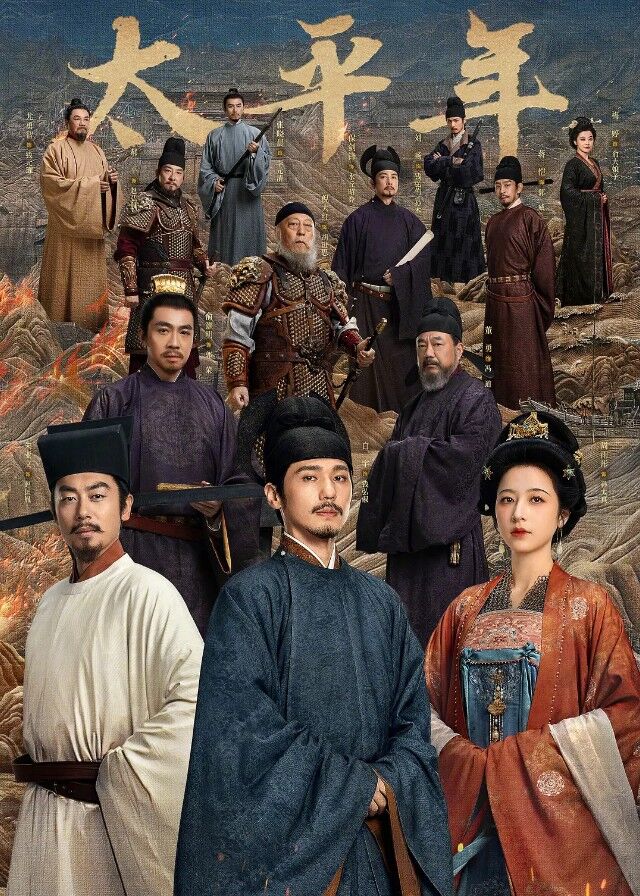



Resumo do episódio 13 de Swords into Plowshares
> Resumos de Swords into Plowshares
In 947 AD, Emperor Taizong Yelü Deguang of Liao, due to fierce resistance in the Central Plains and unsustainable rule, was forced to abandon Bianliang and return north. Feng Dao, as an important minister accompanying the emperor, specially came to bid farewell to Qian Hongchu before his departure, sighing that although he reluctantly submitted, Yelü Deguang had treated him kindly after all.
Having served six emperors across different dynasties, witnessed the departure of five former rulers, seen the dragon banners change and palaces change hands, he had never truly seen a day of peaceful prosperity, feeling as if he was searching for a boat in a dream, only to find emptiness. The next day, Feng Dao and Shi Chonggui left the city with the retinue, disappearing into the northern dust.
In April of the same year, Yelü Deguang died suddenly in Luancheng at the age of 45. In June, Liu Zhiyuan, Emperor Gaozu of Later Han, led his army south, successfully entering Bianliang. To pacify the people, he commended Qian Hongchu and other envoys from Wuyue, and furthermore issued an edict exempting the capital region from three years of taxes, opened granaries for relief, and urged spring plowing, allowing the people a temporary respite.
Before returning south, Qian Hongchu specifically bid farewell to Zhao Kuangyin and Guo Rong, and asked them to bestow courtesy names upon him, promising to reunite and share a cup of warm wine if they ever met in a time of peace. After leaving the capital, Qian Hongchu and his party sailed their boat along the waterway. The severe winds and torrential rains at sea, much like the unpredictable political situation, filled his heart with profound emotion.
In contrast, in Ninghai County, far away in Taizhou, County Magistrate Gao Xu and Prefect Shen Congyue conspired to frame County Lieutenant Shen Yin. Because Shen Yin had once informed Cheng Zhaoyue, the two fabricated charges, accusing him of "betraying the lives of many for personal gain."
At the same time, Fang Hongjin, a prominent local figure in Ninghai County, secretly collected deeds related to the encroachment of villagers' land, handing them all over to Chen Xing, the Clerk of the Agricultural Affairs Bureau, intending to expose the local powerful families' crimes of seizing land. However, this matter was widely implicated; among the sixteen villages, only over two hundred landless households were willing to offer their deeds, while the rest, fearing disaster, dared not comply.
Just as Chen Xing was about to take the deeds and secretly report them, Du Hao, the Agricultural Commissioner of Taizhou, along with Gao Xu, suddenly led a group to the Fang family's residence, where the entire clan, young and old, was brutally massacred. Chen Xing narrowly escaped, gravely wounded, and stumbled to the gate of the county school, personally handing the deeds to Dr. Cui Renji before finally dying.
En route, the Wuyue envoy delegation suddenly encountered a hurricane; their ships veered off course and were forced to dock in Ninghai County, Taizhou. At this time, inside the county school, Gao Xu was leading men to search for Chen Xing's whereabouts. Cui Renji, as a scholar-official, remained unmoved despite the threats and inducements, repeatedly denying having seen Chen Xing, his words impeccable.
Gao Xu rushed to the dock to pay his respects to Shuiqiu Zhaoquan, taking the opportunity to meet Qian Hongchu as well. However, Shuiqiu Zhaoquan refused, stating, "His Highness is weary from the journey and is not receiving guests for now." However, at this moment, Qian Hongchu and Sun Taizhen had disembarked in disguise. Seeing the bustling market, he fully expected Ninghai County, if not prosperous and peaceful, to at least have its people living in contentment.
Before he had finished speaking, a stallholder nearby retorted, saying that he only saw the superficial prosperity of the streets, but did not know that those who lived off the land were now forced to risk their lives at sea.
And those unwilling to go to sea had their land forcibly leased, toiling for a year without enough to eat or wear, and still burdened by the usurious "King of Hell" debts from the Shanyue Society, which their descendants would never be able to repay. Qian Hongchu's heart was stirred by what he heard; he continued forward and witnessed firsthand the dire situation of soaring rice prices.
Notices for Chen Xing's arrest were posted at the city gate, indicating that there must be a hidden secret locally.
After returning to his boat, Qian Hongchu lamented, recalling the Zhenguan era of Emperor Taizong of Tang, when rice was cheap, a dou costing only five wén (one sheng being ten ge), and the people were well-clothed and fed, just as his esteemed elder brother had said: "In a prosperous age, no one shows signs of hunger, and granaries are filled with fragrant surplus."
Yet now, conflicts are frequent in all directions; last year, one could buy five sheng of rice for fifteen wén, but this year, for the same price, only two sheng can be obtained, entirely due to harsh governance and oppressive officials. On the other side, Cui Renji, knowing the gravity of the situation, resolved to expose it with evidence.
He sent his student Zifan to deliver a blank piece of paper to the Wuyue envoy delegation, hinting that there was an important matter requiring face-to-face pleading, yet fearing that walls had ears. Shuiqiu Zhaoquan and Qian Hongchu were both intelligent men; with a little thought, they understood the hidden meaning and decided to meet Cui Renji in person. During the meeting, Cui Renji presented all the deeds and revealed the full truth of Chen Xing's murder.
Qian Hongchu meticulously reviewed them, his expression growing increasingly solemn. It turned out that Ninghai was rife with a corrupt practice called "collect first, measure later," where officials forcibly collected taxes before measuring the land, then pocketed the excess when the actual survey was conducted. This method spread like a poisonous vine, with countless common people having their land seized; over time, it would inevitably lead to popular discontent and the downfall of the state.
Gao Xu arrived at the county school by order, ostensibly for official business, but actually to spy; however, he was stopped by the guards outside the door. Inside, Qian Hongchu gazed at the deeds, filled with indignation. If Chen Xing were alive, these deeds would be irrefutable evidence of collusion between state and county officials and local gentry, and their oppression of the common people. But with Chen Xing's death, the deeds became mere circumstantial evidence.
Now, with a whole prefecture, a county magistrate, and an agricultural commissioner implicated, affecting the entire system, it would be impossible to immediately arrest and prosecute anyone based solely on circumstantial evidence. If delayed for a few days, they would be able to wipe away all traces of evidence. Qian Hongchu understood the unspoken meaning in Shuiqiu Zhaoquan's words: that what needed to be done today should be investigated today; procrastination would be indulgence, and hesitation would lead to failure.