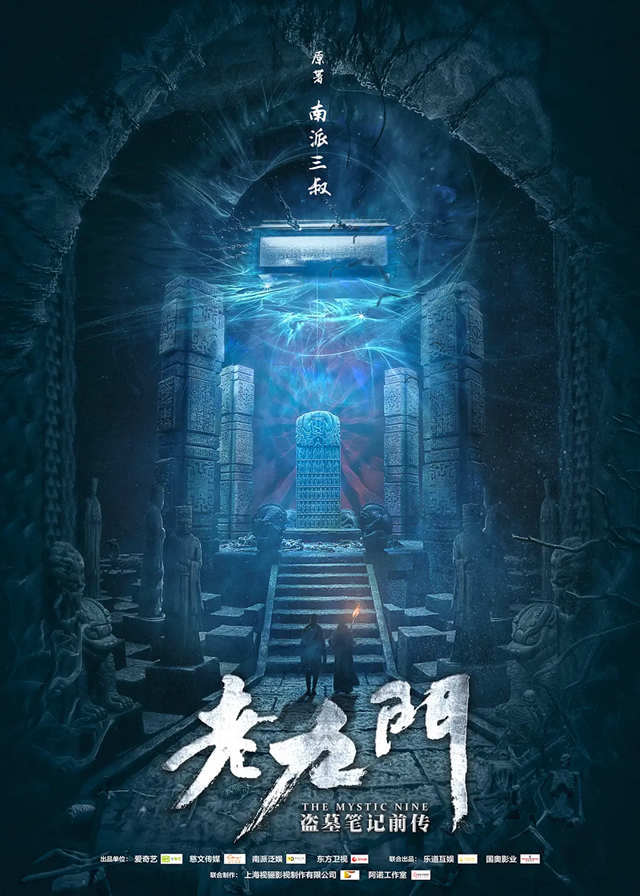



The Mystic Nine Episode 1 Recap
> The Mystic Nine Recap
A mysterious notebook filled with bizarre and obscure chapters, whose stories seemed difficult to distinguish between fiction and historical legends, had been passed down through generations. An unknown narrator recalled his childhood, observing his grandfather, whom he found to be a mysterious person, often poring over old books and notes in his room for long periods. One time, the narrator secretly entered his room, hoping to understand what captivated his grandfather so deeply.
In 1903, a Japanese man named Otani Kozui entered China under the pretense of religious investigation, secretly gathering intelligence on geographic exploration. As his expedition passed through Changsha, a branch of his team, led by Japanese businessman Hatoyama Miyoshi, ventured to a mountain town situated 160 kilometers north of Changsha. They remained there for nearly three months. Upon their departure, only six members of the original team survived. Hatoyama then ceased all exploratory activities and quickly returned to Japan.
No one knew why he had stayed so long, why so many of his subordinates had died, or what had truly transpired in that seemingly ordinary village. A week later, Hatoyama submitted a 16-page document to the Ministry of Foreign Affairs of Japan, care of the Nissin Trading Research Institute. This report mentioned items buried beneath the mountain town and became known as the Hatoyama Report.
On a night in 1933, a peculiar train mysteriously pulled into Changsha station, awakening the sleeping night watchman, Gu Qingfeng, who was on duty. Curious, Gu Qingfeng approached the suddenly arrived train to investigate. Wiping away the dust from a train car window, he was horrified to see corpses hanging inside. He frantically yelled that the train couldn't stop there, urging it to move forward due to other incoming trains.
The following day, a powerful military officer known as Fo Ye, Zhang Qishan, arrived with his men to investigate. Fo Ye and his subordinate, Lieutenant Zhang, examined the train and questioned Gu Qingfeng. Lieutenant Zhang reported that the military train, designated "076," bore no emblems or insignia, had seemingly "appeared out of nowhere," and that the bodies inside were likely Japanese.
Gu Qingfeng initially claimed ignorance, stating that such sudden arrivals were common due to wartime conditions and that his station chief had informed him of this, implying this wasn't the first time. Fo Ye pressed him, asking if it was also not the first time dead people were found on a train, to which Gu Qingfeng denied having seen such a thing before.
Lieutenant Zhang pointed out that military trains typically informed local guards of their arrival, but there were no records for this one. Gu Qingfeng eventually admitted the train arrived around midnight. He confirmed the corpses were already dead when he found them. Gu Qingfeng also noted that both the locomotive and the train cars were sealed with iron sheets, making it impossible to see inside clearly.
Lieutenant Zhang informed Fo Ye that gas cutting equipment had arrived to open the cars. As the preparations continued, Gu Qingfeng, growing increasingly agitated, tried to warn Fo Ye, calling it a "ghost train" and claiming that "demons are coming to Changsha." Fo Ye, undeterred, ordered Gu Qingfeng to be taken away and commanded that Changsha be sealed off, preventing any other trains from entering that day.
Inside the first carriage, Lieutenant Zhang remarked on the "strange" manner of death, with all the bodies facing down. Fo Ye agreed it was peculiar but dismissed the "ghost train" theory. Lieutenant Zhang suggested that Qi Tiezui, known as Ba Ye, a master of divination, might refuse to come if he knew the situation. Fo Ye, decisive, ordered Lieutenant Zhang to threaten Ba Ye with being shot if he didn't comply.
Ba Ye arrived, greeted the soldiers, but attempted to leave, fabricating an excuse about family matters. Lieutenant Zhang, aware that Ba Ye was a loner, pressed him, reiterating Fo Ye's threat. Reluctantly, Ba Ye joined Fo Ye and Lieutenant Zhang inside, complaining about being forced. Despite his initial fear, Ba Ye, upon examining the corpses, noted a peculiar bending of the big toes, suggesting "long-term wearing of wooden clogs."
He speculated if they were "Japanese special agents," a notion Fo Ye did not immediately confirm. Ba Ye then discovered a document, realizing "they were doing secret experiments!" He expressed concern that if true, the "common people of Changsha are in danger." He theorized that these were "secondary coffins" from the "same tomb," and the people in the accommodation carriage were escorts. He concluded that the "final carriage" likely contained the "tomb owner's coffin."
As they prepared to enter the final carriage, Lieutenant Zhang offered Fo Ye and Ba Ye gas masks. Ba Ye initially refused, citing his lack of need for one in previous carriages. However, Fo Ye insisted and gave a mask to Ba Ye, then instructed Lieutenant Zhang to wait outside. Reluctantly, Ba Ye joined Fo Ye inside, complaining about Fo Ye's unconventional methods. Inside the last carriage, Fo Ye observed signs of a "fight."
Ba Ye reiterated how "more than a coincidence" it was for all bodies to be face down. Ba Ye questioned the presence of "poisonous spiders" but Fo Ye clarified they were "bugs from inside the coffin." Puzzled as to how a train full of dead people could have moved, Ba Ye was told by Fo Ye that the Japanese likely "breathed in noxious gas" before boarding and had only "stopped breathing when the train reached the station."
Lamenting the lack of information from the smaller coffins, Ba Ye was then told by Fo Ye that "the real secret is hidden in the biggest coffin." This was a "whistle coffin," not easily opened, sealed with molten iron and possessing only one opening. Fo Ye explained that attempting to pry it open would release "poisonous gas," and the only safe method was for someone to insert a hand and open it from the inside.
This task, he stated, required the unique skills of the Zhang family. Lieutenant Zhang was ordered to prepare a soldier from their family. A Zhang family soldier was brought forward, but Ba Ye expressed skepticism about his ability. Fo Ye sarcastically suggested Ba Ye try, but Ba Ye deflected, praising the soldier instead. Ba Ye observed the elaborate safety mechanism: "pipa-shaped cutters" connected by a rope to a fast horse.
If a gong sounded, signaling trouble inside, the horse would pull the rope, instantly severing the soldier's arm to save his life. As the soldier inserted his hand into the opening, he panicked and cried for help, triggering the mechanism. His arm was severed, but nothing was found inside. Fo Ye calmly stepped forward and, without hesitation, inserted his own hand.
He successfully opened the coffin, revealing no traps, and confirmed that the soldier's arm had been broken purely out of fear, as it got stuck. The body inside was also face down. Ba Ye wondered if this was an ancient Changsha noble family burial custom. Fo Ye then retrieved a ring from the coffin. Ba Ye immediately recognized it as "an item from the Northern and Southern Dynasties."
He suggested that among Changsha's nine families, Er Ye, Er Yuehong, was the most knowledgeable about such ancient tombs. Fo Ye agreed to pay Er Ye a visit to investigate further. At a lavish opera house in Changsha, Er Ye, a man of refined artistry, captivated the audience with a performance of "Farewell My Concubine." The serene atmosphere was shattered by a rude, boorish guest who interrupted the performance, disparaging Er Ye's singing and demanding a "Flower Drum Opera."
He flaunted his wealth and disrespectfully confronted one of Fo Ye's subordinates. Just as chaos threatened to erupt, Fo Ye arrived with his men. He swiftly put an end to the disturbance, ejecting the rude guest and ordering that he be investigated to ensure he could "never leave Changsha." Er Ye greeted Fo Ye, playfully asking what brought him, a man who disliked operas, to his opera house.
Fo Ye explained he had come to ask for a favor, and briefly recounted the details of the "076 military train," the sealed carriages, and the Japanese corpses. Ba Ye then interjected, emphasizing that the matter concerned a "tomb from the Northern and Southern Dynasties," a field in which Er Ye's family was exceptionally knowledgeable. However, Er Ye's demeanor changed; he refused to help, stating he had "don't deal with the underground business anymore."
Fo Ye reminded him of their shared position within the "Old Nine Families" and the "Top Three," arguing that such underground matters affected them all. He highlighted the discovery of "secret experiment blueprints" on the train, expressing concern about a "Japanese scheme." Er Ye, however, dismissed Fo Ye's worries, assuring him that with Fo Ye protecting Changsha and as the "leader of the nine families," nothing significant could escape their notice.
Fo Ye remained firm in his resolve to "investigate this" Japanese conspiracy. Er Ye then issued a warning, advising Fo Ye that "This is dangerous. Don't act impulsively." Fo Ye directly questioned if Er Ye was "holding back information." Er Ye simply stated, "The play is over. Please go back, Fo Ye." Fo Ye did not press further, but left the ring on the table, asking Er Ye to "reconsider it."
After leaving the opera house, Fo Ye reiterated his resolve to Lieutenant Zhang, stating that regardless of Er Ye's decision, he would "investigate this and get to the bottom of it." He then instructed Lieutenant Zhang to invite Ba Ye over again once night fell. Meanwhile, back at his home, Er Ye was seen quietly contemplating the ring Fo Ye had left. His wife, Ya Tou, noticing his pensive mood, asked if her noodles weren't delicious. Er Ye, with a tender smile, assured her, "You make the best noodles."